

Key Takeaways
A midlife dip is common, but a dramatic crisis is not universal
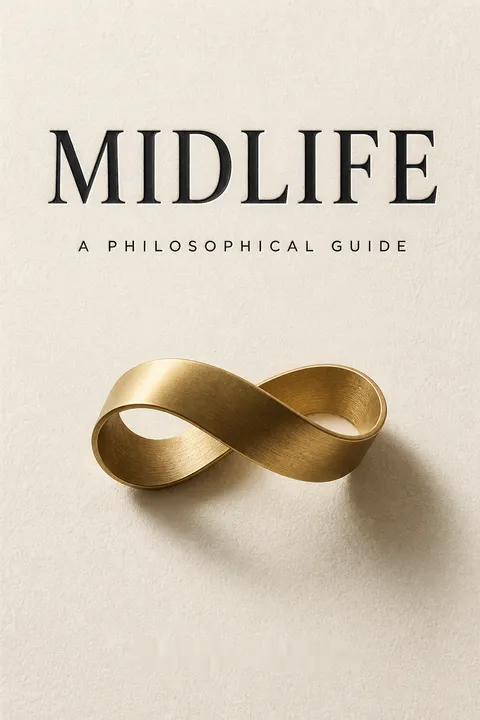
The story is mixed. Kieran Setiya begins with a personal contradiction: at thirty-five, he has a family, a secure academic career, and work he loves, yet the prospect of doing it all for decades feels hollow. His questions are not exclusive to a particular birthday. They concern time, regret, lost possibilities, and death, and can arise at many ages.
Research gives midlife a more modest profile than popular stereotypes suggest. In a follow-up survey, 26 percent of adults over forty said they had experienced a midlife crisis, but respondents used the phrase loosely for many kinds of difficulty. Other studies found a U-shaped pattern in reported life satisfaction, with an average low point around age forty-six across 72 countries. The pattern is not a diagnosis for every individual, and its interpretation remains debated.
The useful distinction is between a population-level pattern and a personal script. An average dip can be real without making upheaval inevitable, just as a common developmental pressure does not dictate how any one person responds. Setiya’s framing also makes midlife philosophically relevant beyond the relatively secure people most represented in some well-being studies: finite time, irreversible choices, and changing bodies are broadly human conditions. Still, the book’s inward focus cannot explain how poverty, discrimination, caregiving burdens, or health can shape midlife differently. A universal question about time does not imply equal resources for answering it.
Build happiness around what matters, not around feeling happy
Mill’s recovery began elsewhere. John Stuart Mill describes a breakdown at twenty, despite believing his life’s ambitions could soon be achieved. He asked himself whether realizing all his plans would make him happy and found that it would not. His later explanation was that happiness is more likely when attention is invested in something beyond personal happiness: other people, an art, or a pursuit valued for its own sake.
Setiya connects this to a second need. Ameliorative value is the value of relieving a problem or meeting a need. Existential value is positive worth that does not depend on fixing something wrong. Mill found such value in poetry. The point is not to abandon work or care for others, but to make room for activities that would still matter in a world with fewer troubles.
This account avoids two familiar traps: treating happiness as a direct performance target, and treating service to others as the only legitimate source of worth. It also explains why a life full of responsible tasks can feel strangely thin: solving problems is valuable, but problem-solving alone leaves little room for delight that is not justified by a crisis. Research on motivation similarly distinguishes pursuing an activity because it is inherently engaging from doing it only for a separate reward. The distinction should not devalue necessary care work, however. People may find deep meaning in caregiving even when its labor is largely responsive to need.
Treat regret over missed paths as the cost of plural goods
Good choices can still hurt. Setiya once considered becoming a poet or doctor before choosing philosophy. He does not think those paths would have made his life better, yet he still feels the loss of what he will not do. The explanation is that some goods cannot be measured on one scale. Money can be compared by amount; knowledge and friendship cannot be neatly exchanged, and choosing one does not satisfy the desire for the other. These are incommensurable values.
Missing out is therefore not always evidence of a bad decision. It can reflect the fact that a life contains more worthwhile possibilities than one person can pursue. A life without such conflict would require indifference to many goods or a narrower world of possible attachments. That offers consolation, not a demand to celebrate every loss or deny that some choices really are mistakes.
The argument gives regret a more generous interpretation: conflict can register sensitivity to several genuine goods rather than indecision or ingratitude. This resembles pluralist ethics, which rejects the idea that every value can be reduced to a single score. The practical benefit is modest but real: a person can mourn an abandoned possibility without concluding that the chosen life is worthless. The limit matters, too. Some paths are closed by coercion, exclusion, or economic necessity, not by freely choosing among attractive goods. Calling every loss the price of richness would romanticize constraints that deserve to be challenged.
Value options, but never mistake possibility for a better outcome
Youth can look deceptively free. Setiya’s nostalgia is not simply for a time when everything was possible. It is for the time before he knew which paths he would lose. A younger person may know that not every ambition can be fulfilled, but does not yet know exactly which ones will be abandoned. That uncertainty can soften the felt cost of choosing.
Options can matter because having alternatives changes what a choice means. But the mere existence of more options does not make life better if every available outcome is worse than the one already in hand. The comic character Reggie Perrin escapes his routine, then deliberately returns to a similar job and marriage, now experienced as choices rather than a fate. The lesson is to distinguish a genuinely bad life from the painful awareness that it could have been different.
This is a sharp correction to the assumption that more choice always means more freedom. Options can support autonomy, but they can also become a fantasy of escape when the imagined alternatives are valued mainly because they remain unchosen. Reggie’s return is significant because the outward circumstances change little while their meaning changes through deliberate commitment. Yet choice is not only a feeling: in constrained situations, more viable alternatives can materially improve a person’s life. The argument is strongest when it challenges romanticized possibility, not when it implies that an attitude shift can substitute for real opportunities.
Judge regret against your lived life, not an imaginary best case
A mistake is not the same as regret. A person can acknowledge that a choice was wrong given what was known at the time, yet not wish to erase it now. Setiya illustrates this with a musician who left piano for law. The legal career is no surprise, but it becomes a known, decent life. The alternative is no longer a guaranteed improvement; it is an uncertain path imagined from the safety of hindsight.
Three considerations can temper regret: an unexpected good outcome, attachment to people whose existence depends on past events, and rational caution about gambling away a life that is already good enough. Setiya’s strongest further move is to attend to the specific texture of one’s actual life, not compare it with an abstract claim that another life would have been better. This does not excuse wrongdoing or guarantee reconciliation with painful events.
The distinction between judging a past decision and deciding whether to erase its consequences is ethically important. It makes room for honest accountability without assuming that remorse requires wishing away everything that followed. Counterfactual thinking can clarify choices, but it can also produce an imagined alternative stripped of its ordinary costs and uncertainties. Attention to particulars corrects that imbalance by making a real life more than a low-resolution comparison. The method has limits: attachment to loved ones cannot automatically justify harms done to others, and some losses remain devastating even when the present contains genuine goods.
Fear death for more than pain: life and attachment can be lost
Epicurus offers only partial comfort. He argues that death cannot harm the person who no longer exists, since there is no experience of being dead. Setiya replies that death can still be a deprivation: it ends the possibility of art, friendship, knowledge, and other goods. Lucretius’s comparison between the time before birth and the time after death offers another therapy, but it depends on treating past and future nonexistence alike. Many people are more concerned about future losses than past ones, a tendency called future bias.
Fear of death may also come from attachment, not only from wanting a longer or happier life. The death of someone loved can reveal a wish that the person continue to exist, even when continued life would not benefit them. Setiya finds no argument that makes mortality painless; philosophical reframing may help some people, but it does not settle grief.
This section is strongest when it refuses to turn mortality into a logic puzzle with a tidy answer. Distinguishing the loss of future goods from the pain of ceasing to exist helps explain why Epicurus’s argument can feel emotionally inadequate, while the contrast with bereavement shows that love is not reducible to self-interest. The analysis also has a useful boundary: philosophical arguments can reshape interpretation, but grief is not simply a mistaken belief awaiting correction. People differ in how they experience future loss, and a consoling symmetry between birth and death may soothe one person while intensifying another’s sense of absence.
Stop making completion the only place your life can matter
A finished goal disappears from the agenda. Schopenhauer sees human beings swinging between frustrated desire and boredom after desire is satisfied. Setiya rejects the idea that every desire is torment, but preserves a subtler insight: if meaning comes mainly from achievements, success removes the very project that gave life direction. He calls goal-directed activities telic: writing a book or reaching a destination has an endpoint. Atelic activities, such as thinking, walking for its own sake, or parenting, have no final state that exhausts them.
The distinction changes where value is located. Writing a book can matter as a completed project, while thinking and writing can also matter as activities happening now. Raising a child includes milestones, but parenting is not completed when one milestone is reached. Goals still matter; the danger is allowing them to monopolize a life’s meaning.
This is the book’s central practical insight: completion is not the only valid form of value. It connects with process-oriented approaches to motivation, which distinguish the satisfaction of engaging in an activity from the reward of reaching its endpoint. That distinction can alter ordinary routines without requiring a dramatic career change. Still, atelic attention is not a cure for every structural problem. A person trapped in unsafe work or relentless caregiving may need material support and greater control, not simply a new interpretation of the process. The framework helps identify one source of emptiness; it should not be used to sanctify preventable hardship.
Practice attention to the activity, without pretending every activity is worthwhile
Mindfulness can train attention. Setiya considers Buddhist meditation and clinical mindfulness without adopting the Buddhist doctrine that there is no enduring self. Focusing on breath, bodily sensations, sounds, and passing thoughts can strengthen the ability to notice what is happening instead of being swept along by plans and habits. That attention may help people recognize value in the ongoing parts of activities they otherwise treat only as steps toward completion.
But presence is not automatically meaningful. A person can attend closely to pointless or harmful work and still have good reason to want a different situation. Setiya rejects the claim that full attention dissolves every problem. Meditation is better understood here as practice for noticing the present, not proof that goals are bad, suffering is imaginary, or circumstances should be accepted unchanged.
The distinction between mindfulness as attention training and mindfulness as a complete worldview is valuable. It lets readers consider the practice without having to accept a metaphysical claim about the self, while preserving the possibility that meditation changes how ordinary activities are experienced. The caution against treating presence as a panacea is equally important. Attention can clarify whether an activity has value, but it cannot create justice or safety by itself. Mindfulness becomes most useful when it increases discernment and agency, rather than asking people to adapt silently to conditions they have good reason to change.
Analysis
Setiya’s central move is to treat midlife not as one predictable breakdown but as a vantage point from which time becomes harder to ignore. The past now contains choices that cannot be repeated, the future has visible limits, and present life can feel crowded by tasks whose completion only makes room for more tasks. Each chapter addresses a different temporal pressure, then asks what philosophical distinctions can change about the way it is understood.
The book’s most original contribution is its account of telic and atelic activity. It does not tell readers to stop pursuing goals. It asks them to notice when they have made achievement the only location of value, so that success itself seems to empty life. This diagnosis unites the book’s reflections on work, relationships, mindfulness, and the feeling that a string of milestones has somehow failed to add up to a satisfying life.
Its other arguments are deliberately less triumphant. Missing out cannot be eliminated without narrowing what one cares about. Regret can sometimes be reconsidered, but not every wound can be redeemed. Mortality remains frightening even after philosophical objections to fear are examined. This restraint makes the book more credible than a guide promising emotional mastery.
The evidence and the advice also belong to different registers. Studies describe average patterns in well-being, while the philosophical chapters examine what a person has reason to value. A population-level U-shaped curve cannot establish that any individual needs a particular response. Nor can reflection alone remove the economic and social constraints that shape available choices. The book is most persuasive when its concepts enlarge a reader’s understanding, not when they are treated as substitutes for material change. Its durable invitation is to preserve worthwhile projects while learning to value some of the living activity that goals can obscure.
Review Summary
Midlife receives mixed reviews, with some praising its philosophical approach to addressing midlife crises and others finding it lacking practical advice. Readers appreciate Setiya's exploration of regret, mortality, and finding meaning in life's processes rather than outcomes. Many find the book intellectually stimulating but not universally relatable. Some critics argue it caters to a privileged perspective and overlooks broader societal issues. Despite its limitations, many readers find value in Setiya's insights on reframing midlife challenges and focusing on atelic activities.
People Also Read





Glossary
U-curve
Midlife well-being patternA pattern found in some surveys in which average reported life satisfaction falls from younger adulthood toward a low point in midlife, then rises in older age. Setiya discusses studies locating the average low point around age forty-six, including research across 72 countries, while noting that the pattern and its explanation remain contested.
MIDUS
US midlife well-being studyThe Midlife in the United States study, a large research program examining health and well-being across adulthood. Its 1995 survey included more than 7,000 people aged twenty-five to seventy-four. Findings challenged the stereotype that midlife is generally a period of psychological crisis, with many measures showing stability or improvement across age groups.
paradox of egoism
Happiness pursued indirectlyThe idea that making personal happiness the direct object of every pursuit can undermine its achievement. Mill’s account suggests that people are often happier when absorbed in things they value beyond their own well-being, such as other people, art, or a worthwhile activity. The pursuit is not necessarily self-sacrifice; the valued object can be personal or shared.
ameliorative value
Value from fixing a problemThe worth an activity has because it addresses a need, reduces suffering, or repairs something wrong. Medicine, social reform, and many forms of care can have this value. Setiya argues that ameliorative activities matter, but a life organized only around responding to problems may lack activities that make life positively worthwhile apart from those problems.
existential value
Positive worth beyond repairSetiya’s term for value that makes life positively good, rather than merely improving it by relieving a problem or meeting a need. Art, friendship, play, and contemplation can have existential value when they are worth engaging in for their own sake. The term does not imply that such activities are more important than urgent duties.
incommensurable values
Goods without one shared scaleValues are incommensurable when one cannot be measured against another on a single scale where the greater simply compensates for the lesser. Choosing friendship over a lecture, for example, does not satisfy the interest in learning. Such choices can be reasonable and still leave a genuine sense of loss.
telic activities
Activities with an endpointActivities directed toward a terminal state at which the activity is complete, such as reaching a destination or finishing a book. Their goals can be worthwhile, but achievement ends that particular project. Setiya warns that a life centered almost entirely on such activities can make meaning seem deferred until success, then removed by success.
atelic activities
Activities without a finishing pointActivities that do not aim at a final state that completes and exhausts them. Walking for its own sake, listening to music, thinking, and parenting are examples. A person can stop doing them, but there is no single achievement that marks them as finished. Their value can be present in the activity itself.
future bias
Giving future experience greater weightA tendency to care more about experiences that are still to come than about comparable experiences already in the past. In a hypothetical choice between a painful operation completed yesterday and a shorter one scheduled for today, people may prefer to learn that the longer pain is over. Setiya uses this tendency to question whether prenatal and postmortem nonexistence feel equivalent.
temporal neutrality
Equal regard for past and futureThe view that benefits and harms should not count for more or less merely because they lie in the future rather than the past. Applied to death, it treats the loss of future life as comparable to the absence of life before birth. Setiya presents it as a possible way to reduce fear of death, while noting that its rationality is unsettled.
FAQ
What's "Midlife: A Philosophical Guide" about?
- Philosophical exploration of midlife: The book delves into the philosophical aspects of the midlife crisis, examining how philosophy can help individuals navigate this challenging period.
- Personal and universal insights: Kieran Setiya combines personal anecdotes with philosophical insights to address common midlife concerns such as regret, mortality, and the pursuit of happiness.
- Self-help with a philosophical twist: It serves as a self-help guide that uses philosophical concepts to offer practical advice for those experiencing a midlife crisis.
Why should I read "Midlife: A Philosophical Guide"?
- Unique perspective: The book offers a philosophical approach to understanding and managing the midlife crisis, which is different from typical self-help books.
- Practical advice: Setiya provides actionable strategies for dealing with common midlife issues, such as regret and the fear of death.
- Broader understanding: It helps readers gain a deeper understanding of the existential questions that arise during midlife, making it relevant for anyone interested in personal growth and philosophy.
What are the key takeaways of "Midlife: A Philosophical Guide"?
- Paradox of egoism: Happiness is best achieved by focusing on things other than one's own happiness, such as the well-being of others or engaging in meaningful pursuits.
- Existential vs. ameliorative value: It's important to engage in activities that have existential value, which make life positively good, rather than just ameliorative value, which addresses needs.
- Living in the present: Shifting focus from telic (goal-oriented) activities to atelic (process-oriented) activities can help alleviate the sense of emptiness and futility in midlife.
How does Kieran Setiya define a midlife crisis in the book?
- Existential questions: Setiya describes the midlife crisis as a period marked by existential questions about loss, regret, success, failure, and mortality.
- Temporal structure: It involves grappling with the temporal structure of human life, where past achievements and future prospects are weighed.
- Not age-specific: While commonly associated with middle age, these existential questions can arise at any point in life, making the book relevant for a broader audience.
What is the "paradox of egoism" mentioned in the book?
- Happiness through selflessness: The paradox of egoism suggests that focusing solely on one's own happiness can actually hinder achieving it.
- Caring for others: True happiness often comes from caring about things other than oneself, such as the happiness of others or engaging in meaningful pursuits.
- Historical roots: This concept has historical roots in the sermons of Joseph Butler and is a key theme in Setiya's approach to midlife challenges.
How does Setiya suggest dealing with regret in midlife?
- New life perspective: Setiya suggests that the existence of loved ones, such as children, can provide a reason to embrace past mistakes, as they might not exist without those events.
- Risk aversion: He advises considering the risks and uncertainties of alternative life paths, which can make one's current life seem more favorable.
- Attachment to particulars: Focusing on the specific, meaningful details of one's life can help mitigate regret, even if the overall outcome could have been better.
What role does "existential value" play in the book?
- Positive life value: Existential value refers to activities that make life positively good, beyond just solving problems or meeting needs.
- Examples of existential value: These activities can range from engaging in art and philosophy to enjoying simple pleasures like playing games with friends.
- Balancing life activities: Setiya emphasizes the importance of balancing existential and ameliorative activities to lead a fulfilling life.
How does Setiya address the fear of death in the book?
- Temporal neutrality: He explores the idea of temporal neutrality, which involves giving equal weight to past and future experiences to mitigate the fear of death.
- Desire for immortality: Setiya argues that the desire for immortality is akin to wanting a superpower, and its absence should not be mourned excessively.
- Attachment and concern: He distinguishes between attachment to oneself and concern for one's well-being, suggesting that letting go of attachment can help accept mortality.
What is the significance of "living in the present" in Setiya's philosophy?
- Atelic activities: Living in the present involves focusing on atelic activities, which are not aimed at completion but are fulfilling in themselves.
- Mindfulness practice: Setiya connects this concept to mindfulness, suggesting that meditation can help appreciate the value of atelic activities.
- Counteracting the telic mindset: By valuing the process rather than just the outcome, individuals can find meaning and satisfaction in everyday life.
What are some of the best quotes from "Midlife: A Philosophical Guide" and what do they mean?
- "Those only are happy who have their minds fixed on some object other than their own happiness." This quote encapsulates the paradox of egoism, emphasizing that selflessness can lead to true happiness.
- "You must make room for activities with existential value." This highlights the importance of engaging in activities that make life positively good, not just those that address needs.
- "To live mindfully is to perceive the value of atelic activities." This quote underscores the book's central theme of finding meaning in the present moment through process-oriented activities.
How does Setiya's approach differ from traditional self-help books?
- Philosophical foundation: Setiya's approach is grounded in philosophical concepts, offering a deeper exploration of midlife issues than typical self-help books.
- Focus on existential questions: The book addresses existential questions and the temporal structure of life, rather than just providing practical tips for change.
- Integration of personal experience: Setiya combines personal anecdotes with philosophical insights, making the book both relatable and intellectually stimulating.
How can "Midlife: A Philosophical Guide" help someone experiencing a midlife crisis?
- Understanding midlife challenges: The book provides a framework for understanding the existential questions and challenges that arise during midlife.
- Practical strategies: Setiya offers practical strategies for dealing with common midlife issues, such as regret, fear of death, and the pursuit of happiness.
- Encouragement for reflection: By encouraging reflection on one's values and activities, the book helps readers find meaning and satisfaction in their current lives.
About the Author
Other books by Kieran Setiya
Download PDF
Download EPUB
.epub digital book format is ideal for reading ebooks on phones, tablets, and e-readers.








