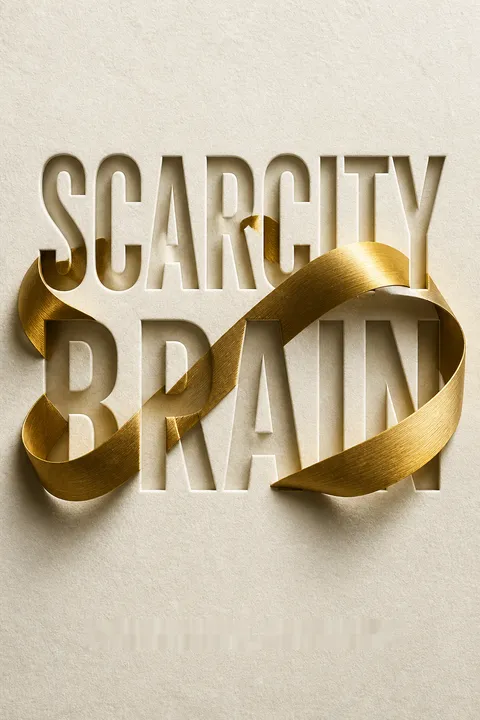


Key Takeaways
Spot the loop: opportunity, uncertain rewards, and rapid repetition drive excess
Old wiring, new abundance. Easter calls our inherited appetite for resources a scarcity brain. A scarcity cue is a signal that makes a person feel they lack something, even when they have enough. The scarcity loop is a repeating pattern: an opportunity promises value, an unpredictable reward creates suspense, and quick repetition makes another attempt easy. The pattern once helped people persist while searching for food and other necessities. In a world where tempting rewards are constantly available, the same persistence can turn into overconsumption.
Slots made it visible. Around 1980, Si Redd redesigned slot machines to offer frequent small wins, near misses, vivid feedback, and faster play. A player might lose money overall while experiencing enough apparent wins to keep going. Removing the handle let players go from about 300 games an hour to 900. The lesson is not that every repeated pleasure is harmful, but that short intervals between uncertain rewards can make stopping unusually difficult.
The framework is memorable because it describes a pattern of reinforcement, not a catalogue of supposedly weak-willed people. It also helps explain why the same person may feel in control in one setting and pulled along in another. Its breadth is a strength, but also a limit: food, social media, and gambling can share features without having identical causes or consequences. The loop works best as a prompt to examine a behavior, not as a complete diagnosis of it.
Slow the loop before platforms turn your attention into their revenue
Designed to repeat. The slot machine is a template for products that combine a desirable possibility with uncertain feedback and low-effort repetition. Social feeds offer unpredictable likes and posts; email refreshes promise new messages; autoplay removes the pause between shows. Online trading and mobile betting make another action available within seconds. In each case, the next reward might be exciting, disappointing, or somewhere in between, which keeps attention fixed on what comes next.
Engagement has two sides. Easter argues that these design choices can turn attention into revenue, while recognizing that engaging technology can also connect people and support useful habits. A practical response is to put back a pause: disable autoplay, check messages at chosen times, or add friction before a purchase or trade. The point is not to make every product dull. It is to notice when a product makes repetition easier than reflection.
This account shifts the debate from whether a person has enough discipline to what the product makes easy, rewarding, and repeatable. That shift can support better personal choices and clearer scrutiny of design incentives. Yet not every highly engaging tool is manipulative, and a user cannot always see how a system selects or times its prompts. Personal friction helps, but it should not be mistaken for a complete answer when companies control the environment and benefit from continued use.
Treat compulsive habits as attempted solutions, not proof of moral failure
A behavior once helped. In Baghdad, Easter investigates Captagon use amid war, unemployment, trauma, and a growing drug supply. The psychiatrist Emad Abdul-Razaq describes people using stimulants to cope, work longer, or escape distress. The book presents addiction as persistently seeking a reward despite harmful consequences, while emphasizing that people often begin because the behavior seems to solve a real problem. A habit can become costly without becoming inexplicable.
Change the conditions. The book challenges both moral condemnation and the claim that an addicted person is helpless. One cited survey found that 75 percent of people reporting drug problems before age twenty-four no longer used by age thirty-seven. The author’s own recovery involved addressing restlessness and dissatisfaction, not merely removing alcohol. Asking what a habit provides, such as relief, stimulation, or confidence, can point toward more durable alternatives and support.
This framing restores context without denying harm or agency. It makes a useful distinction between recognizing that a behavior has learned, biological dimensions and treating a person as incapable of change. The Iraq reporting also shows why availability alone cannot explain a drug crisis: social conditions and motives matter. Still, the book’s emphasis on changed circumstances should not imply that a new job, relationship, or hobby is sufficient treatment for everyone. Severe dependence can require professional care and sustained support.
Test subtraction before adding another fix to an already crowded system
Addition feels like progress. Engineer Leidy Klotz noticed that people asked to improve a crooked Lego structure usually added blocks, even when removing blocks made it stable. In a separate computer-grid task, participants could create symmetry by adding twelve squares or removing four. Most added. Across eight experiments, people often overlooked subtraction, even when it was cheaper or more efficient.
Enough is not deprivation. The same instinct appears in schedules, organizations, and possessions: another program, meeting, feature, or purchase can seem more constructive than removing what is unnecessary. But the book is not arguing that less is always better. A scarcity cue can make people grab more, and forced deprivation can backfire. Before solving a problem, ask whether the answer is to add a resource, remove an obstacle, or stop maintaining something that no longer serves its purpose.
Klotz’s experiments reveal an overlooked part of problem-solving: people may fail to consider an option, rather than weigh it and reject it. That insight matters because many institutions reward visible additions while treating removal as loss or failure. The experiments make a compelling case for deliberately checking the subtraction option. They do not show that subtraction is universally superior, however. Removing staff, services, or safeguards can create serious costs, so the right test is whether subtraction improves the system for the people who depend on it.
Build meals around ordinary foods that make overeating harder
Food can accelerate the loop. The Tsimane of Bolivia eat staple crops such as rice, corn, potatoes, and plantains, alongside some meat, fish, and vegetables. Their traditional diet is not a fashionable formula, and their exceptional heart health cannot be attributed to food alone. Still, it offers a useful contrast with highly processed meals designed to be calorie-dense, easy to chew, and quick to eat.
A controlled test. NIH researcher Kevin Hall gave twenty participants ultra-processed meals for half a month and less processed meals for the other half. The diets were matched on calories and major nutrients, but participants ate about 500 more calories per day on the ultra-processed diet and gained weight. On the less processed diet, they spontaneously ate less. Easter’s practical conclusion is to make simple, filling foods the default, not to pursue a rigid diet or fear every packaged food.
The most useful implication is environmental: some meals make it easier to stop, while others remove natural brakes such as chewing time and fullness. This approach can be more sustainable than turning every meal into a calculation about a single nutrient. The Tsimane comparison is illuminating, but it is not a controlled comparison of entire populations. Activity, local food systems, and other aspects of life differ too. Hall’s small feeding study supports a specific claim about eating behavior, not a universal explanation for weight or heart disease.
Buy tools for meaningful action, not objects for emotional relief
Possessions have motives. Easter finds that people acquire things for practical use, status, belonging, or comfort. Buying can briefly relieve boredom or anxiety, while decluttering can offer a temporary sense of control. Neither collecting nor minimalism necessarily resolves the feeling underneath. In Montana, survivalist Laura Zerra treats possessions as equipment: each item has a purpose and must justify the effort of carrying it.
Constraints can spark invention. In six experiments described in the book, participants with limited resources often solved creative problems more efficiently than people who believed resources were abundant. Zerra’s own travels made her improvise rather than buy a solution. Before a purchase, consider what the item will help accomplish, whether something already owned can do the job, and whether the purchase is answering an emotional urge. The goal is not an empty home, but belongings that support a life worth living.
Zerra’s example reframes restraint as a way to protect attention and make room for experience, rather than as a contest in having the fewest possessions. The creativity experiments give that idea a practical edge: constraints can prompt people to search for solutions already within reach. But scarcity is not automatically liberating. For people with limited money, time, or safety, a missing tool can be a genuine barrier. The useful question is not whether to own less, but whether an object serves a purpose that matters.
Choose your own measure of success before social platforms choose it for you
Scores can change the activity. Philosopher Thi Nguyen describes value capture: a simplified metric begins to replace the richer goals of an activity. A discussion can become a chase for likes; a student can focus on grades instead of learning. Wine critic Robert Parker’s numerical ratings made wine easier to compare, but wineries also altered how they made it to win higher scores. The measure did not merely report value; it helped reshape what producers valued.
Status makes the score tempting. Social approval has mattered to people for a long time, and digital platforms make that approval countable. Easter describes how likes altered his running and Nguyen’s writing. The practical move is to name the real purpose before looking at the metric: connection, understanding, health, or craft. A score can offer feedback, but it cannot define the whole activity or tell a person what deserves attention.
Metrics are powerful partly because they reduce ambiguity: a number appears to settle whether an effort succeeded. That convenience is valuable when decisions need consistency, but it can narrow the very behavior being measured. The wine example captures the feedback effect particularly well: people adapt to a rating, so the rating changes its own subject. Still, some indicators are necessary for accountability and comparison. The safeguard is not to reject measurement, but to keep asking what the measure leaves out and whose priorities it serves.
Trade endless online certainty for effortful exploration and real discovery
More facts are not always understanding. The book distinguishes collecting information from seeing how facts connect and using them to reason. Online searches can deliver a quick feeling of clarity without proving that an answer is reliable. Reviews, for example, often reflect what the reviewer values, which may differ from what a reader wants. The author recalls an editor’s lesson to seek information from the original source rather than rely only on summaries.
Let discovery stay uncertain. Humans evolved to explore for useful information, but digital feeds make new information almost effortless and endlessly repeatable. That can crowd out focus and encourage searching for confirmation. For questions that matter, consult primary evidence, seek ideas that challenge existing beliefs, or experience something directly. Trying a restaurant without first checking its rating is a small example: it restores the chance of genuine surprise instead of outsourcing discovery to a score.
The distinction between information and understanding is a strong corrective to the assumption that access equals insight. Effortful inquiry can reveal context that a search result compresses, while firsthand experience can expose what a summary cannot convey. Yet direct experience is not automatically more accurate: memory is selective, and expert testimony can be essential. The sensible standard is matched effort. Use quick searches for low-stakes questions, and slow down when a decision carries consequences or when a tidy answer feels suspiciously complete.
Turn the loop toward activities that reward effort with a richer life
Keep the mechanics, change the destination. Laura Zerra searches the Montana wilderness for shed antlers. The possible discovery keeps each search uncertain, while walking, observing, and continuing the hunt make it active and absorbing. She values the experience more than selling what she finds. Easter calls this an abundance loop: the same appetite for opportunity and unpredictable reward is directed toward something that supports health and attention rather than passive consumption.
Design a better repeat. Pokémon Go offers another example. It uses game rewards to draw players outside, walking to places of interest and sometimes meeting others. The book’s general strategy is to choose activities where another attempt brings real-world benefits. Hiking, fishing, birdwatching, or exploring a new neighborhood can provide suspense without the frictionless pace of a feed. The point is not to eliminate pleasure, but to make the satisfying action itself worthwhile.
This is the book’s most constructive move: it does not ask people to live without reward, but to attach reward to activities that leave something valuable behind. Nature-based searching offers uncertainty, movement, and attention in the same package. Pokémon Go shows that technology can support those qualities rather than only displace them. The distinction depends on design and use, though. A healthy activity can also become compulsive when it crowds out responsibilities, so the outcome and costs matter as much as the loop’s appeal.
Make happiness a by-product of purposeful work, service, and chosen limits
Contentment needs proportion. At Our Lady of Guadalupe Monastery, Easter encounters Benedictine monks whose days are structured around prayer, shared work, silence, and modest possessions. Saint Benedict’s principle of proportion recognizes that people differ: what is enough for one person may be too much or too little for another. The monks do not treat hardship as valuable by itself; limits are meant to make room for a larger purpose.
Aim beyond a mood. The book argues that chasing happiness directly can keep moving the target. The monks instead organize life around work, service, learning, contemplation, and, for them, faith. A reader need not share their religion to apply the distinction. Choose commitments that contribute to something beyond immediate pleasure, and allow happiness to emerge as a consequence rather than demanding that every moment feel good.
The monastery offers a vivid alternative to treating happiness as a personal score that must rise every day. Routine, useful labor, and commitments beyond the self can provide structure when mood fluctuates. The account also resists a simplistic equation between comfort and well-being. Its limits deserve attention: monastic life is chosen, communal, and supported by a specific tradition, so it is not a template for everyone. The transferable insight is to test which commitments make life feel more coherent, not to imitate the monastery’s austerity.
Analysis
Scarcity Brain is organized around a single behavioral pattern and then tests its reach across gambling, addiction, food, possessions, information, status, and happiness. Its central move is evolutionary: traits that once helped people persist in uncertain environments can misfire when modern systems provide abundant, fast, and engineered rewards. Slot machines make the pattern unusually clear, while the reporting journeys to Iraq, Bolivia, Montana, space, and a New Mexico monastery give the theory human texture. The result is more than a warning about screens or self-control. It asks what a craving is doing for someone, what system amplifies it, and what could make a more durable alternative rewarding.
The framework’s greatest strength is practical diagnostic clarity. Opportunity, unpredictable rewards, and rapid repetition give readers a way to inspect habits and product design without reducing every problem to character. The book also resists the false simplicity of prescribing less across the board. Its alternatives include changing circumstances, removing frictionless access, subtracting unnecessary commitments, choosing measures deliberately, and using engaging activities for beneficial ends.
The same breadth creates a risk. A shared pattern does not prove a shared cause. A slot machine, a meal, a social comparison, and an addiction may all involve anticipation and repetition, but their social contexts, physical risks, and treatment needs differ. Some evidence in the book is experimental, some observational, and some comes from individual stories. The Tsimane comparison, especially, is suggestive rather than proof that one diet alone explains their health. Likewise, chosen difficulty can create meaning, but hardship is not inherently ennobling and can be inaccessible or harmful.
The most durable synthesis is therefore neither abstinence nor indulgence. It is deliberate design. Identify what a behavior offers, notice how uncertainty and speed keep it going, and ask whether its rewards improve life outside the moment of consumption. Then build alternatives with enough challenge, agency, and real-world value to compete. The book’s strongest claim is not that humans should stop wanting more, but that modern abundance makes it essential to decide what deserves that wanting.
Review Summary
Scarcity Brain receives mixed reviews, with an overall rating of 3.97 out of 5. Many readers find the book's exploration of the psychology behind cravings and habits insightful and well-researched. Some appreciate Easter's personal anecdotes and diverse interviews, while others find them distracting. The book's practical advice for breaking addiction cycles and cultivating contentment is praised by many. However, some readers criticize the lack of scientific rigor and feel the solutions offered are too simplistic or not applicable to their situations.
People Also Read










Glossary
Scarcity brain
Inherited appetite for moreThe book’s term for inherited mental tendencies shaped by environments where food, information, safety, and other resources were limited. The scarcity brain scans for cues of shortage and urges people to acquire or consume more. In modern settings, the same tendencies can persist even when resources are abundant, making some useful survival impulses counterproductive.
Scarcity cue
Signal of perceived shortageA piece of information or an environmental signal that makes someone feel they do not have enough. Cues may be major, such as economic crisis, or ordinary, such as seeing a neighbor acquire something desirable. The book argues that such signals can redirect attention toward obtaining more, even among people who already have sufficient resources.
Scarcity loop
Reward-driven repetition patternA behavioral pattern built from three elements: an opportunity to gain something valuable, an unpredictable reward, and the ability to repeat the behavior quickly. The loop captures attention and encourages repeated attempts. It can support persistence, but in modern environments it can also sustain excessive gambling, scrolling, shopping, eating, or other behaviors.
Abundance loop
Rewarding, beneficial repetitionThe book’s term for directing the engaging features of a scarcity loop toward activities that support a person’s well-being. An activity can offer a meaningful opportunity, uncertain rewards, and repeated participation while also promoting movement, discovery, social connection, or skill. Wilderness searching and location-based games are examples discussed in the book.
Losses disguised as wins
Small returns framed as winsA gambling outcome in which a player receives less money than was wagered but experiences celebratory signals resembling a win. Digital slot machines can pair these outcomes with lights and sounds, preserving excitement despite a net loss. The book explains that these events can encourage longer play by maintaining anticipation and hope.
Optimal stimulation model
Preferred level of stimulationA model discussed in the book proposing that animals and humans seek a preferred level of stimulation. When their surroundings provide too little, they may pursue stimulating activities, including gambling or other repetitive consumption. Research on pigeons suggests that richer environments can reduce preference for a lower-yield gambling option.
Value capture
Metric replaces original purposePhilosopher Thi Nguyen’s term for what happens when a simplified measure begins to shape and replace the richer goals of an activity. Likes may displace the aims of discussion, grades may overshadow learning, or wine scores may influence how wine is produced. The metric remains useful as information, but can narrow what participants value.
The Great Endarkenment
Overload of specialized knowledgePhilosopher Elijah Millgram’s term for a condition in which people depend on increasingly specialized experts and bodies of knowledge they cannot fully assess. Information expands, but individuals cannot master every field or independently evaluate every authority. The resulting problem is not simply ignorance, but deciding whom and what to trust.
Proportion
Enough suited to the personSaint Benedict’s principle that the right amount of food, work, possessions, or restraint depends on an individual’s needs and temperament. It rejects both excess and deprivation as universal ideals. In the book’s account, finding proportion means shaping limits to support a larger purpose rather than treating austerity or accumulation as virtues in themselves.
FAQ
What's Scarcity Brain about?
- Understanding Scarcity Mindset: Scarcity Brain by Michael Easter explores how our brains evolved to respond to scarcity cues, which can lead to counterproductive behaviors in today's world of abundance.
- Scarcity Loop Concept: The book introduces the "scarcity loop," a cycle of opportunity, unpredictable rewards, and quick repeatability that drives overconsumption and compulsive behaviors.
- Real-World Implications: Easter connects the scarcity mindset to modern issues like addiction, obesity, and mental health, emphasizing the need to rewire habits for a balanced life.
Why should I read Scarcity Brain?
- Insightful Analysis: The book offers a deep dive into human behavior, linking evolutionary psychology with contemporary issues, helping readers understand their habits and societal pressures.
- Practical Solutions: Easter provides actionable strategies to escape the scarcity loop, teaching readers to cultivate a mindset of "enough" rather than "more."
- Engaging Narrative: Through personal anecdotes and travels, Easter makes complex concepts relatable and engaging, enhancing the reader's understanding.
What are the key takeaways of Scarcity Brain?
- Scarcity Cues Influence Behavior: Recognizing how scarcity cues like advertising trigger cravings can help in making conscious choices.
- Importance of Moderation: Easter suggests finding a balance that allows enjoyment without excess, rather than simply aiming for less.
- Rewiring Habits: Methods like gratitude and mindfulness are introduced to shift the mindset from scarcity to abundance.
What is the "scarcity loop" as defined in Scarcity Brain?
- Three-Part System: The scarcity loop consists of opportunity, unpredictable rewards, and quick repeatability, driving immediate gratification behaviors.
- Behavioral Patterns: It explains compulsive behaviors like overeating and gambling, helping identify and change these patterns.
- Evolutionary Perspective: The loop is linked to our evolutionary past, where resource-seeking was crucial, but now leads to overconsumption.
How does Scarcity Brain relate to addiction?
- Addiction as a Scarcity Loop: Addiction is viewed through the scarcity loop lens, where substances are sought for unpredictable rewards, leading to negative outcomes.
- Environmental Factors: Stress and social conditions are highlighted as influences on addiction, suggesting a need to address root causes.
- Path to Recovery: Recognizing the scarcity loop and finding healthier coping mechanisms, like supportive communities, is emphasized for recovery.
What role do ultra-processed foods play in Scarcity Brain?
- Definition and Impact: Ultra-processed foods are described as hyper-palatable and addictive, leading to overeating and unhealthy patterns.
- Health Consequences: Their consumption is linked to obesity and cardiovascular diseases, stressing the need for whole, unprocessed foods.
- Behavioral Influence: These foods trigger the scarcity brain, making it crucial to understand their impact on eating behaviors.
How does Scarcity Brain address the issue of food consumption?
- Food as a Scarcity Loop: The relationship with food is influenced by the scarcity loop, leading to overeating and unhealthy choices.
- Cultural Shifts: Modern diets have shifted to abundance, with processed foods exacerbating health issues like obesity.
- Tsimane Diet Example: The Tsimane tribe's diet is used as a model for healthy eating, emphasizing whole foods and low processed ingredients.
How does Scarcity Brain relate to modern consumer culture?
- Consumerism and Scarcity Brain: The book explores how consumer culture exploits our scarcity brain, leading to constant seeking and dissatisfaction.
- Marketing Strategies: Companies use psychological tactics to create scarcity and urgency, driving impulsive purchases.
- Finding Balance: Easter advocates for mindful consumption, focusing on quality over quantity to break free from consumerism.
What experiments did Michael Easter conduct in Scarcity Brain?
- Tsimane Diet Experiment: Easter adopted a Tsimane-like diet, focusing on whole foods, to understand diet's impact on health and satiety.
- Controlled Studies: He references studies comparing ultra-processed and whole food diets, showing differences in calorie consumption and weight gain.
- Personal Reflection: These experiments led to insights on cultivating a healthier lifestyle and relationship with food.
What are some practical strategies from Scarcity Brain?
- Mindfulness and Gratitude: Practicing mindfulness and gratitude shifts focus from scarcity to abundance, fostering appreciation for what one has.
- Setting Boundaries: Easter suggests setting boundaries around consumption, like food and social media, to promote healthier habits.
- Finding Enough: Emphasizing the idea of "finding enough" rather than striving for more can lead to greater satisfaction and well-being.
What are the best quotes from Scarcity Brain and what do they mean?
- "We have a scarcity brain.": Highlights how our evolutionary past shapes current behaviors and cravings, reminding us that instincts can mislead in abundance.
- "The scarcity loop is the ultimate trigger of the scarcity mindset.": Emphasizes understanding the scarcity loop to break free from its grip, suggesting awareness as the first step toward change.
- "Finding enough is the key to lasting satisfaction.": Reflects the core message that true happiness comes from appreciating what we have, not constantly seeking more.
How can I apply the lessons from Scarcity Brain in my daily life?
- Practice Mindfulness: Incorporate mindfulness techniques to become aware of cravings and consumption patterns, aiding intentional choices.
- Limit Exposure to Scarcity Cues: Identify and limit exposure to cues like ads and social media to reduce overconsumption urges.
- Cultivate Gratitude: Regularly practice gratitude to shift focus from lack to abundance, fostering satisfaction in life.
About the Author
Other books by Michael Easter
Download PDF
Download EPUB
.epub digital book format is ideal for reading ebooks on phones, tablets, and e-readers.








