

Key Takeaways
Let a notebook become part of your thinking, not just storage
A tool with history. The notebook did not arrive fully formed. Bronze Age sailors could make brief notes on reusable wax tablets, while papyrus held longer texts but cracked and decayed. Parchment lasted, but cost too much for everyday practice. When paper reached western Europe, it offered a cheaper surface that could travel, be written on, and be bound into portable books. Each material made some actions easier and others harder.
More than a container. The book’s central idea is that a notebook can help form a thought, not merely preserve one. In 1997, Maria Sebregondi helped revive the Moleskine as a carefully designed object, drawing on Bruce Chatwin’s account of his beloved notebooks. Its success shows that a notebook carries both practical features and cultural meanings. Its blank pages invite use, while its physical limits can focus attention.
What's striking is how the book treats a familiar object as an active technology. A notebook does not simply store a finished thought; its size, paper, binding, and ease of access shape what a person can notice and develop. This resembles the design principle that tools guide behavior through the actions they make convenient. The Moleskine story also reveals a tension: an object can enable creative work and sell an image of creativity at the same time. The promise is real, but buying the prop cannot substitute for using the pages.
Use durable, inexpensive records to see whether a business truly earns
From tallying to analysis. Around 1299, Amatino Manucci kept records for a branch of Giovanni Farolfi’s Florentine trading business in Provence. His surviving ledger, part of a system of at least seven books, tracked goods, loans, expenses, currency exchange, and profits. The system treated the branch as a distinct accounting entity and compared assets with liabilities across a defined financial year.
A new business logic. Double-entry bookkeeping records each transaction in two linked places, making it possible to calculate profit and loss across separate ventures. Paper helped make the method practical: it was cheaper than parchment, and ink soaked into it, making alteration harder. This combination of material and method let merchants monitor distant branches and delegate work with greater confidence. Manucci’s ledger is the earliest surviving example in which these techniques appear together.
The ledger is a reminder that measurement changes the thing being measured. Once a merchant could compare the return on wool, oil, or lending, business decisions could be made across a portfolio rather than by intuition alone. The same logic appears in modern management dashboards: visibility can expose waste, but it can also reward what is easiest to count. Accounting is therefore not a neutral mirror. Its categories determine which costs, risks, and forms of value receive attention.
Draw from life to train your eye beyond familiar symbols
Practice changed painting. In thirteenth-century Florence, Cimabue and his pupil Giotto moved religious art toward more lifelike bodies, expressions, and spaces. The book links this shift to paper’s arrival as an affordable surface for drawing. Artists could carry paper, sketch ordinary scenes, practise daily, and prepare complex compositions before painting them. A ledger could become a sketchbook when the artist needed somewhere to work.
A plausible connection. Giotto’s own sketchbooks have not survived, so the link is an informed historical argument, not direct proof. Leonardo later made the practice explicit: he urged artists to record fleeting forms because memory cannot retain every shape and position. His surviving notebooks show repeated studies of plants, bodies, water, and machines, demonstrating how drawing can be a method of investigation as well as preparation.
The important distinction is between recognizing an object and seeing its visual structure. A familiar label such as face or tree can make perception feel complete before careful observation begins. Drawing interrupts that shortcut by forcing attention toward proportion, light, edges, and spatial relations. The historical case is persuasive, though it cannot establish that paper alone caused Renaissance realism. Training, patronage, workshop practice, and changing artistic ambitions also mattered. The notebook is best understood as an enabling condition within a larger system.
Select and arrange what you read to create new connections
A personal storehouse. Florentine zibaldoni were informal collections of copied passages, poems, prayers, recipes, observations, and drawings. Their owners chose what mattered to them, then returned to those fragments for learning, writing, or sharing. Unlike a formal library, a zibaldone could put a practical note beside a literary passage, making unexpected combinations possible. Families sometimes continued the books across generations.
A more ordered method. Erasmus’s influential common-place book organized excerpts under topics, or headwords, so readers could retrieve material for an argument or a piece of writing. The method shaped education and gave writers such as Shakespeare a store of plots, examples, and language to adapt. Copying also circulated literature beyond expensive, professionally produced manuscripts. The notebook helped readers become participants in literary culture, not simply consumers of finished books.
Selection is a form of interpretation. To copy a passage, a reader must decide what deserves attention and where it belongs; placing it beside other excerpts can alter its meaning. This anticipates modern practices such as research cards and digital knowledge bases, where retrieval and comparison matter as much as collection. Yet any archive reflects its keeper’s interests and exclusions. A well-organized notebook can sharpen thought, but it can also make a narrow set of assumptions easier to repeat.
Turn rough observations into knowledge through revision and comparison
Separate capture from thought. Charles Darwin used small field notebooks to record observations during the Beagle voyage, then transferred material into fuller scientific notes and separate notebooks for speculation. The rough entries were not finished arguments. They preserved details while he was travelling, giving him material to compare and question later. His notebooks show a gradual process of theory-building rather than a sudden moment of revelation.
Working pages can mislead. Isaac Newton used a large, unfinished book inherited from his stepfather as a working space for mathematical problems that contributed to his development of calculus. He later revised some entries while asserting priority over Leibniz, removing signs of earlier influences and making his progress appear more solitary. A notebook can expose thought in motion, but it can also become evidence that its owner edits to support a public story.
The capture-and-revision cycle resembles experimental science: preserve observations, compare them, test interpretations, and revise claims when the record resists them. It also complicates the myth of the isolated genius. Darwin’s and Newton’s pages show intellectual work as iterative, but Newton’s revisions show that records do not automatically guarantee candor. A notebook’s value depends on how transparently its contents are handled. Raw notes are not yet knowledge; they become useful through interpretation, checking, and willingness to acknowledge sources.
Treat records as instruments of power, not automatic proof
Paper can govern. Jean-Baptiste Colbert applied accounting methods to France’s administration, gathering information in organized portfolios and condensing the nation’s finances into small annual summaries for Louis XIV. The system helped the king inspect revenue and expenditure rather than depend entirely on intermediaries. In this setting, notebooks and ledgers made government more legible and easier to manage.
Paper can be corrupted. British police notebooks began as tools for checking whether constables stayed on their assigned beats. They later helped preserve witness accounts, but officers sometimes manipulated them. In the Hillsborough disaster inquiry, contemporaneous notes were suppressed or altered. By contrast, the Old Weather Project transcribes ships’ logs to improve historical climate records. Records can enable scrutiny, but only when their handling, provenance, and omissions are also examined.
The contrast between Colbert’s administration, police misconduct, and climate transcription makes the notebook’s politics visible. Records distribute authority: they let distant leaders govern, help investigators challenge a story, and give researchers evidence unavailable from memory. But a document’s presence is not the same as its reliability. Modern data systems face the same problem at greater scale: errors and bias can become harder to see once information is standardized. Trust requires an audit trail, independent comparison, and attention to what was never recorded.
Write to rebuild a story when memory has been disrupted
A record can restore continuity. After poet Michael Rosen spent weeks unconscious in intensive care during Covid, he received a diary written by nurses and other caregivers. Their brief daily entries described his treatment and offered a human account of the time he could not remember. Such patient diaries began in Scandinavian hospitals as a way to help people make sense of frightening or fragmented memories. At Whiston Hospital, Christina Jones reported that diary use reduced patients’ risk of post-traumatic stress disorder by more than 60 percent.
Writing can process distress. Psychologist James Pennebaker asked participants to write about a major trauma for fifteen minutes over three days. Those assigned to emotional writing later visited the student health centre at about half the rate of a control group writing about routine topics. This is not a claim that every diary heals: the research suggests that making sense of feelings matters more than merely listing events.
These examples reveal two distinct functions of writing. A patient diary supplies a timeline when the patient cannot create one, while expressive writing helps a person interpret an experience in their own words. Both can reduce the isolation of distress by making events more coherent and shareable. The findings deserve care rather than broad promises: effects vary, and writing can become repetitive without reflection. The most useful question is not whether journaling is universally good, but what kind of record a person needs and who should help create it.
Build a notebook routine around the specific friction you face
One system, several jobs. Ryder Carroll developed what became the Bullet Journal after struggling with ADHD, distracted attention, and disorganized school notes. He used concise lists and a single indexed notebook to capture tasks, events, and reminders, then reviewed the entries and decided what deserved to move forward. The review matters: a notebook is not just a larger memory but a place to reconsider priorities.
Let the format fit. The book’s examples range far beyond planning. A recipe book carried Clara Nguyen’s family food traditions through their flight from Vietnam to the United States, while friendship books preserved social ties through signatures, drawings, and messages. These uses share no single template. Their common feature is a form adapted to a real need, whether that is attention, memory, work, family continuity, or connection.
Carroll’s method is strongest when treated as a response to a particular bottleneck, not as a universal productivity cure. A person who forgets commitments needs a different page than someone trying to preserve family recipes or develop an idea. This is a useful design principle: begin with the recurring failure, then make the relevant information easier to capture and review. The caution is that elaborate tracking can become its own workload. If maintaining the system consumes more attention than it returns, the format needs simplifying.
Handwriting and drawing can recruit attention differently from screens
The body joins the work. In a brain-imaging experiment, trained artist Humphrey Ocean drew a portrait while an untrained participant attempted the same task. Ocean’s brain activity differed, with more emphasis on spatial processing than facial recognition. Later research comparing artists found associations between drawing skill and differences in brain structure, though these results do not prove that notebooks alone caused them.
Paper leaves a physical trace. A 2021 Japanese study found that people taking notes on paper completed the task faster and recalled more details than participants using phones or tablets. The study also found stronger activity in brain regions associated with memory and visual processing among paper users. The book’s closing argument is that a page can become part of the thinking process, not merely a place where its results are stored.
The evidence points toward a plausible advantage of handwriting: slower, spatially fixed marks can encourage selection and make information easier to revisit. Drawing likewise trains attention by translating a scene into relations among shapes. Still, these experiments do not establish a blanket superiority of paper. Tasks, users, accessibility needs, and digital tools differ, and imaging measures are not direct measures of insight. The practical conclusion is modest but valuable: choose the medium that makes the kind of attention your task requires easiest to sustain.
Analysis
The book’s most persuasive claim is not that paper is inherently wiser than digital technology. It is that a notebook is a flexible interface between a person and a problem. Its usefulness depends on the fit between material form and task: a merchant needs durable cross-referenced accounts, a painter needs a surface for repeated observation, a traveller needs portable notes, and an ICU patient may need a timeline supplied by others. The historical sequence shows that the notebook becomes consequential when communities develop practices around it, from paper manufacture and literacy to schools, businesses, hospitals, and archives.
This approach also reframes invention. The notebook has no single inventor because its history is a sequence of adaptations. Wax tablets, paper ledgers, commonplace collections, field notes, diaries, and patient records are related by their ability to externalize information, but they do not serve the same purpose. That variety explains why one universal system is unlikely to suit everyone. Carroll’s planning practice may help someone who loses track of tasks, while a common-place book serves a reader who needs to retrieve ideas, and neither replaces the other.
The book’s causal stories are strongest when they show a mechanism, such as cheaper paper enabling more frequent drawing or double-entry accounting enabling more complex trade. They are less conclusive when a surviving object is used to infer a broad cultural transformation. Giotto’s missing sketchbooks make the link between paper and artistic realism plausible, not demonstrable. Similarly, brain scans can show patterns associated with training or note-taking, but they do not establish that notebook use alone produces expertise.
Finally, the archive is not a neutral witness. Some notebooks survive because powerful people preserved them; others are lost, destroyed, or hidden. The surviving record therefore overrepresents particular classes and interests. The book’s richest lesson may be that notebooks make thought more visible while also shaping what can be remembered, measured, and believed. Their power comes not from blankness alone, but from the practices and institutions that give each page consequence.
Review Summary
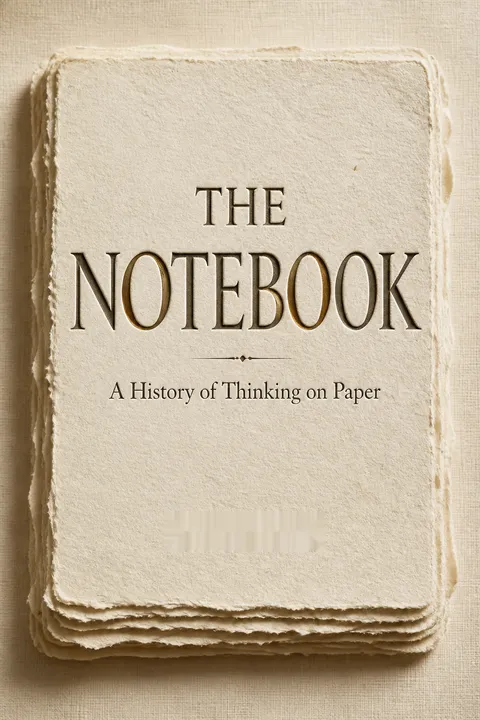
The Notebook by Roland Allen is a captivating exploration of the history and significance of notebooks. Readers praise Allen's engaging writing style, extensive research, and the book's ability to weave together fascinating stories about famous notebook users throughout history. Many find it inspiring for their own note-taking practices. The book covers various types of notebooks, from artists' sketchbooks to scientific journals, and examines how they've shaped human thought and progress. While some reviewers note a Western-centric focus, most appreciate the book's depth and unique perspective on intellectual history.
People Also Read



Glossary
zibaldone
personal mixed anthologyA Florentine notebook used to collect varied material chosen by its owner, including literary passages, poems, prayers, recipes, observations, and drawings. Entries could be copied neatly or informally and organized loosely or not at all. Zibaldoni circulated ideas through families and friends, and some passed from one generation to the next.
common-place book
organized excerpt collectionA notebook for collecting excerpts and examples under named topics, often called headwords or common places. Readers copied passages from books and arranged them so they could later retrieve material for writing, teaching, preaching, debate, or public service. The method trained selection and classification as well as supplying a store of references.
double-entry bookkeeping
linked transaction accountingAn accounting method that records each transaction in two connected places, traditionally as a debit and a credit. By balancing the entries, a business can calculate profit and loss, track assets and liabilities, and assess separate lines of work. The method supported complex merchant networks by making accounts more systematic and easier to check.
waste book
rough working recordA preliminary notebook in which transactions or ideas are recorded before being selected, organized, or copied into a more formal book. The term comes from bookkeeping, where early entries were later transferred to ledgers. Isaac Newton used a waste book as a working space for mathematical reasoning, preserving calculations and revisions as he developed ideas.
expressive writing
writing through emotional experienceA research technique in which participants write freely about their deepest thoughts and feelings concerning a distressing experience. In Pennebaker’s early studies, participants wrote for short sessions over several days. The method is intended to help people name emotions and form a coherent account, rather than simply list events or report facts.
Bullet Journal
indexed notebook planning methodA notebook practice developed by Ryder Carroll to manage tasks, events, notes, and longer-term plans in one indexed place. Users make concise entries, review them regularly, and decide which unfinished items still matter enough to carry forward. Carroll developed the approach partly in response to the attention and organization challenges associated with ADHD.
Old Weather Project
volunteer logbook transcriptionA citizen-science project that recruits volunteers to transcribe historical ships’ logs into structured digital data. Researchers use the observations, including weather and sea-ice reports, to improve records of past ocean and atmospheric conditions. The project turns handwritten material scattered across archives into information that can be incorporated into climate research.
affordance
action an object enablesA feature of an object or environment that makes a particular action possible or easy for a person. In the book’s account, paper’s portability, low cost, and writable surface encouraged uses that parchment or wax did not support as readily. Thinking about affordances shifts attention from an object’s existence to what people can do with it.
extended mind
thinking beyond the brainA philosophical idea associated with Andy Clark and David Chalmers, arguing that external objects can become parts of cognitive processes when people reliably use them to store and retrieve information. In their example, a person who depends on a notebook for directions uses it much as another person uses biological memory. The book applies this idea to notebooks as thinking tools.
Download PDF
Download EPUB
.epub digital book format is ideal for reading ebooks on phones, tablets, and e-readers.








