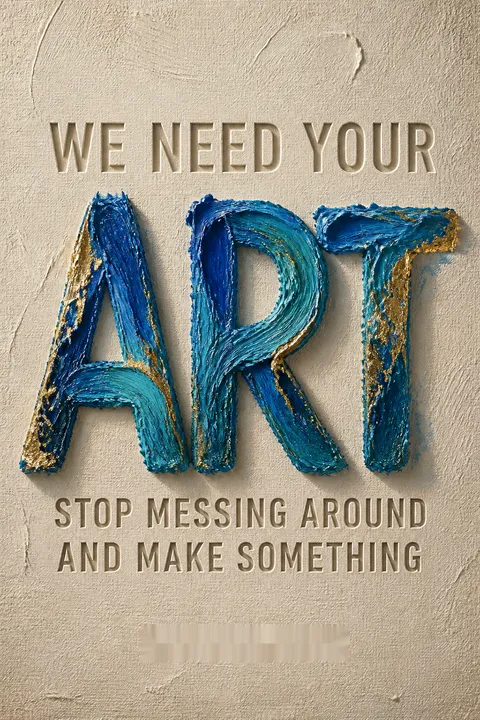


Key Takeaways
Treat art as serious human work, even when nobody pays for it
Value beyond income. McNee argues that art is often judged by whether it earns money, while its effects on joy, identity, and community go uncounted. She compares writing as a hobby with tennis: people rarely ask a recreational tennis player when they will reach Wimbledon, but often demand proof that an artist’s work will become a career. The double standard can make both hobbyists and professionals feel ashamed of creating.
Making is useful work. The book cites research linking creative participation with well-being. One study found that people who made art for 45 minutes showed reduced cortisol, regardless of skill. Art is not a substitute for medical care, but the evidence supports taking creative activity seriously as one contributor to health and connection.
The argument usefully exposes how economic measures can make valuable activity disappear. GDP tracks market transactions, not every benefit people experience, so it is a poor measure of art’s full social contribution. Still, evidence that art supports well-being does not mean every session feels healing or that art should be prescribed as treatment. The stronger claim is more modest: creative work has value that cannot be reduced to income, and people need not justify a private practice by turning it into a business.
Stop waiting for gatekeepers to name you an artist; choose yourself
Permission is internal. Many people wait for a publisher, gallery, audience, or family member to confirm that their creative work counts. McNee describes self-publishing two novels after years of waiting to be selected. The act did not make her a lesser author; it let her claim the work and put it before readers. External approval can open doors, but it cannot reliably undo the belief that creating is frivolous.
Make the title practical. McNee calls this self-coronation: recognizing yourself as an artist and acting on that identity before anyone else validates it. Making the work is the core act. Sharing can happen on your terms, from a private circle to an anonymous account or independent publication. This does not erase discrimination or institutional barriers, but it prevents those barriers from defining whether you may create.
Self-authorization resembles agency-building in fields where access depends on institutions: people can begin meaningful work before receiving formal recognition. The distinction between claiming a title and claiming expertise matters, though. Calling oneself an artist grants permission to practice; it does not promise mastery, income, or an audience. That separation helps make the idea both empowering and grounded. Gatekeepers may still control resources, but they do not own the definition of who is allowed to make art.
Build your practice from small promises, not grand bursts of inspiration
Shrink the commitment. The Two-Week Reset Challenge is a short program for returning to creative work through a deliberately tiny daily goal. Choose a minimum amount of time or output, then make it smaller still. Add one to three constraints to reduce decisions, choose a time or routine cue, and limit setup to five minutes. Repeat the practice for two weeks, stopping at the planned maximum even when energy remains.
Build trust through repetition. A writer aiming for 2,500 words in a session may produce one burst, then stall under pressure. A writer aiming for 300 words on workdays can build a steadier rhythm and finish a draft over time. The point is not to keep every promise perfectly. Missing a day, responding kindly, and returning the next day are part of the practice.
The reset turns an identity claim into a behavioral experiment. A small commitment lowers the cost of starting, while repetition provides evidence that the practice can fit into ordinary life. This resembles graded exposure: a person approaches a feared activity in manageable doses rather than waiting to feel fearless. The method works best when the goal is genuinely small, not a disguised productivity challenge. Its success should be judged by sustainable contact with the work, not by a dramatic two-week output total.
When you avoid your art, ask what feeling you are trying to escape
Avoidance carries information. McNee rejects the idea that procrastination automatically proves laziness or lack of talent. Her diagnostic question is what discomfort the artist is avoiding. While drafting a difficult paragraph, she notices herself reaching for her phone because she feels stuck and fears the writing is not good enough. Naming that fear lets her respond with patience rather than a demand to try harder.
Distinguish delay from a pattern. A 2021 study by Jihae Shin and Adam Grant found a curved relationship between procrastination and creativity: some delay was associated with more ideas, while chronic postponement can become damaging. Repeatedly promising to create and not showing up can weaken self-trust. Small, compassionate returns help rebuild it, after which curiosity about the project can become easier to access.
The shift from moral judgment to functional inquiry is valuable because avoidance often reduces distress in the short term, which can reinforce the habit. Asking what emotion is being escaped makes that loop visible and suggests a more targeted response. The study also cautions against treating every delay as pathology. Yet understanding a cause is not always enough: exhaustion, unclear tasks, or competing responsibilities may require practical changes, not just self-reflection.
Make deliberately imperfect work to weaken perfectionism’s hold
Imperfection is practice. McNee describes perfectionism as protection from embarrassment and failure, but that protection can prevent starting, finishing, and learning. She recommends regularly making work that is intentionally rough. A writer might draft without rereading; an artist might draw with eyes closed. These experiments teach the creator that an imperfect result is not a catastrophe and can reveal useful directions.
Bad work can teach. McNee calls disliked or weak creations shitty art, meaning work the maker considers unsuccessful, not a verdict on the maker’s ability. Her account of Leonardo da Vinci emphasizes experimentation and unfinished projects rather than an imagined record of flawless output. The point is not to lower every standard. It is to stop demanding perfection at the stage where practice, discovery, and revision are supposed to happen.
This advice treats artistic development as exploration rather than performance. In learning, errors provide feedback about what a person can and cannot yet do; hiding from errors deprives the learner of that information. A deliberate low-stakes exercise can also separate self-worth from the quality of one artifact. The nuance is that some work does need high standards, especially when safety, clients, or publication are involved. The useful distinction is between standards for finished work and permission to experiment while making it.
Use jealousy to identify your desires, not to rank your worth
Jealousy can point. McNee treats jealousy as a clue to what an artist wants, while comparison often turns into a verdict about being inferior. Feeling envious of another writer’s audience might reveal a real wish to reach readers. Envy of a person’s lifestyle, however, may reflect a borrowed expectation rather than a genuine goal. Naming the difference can turn a painful emotion into a decision about what matters.
Similarity is not defeat. When McNee discovered that a bestselling author had written a story resembling her school project, she felt there was no point continuing. She later reframed similar work as evidence that readers may be interested in the subject. Her book also argues that an artist’s perspective makes familiar themes distinct. That does not guarantee commercial success, but it does challenge the assumption that another person’s work uses up the audience.
The distinction between desire and status is psychologically sharp: envy can reveal a valued outcome, while comparison often confuses another person’s visible achievement with evidence about one’s own potential. The exercise becomes more useful when it ends in a specific next step, such as practicing, sharing, or revising a goal. The claim that art markets are effectively unsaturable needs qualification. Audiences can love many works, but attention, money, and distribution remain limited. Shared interest is an opening, not a promise.
Make art from personal truth, not from the impossible demand to be original
Voice is your lens. McNee defines creative voice as the distinctive style and sensibility that emerge through a person’s work. She argues that vulnerability, or emotional exposure, matters more than inventing an unprecedented subject. A familiar story can still feel particular when shaped by the maker’s experiences, humor, culture, and attention.
Learn without disappearing. Artists can study and imitate elements of work they admire, then adapt what they learn; copying someone’s work and claiming it as one’s own is different. The same caution applies to trends and audience expectations. They can offer useful experiments, but chasing approval can crowd out a creator’s interests. Sharing personal work may carry real risk, so boundaries such as pseudonyms, limited comments, or selective audiences can make expression safer without requiring silence.
The emphasis on personal perspective offers a more attainable route to distinctiveness than novelty for its own sake. It also treats influence as a normal part of cultural creation, while retaining the ethical boundary against plagiarism. Vulnerability, however, should not be confused with disclosure: artists can make emotionally resonant work without exposing private experiences or inviting unsafe attention. The strongest version of the advice gives creators control over both what they reveal and how their work circulates.
Protect your capacity with limits on both work and output
Rest is part of the work. McNee describes burnout both as numbness while fitting art around disliked jobs and as physical pain and panic after a year of creative work. She identifies pressures including hustle culture, lack of protected time, and the emotional exposure of making art. Creative work can be meaningful and still consume energy; enjoyment does not make fatigue imaginary.
Set an upper limit. Alongside a small minimum, a bare maximum is a cap on how much work to do in a session or day. McNee gives her own deadline-period example: she planned to stop at 1,500 words even when she could write more, because exceeding that limit had left her depleted. Artists need to find their own rhythms and capacities. Recovery may require real rest before returning through low-pressure play.
The maximum is a useful counterweight to cultures that reward visible overwork. It recognizes that energy is a resource with a recovery rate, not an unlimited input. This also makes the advice more inclusive of people with disability, illness, caregiving duties, or variable capacity. A personal cap is not a universal prescription, and serious or persistent panic and pain deserve professional attention. The central insight remains sound: sustainability requires noticing costs before a crisis forces the decision to stop.
Finish when further tinkering stops making meaningful changes
Completion is a judgment. Unlike a race or an exam, many art projects have no external finish line. McNee says the artist must learn to declare work complete despite remaining flaws. Her adopted 80 percent rule, associated with Hank Green, is a practical signal: after most of the work is done, repeated tiny edits may reflect anxiety more than improvement. Signs include cycling between versions and making changes that do not alter the work meaningfully.
Get focused feedback. Outside eyes can help, but feedback should come late enough to be useful, from a small number of people who understand the form, and with clear questions. The artist retains final authority. Finishing also differs from refusing to quit: a project may deserve abandonment if it was built around someone else’s expectations, has become a permanent excuse not to make other work, or no longer fits the creator’s aims.
The 80 percent rule is best understood as a decision aid, not a literal measurement of quality. It counters the cognitive trap of believing that more revision must produce a better result. Selective feedback can add perspective, but reviewers also bring their own tastes and assumptions. Finishing small projects can build the skill of completion before the stakes rise. The advice therefore combines a stopping rule with a broader question: is continued work serving the piece, or protecting the maker from judgment?
Let failure hurt without letting it define your ability
Failure is an event. McNee recounts hundreds of publishing rejections, an unsuccessful workshop, and creative products that did not earn back their costs. These outcomes were painful, but none proved that she was a failed artist. She draws on psychologist Carol Dweck’s growth mindset: abilities can develop, and a disappointing result can become information about the work or the next attempt.
Feel, then continue. The book does not demand thick skin. Rejection and silence can hurt, and artists may need someone to listen and validate the disappointment. Once the emotion has been processed, returning to the work creates another chance to learn, revise, or try a different route. Repeated attempts do not guarantee success, but they increase opportunities to improve and to encounter favorable circumstances.
Separating an outcome from identity is a powerful defense against turning a setback into a global self-judgment. The book’s insistence on feeling pain is also important: resilience does not require emotional numbness. Still, not every failure should be treated as a lesson to persist in the same direction. Sometimes the evidence calls for changing the project, strategy, or goal. Learning from failure means extracting information, not automatically converting every loss into motivation.
Define success on your terms before praise begins setting the terms
Choose the measure. Success might mean money, an audience, time to create, or a satisfying private practice. McNee asks artists to decide what they want and what they do not want before opportunities arrive. Boundaries around deadlines, workload, ownership, and exposure can protect creative freedom. Earning money does not automatically corrupt art, and choosing not to sell is equally valid.
Expect a long horizon. McNee says she spent ten years building an audience; for the first seven, she had fewer than five people she considered true fans. Her account makes patience concrete: repeated making and sharing can build relationships even when visible growth is slow. Success can also bring audience capture, a pattern in which creators keep producing what first attracted attention, even when their interests have changed. A growing audience is not a reason to surrender direction.
Defining success in advance is a form of precommitment: it makes it easier to evaluate opportunities against chosen values rather than urgency or flattery. The account of slow audience growth counters the fantasy that meaningful recognition arrives on demand. Yet patience should not become a command to endure harmful contracts, exploitative conditions, or a strategy that clearly fails. Sustained effort is most useful when paired with periodic reassessment and the freedom to change course.
Celebrate finished work before anyone important tells you it counts
Notice the milestones. Creative progress often lacks the rituals attached to promotions, birthdays, or graduations. McNee encourages artists to mark small and large achievements: completing a session, finishing a draft, applying for an opportunity, or sharing a piece. Her own celebrations range from a private congratulation to a meal or a gathering. The reward need not be expensive or public; it should feel meaningful to the person who did the work.
Invite witnesses. Solitary creators may need to tell trusted friends or fellow artists what deserves recognition instead of waiting for others to guess. McNee describes an online creative community that meets to discuss art and work alongside one another. Such company can make the vulnerability of practice less isolating. Celebration is not a claim that every result is brilliant. It acknowledges effort, completion, and the choice to keep creating.
Rituals help make progress visible, especially when creative work unfolds through long, ambiguous stages. A small celebration can mark a transition and reinforce the value of the process without depending on public acclaim. Social recognition matters too, but it is healthiest when it supplements rather than replaces self-recognition. The practice also corrects a cultural imbalance: artistic milestones are often private, so creators must deliberately build occasions and communities that notice them.
Analysis
McNee’s central argument is both cultural and practical: art should not need to become a paid career to count, and a person should not need permission to begin. The book then makes that claim operational. Self-naming leads to small commitments; small commitments build trust; trust makes it easier to meet avoidance, imperfection, and rejection without treating them as evidence of personal inadequacy. The arc is less about producing a masterpiece than becoming someone who can return to creative work over a lifetime.
Its strongest contribution is the consistent refusal to separate artistic ambition from care. The Two-Week Reset and bare maximums challenge the familiar equation of seriousness with intensity. Advice to make bad work, finish at a practical stopping point, and celebrate small milestones all address the same problem from different angles: perfectionism and external validation make the act of creating feel unsafe. The book also recognizes that safety is not merely psychological. Gatekeeping, discrimination, online harassment, limited time, disability, and money shape who gets to make and share art. Its suggestions for anonymity and boundaries are therefore more than confidence tricks.
The research supports taking arts participation seriously, but some claims need careful reading. Associations between art and well-being do not establish that every art practice heals every person, or that art replaces clinical care. Likewise, an audience’s appetite for art does not remove competition for attention, income, or institutional access. The book is most persuasive when its expansive rhetoric is read as permission, not prediction: creating may enrich a life without guaranteeing success or public impact.
That distinction preserves the book’s generous spirit while making its advice sturdier. Readers can take art seriously without turning it into a business, accept ambition without making fame the scorecard, and pursue persistence without mistaking exhaustion for commitment. The practical test is not whether the artist feels inspired every day. It is whether the practice can survive ordinary life, setbacks, and changing desires, while remaining worth returning to.
Review Summary
We Need Your Art receives overwhelmingly positive reviews (4.41/5) for its empowering approach to creativity. Readers praise McNee's motivational yet tender guidance on overcoming perfectionism, procrastination, and self-doubt. Many highlight the practical two-week reset challenge and journaling prompts that helped restart their creative practices. The audiobook narrated by the author is particularly beloved. Critics note some repetition and that it's most valuable for those struggling with permission to create. Reviewers consistently describe feeling seen, understood, and inspired to reclaim their identity as artists regardless of commercial success.
People Also Read
Glossary
The Two-Week Reset Challenge
A two-week creative restartA fourteen-day program for re-establishing contact with an art practice. The creator chooses a very small daily goal, adds a few constraints, selects a time or routine cue, and limits setup. The aim is not maximum output. It is to make showing up manageable, rebuild self-trust, and practice returning after a missed day.
Coronating yourself
Self-granted artistic permissionMcNee’s term for claiming the identity of artist before receiving recognition from a publisher, gallery, audience, or other authority. It means choosing to take one’s creative work seriously and acting on that choice by making or sharing art. The idea does not imply mastery or guaranteed success; it removes external approval as a prerequisite for beginning.
Small Magic
Progress through small stepsMcNee’s name for the ordinary, repeatable actions through which creative work gets made. Rather than depending on inspiration, ideal conditions, or occasional bursts of extreme effort, the artist takes modest steps on a regular basis. These small sessions can protect against overwhelm, support learning, and make ambitious projects more sustainable.
bare maximum
A protective work limitAn upper limit on creative output or time spent working in a session or day. McNee recommends it for creators prone to overwork, especially when they have trouble noticing or respecting their own fatigue. Paired with a small minimum, it discourages exhausting bursts and helps preserve energy for continued practice.
shitty art
Work the maker dislikesMcNee’s deliberately blunt term for art its creator considers weak, awkward, or unsuccessful. It is not a judgment of the artist’s worth or permanent ability. Making such work is treated as a normal part of experimentation and learning, and a way to reduce the fear that every attempt must be polished or shareable.
80 percent rule
A practical stopping pointA completion guideline McNee attributes to Hank Green: bring a creative project close to its best form, then avoid endless revision once changes become tiny, repetitive, or inconsequential. The percentage is not an objective quality score. It is a reminder that creators can lose perspective near completion and may need to stop or seek selective feedback.
vulnerable art
Art carrying personal truthArt that exposes something of the maker’s perspective, emotions, experience, or way of seeing. McNee contrasts it with work driven mainly by the demand to be unprecedented. Vulnerability does not require revealing every private detail; it means allowing a genuine point of view to shape the work rather than hiding behind imitation or broad approval.
audience capture
Success narrowing creative choicesA pattern in which a creator keeps producing the same kind of work because it previously attracted attention or approval. Fear of losing an audience can make an artist repeat a successful formula despite wanting to explore other interests. McNee argues that gratitude toward an audience need not become an obligation to keep serving it identical work.
growth mindset
Belief that ability developsA concept associated with psychologist Carol Dweck, describing the view that abilities can develop through learning and effort rather than being fixed traits. In the book, this perspective helps artists interpret rejection, mistakes, and weak work as experiences that may inform future practice, instead of as final proof that they lack talent.
Shin and Grant's procrastination study
Research on delay and creativityA 2021 study by Jihae Shin and Adam Grant examined the relationship between procrastination and creativity. McNee summarizes its finding as a curved relationship: some delay may accompany greater idea generation, while excessive procrastination can undermine progress. The study supports distinguishing ordinary hesitation from chronic avoidance rather than treating every delay as a character flaw.
Wang, Mak, and Fancourt's 2020 study
Research on arts and well-beingA longitudinal analysis by Senhu Wang, Hei Wan Mak, and Daisy Fancourt examined arts participation, mental health, distress, and life satisfaction. McNee cites its finding that regular arts participation and attendance at cultural events were associated with higher life satisfaction. The result supports a connection between arts and well-being, but does not show that art alone causes improved health.
Download PDF
Download EPUB
.epub digital book format is ideal for reading ebooks on phones, tablets, and e-readers.








