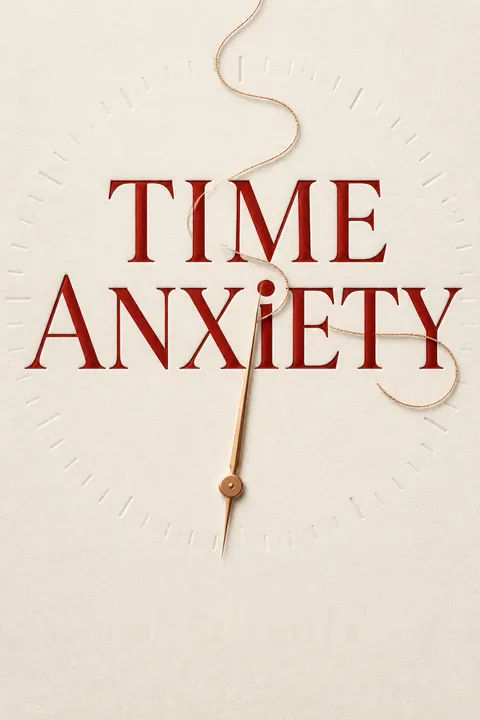


Key Takeaways
Stop trying to manage time; choose what deserves your finite attention.
More than a packed calendar. Time anxiety is the fear that life is slipping away while you are unsure how to use it. It can look like regret over the past, paralysis in the present, or dread about the future. Some people feel it as existential pressure to find a purpose; others feel buried by daily tasks. In surveys with more than a thousand respondents, the same refrain appeared in different forms: there must be something important to do, but it is unclear what.
Choices have a cost. The author recalls Sylvia Plath’s image of a tree laden with figs, each representing a possible life. Choosing one means losing others, and refusing to choose does not stop time. The first relief comes from admitting that desire can exceed the hours available. The task is not to fit everything in, but to choose deliberately.
The book’s central shift is from a scheduling problem to a problem of finite choice. That distinction matters: a better calendar cannot remove the grief of paths not taken. The fig tree makes opportunity cost emotionally legible, not merely economic. Still, personal choice is constrained by money, caregiving, health, and work structures, so anxiety should not be treated as a failure of attitude. The useful question is not whether every demand can be declined, but which available choices express the most agency under real conditions.
Buy breathing room before demanding better decisions from yourself.
Relieve pressure first. Anxiety narrows attention and makes ordinary choices feel impossible. The book’s practical first move is to create a small time surplus before attempting sweeping life changes. Review the next few weeks and remove commitments that no longer serve a purpose. Turn off a channel of incoming messages or silence nonessential notifications. Even twenty minutes reclaimed from a crowded schedule can feel like space to think, rather than another resource to spend.
Regulate, then act. When overwhelm freezes action, the suggested sequence is simple: take a few slow breaths, notice five visible things in the room, and choose one small task. Opening an email and writing a greeting can be enough to break the freeze. The goal is not to solve everything while distressed, but to lower the immediate alarm enough to make a next decision.
This sequence resembles a basic principle of crisis response: stabilize before problem solving. It also respects the difference between knowing what to do and being able to initiate it under stress. Calendar pruning is more than efficiency because it interrupts the assumption that every prior yes remains binding. Yet reclaimed time can quickly be swallowed by the next demand. Protecting some of it for rest or pleasure makes the surplus psychologically real, rather than merely a temporary opening for more work.
Make time visible, and let tools remember what your brain misjudges.
Externalize the clock. Time blindness is a persistent difficulty sensing time’s passage or estimating how long tasks will take. The book notes research on teenagers with ADHD who showed greater difficulty tracking time than a comparison group, while emphasizing that time blindness can affect others too. The practical response is to stop relying on mental estimates: place clocks where they are easy to see, use alarms and calendars, or mark time with a playlist or visual timer.
Build in a margin. Notice tasks that repeatedly take longer than expected, then give them more room in advance. The author blocks two hours for tax preparation because gathering records is predictably slow. For appointments, leaving ten to fifteen minutes earlier can absorb travel delays and transitions. External cues are not a cure for every cause of lateness, but they reduce the memory burden and the panic of running behind.
This is a strong example of designing around cognitive variability instead of moralizing it. A clock or alarm acts as an external memory aid, making a hidden process observable. That approach is especially useful when attention or time estimation fluctuates, and it avoids the unhelpful demand to simply try harder. The caution is that constant clock checking can itself become stressful. The aim is accessible information and sensible buffers, not surveillance of every minute.
Replace inherited time rules with flexible defaults for real conflicts.
Rules are learned. Time rules are explicit or unspoken expectations about when to wake, how quickly to reply, or whether every project must be finished. They come from personal habits and social norms, which vary by family and culture. A rule such as answering every email the day it arrives can be useful in one setting and harmful in another. Ask whether each rule supports well-being, whether it is too rigid, and what would happen if it changed.
Decide before the interruption. Rules of engagement, or ROEs, are preselected responses to recurring conflicts. The author borrows the term from military practice, where guidance helps people make decisions under pressure. In everyday life, an ROE might reserve school pickup time, keep mornings free of meetings, or set a limit on a cleaning session. Asking “Can this wait?” also separates genuine deadlines from urgency imposed by habit or by someone else.
Defaults reduce decision fatigue because they move repeated choices out of the moment of maximum pressure. The military analogy is useful insofar as it highlights the value of clear boundaries under stress, though ordinary life is not a battlefield and rules should remain revisable. A good default protects a meaningful commitment without pretending every conflict has an easy answer. The key test is whether a rule helps a person act by choice, rather than merely obeying a familiar standard.
Define enough before endless work takes over.
Give work an endpoint. Many jobs and creative projects regenerate tasks as soon as one is completed. A writer finishes a draft and immediately faces editing, pitches, and follow-up work. Without a chosen stopping point, a cleared list offers little satisfaction. Before starting, decide what counts as enough for the day or project. A short list of a few important outcomes can create a finish line where none exists naturally.
Lower the standard selectively. The book argues that not every task deserves excellent work. A team planning a large event used a three-quarters-effort rule for details that mattered less than the core experience. The same logic can apply to a messy room or an overdue message: do a useful, imperfect version rather than remain stuck. It can also be reasonable to abandon a book or show that no longer earns its time. Protect care for high-stakes work by not spending it everywhere.
Defining “enough” counters the ratchet effect of work that expands to fill every available hour. It also makes completion perceptible, which matters when the task queue never reaches zero. The argument is not an excuse for carelessness: standards should track consequences. A medical decision, for example, deserves more scrutiny than a minor formatting choice. Selective imperfection is most effective when paired with a clear sense of what must be done well.
Face the dreaded task with one small, completed action.
Avoidance borrows relief. Putting off a hard conversation or a short phone call can feel better for a moment, but the unresolved task continues to occupy attention. The book tells of a business owner who lost a large sale because he could not make a brief call. More extreme examples include people fabricating elaborate excuses to avoid court or a wedding. These stories illustrate the same pattern: escape can become more costly than engagement.
Interrupt the loop. A friction loop is repeated reconsideration without forward movement, such as reopening travel options or drafting and redrafting an email. Make a list of tasks being avoided, then spend a short, protected block on one of them. For ordinary decisions, try to handle an item once and move on. When the whole task feels too large, identify the next small action, complete it, and count progress rather than waiting for total resolution.
Avoidance is reinforced by immediate relief, which explains why it persists even when its long-term costs are obvious. A small approach step changes the reward structure: action can produce relief too, and the feared task may prove manageable. The approach should be scaled to the situation. A difficult conversation may need preparation, and a distressing task may call for support. The principle is not to force exposure indiscriminately, but to distinguish useful caution from delay that only deepens dread.
Match effort to your energy, and judge progress across longer cycles.
Focus has seasons. The book describes a hyperfocus-burnout cycle: intense concentration can produce meaningful work, but it also uses energy that must be restored. Its traffic light model offers three cues. Green means focused and energized. Yellow signals that effort should be reduced or redirected. Red means stop and recover. The model allows hyperfocus without pretending it can be sustained all day.
Widen the measurement. The author cites Mason Currey’s collection of famous creators’ routines, in which many did only a few hours of concentrated work daily. That observation is not a universal biological limit, but it challenges the fantasy of uninterrupted high focus. A difficult day may be followed by a strong one, so assess work across a week or month rather than using one bad day as a verdict. Rest is part of the cycle, not evidence of failure.
The traffic light model makes fluctuating capacity easier to notice before exhaustion becomes a crisis. Its greatest value is descriptive: it gives people permission to change the task, lower the target, or recover. The three to four hour figure should be treated as an illustrative pattern from selected lives, not a precise limit for every occupation or person. Even so, distinguishing focused work from availability, meetings, and routine duties can correct unrealistic expectations about what a working day contains.
Schedule joy before obligations consume the week.
Pleasure need not be earned. The author describes treating games and other leisure as rewards reserved for completed work, then experimenting with enjoying them during the workday. The financial idea of paying yourself first becomes a time principle: reserve some hours for activities that matter to you before obligations fill the calendar. Planning can help when spontaneity tends to become doing nothing. A concert, outing, or visit with a friend gives free time a shape without requiring every hour to be scripted.
Notice what feels alive. Jan Mul, a Dutch traveler, reportedly flew to another European city almost every week for twenty years, walked around the airport, and returned home. He enjoyed flying for its own sake. The example challenges the assumption that leisure must be useful or impressive. Tactile hobbies such as knitting, gardening, or board games offer another low-stakes way to focus away from screens. Track which experiences genuinely lift your mood, then make room for more of them.
The chapter treats enjoyment as information about a person’s values, not a prize to be justified by productivity. That is a meaningful corrective in cultures where leisure is often framed as recovery for more work. Mul’s unusual ritual also shows why other people’s standards are poor measures of a worthwhile life. Still, planned pleasure should not become another performance quota. The point is to make room for experiences that feel nourishing, including quiet or ordinary ones.
Let mortality clarify choices, instead of demanding a permanent legacy.
Finitude is the root pressure. The book argues that the deepest reason time feels scarce is that life ends, though no one knows the exact countdown. In Liu Cixin’s novel The Three-Body Problem, a character sees a timer appearing in photographs and other places, apparently counting down his remaining life. The image dramatizes a fear people usually carry without a visible clock. Mortality can prompt the question of what remains unresolved, but it need not demand immediate, dramatic action.
Choose a direction, then act over time. The author recommends using future regret as one lens for decisions and planning across a year rather than overloading a single day. Dreamers need to translate ideas into action; doers need to ask whether their effort serves a meaningful aim. Building a legacy is uncertain and partly beyond anyone’s control. Living well, through care for oneself and others and attention to chosen goals, is available in the present.
Mortality offers a powerful filter because it exposes the difference between urgency and importance. Its use is not to make every choice dramatic, but to place small obligations in proportion to the life they serve. Regret can motivate change, yet fear of future regret can also become another form of pressure. The book’s more grounded alternative is to combine aspiration with modest execution, while accepting that outcomes and recognition cannot be guaranteed.
Analysis
The book begins with a useful diagnosis: distress about time is not just a shortage of hours. It is a collision between unlimited wants, limited attention, uncertainty about the future, and an economy of work that rarely supplies a natural stopping point. Its recurring stories make that collision concrete, from the unread messages that become a source of shame to the traveler who repeatedly flew for the pleasure of flying. The strongest move is replacing mastery with discernment. Clocks, timers, rules, and plans still matter, but they are supports for choice rather than instruments for controlling time.
Its practical advice works best when it addresses a specific failure mode. External reminders help when time estimates are unreliable. A predecided boundary helps when requests repeatedly displace valued activities. A finish line helps when work expands without limit. The book’s insistence on imperfect work and unfinished projects is especially valuable because it challenges the assumption that every commitment deserves equal effort. Its focus on pleasure also resists a common trap: treating leisure as another productivity tool.
Some claims need careful interpretation. The idea that time management is impossible is rhetorically sharp, but people can manage schedules, attention, and commitments, even if they cannot alter time itself. Likewise, the estimate of three to four hours of focused work comes from patterns described in a book about notable people, not a universal prescription. The distinction between time itself and one’s usable capacity is more helpful than a literal rejection of planning. Structural constraints also matter. Caregivers and workers with little control over schedules cannot simply remove obligations or reserve ideal hours. Taken as adaptable tools rather than universal commands, the book’s central lesson is humane and durable: accept limits, protect agency where it exists, and judge a life by chosen experience rather than an empty task list.
Review Summary
Time Anxiety by Chris Guillebeau receives mixed reviews averaging 3.64/5 stars. Many readers appreciate its practical, empathetic approach to managing time-related stress, praising its accessible writing, helpful tips on reframing urgency, and validation of common struggles. Readers particularly value advice on time blindness, email management, and letting go of guilt. However, critics find the content basic, repetitive, or lacking depth, with some noting it offers common-sense advice without new research. The book resonates most with those experiencing genuine time anxiety, while others found it less relevant to their situations.
People Also Read




Glossary
Time anxiety
Fear of running outA persistent unease about time passing and not knowing how best to use it. It can involve regret about the past, indecision in the present, and worry about the future. The book distinguishes existential concerns, such as fear of missing one’s purpose, from daily pressure about tasks, deadlines, and availability.
Time blindness
Difficulty sensing timeA recurring difficulty tracking time’s passage or estimating how long activities will take. It can contribute to lateness, procrastination, and anxiety about unfinished tasks. The book discusses research involving teenagers with ADHD, while noting that time blindness can also occur without a diagnosis and can be addressed with visible clocks, alarms, and other external cues.
Time rules
Rules shaping time usePersonal habits and cultural expectations that govern when people work, rest, respond, or finish tasks. Some support well-being, while rigid or outdated ones can intensify stress. Examples include expecting oneself to answer every message the same day or believing a project must always be completed once started.
Rules of engagement
Defaults for recurring conflictsPreselected guidelines for responding to interruptions, competing requests, and recurring scheduling conflicts. The book borrows the term from military practice, where rules guide decisions under pressure. Everyday examples include protecting a family commitment, limiting client loads, or reserving a work period from notifications.
Radical acceptance
Accepting unavoidable painA mindfulness approach that distinguishes unavoidable pain from additional suffering caused by resisting it. Applied to time, it means acknowledging that time passes beyond personal control, making plans without demanding that they unfold perfectly, and directing effort toward choices that remain possible.
Friction loops
Repeated thought without progressCycles of reconsideration that consume time and attention without completing a decision or task. A person might repeatedly compare travel options, postpone a response, and then restart the same deliberation. The book contrasts these loops with small completed actions that build momentum and reduce cognitive clutter.
Hyperfocus-burnout cycle
Intense work followed by exhaustionA pattern in which prolonged, concentrated effort can produce strong short-term output but also leaves a person depleted. The book does not treat hyperfocus as inherently bad. Instead, it recommends pairing intense work with deliberate recovery and avoiding the expectation that high focus can continue indefinitely.
Traffic Light Strategy
Adjust effort to capacityA model for recognizing changing focus and fatigue. Green indicates energized concentration, yellow signals a need to slow down or change tasks, and red indicates a need to stop and recover. The colors can describe a work session or an entire day and help people adjust expectations to their capacity.
Granny hobbies
Low-stakes tactile activitiesHands-on, often repetitive activities such as knitting, gardening, baking, or board games. The book emphasizes their low stakes, easy start and stop points, and freedom from screen-based scrolling. They can provide focused attention, a sense of control, and either solitary or social enjoyment.
Un-finishing
Choosing to stop earlyThe deliberate choice to abandon something already started when it no longer offers enough value. It can mean leaving a book unread, stopping a show, or exiting an unhelpful meeting. The point is not that unfinished work is always harmless, but that completion is not automatically worth the time it costs.
Subjective Units of Happiness
Personal happiness ratingA self-reported rating of happiness or pleasure during an activity, using a numerical scale such as zero to ten. The practice is intended to reveal which ordinary routines, people, or experiences feel rewarding. Repeated ratings may help identify where someone wants to spend more or less time.
About the Author
Other books by Chris Guillebeau




Download PDF
Download EPUB
.epub digital book format is ideal for reading ebooks on phones, tablets, and e-readers.








