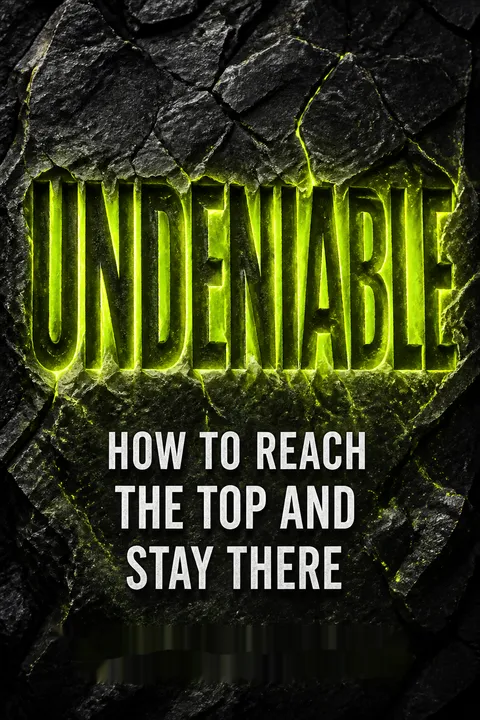


Key Takeaways
Become undeniable through daily proof, not status or declarations.
Start with a small world. Cameron Hanes grew up in a logging town where his horizons felt limited. A friend, Roy Roth, introduced him to bowhunting, and the challenge of learning it gave him a reason to look farther: first into Oregon’s wilderness, then toward bigger hunts and a wider community. In this book, being undeniable means earning a reputation through sustained work and visible results, not simply claiming greatness. Hanes’s career grew from that pattern, not from a master plan.
Let effort widen possibility. Bowhunting became the organizing purpose behind his running, strength training, daily practice, and eventually his work sharing what he learned. The central promise is not that everyone will become famous or elite. It is that committed effort can expand what a person thinks is possible.
What's striking is how purpose changes the scale of a life. A demanding interest gave Hanes both a practical goal and a new identity, while each successful hunt supplied evidence that he could attempt more. That resembles a useful principle in behavior change: confidence often follows action rather than preceding it. The caution is that public results are an incomplete measure of worth. A person can become highly capable without becoming celebrated, and obscurity does not make effort less meaningful.
Choose hard things that prepare you for hardships you cannot choose.
Practice under pressure. Hanes treats voluntary hardship as preparation for the setbacks life delivers without permission. During a cold, wet 50K with David Goggins, he watched Goggins maintain his effort even as the race wore him down. On another outing, podcaster Chris Williamson helped carry a 72-pound rock up Mount Pisgah. The exercise was deliberately uncomfortable, but its point was not merely to suffer: it made strain familiar and revealed how each person responded when tired.
Build capacity in steps. Former Green Beret Mike Glover described resilience as responding to adversity through action, sometimes one breath or one step at a time. The book links such chosen challenges with grief, illness, and other forms of unchosen hardship, arguing that practice can make a person less easily overwhelmed.
The strongest version of this idea is stress inoculation: manageable challenges can rehearse attention, pacing, and persistence before higher-stakes demands arrive. The rock is useful because it is concrete and temporary, not because pain is automatically ennobling. Training also needs progression, rest, and safety. Deliberate difficulty can build capacity, but chronic overload can produce injury or exhaustion, and traumatic events are not simply workouts in disguise.
Make consistency boring enough to survive changing motivation.
Repeat the essentials. Hanes’s daily routine, Lift Run Shoot, combines strength work, running for endurance, and bow practice for accuracy. The order can change, but the recurring commitment is the point. He connects this habit to the demands of backcountry hunting, where strength helps carry game, endurance helps cover rugged terrain, and a missed shot can undo all the other preparation.
Let small efforts accumulate. Entrepreneur and athlete Nick Bare contrasted steady training and years of building a business with occasional bursts of ambition. Ultrarunner Courtney Dauwalter advised beginners to increase distance gradually, adding small amounts rather than expecting immediate transformation. Both accounts support the same lesson: reliable practice creates more opportunity to improve than sporadic heroics. Hanes’s unusually demanding schedule is his personal standard, not a requirement for everyone.
Consistency converts intention into repeated contact with the task, which creates room for skill and capacity to develop. The book’s examples also make a useful distinction between being consistently good and occasionally spectacular. Still, daily effort should not be mistaken for daily maximum effort. Recovery is part of training, and a routine that ignores fatigue may undermine the adaptation it is meant to create. The transferable principle is regular, sustainable practice, not copying Hanes’s volume.
Rehearse the exact skill that must hold under pressure.
Practice the decisive moment. Hanes argues that physical fitness cannot substitute for an accurate shot. He shoots his bow throughout the year and sometimes adds distractions or awkward positions to make practice less predictable. The goal is to make the shooting sequence familiar enough that adrenaline does not erase it. At a public event attended by roughly 2,000 people, he used a bow to cut a ceremonial ribbon, relying on extensive preparation to manage the pressure.
Study what fails. Champion archer Levi Morgan recorded how his shots performed across different targets, lighting, weather, and terrain. Reviewing those records helped him identify weaknesses to address. Hanes’s own missed shot at a Dall sheep, despite a close opportunity, showed the cost of skipping a basic part of his aiming process. Practice makes skill more dependable, but attention still matters.
This is a strong case for deliberate practice: repeat a specific skill, notice errors, and adjust the next attempt. Morgan’s record keeping is especially useful because it turns a vague feeling of inconsistency into information about conditions and technique. Pressure cannot be perfectly reproduced in training, but realistic variation can reduce surprise. The nuance is that repetition alone may reinforce mistakes; feedback, competent coaching, and honest review are what make practice developmental.
When plans break, keep moving while updating your method.
Separate the goal from the detour. During a 50K race, course markers had been moved, sending Hanes and other runners off track. They spent time navigating, ran extra miles, and fell behind. He considered quitting, then remembered that he was using the race to prepare for a difficult sheep hunt, not merely to win. He finished fourth. The result was not the one he wanted, but the effort still served its purpose.
Stay useful late. Hanes’s advice to be stronger on the tenth day than the first captures persistence when novelty has worn off and fatigue has accumulated. His sheep hunt offered a harsher lesson: after a poor first shot, he had to follow the blood trail and continue working until he recovered the animal. Determination kept him engaged, while preparation and adjustment helped him respond to what had actually happened.
Persistence is most valuable when paired with situational judgment. Hanes’s race illustrates how a changed goal can turn a frustrating outcome into useful practice; the hunt shows that persistence can also mean taking responsibility after an error. This is not a case for pushing blindly through every obstacle. In work, sport, and recovery, the better question is whether the next effort advances the real objective or simply protects pride.
Remove the escape that keeps resetting your progress.
Notice what costs tomorrow. Hanes describes his early adulthood as a cycle of drinking, regret, and returning to alcohol to avoid facing a life that felt directionless. After becoming a father and finding a serious commitment in bowhunting, he stopped drinking. He argues that alcohol worked against his goals by interfering with the energy and discipline he wanted to bring to training and family life.
Make change a daily practice. Other interviewees show different versions of the struggle. Wrestler and runner Natalie Eva Marie experienced a relapse before returning to sobriety support. Marathoner Ken Rideout describes overcoming opioid addiction and building a new life around endurance training. Chris Williamson found that alcohol-free stretches gave him more time and consistency. Their stories do not prescribe one method for everyone; they show how removing a disruptive habit can make room for sustained effort.
The practical insight is about opportunity cost: a habit can take more than the hours it occupies if it repeatedly disrupts sleep, judgment, or follow-through. These accounts are compelling because they describe change as ongoing rather than as a single dramatic decision. They also need a careful boundary: addiction is not merely weak discipline. Social support, clinical treatment, and recovery communities can be essential, and abstinence is not a substitute for care when dependence is present.
Bet on yourself by turning ambition into visible evidence.
Make a calculated move. Hunting personality Michael Waddell left a stable heating and cooling job to pursue outdoor media, believing that even a slim chance of success was worth exploring because he could return to his trade if it failed. Hanes also challenged sponsors to recognize the value of his work and proposed releasing hunting footage daily rather than waiting months for a conventional film. The idea required a costly crew, but the resulting video attracted millions of views.
Earn confidence through proof. Quarterback Aaron Rodgers described setbacks at college and in the NFL as moments that forced him to rebuild his self-image. Hanes relates this to imposter feelings: repeated work and results can create a body of evidence against self-doubt. Belief matters, but the book repeatedly grounds it in preparation, risk, and action rather than affirmation alone.
Betting on oneself becomes more rational when ambition is paired with experiments, feedback, and a fallback plan. Waddell’s decision shows a way to test a nontraditional career without pretending the odds are guaranteed; Hanes’s media idea shows the value of noticing a format others have not tried. Self-promotion can also be necessary when work is otherwise invisible. The useful distinction is confidence versus entitlement: evidence supports a claim, while a claim alone does not make it true.
Let passion grow into a contribution others can use.
Begin with what holds attention. Hanes found bowhunting absorbing enough to organize his time and ambitions. Neuroscientist Andrew Huberman followed a childhood fascination with learning into decades of study and research. Their paths show that passion can begin as sustained curiosity, then deepen through practice rather than arrive as a perfectly formed career plan.
Make the pursuit useful. Hanes’s friend Roy Roth viewed hunting as a way to earn trust and help others. Australian runner Nedd Brockmann used extreme runs to raise awareness and money for people experiencing homelessness. Politician Tulsi Gabbard traced her public service to local environmental activism. These examples broaden purpose beyond personal achievement: a pursuit can become a platform for teaching, service, or inspiration.
Passion is powerful partly because attention and effort become easier to sustain when the work matters to the person doing it. Contribution adds another source of motivation: the pursuit can benefit people beyond its practitioner. Yet passion is not automatically a public mission, and not every interest needs to become a business or platform. The book’s more inclusive implication is that meaningful work can be private, communal, or public, provided its demands fit the life around it.
Measure toughness by judgment, repair, and the people it protects.
Face the cost honestly. Hanes’s friend and hunting mentor Roy Roth died in a fall while sheep hunting in 2015. Returning to Alaska years later, Hanes hoped to honor him, but a grizzly hunt left him troubled: after his arrow wounded the bear, his guide and another hunter used rifles when it charged. Hanes was grateful they protected the group, yet regretted the outcome and questioned his own decisions. The episode complicates any simple celebration of toughness.
Listen to consequences. Ultrarunner Courtney Dauwalter learned to heed injury warnings after pushing too hard. Hanes’s son Truett also told him that his intensity helped drive him away from hunting for eight years. Hanes admits that this was difficult to hear. Persistence matters, but reflection, restraint, and repair are also forms of strength.
This is the book’s most important corrective to its celebration of relentless effort. Courage without judgment can endanger the person pursuing a goal, other people, or the animal at the center of a hunt. Truett’s account also shows that an approach can produce impressive achievement while damaging a relationship. Toughness becomes more credible when it can accept feedback, recognize limits, and change course without treating restraint as weakness.
Analysis
Undeniable is part memoir, part motivational argument, and part portrait gallery. Its structure follows Hanes’s central claim through stories of his own hunts and training, then widens the lens through conversations with athletes, entrepreneurs, veterans, and people rebuilding their lives. The recurring Lift Run Shoot sessions give the book a distinctive narrative device: guests share exertion before explaining what drives them. The result is less a universal program than a set of lived examples organized around practice, resilience, focus, self-belief, and purpose.
The book is strongest when its abstractions acquire a concrete cost. Hanes misses a shot after decades of preparation, loses Roy, returns to a hunt that goes wrong, and hears from his son that his intensity helped push him away from hunting. These admissions complicate the heroic image and make persistence feel earned rather than effortless. They also reveal that toughness is relational. It depends on the trust of partners, family, mentors, and communities, not solely on private willpower.
The main limitation is a familiar one in achievement narratives: vivid examples of exceptional performers cannot prove that effort reliably produces elite outcomes. Genetics, opportunity, money, health, timing, and luck shape results, and many hardworking people do not become champions or successful entrepreneurs. Hanes occasionally acknowledges luck and limits, but his emphasis on work can make structural constraints seem smaller than they are. His extraordinary training schedule is also a personal choice, not a general prescription.
The most useful reading therefore separates the principle from the spectacle. Readers need not run hundreds of miles or carry rocks uphill. They can identify a meaningful pursuit, practice its crucial skills, increase difficulty gradually, review failures, and remove habits that repeatedly obstruct progress. The title’s promise is best understood as earned credibility: become hard to dismiss in the work that matters to you, while staying alert to the human costs of chasing the summit.
Review Summary
Undeniable receives mixed reviews, with an average rating of 4.11 out of 5. Many readers find it inspirational and motivating, praising Hanes' storytelling and the lessons from successful individuals. They appreciate the emphasis on hard work, resilience, and personal growth. However, some critics find the book repetitive, poorly written, and overly focused on extreme behaviors. A few readers note that while the message is powerful, the constant emphasis on "grinding" may not be realistic or healthy for everyone.
People Also Read








Glossary
Undeniable
credibility earned through workHanes uses undeniable to describe a person whose sustained effort and results are difficult to dismiss, even when critics disagree with the person or their choices. It is not simply fame, confidence, or public approval. In the book, the standard is built through repeated preparation, performance, and commitment to a chosen craft.
Lift Run Shoot
three-part daily training routineHanes’s named training routine combines lifting weights, running, and shooting a bow. Each activity supports a different demand of backcountry bowhunting: strength for carrying game, endurance for difficult terrain, and accuracy for making a responsible shot. The order can vary. Hanes presents daily repetition as his personal practice, not as a universal training prescription.
chosen suffering
voluntary hardship for preparationThe book uses chosen suffering for difficulty a person deliberately undertakes, such as a demanding workout, race, or wilderness hunt. Interviewees connect these experiences with readiness for unchosen hardship, including loss, injury, and unexpected adversity. The idea is that manageable challenges can build capacity and reveal habits of response, not that all suffering is beneficial or should be pursued without limits.
Roy Tough
resilience shaped by hard experienceRoy Tough is Hanes’s personal label for a standard of enduring hardship without giving up on meaningful work. The term honors hunting mentor Roy Roth, whose toughness was paired with optimism, practical skill, and care for others. It represents more than tolerating pain: it is the effort to stay capable and constructive when conditions are difficult.
FAQ
1. What’s Undeniable: How to Reach the Top and Stay There by Cameron R. Hanes about?
- Relentless pursuit of excellence: The book details Hanes’s journey from a small-town upbringing to becoming an elite bowhunter and ultra-endurance athlete, focusing on the mindset and habits that define outliers.
- Core themes of motivation and resilience: It emphasizes hard work, discipline, and embracing suffering as tools for personal growth and achievement.
- Blend of memoir and guide: Hanes combines personal stories with lessons from other high achievers, offering both inspiration and practical advice for readers seeking to elevate their lives.
- Focus on mindset and purpose: The narrative highlights the importance of self-belief, tenacity, and having a clear purpose to fuel perseverance and impact.
2. Why should I read Undeniable by Cameron R. Hanes?
- Motivational and relatable storytelling: Hanes shares candid accounts of overcoming addiction, family struggles, and self-doubt, making his journey accessible and inspiring.
- Actionable advice for growth: The book provides practical routines and mindset shifts, such as the "Lift Run Shoot" method, that readers can apply to their own lives.
- Insights from top performers: Through interviews and stories from elite athletes, entrepreneurs, and military veterans, readers gain a multifaceted view of what it takes to excel.
- Focus on purpose and impact: Hanes encourages readers to find their passion and use it to make a positive difference, not just achieve personal success.
3. What are the key takeaways from Undeniable by Cameron R. Hanes?
- Work ethic trumps talent: Consistent, relentless effort is more important than innate ability for achieving and sustaining success.
- Mindset and self-belief: Overcoming imposter syndrome and building confidence through a “stack of proof” are essential for growth.
- Passion fuels perseverance: Loving what you do makes enduring hardship and sacrifice meaningful and sustainable.
- Purpose and impact matter: True success is about making a positive difference and leaving a legacy, not just personal achievement.
4. What is the "Lift Run Shoot" method in Undeniable and how does it work?
- Daily training regimen: Hanes’s foundational routine involves weightlifting, running, and archery practice every day, with the order varying but the consistency unwavering.
- Physical and mental preparation: Lifting builds strength, running develops endurance, and shooting hones focus and precision—each essential for bowhunting and endurance sports.
- Discipline and resilience: The method is as much about mental toughness as physical fitness, pushing through discomfort and embodying Hanes’s “Keep Hammering” mantra.
- Transferable to any pursuit: While rooted in hunting, the principles of this routine can be applied to any area requiring discipline and mastery.
5. How does Cameron R. Hanes define and use suffering in Undeniable?
- Chosen vs. unchosen suffering: Hanes advocates deliberately embracing difficult challenges (“chosen suffering”) to build strength and resilience for life’s inevitable hardships.
- Suffering as a truth serum: Facing pain and discomfort strips away pretenses, revealing true character and fostering personal growth.
- Passion rooted in suffering: Hanes connects the concept of passion to its Latin and Greek origins, arguing that suffering is integral to finding meaning and motivation.
- Preparation for adversity: By scheduling suffering into daily life, readers become better equipped to handle unexpected challenges.
6. What does "ROY TOUGH" mean in Undeniable by Cameron R. Hanes?
- Definition of ROY TOUGH: It signifies being “unable to be broken; able to endure hardships and misery for a reward,” representing ultimate mental, physical, and emotional resilience.
- Inspired by Roy Roth: Hanes’s mentor exemplified this toughness through decades of extreme hunting and life challenges, serving as a benchmark for grit.
- Mindset for greatness: Embracing suffering, pushing limits, and refusing to quit are key to becoming ROY TOUGH.
- Daily application: The concept encourages showing up every day, grinding through pain, and maintaining discipline regardless of circumstances.
7. How does Undeniable by Cameron R. Hanes describe the importance of consistency?
- Consistency as a defining trait: Hanes identifies daily, relentless effort as the hallmark of all high achievers, surpassing occasional bursts of greatness.
- Stories from elite performers: Examples from athletes like Nick Bare and Courtney Dauwalter illustrate how steady progress compounds into extraordinary results.
- Consistency over talent: The book emphasizes that showing up and putting in the work every day is more important than natural ability.
- Resilience through routine: Consistency helps overcome setbacks, criticism, and fluctuating motivation, building long-term success.
8. What does discipline mean in Undeniable by Cameron R. Hanes, and why is it crucial?
- Discipline as self-control: Hanes defines discipline as the ability to enforce order and make healthy choices, even when it’s difficult or inconvenient.
- Foundation for other traits: Discipline underpins consistency, focus, and resilience, enabling individuals to avoid self-sabotage and pursue long-term goals.
- Daily commitment: It’s not a one-time decision but a series of hard choices made every day, especially in the face of temptation or adversity.
- Personal transformation: Hanes’s own battle with alcohol and subsequent sobriety highlight discipline as a turning point for personal growth.
9. How does Undeniable by Cameron R. Hanes address self-belief, confidence, and imposter syndrome?
- Confidence beyond talent: Hanes argues that confidence is built through preparation, persistence, and appreciating one’s own abilities, not just innate talent.
- Betting on yourself: The book stresses the importance of self-belief and taking risks on your own potential, even in the face of doubt or criticism.
- Overcoming imposter syndrome: Hanes and his guests discuss feeling undeserving despite success, advocating for building an “undeniable stack of proof” through consistent achievement.
- Balancing humility and self-promotion: Sharing your skills and believing in your value are necessary for success in today’s world.
10. What role do passion and purpose play in Undeniable by Cameron R. Hanes?
- Passion as a driving force: Hanes defines passion as an intense conviction that fuels perseverance through hardship and sacrifice.
- Connection to purpose: Passion leads to discovering one’s purpose, which in turn drives meaningful impact and legacy.
- Examples from high achievers: Stories of individuals like Joe Rogan and Evan Hafer illustrate how finding and pursuing passion transforms lives.
- Making a positive impact: Hanes encourages readers to use their passion and purpose to uplift others and make a difference beyond personal achievement.
11. How does Undeniable by Cameron R. Hanes view failure, struggle, and tenacity?
- Failure as a teacher: Hanes and his guests emphasize that failure is inevitable and essential for growth, shaping resilience and empathy.
- Struggle builds strength: Embracing suffering and hardship is portrayed as a necessary part of the journey to success.
- Tenacity defined: The book highlights persistence, grit, and the refusal to quit as defining traits of outliers.
- Mindset over circumstance: Hanes stresses that mental toughness and the willingness to keep moving forward are more important than external conditions.
12. What are the best quotes from Undeniable by Cameron R. Hanes and what do they mean?
- “Keep Hammering” mantra: Hanes’s signature phrase encapsulates relentless daily effort and persistence, the core message of the book.
- “Choose your suffering”: Inspired by David Goggins, this quote emphasizes the power of deliberately embracing hardship for growth and resilience.
- “If you can’t bet on yourself, who the hell are you gonna bet on?” —Michael Waddell: This challenges readers to take ownership of their dreams and efforts, highlighting the necessity of self-confidence.
- “The purpose of life is to discover your gift. The work of life is to develop it. The meaning of life is to give your gift away.” —David Viscott: This encapsulates the book’s message about finding, cultivating, and sharing your unique talents for the benefit of others.
- “If people don’t believe in you, there are two choices: shrink and go away or become undeniable.” —Cam Hanes: This quote urges readers to respond to doubt and criticism by rising above and proving their worth through relentless effort.
Download PDF
Download EPUB
.epub digital book format is ideal for reading ebooks on phones, tablets, and e-readers.








