

Key Takeaways
Wisdom is a lagging indicator of work you did years ago
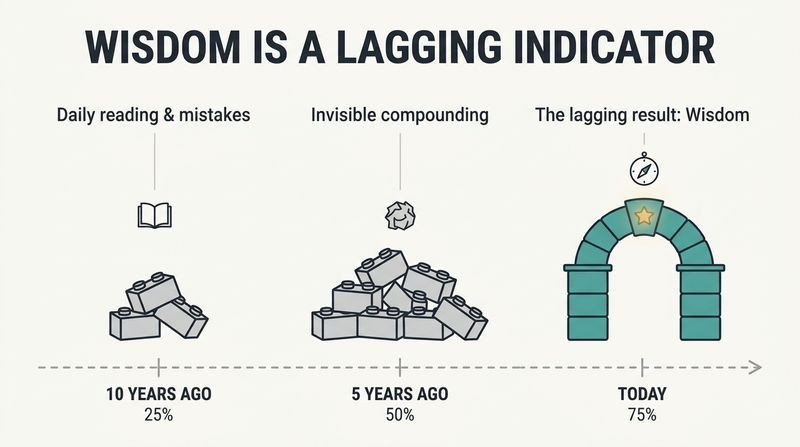
You reap what you sowed. Ryan Holiday, in the fourth book of his cardinal virtues series, argues wisdom cannot be hacked, downloaded, or delegated. He opens with Seneca's story of a lazy Roman who bought educated slaves to whisper poetry at dinner parties, hoping to seem cultured without reading. It fooled no one. Wisdom is knowing what to do, when to do it, and how to do it, and it accrues only through decades of reading, questioning, mistakes, and experience.
The method is the point. There is no app, guru, or shortcut. Wisdom is the mother of virtues: courage without judgment is recklessness, self-discipline aimed wrongly is waste. You can spell neither learned nor earned without the other. You get wiser, never wise, closer, never there.
The framing as a lagging indicator borrows from economics and resonates with modern deliberate-practice research: Anders Ericsson showed expertise emerges from thousands of structured hours, not talent bursts. What's compelling is Holiday's refusal of the self-help genre's central lie, the promise of speed. The tension worth noting: not all accumulation compounds into wisdom. Plenty of well-read people remain fools, a point Holiday himself later illustrates. Reading is necessary but insufficient. The variable he underweights here is reflection quality, the difference between logging hours and metabolizing them, which he addresses only obliquely through his emphasis on journaling and questioning.
Reading is talking to the dead, a superpower most people ignore

Books collapse centuries. The shipwrecked merchant Zeno, told by the Oracle he would grow wise when he conversed with the dead, discovered the meaning in an Athens bookshop: books are the dead still speaking. From this insight he founded Stoicism. Holiday contrasts the average person's five hours of daily phone use and twenty weekly TV hours with voracious leaders: de Gaulle read two to three books weekly, Mattis blocked an hour daily even in war, Truman read his town library dry by fifteen.
Read actively, not passively. Great readers interrogate authors. John Adams scrawled 12,000 words of notes in one book on the French Revolution, writing Fool! and Excellent! in the margins. Reading is cheap wisdom bought with someone else's pain.
The metaphor is old (Machiavelli described conversing with the ancients), but the phone-versus-book contrast lands with fresh force in the attention economy. Cognitive science supports active reading: the generation effect and elaborative interrogation show that arguing with a text encodes it far better than passive absorption. One caveat Holiday soft-pedals: the reading-leaders correlation risks survivorship bias, since we celebrate readers who succeeded and ignore the equally bookish who failed. Reading is a tool, not a guarantee. Still, the practical prescription (annotate, quit bad books, disagree) transforms reading from consumption into dialogue, which is where its real value lives.
Stay curious past childhood, because incuriosity leads exactly nowhere

Curiosity accelerates. The Wright brothers, with under a thousand dollars and no college degrees, beat a government-funded rival that spent the equivalent of millions. Their edge was a childhood home overflowing with books and a father who valued following a question over grades. They asked the Smithsonian for every book on flight and watched birds for hours. Biographer David McCullough noted curiosity is like gravity, accelerative: the more you know, the more you want to know.
Read like a scout in enemy territory. Seneca advised exploring ideas you disagree with. Playwright Ben Jonson inscribed his books tanquam explorator, like an explorer. Everything is figure-out-able. Kids are born curious; the task is refusing to let it get stamped out.
Holiday's claim that curiosity is self-actualizing echoes intrinsic-motivation research: Deci and Ryan found autonomous, interest-driven work outperforms extrinsic reward, which explains why the Wrights, working for love rather than money, out-innovated funded competitors. The neuroscience adds weight: curiosity activates dopaminergic circuits that enhance memory encoding, so curious learners literally retain more. The subtle risk is undirected curiosity, the endless rabbit-holing that mimics learning without producing mastery. Curiosity needs a spine of focus to become wisdom rather than trivia. Holiday knows this, which is why the very next lessons concern focus and going deep.
Train ferocious focus, the skill every other form of wisdom depends on
Look, look, look. Harvard biologist Louis Agassiz handed his new student a dead fish and one instruction: study it. For three days Scudder stared, discovering he had barely seen it at first. The lesson was not about fish but about the power of sustained, uninterrupted attention. Feynman insisted real physics requires solid, unbroken stretches of concentration.
Focus is a trained ritual. Machiavelli, exiled to the countryside, changed into fine clothes each evening before entering his study to spend four uninterrupted hours conversing with the ancients. Performance artist Marina Abramovic trains focus by having students walk backward holding mirrors or find their way home blindfolded. After three hours slowly opening a door, she says, the door stops being a door. A short attention span is an enemy of wisdom.
In an era engineered for distraction, Holiday's focus chapter is arguably the book's most urgent. Cal Newport's Deep Work makes the same argument quantitatively: cognitively demanding output requires distraction-free blocks, and the ability to produce them is becoming rare and therefore valuable. The Agassiz fish story doubles as a lesson in perception itself; expertise researchers call it the trained eye, the capacity to see structure novices miss. What Holiday captures that productivity writers often miss is the aesthetic dimension: focus is not just efficient, it dissolves boredom and reveals beauty. The door stops being a door. That reframe alone justifies the practice.
Talent without teachers stalls; attach yourself to a master
Seek doors, avoid door-closers. Zeno's teacher Crates was nicknamed the door-opener. A single teacher can change the world through one student: Socrates to Plato to Aristotle to Alexander. But teachers can also destroy: Malcolm X's teacher told him a Black boy could never be a lawyer, and he drifted into crime. John Adams transformed academically only after switching to a schoolmaster who fit him.
Become an apprentice, not an occasional advice-seeker. Lyndon Johnson, denied an Ivy League education, became a professional son, attaching himself to mentors like Sam Rayburn and FDR, running errands and absorbing the art of power. Bill Belichick volunteered to drive older coaches for the thirty minutes of learning. You must prove yourself worth teaching: hungry, coachable, and willing first to serve.
The mentorship framing corrects a common misconception that mentors are charity. Holiday reframes it as mutual value and earned proximity, consistent with how sponsorship actually functions in careers: research on workplace advancement shows sponsors invest in proteges who make them look good, not in supplicants. The samurai anecdote (a student in a hurry learns slowest) captures a paradox behavioral economists call the planning fallacy inverted, where impatience extends timelines. One limitation: the LBJ model of instrumental relationship-building shades toward manipulation, and Holiday's own later portrait of Johnson's Vietnam hubris suggests proximity to power teaches vices as readily as virtues.
Being the smartest person alive can make you dangerously stupid
Success breeds the disease. Holiday's centerpiece cautionary tale is Elon Musk, who taught himself rocketry from Soviet manuals, applied first-principles thinking to discover raw materials cost 2% of rocket market prices, and built world-changing companies. Yet the same man degraded his information diet from technical manuals to obsessive tweeting, tanked Twitter's value by roughly 80% after a $44 billion impulse buy, and spread misinformation to hundreds of millions.
The Midas trap. When people never hear no, when critics keep being proven wrong, they conclude everything they do is smart, even when it is dumb. Musk's idiot index (price minus raw material cost, flagging waste) curdled into calling everyone who disagreed an idiot, selecting for sycophants. The most dangerous thing is believing you are the smartest person in the room.
Holiday's Musk chapter is bold, writing critically about a litigious neighbor and acquaintance, and it functions as the book's thesis in negative: intelligence is not wisdom. The psychology is sound. Dunning and Kruger showed incompetence breeds overconfidence, but the more insidious cousin is the halo effect, where genuine expertise in one domain (rockets) gets over-extended to unrelated ones (epidemiology, geopolitics). Philip Tetlock's forecasting research found that the most confident experts, the hedgehogs with one big idea, were the worst predictors. The chapter's risk is that Musk-as-villain may age unpredictably, but the structural lesson (feedback scarcity corrupts) transcends the example.
Empty and clean your cup, because your mind fools you constantly
Guard against your own biases. A Zen master pours tea until the student's cup overflows: a full mind cannot learn. Holiday notes scientists have catalogued nearly two hundred cognitive biases. Even Agassiz, who taught focus, calcified in old age into a delusional creationist and scientific racist, denying evolution and the evidence before his own eyes rather than admit he was wrong.
Wash the cup, not just empty it. Horace warned that a dirty vessel sours whatever you pour in. The Stoics tested every impression before trusting it. Pontius Pilate, too busy and incurious, asked What is truth? and walked out on the man claiming to have it. Closed-mindedness does not just make us wrong, it makes us cruel. Stay empty, open, and moving like a river.
The overflowing-cup parable pairs neatly with modern debiasing literature. Kahneman's work on System 1 versus System 2 thinking maps directly onto Holiday's plea to test impressions rather than trust snap judgments. The Agassiz decline is the chapter's dark gift, a documented case of motivated reasoning, where a brilliant mind weaponized intelligence to defend a conclusion he needed to be true. That is more dangerous than ignorance, because sophistication supplies better rationalizations. Holiday's river metaphor adds a useful nuance biases research often omits: openness is not a state you achieve but a flow you maintain, requiring continual effort as certainty accumulates with age.
Write to discover what you actually think, not to record it
Writing is thinking with your fingers. Trappist monk Thomas Merton, sworn to silence, wrote nearly a million words, calling writing a form of contemplation. He was not telling readers what he thought; he was figuring it out. When Marshall asked Eisenhower for a Pacific war strategy days after Pearl Harbor, Eisenhower did not brainstorm aloud. He asked for hours, sat with paper and typewriter, and returned a tight 300-word plan that launched his career.
Structure forces clarity. Amazon banned PowerPoint, requiring six-page narrative memos read silently for thirty minutes before meetings begin. Bezos wanted memos like angels singing, then messy discussion. Keynes called writing the assault of thought on the unthinking. You cannot make others see what you have not first genuinely worked out yourself.
The claim that writing is thinking, not transcription, has strong cognitive backing: the act of composing forces the linearization of tangled thoughts, exposing gaps that feel resolved in the head. This is why the Feynman technique (explain it simply or you do not understand it) works, and why Amazon's memo culture outperforms slide decks that let vagueness hide behind bullets. The timely edge is AI. Holiday argues outsourcing writing to a machine defeats the purpose, because the cognitive labor is the product, not the prose. That reframes the AI-writing debate: the question is not whether the output is good but whether you skipped the thinking.
Change your mind when facts change; a fool stays the same
Evolving is strength, not betrayal. Writers Richard Wright and Ralph Ellison joined the Communist Party in the 1930s when it seemed the only movement recognizing racial equality, then broke with it when its intolerance and the Soviet show trials became undeniable. Breaking away was agonizing (Wright ended up exiled) but essential to their growth. Ellison said the break let him come alive.
Consistency is overrated. Keynes reportedly said when the facts change, he changes his mind. Churchill switched parties at twenty-nine to stop saying stupid things. We mock politicians as flip-floppers, but the real failure is never having changed at all, still believing what you believed as a child. Ask people: what did you last change your mind about? Honest answers reveal mental strength.
Holiday targets a genuine cultural pathology: treating mind-changing as weakness. This inverts the scientific ideal, where updating beliefs on evidence is the whole game, and Bayesian reasoning formalizes it as rational. Adam Grant's Think Again makes the parallel case that identity foreclosure (fusing beliefs to selfhood) blocks learning. The Wright and Ellison example adds texture bias research often lacks: changing your mind has social and emotional costs, exile and shame, which is precisely why it is rare and admirable. The unresolved tension is distinguishing principled updating from spineless drift. Holiday's answer, that values stay fixed while thinking evolves, is cleaner in theory than in practice.
Seek out criticism actively; yes-men are useless parts of any organization
Criticism is service. Young Marcus Aurelius told his mentor Fronto that a letter of harsh critique pleased him more than one of praise. Gandhi said hostile critics do him a service by teaching him self-examination. Churchill compared criticism to pain in the body: unpleasant but it signals where something is wrong.
Build a board of directors. Nero and Commodus both inherited wise advisers and both ignored them into ruin. Eisenhower, as president, split experts into three teams for Project Solarium and ordered them to disagree and produce competing strategies. Admiral Rickover held that a subordinate who always agrees is a useless part of the organization. Wisdom is discernment: separating good advice from bad, taking what serves you, discarding the rest. Do not rig the game in your favor.
The prescription runs against powerful psychological currents. Confirmation bias makes us seek agreement, and power amplifies it: studies show high-status individuals receive less honest feedback precisely when stakes are highest. Holiday's board-of-directors metaphor is practical, echoing the red team concept from military and intelligence practice, where designated dissenters stress-test plans. The Nero and Commodus pairing is instructive because both had the structural safeguard (wise counsel) and destroyed it through ego, proving that advisers only help if you can tolerate them. The harder skill Holiday flags is discernment, since not all criticism is valuable, and mistaking noise for signal can be as costly as ignoring signal.
Practice empathy as a skill: it is savvy, not just kindness
Get inside the other umwelt. Umwelt is one's whole sensory world, unique to each being. Autistic animal scientist Temple Grandin climbed into cattle chutes and took black-and-white photos to see as cows do (they are red colorblind but see contrast sharply), discovering that shadows and dangling chains terrified them. She revolutionized animal welfare because she cared enough to notice.
Empathy solves problems. Lincoln loathed slavery yet understood why slaveholders thought as they did, which let him unlock Black enlistment through the logic of motive. During a war-threatening diplomatic crisis, he had Seward argue the British case in writing while he argued the American one, then conceded when he honestly could not build a stronger case. Empathy is not accepting or excusing; it is seeing clearly enough to act.
Reframing empathy as a practical, trainable competence rather than a soft virtue is Holiday's sharpest move here, and it aligns with negotiation research: Chris Voss's tactical empathy and the broader literature on perspective-taking show that understanding an adversary's incentives improves outcomes measurably. The Grandin example is powerful precisely because it comes from someone often assumed to lack empathy, complicating the pop-psych equation of empathy with emotional contagion. Cognitive empathy (modeling another mind) and affective empathy (feeling their feelings) are distinct systems. Holiday implicitly champions the former. The pointed jab at Musk calling empathy a civilizational weakness sets up a clear values contrast, though it risks flattening a genuine debate about empathy's scaling limits.
Wisdom's final test is dying well; philosophy is learning to die
Practice for the last act. Seneca stayed too long serving Nero and knew it, but when the death squad came, he faced it calmly, telling weeping friends he left them his example as his final gift. Cicero, ambushed on a road, told his killers to at least kill him properly. To philosophize, Cicero wrote, is to learn how to die.
Death is daily, not singular. Seneca understood we die every moment as time passes; the self of each vanished instant is gone. Epicurus, dying painfully, remained happy, having grasped that it is the opinion that death is terrible, not death itself, that torments us. Montaigne, after a near-fatal riding accident, wanted death to find him planting cabbages, unafraid. Freedom from the fear of death frees us from all subjection.
Ending a wisdom book with mortality is philosophically classical and psychologically shrewd. Terror Management Theory in social psychology demonstrates that mortality salience shapes behavior profoundly, often toward defensiveness and tribalism, so learning to hold death calmly is not morbid but liberating. The Stoic and Epicurean convergence Holiday highlights (Epicurus's argument that death cannot harm the nonexistent) remains one of philosophy's most durable consolations, echoed in modern thanatology. The practical takeaway, memento mori as a spur to urgency rather than despair, connects to research on posttraumatic growth, where mortality awareness increases meaning and gratitude. The chapter's quiet claim is that a good ending redeems a flawed life, a narrative grace worth examining.
Analysis
Wisdom Takes Work closes Ryan Holiday's four-part Stoic Virtues series, and it is structurally the most ambitious. Rather than a linear argument, it is an anthology of roughly forty short chapters organized into three movements borrowed from Greek myth: the Agoge (training), the Sirens (the traps), and the Apotheosis (touching the divine). The difficulty in summarizing lies in its breadth: dozens of historical figures orbit two anchoring biographies, Montaigne and Lincoln, with Marcus Aurelius, Feynman, and the Stoics recurring throughout.
The book's genius and its risk both stem from its dialectical method. Holiday teaches wisdom largely through its opposite, folly, and his boldest choice is a sprawling, damning portrait of Elon Musk as the era's cautionary tale, a genius undone by feedback scarcity, ego, and a degraded information diet. This is intellectually coherent (intelligence is not wisdom is the through-line) but dates the book to a specific cultural moment and exposes Holiday to the charge that he is settling scores. He preempts this in the afterword, noting Musk is a litigious neighbor he could have safely ignored.
What elevates the book above genre convention is Holiday's insistence that wisdom is asymptotic: you get wiser, never wise, closer, never there. This humility inoculates against the self-help promise of arrival. The Lincoln chapter, the book's longest and finest, functions as the positive counterweight to Musk, demonstrating wisdom fused with goodness: empathy, patience, self-control, and the capacity to keep learning under catastrophic pressure.
The weaknesses are those of anthology form: some chapters feel thin, examples occasionally strain (the same handful of figures recur), and the survivorship bias in celebrating readers-who-succeeded goes largely unexamined. Yet the cumulative effect is persuasive. Holiday's real contribution is repackaging perennial wisdom, mentorship, focus, mind-changing, humility, for an attention-fractured, AI-tempted audience, arguing that the ancient methods matter more, not less, precisely because shortcuts have never been more seductive.
Review Summary
Wisdom Takes Work receives mostly positive reviews, with readers praising Holiday's accessible writing style and practical insights on cultivating wisdom. Many appreciate the blend of ancient philosophy and modern examples. Some criticize the book's political undertones and repetitive examples. Reviewers note it as a fitting conclusion to Holiday's Stoic Virtues series, offering valuable lessons on self-reflection and personal growth. While some find certain sections dense, most agree the book provides thought-provoking content for those seeking to develop wisdom in their lives.
People Also Read









Glossary
The Agoge
Rigorous lifelong training groundBorrowed from the brutal Spartan education system, Holiday uses it as the title for the book's first section, meaning the ongoing self-directed training through which one pursues wisdom: reading, apprenticeship, travel, questioning, focus, and experience. Unlike formal schooling, this education never ends and must eventually be taken into one's own hands.
Cardinal virtues
Courage, temperance, justice, wisdomThe four near-universal ideals at the heart of ancient philosophy and Holiday's series. Called cardinal from the Latin cardo, meaning hinge, because the good life turns on them. Wisdom is deemed the mother of the others: without it, courage becomes recklessness and discipline is misdirected.
Second brain
External system capturing insightsA personal archive of quotes, observations, and ideas recorded so they can be drawn on later, descended from the centuries-old commonplace book. Examples include Joan Didion's notebooks, Mattis's Book of Wisdom binders, and the zettelkasten index-card system. The principle: never start from zero and trust nothing to memory.
First-principles thinking
Reasoning from fundamental truths upAristotle's method of going to the origins of a matter rather than accepting common belief or copying others by analogy. Holiday illustrates it with Musk's SpaceX team discovering rocket raw materials cost about 2% of market price. It means questioning every assumption and building understanding from what is irreducibly true.
Idiot index
Price minus raw-material costMusk's metric: the gap between a product's quoted price and the cost of its raw materials. A large index flags waste, inefficiency, or stupidity in a process. Holiday notes the concept later curdled, as Musk began labeling anyone who disagreed with him an idiot, selecting for sycophants.
Scenius
Collective genius of a sceneMusician Brian Eno's coinage for the intelligence and creativity that emerge from a group, culture, or ecosystem rather than a lone individual. Holiday cites the Scipionic Circle, the Bloomsbury Group, and the Lost Generation as proof that even geniuses need a community that challenges and improves them.
Negative capability
Tolerating uncertainty without forcing answersPoet John Keats's term for the ability to remain in uncertainties, mysteries, and doubts without irritably reaching after fact and reason. Holiday extends it to leadership and wisdom generally: the capacity to hold contradiction and ambiguity, since all solutions are partial and knowledge always borders greater ignorance.
Umwelt
An organism's unique sensory worldA German term for one's total lived experience of reality, which differs for every person or creature. Holiday uses Temple Grandin's cattle work to show that empathy means entering another's umwelt, seeing the world as they sense it, rather than assuming everyone experiences reality as you do.
FAQ
What is Wisdom Takes Work: Learn. Apply. Repeat. by Ryan Holiday about?
- Exploration of Wisdom: The book examines wisdom as a cardinal virtue, emphasizing that it is more than intelligence or knowledge—it's about knowing what to do, when, and how.
- Structure and Themes: Divided into three parts—The Agoge (training), The Sirens (pitfalls), and The Apotheosis (mastery)—it guides readers through the lifelong process of acquiring wisdom.
- Blend of History and Philosophy: Ryan Holiday uses stories from historical and philosophical figures to illustrate how wisdom is cultivated through learning, reflection, and action.
- Practical Application: The book offers actionable advice for developing wisdom, making it accessible and relevant for modern readers.
Why should I read Wisdom Takes Work: Learn. Apply. Repeat. by Ryan Holiday?
- Timeless Relevance: The book connects ancient philosophical wisdom to contemporary challenges, showing its ongoing importance in personal growth and decision-making.
- Practical Methods: It rejects shortcuts, emphasizing that wisdom requires consistent work, self-reflection, and learning from both success and failure.
- Inspirational Examples: Readers gain insight from the lives of figures like Lincoln, Seneca, and Montaigne, learning how wisdom is forged through adversity and humility.
- Universal Accessibility: Wisdom is presented as attainable for anyone willing to commit to the process, regardless of background or intelligence.
What are the key takeaways from Wisdom Takes Work: Learn. Apply. Repeat. by Ryan Holiday?
- Wisdom Requires Change: True wisdom involves the willingness to change one’s mind when presented with new evidence, avoiding stubborn consistency.
- Embrace Criticism and Mistakes: Seeking feedback and learning from errors are essential steps toward growth and wisdom.
- Empathy and Humility: Developing empathy and maintaining intellectual humility are crucial for effective leadership and personal development.
- Lifelong Process: Wisdom is not a destination but an ongoing journey of learning, applying, and repeating.
How does Ryan Holiday define wisdom in Wisdom Takes Work: Learn. Apply. Repeat.?
- Applied Knowledge: Wisdom is the practical application of knowledge, not just the accumulation of facts or intelligence.
- Virtue and Process: It is described as the “mother of virtue,” guiding courage, justice, and self-discipline, and is a process rather than a fixed state.
- Lifelong Pursuit: Holiday emphasizes that wisdom is never fully attained; it requires continuous effort, reflection, and openness to change.
- Knowing What, When, and How: Wisdom is the ability to discern what to do, when to do it, and how to do it, especially in complex situations.
What are the four cardinal virtues in Wisdom Takes Work: Learn. Apply. Repeat. by Ryan Holiday, and why are they important?
- Definition and Origin: The four cardinal virtues—courage, temperance, justice, and wisdom—originate from ancient philosophy and are foundational to a good life.
- Interconnected Virtues: Each virtue supports and informs the others; for example, courage requires wisdom to know what to be courageous about.
- Moral and Practical Excellence: These virtues guide individuals toward excellence in moral, physical, and mental domains.
- Framework for Living Well: They serve as a compass for making honorable, just, and wise decisions throughout life.
What methods for acquiring wisdom does Ryan Holiday recommend in Wisdom Takes Work: Learn. Apply. Repeat.?
- Lifelong Learning: Embrace continuous education through reading, questioning, and self-study, following the example of historical figures like Montaigne.
- Mentorship and Community: Seek out mentors, apprenticeships, and communities that challenge and inspire growth, while avoiding isolation or toxic influences.
- Reflection and Writing: Use writing as a tool for clear thinking and refining ideas, as practiced by Thomas Merton and Dwight Eisenhower.
- Embrace Criticism: Actively seek feedback and dissent to avoid intellectual isolation and foster growth.
What are the main obstacles to wisdom according to Wisdom Takes Work: Learn. Apply. Repeat. by Ryan Holiday?
- Cognitive Biases: The mind’s tendency to create false patterns and resist new information can hinder wisdom, as illustrated by Louis Agassiz’s denial of evolution.
- Ego and Closed-mindedness: Pride and a know-it-all attitude block learning; humility and the willingness to admit ignorance are essential.
- Information Overload: Consuming excessive or low-quality information leads to confusion and folly, highlighting the need for a disciplined information diet.
- Fear of Change: The difficulty of changing one’s mind due to shame or social stigma can prevent growth and wisdom.
How does Wisdom Takes Work: Learn. Apply. Repeat. by Ryan Holiday suggest managing focus and attention to cultivate wisdom?
- Deep Focus is Essential: Sustained, undistracted attention is necessary to truly understand and master a subject, as shown by the fish exercise of Louis Agassiz.
- Focus as a Trainable Skill: Focus is developed through rituals, discipline, and consistent practice, exemplified by Marina Abramović and Machiavelli.
- Freedom and Joy in Focus: Proper focus allows for immersion in learning and creativity, leading to breakthroughs and clarity.
- Guard Against Distraction: The book warns against the dangers of information overload and encourages cultivating environments that support deep work.
What role does experience play in gaining wisdom in Wisdom Takes Work: Learn. Apply. Repeat. by Ryan Holiday?
- Experience Complements Knowledge: Wisdom arises from the interplay of study and real-world practice, as seen in the lives of Plutarch and Leonardo da Vinci.
- Learning Through Action: Practicing skills, making mistakes, and engaging with life’s complexities are necessary for developing wisdom.
- Integration of Mind and Body: Physical training and mental discipline support each other, emphasizing the importance of a sound mind in a sound body.
- “Getting Your Reps In”: The book stresses the necessity of repeated practice and real-life engagement to internalize wisdom.
How does Wisdom Takes Work: Learn. Apply. Repeat. by Ryan Holiday address humility and openness as part of wisdom?
- Empty the Cup: The Zen metaphor of the overflowing cup illustrates the need to clear preconceptions and biases to learn effectively.
- Beware Closed-mindedness: Even brilliant minds can become deluded by refusing to accept new evidence, highlighting the danger of intellectual rigidity.
- Continuous Self-Examination: Wisdom demands ongoing questioning of assumptions, openness to criticism, and the courage to admit “I do not know.”
- Humility as a Foundation: Intellectual humility is presented as essential for lifelong learning and growth.
What is the importance of empathy in wisdom according to Wisdom Takes Work: Learn. Apply. Repeat. by Ryan Holiday?
- Empathy as Practical Skill: Empathy is crucial for leadership, problem-solving, and understanding others’ perspectives, as demonstrated by Lincoln and Temple Grandin.
- Balancing Justice and Wisdom: Empathy enables one to care for others genuinely while maintaining clarity and fairness in decision-making.
- Deeper Human Connection: Practicing empathy fosters compassion and effective communication, leading to wiser and more humane choices.
- Learning from Others: Understanding different viewpoints is essential for personal growth and avoiding the traps of ego and narrow-mindedness.
How does Wisdom Takes Work: Learn. Apply. Repeat. by Ryan Holiday relate wisdom to happiness and fulfillment?
- Wisdom Produces Happiness: Drawing on Aristotle, the book explains that true happiness (eudaimonia) comes from living wisely and fulfilling one’s potential.
- Happiness as Byproduct: Happiness is described as something that results from virtuous living and good choices, not something to be pursued directly.
- Examples of Struggle and Contentment: Figures like Lincoln and Seneca show that wisdom can foster inner peace and joy, even amid adversity.
- Focus on What You Control: The book emphasizes the importance of focusing on controllable actions and attitudes to achieve lasting fulfillment.
Download PDF
Download EPUB
.epub digital book format is ideal for reading ebooks on phones, tablets, and e-readers.








