



Plot Summary
A Contract for the Missing
At thirty-two, Myron Bolitar1 is a sports agent and former basketball prospect whose professional career ended when a collision shattered his knee. New Jersey Dragons owner Clip Arnstein8 offers him a roster spot, a signing bonus, and the promise of a first-round draft client.
The real assignment is to find Greg Downing,5 Myron’s old college rival5 and the Dragons’ star, missing for five days. Management has concealed the disappearance behind a false ankle-injury story to protect the team during its playoff run.
Myron1 accepts despite doubts about his knee and the convenient publicity of his supposed comeback. General manager Calvin Johnson12 warns that the uniform may wake a dream Myron1 has kept buried, while Myron’s partner3 Esperanza3 and friend2 Win2 prepare to help investigate.
The job is designed to make Myron’s private wound useful to a corporation. Clip offers him the appearance of a second chance while actually recruiting him as an undercover investigator. That double purpose gives the comeback its emotional charge: Myron cannot enter the team without confronting the career he lost, but the organization also expects him to treat that loss as a costume. Calvin recognizes the danger more clearly than Myron does. His warning establishes that the central mystery will test not only Myron’s loyalty to Greg, but also his ability to distinguish genuine desire from the role other people have arranged for him.
Blood in the Playroom
Before Myron’s1 public signing, he and Win2 break into Greg’s5 Ridgewood home. Five days of unopened mail confirm that Greg5 has not returned, and his answering machine offers a clue: a woman named Carla had arranged a late-night meeting in a back booth.
Calls from Greg’s agent13 and a sneaker company suggest that his planned endorsement deal was suddenly urgent. Upstairs, women’s clothing and cosmetics indicate a hidden partner, though Myron1 cannot tell who she is. The children’s rooms look undisturbed.
In their basement playroom, however, the men find blood smeared across the floor and wall, with no body. A car circles the house more than once. Win2 traces financial activity while Myron1 begins to suspect that someone else is searching for Greg.5
The house converts an ordinary disappearance into a question of evidence and interpretation. The blood is alarming, but without a body it cannot explain whether Greg was attacked, injured someone, or left it there for another reason. The domestic setting sharpens the unease: the stain lies where his children played, while the hidden woman’s belongings suggest a life he kept separate from his family. Myron’s investigative instincts begin with physical details, yet each detail offers several incompatible stories. The circling car adds a human threat to that uncertainty, establishing that the search is already being watched.
The Comeback Gets Booed
Clip8 stages an emotional press conference around Myron’s1 return, but the players greet him coolly and his locker bears only a handwritten label. In a blowout against Boston, the crowd demands to see the former prospect; Myron1 enters, makes one shot, and feels the court briefly become familiar again.
Afterward, Win2 locates Greg’s5 last cash withdrawal near two Manhattan bars with back booths. At the Swiss Chalet, staff recall Greg5 meeting an older, conspicuously curvy woman they did not know.
Outside, two men demand Greg’s5 whereabouts and beat Myron1 when he refuses to help. Jessica4 tends his bruises, while Win2 later spots the same men following him. Their surveillance leads to a van, where a gangster threatens to destroy Myron’s1 knee unless he reveals what he knows.
The chapter’s two forms of violence, public ridicule and private assault, attack different parts of Myron. The crowd reduces him to a punchline, while the gangster targets the knee that ended his career. Yet the single made basket restores a bodily knowledge he cannot dismiss as nostalgia. Myron’s humor helps him endure both threats, but it also risks making danger seem manageable. The back-booth clue moves the investigation forward, even as the beating makes clear that Greg’s disappearance is connected to people willing to turn a missing man into a physical warning.
The Knee Is Still There
Win2 crashes an old car into the kidnappers’ van before the B Man can wrench Myron’s1 kneecap apart. He shoots one armed captor and forces another to explain that Greg5 owes the Midwest criminal a fortune, probably from gambling.
Greg’s5 new sneaker endorsement may have been an attempt to raise money, and his debt makes it likelier that he is hiding rather than dead. The next morning, Esperanza3 reports that the basement blood is AB positive, while Greg5 is O negative, ruling out Greg5 and his children.
Myron1 visits Emily,6 Greg’s estranged wife6 and his own former college sweetheart.6 She resents Greg’s5 custody tactics but knows nothing about his location. Her fierce determination to keep her children brings Myron’s1 buried guilt about their old affair back into view.
Win’s rescue is efficient and frightening, a reminder that Myron survives partly because his friend is willing to use force without hesitation. The blood test removes one easy explanation but intensifies the question of whose blood is in Greg’s home. Emily’s meeting turns the investigation inward: Myron’s sense of obligation is not merely professional, because he once slept with the woman Greg later married. Her anger and her maternal fear also complicate the temptation to treat Greg as the only person with a motive. Every personal history in this case carries consequences that outlast the moment in which it began.
The Woman Behind Carla
Esperanza3 traces Carla’s call to a pay phone in the Parkview Diner’s kitchen. Myron1 tricks the owner19 into identifying the waitress who used it: Sally Guerro, a private woman who left suddenly and gave no home address.
A homeless screenwriter calling himself Norman Lowenstein15 offers to lead Myron1 to Sally’s apartment, then vanishes when police arrive. Inside, Myron1 finds Sally’s decomposing body. Homicide detective Roland Dimonte14 identifies forged passports under several names, including Carla Whitney, and finds cash in the room.
The implants and disguises initially suggest a drug courier, but Myron1 soon learns that the dead woman is Liz Gorman, a fugitive from the radical Raven Brigade. Greg5 was the last known person to meet her, making him a murder suspect.
The aliases first make Liz look like an invented person, but each false identity conceals a life with its own history and danger. Myron’s deception at the diner gets him a lead, yet it also makes him uneasy because it exploits a small business owner’s vulnerability. The discovery of Liz’s body changes the case from locating Greg to determining whether he is a fugitive, a witness, or a killer. Naming her as a former radical opens a historical dimension, but does not settle the present mystery. Her past explains why she hid; it does not explain why she met a basketball star.
A Debt Comes Due
Win2 follows Myron’s1 watchers to a second ambush, where the B Man’s crew abducts him and pins his injured leg down. Win2 hears the threat through Myron’s1 open cellular call and smashes into the van, killing one gunman and rescuing his friend.1 When the B Man later confronts Myron1 and Win2 at their office, Win2 proposes a bargain: they will find Greg,5 and the gangster will leave him unharmed if he repays his debt.
The B Man explains that Greg5 lost roughly half a million dollars gambling, then failed to shave points in a game as promised. The unpaid loss has grown to nearly two million. He insists Greg5 was meant to help the Dragons win by less, not lose the game outright, making the debt a motive for flight but not yet for murder.
The gangster’s account gives Greg’s disappearance a practical cause, but it also exposes how addiction distorts obligation. Greg’s promise to manipulate a game turns private gambling into a threat to the team, while the B Man treats coercion as an ordinary business arrangement. Win’s bargain protects Myron and redirects the conflict toward finding Greg, but it rests on a criminal’s conditional restraint. The rescue also forces Myron to acknowledge the cost of his investigation in bodily terms. His knee is not an abstract symbol of a lost career; it is a vulnerable joint someone has deliberately targeted.
The Blood Is Moved
Treasury traces the cash in Liz’s apartment to a Tucson bank robbery attributed to the Raven Brigade. Win2 finds an email on Greg’s5 computer promising a secret meeting and discovers that Greg5 withdrew fifty thousand dollars shortly before disappearing.
Then Dimonte14 searches Greg’s5 basement and finds it clean, although a bloody baseball bat has been hidden behind the laundry-room dryer. The blood in the basement matches Liz’s, not Greg’s.5 A long-distance call from the diner phone leads to Clip Arnstein.8
Confronted, Clip8 admits that Liz contacted him and Calvin,12 threatening to expose damaging information about Greg5 unless she was paid. He already knew Greg5 gambled and had arranged for him to see a specialist, but he insists he does not know what happened to Liz.
The case now contains evidence that has been moved, cleaned, or concealed, so physical proof can no longer be treated as a neutral record. The matching blood connects Liz to Greg’s house, but the hidden bat suggests someone wanted the police to connect them more forcefully. Clip’s admission changes his role from employer to participant in the blackmail negotiations, though his partial candor does not establish guilt. Meanwhile, the bank robbery supplies a reason Liz had money and multiple identities. The clues converge around secrets, but each person has a different incentive to manage what becomes public.
The Franchise Keeps Quiet
Clip8 explains that Liz demanded money and that he and Calvin12 feared a scandal during the ownership vote. He believed Greg’s gambling debt threatened both the player and the franchise, but still conceals details about Liz’s final visit.
At the arena, Win2 confronts Maggie Mason,10 known as Thumper,10 after learning Greg’s5 last home call went to her investment firm. She denies speaking with him. Myron’s1 second game offers no consolation: with his parents18 watching, he is badly outplayed and hears the home crowd turn on him.
The failure brings his physical limits into focus, while Audrey Wilson,7 a sports reporter covering the team, continues probing the suspicious timing of his signing. She offers information about Greg’s5 divorce and private life in exchange for an exclusive on the search.
Clip’s concern is genuine but entangled with institutional self-preservation. He wants Greg safe, yet he also wants the franchise protected from any fact that could damage its value or his control. Thumper’s denial shows how ordinary professional connections can conceal intimate ones, and Win’s interrogation makes that concealment costly. On court, Myron’s defeat strips away the comforting idea that the old talent remains intact. His parents’ presence makes the failure more than a private athletic reckoning. The reporter’s offer adds another pressure: Myron must decide how much truth can be shared before publicity itself becomes a danger.
A Tape Changes the Divorce
Greg’s agent,13 Martin Felder,13 tries to recruit Myron1 into his larger firm but refuses to reveal where Greg5 is. He eventually shows Myron1 a surveillance tape made during Greg5 and Emily’s6 custody dispute.
It records Emily6 entering a hotel room and having sex with Thumper,10 material Felder’s13 agency gathered to counter abuse allegations against Greg.5 Myron1 recognizes that Thumper10 may have helped engineer the encounter, though he does not yet know why she was involved. Police footage also shows a woman carrying a bagged object near Liz’s apartment after the murder.
Myron1 identifies the figure’s walk, then confronts Emily6 when he finds the distinctive coat she wore. Emily6 admits planting Liz’s blood and the bat at Greg’s house, claiming Greg5 had killed Liz, but she cannot prove it.
The tape turns a custody dispute into a contest over whose private life can be made legible to a judge. Felder presents surveillance as retaliation against an allegedly false accusation, while the result is still an intimate violation that can distort a parent’s case. Emily’s confession confirms that she manipulated evidence, but it does not confirm her account of the murder. Her desperation is credible and dangerous at once. Myron’s own history with Emily makes his questioning vulnerable to old loyalties, so he insists on proof rather than accepting either her fear or his suspicion as a substitute.
Norman Was Cole
Myron1 recognizes that Norman Lowenstein15 is Cole Whiteman,15 the Raven Brigade’s elusive leader, disguised as a homeless man. He tracks Cole15 to a shelter near Columbia University, where Cole15 runs through the cathedral before Myron1 catches him in a dark storage room.
Cole15 confirms that he and Liz blackmailed Greg,5 Emily,6 and Clip,8 and that he watched their visits to Liz’s apartment. Clip8 arrived first, Greg5 came later carrying a satchel, and Emily6 entered after him; Cole15 saw no bat in Greg’s5 possession.
He cannot identify the killer, but his account weakens the simple claim that Greg5 killed Liz. Afterward, Myron1 visits Leon White,11 Greg’s teammate and friend,11 and learns that Greg5 had pursued Leon’s wife,11 Fiona, though Leon11 says Fiona refused him.
Cole gives Myron a witness account, not a solution. His years of concealment have taught him to observe from a distance, but that same distance leaves gaps at the crucial moment. His insistence that he and Liz were not killers is complicated by his group’s past and by their blackmail scheme. Myron does not need to absolve Cole to use what he saw. The satchel and the order of the visitors shift suspicion away from an easy narrative of Greg’s guilt, while Leon’s account introduces another possible secret. The case is now a problem of relationships hidden behind respectable public identities.
Audrey Takes the Bait
Myron1 pieces together that Greg5 had confided in fellow superstar TC Collins,9 who understands the isolation fame creates and has helped him hide. The remaining clues point to Audrey:7 she knew about the basement blood, had access to Greg,5 and was personally invested in finding him.
Myron1 arranges a fake sale of the blackmailer’s evidence at Overpeck Park, with Audrey7 listening as he prepares to meet the seller. When a masked figure appears with a box, Audrey7 emerges from hiding and shoots him, believing she has silenced the last witness.
Myron1 reveals that the gun carried blanks and the seller was a police decoy. Audrey7 admits she killed Liz because she was pregnant with Greg’s5 child and feared Liz would keep blackmailing them. Dimonte14 arrests her as Win2 arrives.
Audrey’s professional appetite for a scoop has masked a private attachment that would have destroyed her standing as a reporter covering the team. Her cooperation with Myron was never simply journalistic ambition; she was using his investigation to reach Greg. At the park, she acts from the same logic that shaped her relationship with fame: protect the future by controlling what others can know. The pregnancy makes her fear understandable, not exculpatory. Myron’s trap succeeds because he anticipates her willingness to use violence, yet the outcome is not triumph. He has found the killer and exposed a relationship built on concealment and fear.
The Old Injury Reopens
After Audrey’s7 arrest, Esperanza3 finds that a Tucson safe-deposit box rented by Burt Wesson, the player who shattered Myron’s knee,16 connects the bank robbery to the blackmail evidence. A package from Cole15 contains a cassette.
Myron1 hears Greg5 arranging to pay Wesson16 to injure him, though Greg5 claims he wanted Myron1 hurt only enough to lose a few games. Myron1 races to TC’s9 house, finds Greg5 hiding there, and attacks him before Win2 stops the beating.
Greg5 admits he feared being blamed for Liz’s murder, was pursued over gambling debts, and needed time; he also confirms that his old act was deliberate revenge after discovering Myron1 had slept with Emily.6 Clip8 then explains that he hired Myron1 partly to uncover the truth and partly to force him to face basketball’s end. Myron1 accepts Jessica’s4 invitation to move in.
The cassette breaks the story’s deepest assumption: Greg’s bedside loyalty after Myron’s injury was mixed with guilt, not simply the bond of rivals. Myron’s attack is therefore both a response to betrayal and a repetition of the old competitive violence that has defined their lives. Win stops him at the point where justice might become vengeance. Clip’s confession reveals that the comeback was another controlled experiment, but Myron can now separate the use others made of his dream from the grief he had never fully faced. Accepting Jessica’s invitation marks a different kind of return, one chosen without pretending the past can be repaired.
Epilogue
Win2 travels to Tucson and finds Burt Wesson16 at home. He identifies the former player and coach,16 then offers the quiet assurance that he has something Wesson16 can help with. The story ends before Win2 reveals what he intends to do. Myron1 has learned who arranged the injury that ended his career; Win2 is left to confront the man who carried it out.16
The final visit gives the old injury a practical aftermath without suggesting that retaliation can restore what Myron lost. Win’s appearance in Tucson is deliberately unresolved: he has always believed that harm demands a counterweight, while Myron has chosen to stop short of making violence his answer. Ending on Win’s approach keeps that difference alive. Burt’s presence confirms that the past was not an accident, but the narrative leaves open whether accountability will mean justice, vengeance, or simply another person deciding that force is the only language available.
Analysis
Fade Away uses a missing-person investigation to force Myron1 to revisit the life he has organized around surviving loss. His return to basketball begins as a cover, but the first made shot and the later humiliating game expose how much of the old desire remains. The book does not treat the body as a simple instrument of nostalgia: Myron’s1 damaged knee is vulnerable to renewed harm, and his athletic skill has limits that cannot be overcome by will alone.
The mystery’s evidence is repeatedly compromised by people who believe they are protecting someone. Emily6 plants clues to win custody, Clip8 suppresses information to shield Greg5 and the franchise, and Audrey7 kills Liz to protect a hoped-for future with Greg.5 Their actions differ in scale, but each turns care into control. The book asks readers to distinguish motive from justification: fear can explain a choice without making its consequences disappear.
Myron’s1 relationships expose different models of loyalty. Win’s2 protection can become lethal, Esperanza’s3 honesty can be uncomfortable, and Jessica’s4 love depends on allowing Myron1 to make his own choices. Greg’s5 betrayal of Myron’s1 career finally clarifies that their celebrated bond was never pure. Myron’s1 decision not to continue beating Greg5 marks a meaningful break from the rivalry’s logic. He cannot recover the career, the lost years, or the innocence of their friendship. He can choose not to let those losses dictate his next act. Moving in with Jessica4 is not a cure for the past, but a willingness to build a future without treating intimacy as another thing about to be taken away.
Review Summary
Characters
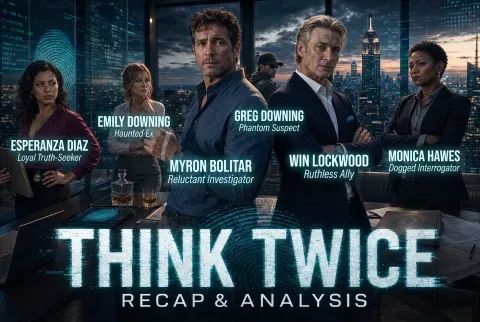
Myron Bolitar
The injured investigatorA former basketball star turned sports agent, Myron is quick-witted, competitive, and unusually willing to involve himself in other people’s crises. His legal training and past undercover work make him resourceful, while his instinct to joke often shields pain he has not examined. He values friendship and loyalty, but can mistake guilt for obligation and persistence for emotional courage. The loss of his playing career remains a defining absence, even as he builds a business and a life beyond sports. His work for the Dragons forces him to weigh ambition against truth, and to confront how old rivalries shape the stories he tells himself.
Win Lockwood
The dangerous best friendMyron’s1 college roommate and closest friend, Win is a wealthy investment banker with formidable martial-arts skill and a talent for moving through dangerous situations without visible strain. His polished manners conceal an appetite for control and a pragmatic willingness to use violence. He is fiercely protective of the very few people he loves, though emotional intimacy makes him uncomfortable. Win sees loyalty as action rather than discussion, often rescuing Myron1 before explaining the risk. Their friendship is a deep bond, but Win’s belief that force can restore balance differs sharply from Myron’s1 growing insistence that some wrongs cannot be corrected by repeating them.
Esperanza Diaz
The unflappable partnerMyron’s1 business partner, Esperanza is a former professional wrestler finishing law school, with the intelligence and discipline to keep MB SportsReps functioning while its founder disappears into danger. She handles clients, finds records, and spots weaknesses in Myron’s1 reasoning. Her bluntness is not cruelty but a form of loyalty: she refuses to let him turn guilt into noble purpose without challenge. Esperanza is protective of Myron1 and openly skeptical of Jessica4, partly because she remembers how deeply Myron1 was hurt before. Her professional competence and emotional candor make her the person most likely to connect the evidence he overlooks.
Jessica
Myron’s returning loveJessica is a novelist and Myron’s partner1, a perceptive woman who understands both his humor and the wounds he tries to hide behind it. Their relationship carries the memory of an earlier separation, so affection is joined to caution on both sides. Jessica does not treat Myron’s1 ambition as something to manage for him; she gives him room to make choices, even when those choices frighten her. Her steadiness is not passive. She can recognize when he is withholding the truth, tend to him after violence, and ask for the closeness she wants. Their relationship tests whether love can be rebuilt without pretending its earlier damage never happened.
Greg Downing
The vanished rivalGreg is a celebrated New Jersey Dragons guard, Myron’s1 former college rival, and a divorced father of two. His gifts on the court coexist with erratic habits, a dislike of celebrity, and a tendency to withdraw when pressure mounts. He values the rare understanding shared by elite competitors, but that bond is tangled with resentment and old acts neither man has openly resolved. His divorce, money problems, and private life place him under competing pressures from family, teammates, management, and criminal associates. Greg’s public charm can obscure how frightened and isolated he becomes when his carefully managed image is threatened.
Emily Downing
The embattled former wifeGreg’s estranged wife5 and Myron’s former college sweetheart1, Emily is sharp, sexually confident, and fiercely protective of her children. She approaches conflict as someone who expects to be outmaneuvered unless she acts first. The custody dispute has made her distrustful of Greg5 and willing to use tactics she would once have considered unthinkable. Her history with Myron1 gives their reunion an intimacy that complicates his investigation, but she is not simply a former lover or a grieving ex-wife. She is a mother trying to preserve her place in her children’s lives, with fear and pride often pushing her toward the same hard edge.
Audrey Wilson
The relentless sports reporterA prominent sports journalist who covers the Dragons, Audrey is ambitious, observant, and skilled at turning scraps of information into a coherent story. In a profession where women’s authority is often treated as provisional, she has built a public position through persistence and sharp instincts. She is playful with Myron1 but never loses sight of what he may be hiding. Her appetite for access gives her a complicated relationship with the players she covers: she understands their public personas while remaining alert to private contradictions. Audrey’s professional confidence makes her a compelling ally, though her desire to know can carry personal stakes she does not readily reveal.
Clip Arnstein
The Dragons’ ownerThe elderly owner of the New Jersey Dragons is a legendary basketball mind, shrewd dealmaker, and fatherly presence to players he has known for years. Clip speaks in public as a guardian of the game’s mythology, but he understands the leverage behind that mythology. He admires talent and loyalty, and he fears that a scandal could cost him both his franchise and the people he considers family. His care is real, yet his methods can become manipulative when he believes the end justifies keeping others in the dark. Myron’s1 respect for Clip makes their dealings especially difficult to judge.
Terry Collins
The guarded superstarKnown as TC, Collins is a powerful Dragons forward whose tattoos, piercings, and abrasive public manner make him an easy target for criticism. Beneath the spectacle, he is alert to the loneliness of fame and distrustful of people attracted to his money or status. He understands that a sports career can vanish with one injury, a fear that gives him an unexpected point of contact with Myron1. TC’s candidness about how he uses his public image complicates the assumption that his outrageousness is simply immaturity.
Maggie Mason
The team’s private confidanteAn investment banker known around the Dragons as Thumper, Maggie has a highly unconventional pattern of sexual relationships with professional athletes. She presents her choices as deliberate and bounded, resisting the judgment attached to women who refuse conventional romance. Her connections to players give her access to intimate team dynamics, but she guards her privacy and is quick to notice when questions have a hidden purpose. Maggie is both self-assured and more vulnerable to other people’s labels than she wishes to appear.
Leon White
Greg’s wary teammateA Dragons player and Greg’s5 longtime road roommate, Leon is often described publicly as Greg’s closest friend5, though he is wary of the way sports media packages that friendship. He is direct, proud, and protective of his marriage. Greg’s5 fame troubles him because it can make ordinary boundaries seem optional. Leon’s resentment is mixed with genuine history, leaving him neither a simple ally nor an obvious enemy. He reacts sharply when Myron1 asks about his private life, but his guardedness also gives Myron1 important context about the team’s relationships.
Calvin Johnson
The Dragons’ cool managerThe Dragons’ general manager is a former professional player who now works beneath Clip’s8 authority. Calm, polished, and difficult to read, Calvin understands the politics behind the team’s public story. He remembers Myron1 as a fierce competitor and recognizes the personal danger of putting him back in uniform. His restraint makes it hard to tell when he is protecting the organization, a player, or himself. Calvin’s knowledge of the franchise’s private negotiations gives him a crucial position between Clip8 and the team.
Martin Felder
Greg’s calculating agentFelder is Greg’s veteran sports agent5, an affable recruiter with a polished office and a strong reputation for publicity. He understands how contracts, custody disputes, and public image can become parts of one negotiation. His friendliness does not make him naïve; he listens carefully and reveals information only when he believes the exchange serves his client. Felder sees himself as an advocate rather than a parent, a distinction that shapes what he is willing to interfere with and what he leaves untouched.
Roland Dimonte
The skeptical homicide detectiveA New York homicide detective, Dimonte is blunt, theatrical, and suspicious of Myron’s1 involvement in a case that belongs to the police. He is eager to build a clean theory, but the evidence repeatedly forces him to revise it. His impatience can obscure a competent investigator’s attention to procedure, and he is willing to cooperate when Myron1 offers information that advances the case. Their relationship is an uneasy partnership between official authority and private access.
Cole Whiteman
The fugitive with a pastCole is an elusive man who has survived by changing his appearance, avoiding predictable routines, and trusting very few people. His connection to a decades-old political group gives him a history he would rather keep buried. He is intelligent and disciplined, but grief and the long strain of concealment have worn through his defenses. Cole’s account of events is valuable because he watched from a distance, though his secrecy leaves Myron1 with gaps rather than easy answers.
Burt Wesson
The former basketball enforcerBurt Wesson is the large, physical player whose collision ended Myron’s1 professional career. A former athlete who later became a high-school coach, he represents the point where Myron’s1 life divided into before and after. His role in the basketball world is built around force more than finesse, and his presence remains vivid in Myron’s1 memory long after the injury.
Big Cyndi
Esperanza’s formidable allyA former wrestling partner of Esperanza3, Big Cyndi is physically imposing, blunt in manner, and unexpectedly capable at office work. Her intimidating appearance gives way to a more playful temperament around people she trusts. She brings muscle, loyalty, and comic unpredictability into Myron’s1 business.
Al and Ellen Bolitar
Myron’s steadfast parentsMyron’s parents1 are affectionate, teasing, and quietly attentive to the adult son1 who still lives in their basement. Al supports Myron1 without turning his own athletic expectations into a burden, while Ellen’s worry can arrive wrapped in sharp humor. They know when to hover and when to leave him space. Their home preserves the history Myron1 is reluctant to revisit, but also offers a dependable place to return.
Hector
The diner’s careful ownerHector runs the Parkview Diner with his family and protects the business through hard work and close attention to its customers. Myron’s1 false official identity frightens him, but he is perceptive enough to question the story afterward. Hector’s ordinary decency gives the investigation a human cost beyond its famous players and criminals.
Plot Devices
The Comeback Cover
Gets Myron inside the teamClip8 uses a roster opening and a public comeback narrative to give Myron1 access to Greg’s teammates5. The device works because Myron’s1 former career makes his return plausible enough for the press and the locker room, while his real assignment remains secret. It also puts Myron1 back into the physical and emotional environment he has avoided since his injury. The uniform is therefore both investigative disguise and personal test: every practice and game risks awakening a genuine desire to play again.
Blood and the Baseball Bat
Makes evidence change handsThe blood in Greg’s5 children’s playroom first suggests that he has been hurt, but testing shows it is Liz Gorman’s. Someone later cleans the room, while a bloodied bat remains hidden behind the dryer. Emily6 admits planting both blood and weapon to implicate Greg5, but the investigation also shows that evidence can be altered by people trying to protect or destroy him. The clues drive police suspicion while withholding a reliable account of the murder.
The Raven Brigade’s Heist
Connects old crime to new blackmailA stolen banknote leads Myron1 and the authorities to the Raven Brigade’s Tucson robbery. The robbers had taken contents from safe-deposit boxes, and one box held evidence that Liz used to blackmail Greg5. A box rented by Burt Wesson16 ties the robbery to the cassette exposing Greg’s5 role in Myron’s1 injury. The device binds a decades-old fugitive story to the present murder investigation and transforms a financial clue into a revelation about Myron’s1 past.
Greg’s Gambling Debt
Turns a disappearance into flightGreg’s5 compulsive gambling has left him owing the B Man an enormous sum and agreeing to manipulate a game. When Greg5 fails to carry out the point-shaving arrangement, the debt escalates and criminal pressure follows him. His planned endorsement deal and cash withdrawal appear to be attempts to buy time or escape. The gambling explains why Greg5 may flee, but it also creates suspicion around his sudden disappearance and gives management a reason to conceal the truth.
Greg’s Answering Machine
Preserves clues and hidden connectionsThe answering machine at Greg’s5 home records Carla’s arrangement for a meeting, calls from his agent13 and sneaker-company contact, and a code that lets Myron1 retrieve the messages remotely. Greg’s5 email and financial records expand the trail, while a later message helps link the blackmail scheme to the people around him. The device turns a private home into a record of who was trying to reach Greg5 and when, though Myron1 must interpret each fragment without assuming that its apparent meaning is correct.
Myron Bolitar Series



About the Author
Other books by Harlan Coben








Download PDF
Download EPUB
.epub digital book format is ideal for reading ebooks on phones, tablets, and e-readers.








