

Key Takeaways
Replace failure-first experimentation with truth-seeking before costly execution
Investigate before building. The book challenges the popular instruction to fail fast and often. Its point is not that failure has no lessons, but that treating failure as a goal can make teams mistake ordinary obstacles for proof they should quit or pivot. The author cites high failure rates for enterprise innovation projects and startups, arguing that most leaders cannot afford repeated expensive attempts. The alternative is to insert a deliberate search for evidence between dreaming and execution.
HomeFellas paid for assumptions. The author's first startup helped homeowners find contractors, but he had researched the homeowner's problem and overlooked whether contractors could use the online platform. Many wanted phone-based support instead. The mismatch surfaced after money and time were spent. Earlier discovery could have exposed it before development.
The useful distinction is between learning from a failed test and celebrating failure regardless of what it teaches. A small, well-designed experiment can be a form of truth-seeking, not an invitation to fail. That distinction protects the book's strongest argument from becoming a blanket rejection of iterative methods. HomeFellas also shows why evidence must come from every essential side of a market: enthusiasm from one group cannot prove that a two-sided service works. The caution is that research cannot eliminate uncertainty. Its value lies in making assumptions visible while they are still cheap to change.
Choose the market's moment before judging the idea's brilliance
Timing changes the odds. The book calls the defining mood and demand of an era the zeitgeist. It presents a study of startups by Idealab founder Bill Gross, reporting that market timing explained about 42 percent of success in the sample, ahead of team strength at 32 percent and funding at 14 percent. These figures are presented as evidence that a strong product and capable team can still arrive too early or too late.
Read supply and demand. The framework names four conditions: Greenfield, rising demand with relatively little competition; Redfield, strong demand and strong competition; Brownfield, demand and supply still uncertain or immature; and Deadfield, falling or saturated demand with established supply. The iPhone followed early smartphone groundwork laid by General Magic, whose era lacked a ready ecosystem.
The framework is valuable because it separates an attractive idea from the conditions that let a business deliver it. General Magic's story makes ecosystem readiness concrete: a technically ambitious product may depend on infrastructure, suppliers, and customers that are not ready. Yet timing should be treated as a probability, not a verdict. Markets are difficult to forecast, and a crowded Redfield can still reward a meaningfully better experience. The practical question is not simply whether a market is early or crowded, but what observable evidence shows that demand is real and the route to customers is viable.
Treat fear as evidence to investigate, not an order to obey
Translate anxiety into questions. The author frames fear as a warning from the mind's survival system, not as proof that a plan is doomed. The proposed method is to pause, write down the specific “what if” thoughts, identify the possible loss behind each one, and estimate both likelihood and severity. For risks rated high on both, create a practical mitigation plan. A vague worry such as “What if the idea fails?” becomes a research question about whether customers have an urgent need.
Leave room to stop. If a serious risk has no workable answer, the method allows the founder to abandon that particular plan rather than force progress. It also recommends asking teammates for their concerns and revisiting risks as circumstances change.
This approach resembles a pre-mortem: a team imagines what could go wrong, then uses the imagined failure to identify preventable weaknesses. Writing fears down can also reduce the fog that makes an undefined threat feel overwhelming. The important safeguard is not to treat numerical ratings as objective truth. A likelihood score is still a judgment, and anxious people may overestimate danger while overconfident people may underestimate it. The exercise works best when scores are challenged with evidence, including perspectives from people who do not share the decision-maker's optimism.
Find the high-leverage route before you donate more hours
Effort is not the same as progress. The author argues that working longer cannot compensate indefinitely for choosing an inefficient route or the wrong goal. His 2005 drive from New York to Miami was planned as a nonstop trip to save money. Exhaustion nearly caused a crash, and a costly motel stop made the trip longer and more expensive than expected. Better planning, or flying, might have been the smarter choice.
Prioritize the leap. The book defines smart work as identifying the skills, processes, and resources that produce the most progress toward a clear goal. Its daily planning routine distinguishes a few high-value tasks, called the day's “wow factors,” from essential maintenance tasks, called “deal breakers.” Invest exceptional effort in the former and meet the latter's basic requirements.
The road-trip story works because it exposes a common mistake: measuring commitment by visible strain rather than by whether the chosen method serves the goal. Prioritization and planning are forms of resource allocation, not shortcuts around effort. Still, the claim that hard work does not pay off needs context. Some people have little control over their hours, tools, or opportunities, and better planning cannot erase those constraints. The framework is most useful when a person has meaningful choices about where to direct effort, and when the goal itself is worth pursuing.
Make one hard-to-copy feature the customer's clear reason to choose you
Name the customer value. A “wow factor,” also called a most valuable feature, is the distinctive part of a product that solves a problem customers care about strongly enough to notice and value. It is more specific than a broad market trend or a long-term vision. Google's early search product focused on quickly returning relevant results, while Yahoo expanded across many services and, according to the book, lost clarity about what it stood for. Blockbuster provides the opposite warning: a once-useful rental experience could not protect the business from the shift to streaming.
Separate delight from survival. A deal breaker is a necessary feature, such as account security, that keeps a business viable but need not delight customers. The author recommends concentrating exceptional resources on the wow factor and doing only what is required for deal breakers.
The focus on a single customer-valued feature offers a useful antidote to feature sprawl. It forces a team to explain why someone would choose its offering instead of merely listing what the product can do. The contrast between Yahoo and Google also suggests that focus is not the same as refusing to evolve: a winning feature can lose relevance as customer needs and technology change. The limit is that “hard to copy” is not always a property of the feature itself. Distribution, trust, reliability, or a wider system of complementary services may be what makes the advantage durable.
Stress-test each feature against tomorrow's customer, not yesterday's applause
Treat the idea as a hypothesis. The author calls the structured testing of ideas Test-Driven Ideation. Its central instruction is to avoid building the first idea that feels exciting. Start with a market trend and a specific vision, generate possible features, then assess each for customer value, launch timing, fit with the vision, and the team's ability to build it. The book combines those ratings into a quality-of-idea score, so a feature that is desirable but untimely or infeasible does not automatically win.
Test the reason to buy. The “why” test asks why a customer would value the feature, pay for it, and recommend it. Then take the strongest candidate to potential users before spending heavily on development. The author's consulting example describes a fundraising platform idea that had not been validated with enough potential customers.
This process turns ideation from a contest of confidence into a sequence of testable claims. Its strongest feature is that it considers more than desirability: timing, feasibility, and alignment can disqualify an idea that sounds compelling in a pitch. A score can organize discussion, but it should not create false precision. Multiplying subjective ratings may make a result look more scientific than the inputs justify. Customer interviews also need careful questions: polite approval is weaker evidence than observed behavior, a clear commitment, or willingness to pay.
Choose first customers who love it and naturally carry the story
A first customer is a group. The book's “Day 1 Customer” is a reachable customer persona, not a single lucky buyer. The right group cares about the problem, can afford the offering, and is connected enough to introduce it to others. The author illustrates this with a fictional pizza shop. Joe loves its pizza but keeps the discovery private, while Jane tells friends and tourists, helping awareness spread. The same product can therefore have very different growth potential depending on its first audience.
Measure more than excitement. The proposed Virality Score combines average passion for the feature, network strength, reachability, and affordability. The author recommends rejecting a group whose average passion is below seven out of ten, even if other factors look promising.
The pizza story makes a useful point about distribution: a satisfied customer is not automatically a referral source. Network structure and willingness to share matter, as does the practical ability to reach and serve the group. But social reach is only a starting advantage. Word of mouth can accelerate disappointment as quickly as enthusiasm if a business cannot maintain quality when demand grows. The framework is strongest when a founder treats network influence as a hypothesis to test, rather than assuming that a well-connected group will recommend a product simply because its members say they like it.
Build the most valuable product slice, not a forgettable minimum
Redefine the first product. The familiar abbreviation MVP is reinterpreted here as “Most Valuable Product,” not “Minimum Viable Product.” The product should deliver its most important customer value in each development phase, rather than launching a bare version that fails to impress or produce useful feedback. This does not mean building everything at once. It means choosing the valuable slice that demonstrates why the product deserves attention.
Make the destination visible. The book's one-page product blueprint gathers the chosen market trend, a clear vision, the Day 1 Customer profile, market size and revenue aims, up to three wow factors, essential deal breakers, and major fears with mitigation plans. The document is meant to keep a team aligned on what it is building, why it matters, and for whom.
The reframing challenges teams to ask whether an early release teaches customers anything meaningful or merely exposes incompleteness. A narrow product can still be valuable if it delivers a complete, compelling benefit to a specific user. That is a more useful distinction than “minimum” versus “maximum.” The book's position should not be read as a case against small releases: a limited release can reduce risk, provided it tests the right value proposition. The one-page blueprint helps prevent a different failure, where teams build efficiently but lose sight of the customer or purpose.
Raise money against proof, and ask before the runway disappears
Evidence attracts capital. The author argues that money cannot rescue a weak business idea, but running out of it can end a promising one. For seed investors, the strongest evidence is sales; if sales are not yet available, paid pilots, letters of intent, product-market evidence, and detailed customer knowledge can help establish demand. A founder should also explain the plan, the use of funds, and the route to revenue.
Match funding to stage. The book distinguishes pre-seed funding for prototypes and customer research, seed funding for a working prototype and early validation, and growth capital for businesses with established product-market fit and sustained revenue. It recommends planning roughly eighteen months of seed-stage runway, allowing time to execute and pursue the next funding round rather than beginning fundraising only when cash is nearly gone.
The central lesson is that fundraising is a credibility exercise as much as a capital search. Investors need to understand what uncertainty their money will resolve and what evidence should exist afterward. The staged approach helps founders avoid treating every round as a generic request for cash. Still, a revenue-first standard can disadvantage products with long development cycles, especially in deep technology. In those cases, credible technical milestones and customer commitments may be the more relevant proof. The useful discipline is to tie the amount raised to a specific, believable next milestone.
Keep a small, skilled team energized by visible ownership and weekly wins
Build the core before scaling. The book calls the early, compact group responsible for delivering the vision the Most Valuable Team. It suggests roughly three people as a useful early size, with startups generally keeping this core to five or fewer. Members need strong foundational skills, a willingness to learn, and enough alignment between their own aims and the work's purpose. The author favors leaving a role open over hiring someone who is not a sound fit.
Make progress observable. The proposed “burn-on” approach uses weekly development cycles, demonstrations of completed work, and goals that are specific, measurable, achievable, relevant, time-bound, and stretching. Ownership and rewards should reflect meaningful contributions, not merely tenure. The intent is to help capable people sustain momentum without letting activity masquerade as progress.
Small teams can shorten communication paths and make responsibility easier to see, while regular demonstrations expose gaps sooner than status reports alone. The emphasis on skill fit and shared purpose also recognizes that resilience is partly a design problem, not just a matter of individual toughness. The caution is that a weekly cadence and stretch goals can become pressure machines if teams lack recovery time or if rewards favor visible output over careful work. A durable team needs both accountability and a credible pace. Speed is useful only when people can maintain the quality of their decisions.
Analysis
The book's central argument is a change in the sequence of innovation. Rather than begin with execution and treat failure as an expected price of progress, it asks founders to reduce avoidable waste before committing their scarce time, capital, and credibility. Its sequence moves from market conditions to vision, customer-valued feature, first audience, product, funding, and team. That order is the book's most coherent contribution: it connects strategy to daily execution instead of treating them as separate leadership problems. Its examples make the argument memorable because they contrast potential with readiness. General Magic had technical imagination but lacked a supportive market ecosystem; the iPhone arrived when infrastructure and manufacturing conditions were more favorable. HomeFellas demonstrates a different blind spot: demand from one side of a marketplace does not validate the other. The pizza story translates network effects into a vivid distinction between a delighted customer and a customer who helps others discover the product.
The book's strongest practical tools are its insistence on naming assumptions, testing customer value before development, and reserving disproportionate effort for the feature that distinguishes the offering. Its market categories, scoring systems, and equations are best understood as prompts for disciplined discussion, not reliable forecasts. Subjective judgments about demand, timing, and virality cannot become objective merely by assigning numbers. Nor can planning eliminate the structural constraints that limit many founders' choices.
That qualification strengthens rather than weakens the core thesis. “Succeed faster” is most persuasive when it means improving the quality of decisions and shortening the distance between a consequential assumption and evidence about it. It is less persuasive if interpreted as a guarantee that careful founders can control outcomes. The book's practical promise is narrower and more defensible: do not spend heavily before understanding what customers need, why they would choose the product, and whether the conditions exist to deliver it.
Review Summary
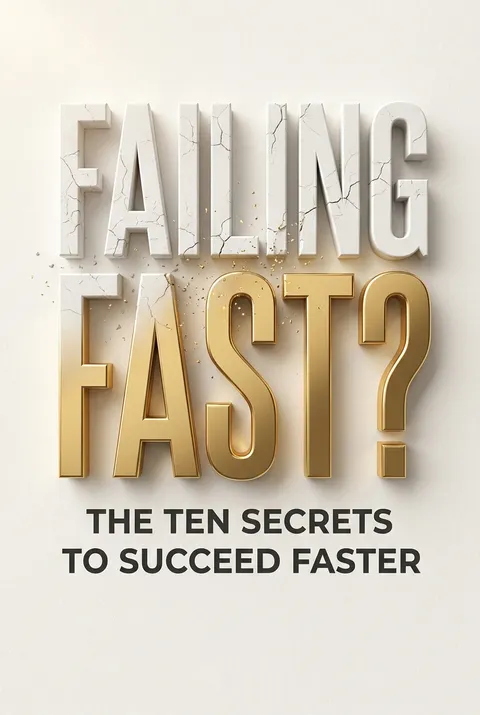
"Failing Fast?" receives mostly positive reviews, with readers praising its practical advice, personal anecdotes, and insights on innovation and success in the AI era. Many find the book engaging and valuable for leaders, entrepreneurs, and professionals. Readers appreciate the actionable strategies, case studies, and tools provided. Some criticize the book's length and occasional verbosity. Overall, reviewers commend the author's expertise and the book's relevance to modern business challenges, though a few find it average or overly detailed.
People Also Read

Glossary
Zeitgeist
Era's defining market moodThe book uses zeitgeist to mean the dominant mood, beliefs, and market conditions of a historical period. In business, tapping into it means offering something that answers a growing need when customers, technology, suppliers, and distribution channels are ready. The concept emphasizes timing as well as the quality of an idea.
Greenfield, Redfield, Brownfield, and Deadfield
Four market timing conditionsThese labels describe the book's market timing categories. Greenfield has rising or high demand and relatively low competition. Redfield has strong demand and strong competition, offering room for a distinctive disruptor. Brownfield describes an immature or uncertain market, often with an unready ecosystem. Deadfield describes saturated or declining demand with substantial existing supply.
Zeitgeist Predictive Model
Market timing assessmentA framework for assessing whether an idea's market conditions justify further work. It compares demand and supply to place an idea among the market timing categories, then considers factors such as problem urgency and the ability to compete. The author presents it as a way to reason about probabilities, not as a guarantee of success.
Wow Factor
Distinctive customer-valued featureThe specific feature or benefit that makes customers choose and value a product or service. The book treats it as the most valuable feature, one that addresses an important customer problem in a distinctive way. It must fit the chosen market and vision, and should be tested before substantial development begins.
Test-Driven Ideation
Evidence-led idea filteringThe book's process for evaluating ideas before building them. Candidate features are treated as hypotheses and assessed for customer value, timing, alignment with the vision, and feasibility for the team. The strongest candidates are then tested with prospective customers. Its purpose is to make changes while they are still less costly.
Day 1 Customer
Initial target customer groupThe specific persona or group a business serves when it first enters the market. The book recommends choosing people who value the feature, can afford it, are reachable, and have networks through which they may share it. A Day 1 Customer is not the entire eventual market, but a focused starting audience.
Virality Score
First-customer growth estimateA proposed score for comparing possible Day 1 Customer groups. It combines average enthusiasm for the feature with the group's network strength, reachability, and affordability. The book uses the score to encourage founders to assess whether an initial customer group can help spread awareness, while noting that customer interest still needs validation.
Most Valuable Product (MVP)
Product's highest-value sliceThe author's redefinition of MVP from “Minimum Viable Product” to “Most Valuable Product.” It calls for delivering the product's most meaningful customer value in each development phase, rather than launching a bare version with little reason to attract attention. The concept favors focused value, not building every feature at once.
Most Valuable Team
Compact core delivery teamThe small group of people whose complementary skills are essential to delivering the company's vision. The book recommends a compact early team with strong foundational capabilities, commitment to the mission, and the ability to learn. This core team is expected to demonstrate productivity before expanding its functions through additional hiring.
Burn-On Team
Sustainable high-performing teamThe book's term for a team designed to maintain motivation and effectiveness through demanding work rather than becoming exhausted or disengaged. Its practices include clear shared purpose, careful hiring, short work cycles, demonstrations of completed work, meaningful ownership, and goals tied to measurable contributions.
SMARTS
Structured goal-setting methodAn acronym for goals that are Specific, Measurable, Achievable, Relevant, Time-Bound, and Stretching. The book applies it to team objectives so each person understands the intended result, how progress will be judged, why the work matters, and when it is due. Stretching goals should challenge people without becoming unattainable.
Download PDF
Download EPUB
.epub digital book format is ideal for reading ebooks on phones, tablets, and e-readers.








