

Key Takeaways
Grief does not restore your old self; it can enlarge the life that remains.
Loss changes the person. After Nick Cave’s son Arthur died, grief did not feel like a lesson or a temporary sadness. It was a physical and mental upheaval that made ordinary tasks difficult and left time and memory fractured. Cave describes coming through not as returning to who he was, but as becoming someone altered, more alert to other people’s vulnerability and to the beauty of ordinary life. His wife, Susie, also found a way back, though grief remained part of their lives.
There is no clean ending. Cave resists the language of closure. He describes happiness returning alongside sorrow, and small acts of kindness helping him reconnect with the world. This is a personal account, not a timetable or promise that every bereaved person will experience grief in the same way.
What's striking is the rejection of recovery as a return to baseline. Bereavement scholarship increasingly recognizes that an ongoing inner relationship with someone who has died can coexist with adaptation, rather than signal failure to move on. Cave’s account gives that continuing bond a creative and spiritual form. Still, his hope should not be turned into a demand that grief produce growth. Some losses remain disabling, and a survivor’s changed life need not be brighter to be real. The humane insight is that grief can alter identity without making the bereaved person reducible to the loss.
Treat belief as a practice of hope, not a test you must pass.
Faith can begin in doubt. Cave is drawn to Christianity, scripture, and ritual, yet he distrusts rigid certainty. He describes belief as a willingness to live toward the possibility of God, even without proof. In Narcotics Anonymous, he saw people asked to rely on a higher power, which could mean something larger than the self. For some, that practice helped them get clean before they had settled what they believed.
Use is not proof. Cave calls a belief “true enough” when it cannot be empirically verified but brings a practical benefit, such as comfort, connection, or a better way of living. He sees prayer, meditation, and religious community as resources that eased his return to life after Arthur’s death. Their value, for him, does not settle the question of whether God exists.
This is close to philosophical pragmatism: a belief can be assessed partly by what it enables people to do and how it shapes their lives. That perspective makes room for ritual without requiring certainty, a useful alternative to both dogmatism and dismissive skepticism. The necessary distinction is between a belief’s usefulness and its truth. A practice may support recovery without proving its metaphysical claims. Cave’s strongest point is less that everyone should believe than that a person need not wait for certainty before exploring practices that bring care, humility, or steadiness.
Let images arrive before explanations, then work until their meaning earns trust.
Begin with what you see. Cave increasingly builds songs from vivid images rather than from a plot or a message. Before making Ghosteen, he imagined a beach filled with frightened animals, fire, and children rising skyward. Those pictures became the record’s imaginative framework, with images recurring across songs and changing their meaning in each setting.
The ordinary can carry catastrophe. One central image in Ghosteen is Susie at the kitchen table, listening to the radio. It was Cave’s last peaceful memory of her before the news that Arthur had died. The scene is mundane, but its place in his life gives it extraordinary emotional weight. Cave describes writing images before fully understanding them, then discovering what they mean through the work. He trusts a line when it feels emotionally honest, not merely clever.
Images can hold emotional information before a person can explain it. That is especially plausible when experience is too complex for a neat story: a concrete scene can preserve its sensory force while leaving interpretation open. Cave’s process treats ambiguity as a working space, not as permission for meaninglessness. The caution is that bodily intensity or vividness cannot, by itself, certify an image as true. Artists still have to test what they make against experience, context, and craft. The value lies in letting intuition propose material, then bringing judgment to its interpretation.
Prepare deeply, then surrender control where collaboration can reveal the unexpected.
Improvisation needs experience. Cave and musician Warren Ellis developed songs by playing for long stretches, collecting fragments, and shaping them into finished pieces. Cave arrived with written lyrics, images, and themes, while Ellis listened for musical possibilities. Their method, which Cave calls “informed accidents,” means allowing unpredictable outcomes inside a practiced, trusting collaboration. It is not simply improvising without preparation.
A mistake can become form. In “I Need You,” the vocal and music do not settle neatly into the same rhythmic pattern. Rather than correcting the mismatch, the collaborators kept the tension because it gave the song emotional force. In “Spinning Song,” pieces made at different moments were assembled into a sequence that moved from folktale toward a personal declaration. Neither outcome was fully planned in advance.
This process resembles research on group creativity: novelty often emerges when people with different skills share material, respond to one another, and have enough trust to tolerate unresolved work. Preparation supplies a common vocabulary; surrender lets the group discover options no individual planned. The method is not universally effective. Improvisation can produce noise, and a strong partnership cannot be manufactured by simply adopting an open-ended process. Cave’s example is useful because it shows both halves of the equation: accumulated expertise and a willingness to let the first idea be disrupted.
Give grief a language, but don't mistake silence for lack of love.
Speaking can make room. After Arthur died, Cave began answering readers’ questions through The Red Hand Files, an online project where he personally reads submissions and responds publicly. Many people wrote about losses of their own. He found that telling a story and having someone genuinely listen could make suffering less solitary, even when no answer could repair it.
Words are not the only language. Cave remembers a worker at a Brighton takeaway shop squeezing his hand during his first outing after the death. The quiet gesture communicated care more clearly than a speech could. He also describes a bereaved mother’s poem about her son’s death as brave because it brought the reader close to the shock itself. Such exchanges helped him find language for grief, but his examples include listening and touch, not just explanation.
Narrative disclosure can help people organize experience and feel recognized, while attentive listening signals that the story is bearable to hear. Cave’s examples make an important distinction: support is not always advice. Sometimes the most useful response is presence, a careful question, or a gesture that does not demand a polished account. Public sharing is not right for everyone, however, and disclosure can expose people to unwanted attention or leave them feeling raw. The deeper principle is consentful connection: offer space for someone’s story without treating speech as a cure or a requirement.
Anchor grief's chaos with repeatable actions, not demands to feel better.
Action can come first. In the period after Arthur’s death, Cave could not reliably think, remember, or write. He recalls insisting that he and Ellis work on music soon after the loss, then struggling through later recording sessions in a state of exhaustion and despair. The work did not make him feel well. It gave the day something to hold on to.
Small routines preserve contact with life. Cave describes meditation, exercise, meals, caring for family, and making things as ways to maintain some structure. Susie returned to designing clothes, while Cave found steadiness in work and, at times, in being with a dog at the studio. He emphasizes that neither partner was simply strong. They survived by remaining connected and taking turns supporting each other.
This resembles behavioral activation, a therapeutic approach that uses manageable activity to interrupt withdrawal and restore contact with daily life. The point is not to earn recovery through productivity; action can provide scaffolding while feelings remain chaotic. Cave’s account is especially useful because it refuses the heroic version of resilience. Work sometimes gave him a reason to continue, but it also coexisted with collapse and self-reproach. Routines should be supports, not tests. If someone cannot work or maintain ordinary habits, that is not evidence of a failure to grieve properly.
Make art accountable to other people, not just the artist's ego.
A performance is shared. Cave describes live music as a meeting between musicians and audience, where people can experience collective attention and emotional release. After Arthur’s death, the audience’s care during the Skeleton Tree tour helped him perform through a period when he doubted he could go onstage. He came to see that exchange as more than entertainment: listeners brought their own needs and histories to the songs.
The work changes hands. Cave believes songs matter partly because they can offer solace or connection to listeners. Once released, a song is no longer solely the artist’s possession; the audience gives it new meanings. He also warns himself that creative gifts should not exist only for personal acclaim. The artist’s responsibility is to make something with care and let other people participate in what it becomes.
The shared intensity of a concert recalls what sociologists call collective effervescence, the feeling of belonging produced when people attend to the same event together. Music can create a temporary community without requiring agreement about doctrine or identity. That is a real social function, even if its effects are difficult to measure after the audience leaves. Cave’s larger claim, that music can make people better, is harder to establish. A moving performance may open a possibility for empathy, but it cannot guarantee lasting moral change. Its value can be meaningful without being permanent.
Protect creative change from nostalgia, markets, and recycled ideas.
Familiar can masquerade as new. Cave calls an “astonishing idea” a fresh possibility that emerges after the easy, familiar material has been used up. A “residual idea” is an appealing leftover from earlier work that feels comfortable because it is already known. When he begins a record, the first lines may seem promising, but he tries not to mistake that initial ease for discovery.
Risk may cost an audience. Some longtime fans wanted the Bad Seeds to return to earlier styles. Cave understood the attachment but did not want nostalgia, commercial expectations, or fear of losing listeners to dictate the music. Ghosteen’s fractured structure was a departure from conventional storytelling, and early online reactions were hostile. He kept moving toward the unfamiliar rather than reproducing a previous success.
Creative fields reward both recognition and surprise. Familiar forms help audiences enter a work, while genuine change can deepen attention and keep an artist from becoming a copy of their own past. Cave’s distinction between a fresh idea and a leftover one is a practical way to notice when comfort is steering the work. But novelty alone is not artistic progress. Tradition can be chosen deliberately, and audiences are not merely obstacles. The stronger standard is whether a form serves the work’s real purpose, rather than whether it is new or marketable.
Order the workspace so the mind can risk disorder.
Structure can protect freedom. When the pandemic cancelled Cave’s tour, he was first shaken because performing had become part of how he understood himself. Relief soon followed: he could stay home, read, and spend ordinary time with Susie and his children. The pause exposed how much touring had crowded out domestic life, even though the concerts mattered deeply to him.
Chaos is not a requirement. Cave once treated personal disorder as part of an artist’s identity. He later concluded that addiction and damaged relationships were not necessary prices for good work. A disciplined workplace and a small, capable team gave him room to experiment without letting every practical problem become a crisis. The freedom was not freedom from effort. It was freedom to take creative risks without needing life itself to be unstable.
The romantic image of the artist thriving on chaos confuses intensity with conditions for good work. Reliable routines, competent collaborators, and protected time reduce practical friction, leaving attention available for experimentation. Cave’s pandemic pause shows that a lost opportunity can reveal an unnoticed cost: a touring identity had made absence feel normal. Still, structure must serve a life rather than become another productivity regime. The relevant question is not whether a person should work less or more, but whether the arrangement leaves enough room for relationships, rest, and the kind of uncertainty that creative work requires.
Turn regret into living amends instead of asking the past to change.
Regret asks for a response. Cave apologized to longtime collaborator Mick Harvey for how he behaved around the end of their working relationship. He also describes a larger effort to address regret through what he calls “living amends”: using one’s abilities and daily actions to put something valuable into the world, including in memory of people who are gone.
Art became a plea. Cave made eighteen ceramic figures tracing a life of wrongdoing and suffering, ending with a child offering forgiveness to the dead figure. He came to understand the work, along with songs and public conversations, as a request for absolution connected to his feelings of responsibility after Arthur’s death. That feeling is not proof of culpability. For Cave, making art offered a way to face it and seek peace, not to undo the loss.
The idea of living amends extends accountability beyond apology: when direct repair is impossible, conduct can still honor what was damaged or what mattered. Creative work can give regret a shape, making it possible to examine rather than evade. Yet symbolic repair should not substitute for practical restitution when a living person can be approached. Nor should bereaved parents be encouraged to treat tragedy as evidence of guilt. Cave’s art is powerful partly because it shows how self-forgiveness can be sought without pretending that sorrow has been settled or that the past can be reversed.
Analysis
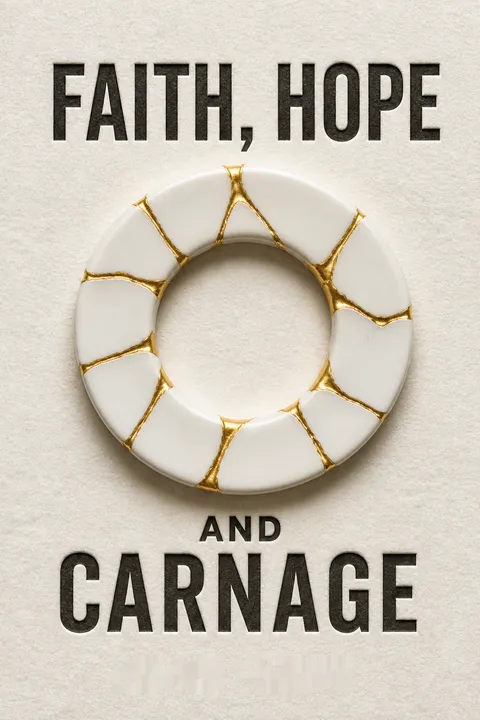
Faith, Hope and Carnage is a long conversation rather than a conventional argument. Its narrative moves through a public artist’s life after catastrophic loss, but the center is not a tidy account of recovery. It is the gradual discovery that grief, belief, artistic work, and responsibility cannot be separated cleanly. Cave’s son Arthur is an explicit subject at points and an unspoken presence elsewhere, shaping how Cave thinks about songs, marriage, audience, memory, and God.
The book’s most distinctive tension is epistemic. Cave makes room for spiritual presence and poetic truth while acknowledging that rational skepticism has the stronger public case. He does not resolve the conflict. Instead, he asks what forms of belief, ritual, and attention make possible in a life. This is an existential argument, not evidence that spiritual claims are objectively true. Its force comes from showing why strict proof may not exhaust the human need for meaning.
The creative story is equally nuanced. Cave’s movement from linear storytelling toward imagery and improvisation is not presented as a recipe. It depends on years of practice, a rare partnership with Warren Ellis, and the willingness to discard cherished ideas. The book gives artistic uncertainty a practical shape: prepare, collaborate, tolerate discomfort, and listen for what the work is becoming. It also rejects the familiar myth that suffering or addiction is the price of art.
Cave’s public exchanges with readers widen the book beyond memoir. Listening becomes a form of service, and music becomes relational rather than merely expressive. That account is compelling, but it reflects an unusually privileged artist with an audience, collaborators, and resources. It should not be mistaken for a universal model of grief support. The enduring contribution is more modest and more credible: a life can remain marked by loss while still making room for love, work, doubt, and other people.
Review Summary
Faith, Hope and Carnage receives overwhelmingly positive reviews, praised for its candid exploration of grief, creativity, and spirituality. Readers appreciate Cave's vulnerability and eloquence in discussing the loss of his son and his creative process. Many find the book deeply moving and insightful, with Cave's reflections on faith and art resonating strongly. The interview format is generally well-received, though some find it repetitive. Critics commend the book's literary quality and its ability to inspire and comfort readers, even those unfamiliar with Cave's music.
Glossary
true enough
Useful belief without proofCave’s phrase for a belief that may not be empirically demonstrable but can still have practical value. He uses recovery groups’ appeal to a higher power as an example: a person may begin acting as if such a power exists and find that the practice supports sobriety or a more grounded life. Its usefulness does not establish that the belief is literally true.
imaginal realm
Liminal spiritual awarenessA term Cave borrows from religious writer Cynthia Bourgeault for a mode of awareness he sees as distinct from ordinary reasoning and from deliberate fantasy. He describes it as a threshold space where images or intimations of spiritual reality may appear. Cave believes this space helped him feel close to Arthur, while acknowledging that such experiences are difficult to prove.
informed accidents
Prepared creative unpredictabilityCave’s description of improvisation conducted by experienced collaborators who share musical understanding and trust. The musicians prepare, bring knowledge and intention, and then allow unexpected sounds or mistakes to shape the result. The term distinguishes purposeful openness from simply making music without skill, context, or attention.
residual idea
Familiar leftover materialAn idea that remains from earlier creative work and feels promising because it is already familiar. Cave warns that such material can be mistaken for a genuinely new direction, particularly at the start of a project. Clearing away these leftovers makes room for ideas that may feel more uncomfortable and less predictable.
astonishing idea
A genuinely new creative insightCave’s name for a creative idea that feels newly discovered rather than comfortably recycled. He associates it with patience, uncertainty, and the willingness to stay with a project before its direction becomes clear. The idea is not guaranteed to arrive, and the phrase describes a hoped-for moment of discovery, not a repeatable formula.
living amends
Repair through daily actionCave’s term for responding to regret by living in a way that contributes something good, especially when the person one wishes to address is no longer available. It can include creative work, service, or changed conduct. Such actions may help someone seek forgiveness or make meaning, but they cannot replace direct repair when that remains possible.
The Red Hand Files
Public reader question projectCave’s online project in which readers send him questions and personal accounts, and he publishes selected responses. He describes reading submissions as an exercise in attentive listening, not merely a chance to give advice. The project grew into a space where people discuss grief, loneliness, and other matters beyond music.
The impossible realm
Life altered by griefCave’s phrase for the disorienting state he entered after Arthur’s death, when ordinary assumptions and rational explanations no longer seemed sufficient. He associates it with acute vulnerability, a sense of closeness to the dead, and heightened openness to spiritual possibilities. The phrase names his experience, not a claim that bereavement grants objective access to another world.
FAQ
What's Faith, Hope and Carnage about?
- Conversations with Nick Cave: The book is a series of dialogues between Nick Cave and journalist Seán O'Hagan, offering insights into Cave's life and thoughts.
- Themes of Grief and Loss: It focuses heavily on the impact of the death of Cave's son, Arthur, and how this tragedy has influenced his music and worldview.
- Artistic Process: The discussions explore Cave's songwriting, collaborations, and how personal experiences shape his creative output.
Why should I read Faith, Hope and Carnage?
- Insight into Nick Cave: Readers gain a deeper understanding of Cave as both an artist and a person, including his struggles and triumphs.
- Exploration of Universal Themes: The book addresses themes of grief, love, and the search for meaning, resonating with many readers.
- Unique Perspective on Creativity: Cave shares his artistic philosophy and the transformative power of music, valuable for aspiring artists and fans alike.
What are the key takeaways of Faith, Hope and Carnage?
- Embracing Vulnerability: Cave emphasizes the importance of vulnerability in life and art, suggesting creativity often arises from personal struggle.
- The Role of Grief: The book illustrates how grief can lead to personal growth and deeper connections with others.
- Spiritual Exploration: Cave discusses his evolving relationship with spirituality and how it informs his music, suggesting belief can coexist with doubt.
What are the best quotes from Faith, Hope and Carnage and what do they mean?
- “The creative process is not a part of one’s life but life itself.”: Creativity is intertwined with personal experiences, reflecting one's life journey.
- “Grief can have a chastening effect.”: Experiencing loss can lead to greater empathy and understanding, transforming one's perspective on life.
- “Hope is optimism with a broken heart.”: This captures the duality of hope and despair, suggesting that hope persists even amidst suffering.
How does Nick Cave describe his songwriting process in Faith, Hope and Carnage?
- Improvisational Approach: Cave collaborates with Warren Ellis, using improvisation to allow spontaneous and organic song development.
- Emotional Connection: His experiences, particularly grief, deeply influence his lyrics and melodies.
- Struggle with Self-Doubt: Despite success, Cave faces self-doubt and anxiety when starting new projects, viewing it as a necessary creative process.
What role does grief play in Nick Cave's life and work?
- Catalyst for Change: The death of his son Arthur reshaped Cave's understanding of life, love, and creativity.
- Source of Empathy: Grief has fostered deeper empathy, allowing Cave to connect more profoundly with his audience.
- Inspiration for Music: His recent works, including Ghosteen, are infused with themes of loss and longing, reflecting his journey through grief.
How does Nick Cave view spirituality in Faith, Hope and Carnage?
- Complex Relationship: Cave describes his spirituality as evolving, marked by both belief and doubt, emphasizing the importance of questioning in faith.
- Art as a Spiritual Practice: He sees music and songwriting as a means of connecting with the divine, suggesting creativity can serve as worship.
- Collective Experience: Cave believes shared experiences of music create a sense of community and connection to something greater.
How does Faith, Hope and Carnage address the theme of forgiveness?
- Forgiveness as a Central Theme: Cave discusses the need for forgiveness, both for oneself and others, as crucial for healing from grief.
- Art as a Path to Forgiveness: Creating art can be a way to seek absolution for past mistakes, confronting feelings of guilt and regret.
- Personal Reflections on Forgiveness: Cave shares his struggles with forgiveness in the context of his son's death, articulating the complexity of these feelings.
What insights does Faith, Hope and Carnage provide about the impact of loss on relationships?
- Strain on Personal Relationships: Cave candidly discusses how grief can strain relationships, particularly with loved ones.
- Mutual Support in Grief: He emphasizes the importance of supporting one another through grief, sharing how he and his wife, Susie, have leaned on each other.
- Transformative Nature of Shared Suffering: Shared experiences of loss can deepen relationships, fostering greater understanding and intimacy.
How does Faith, Hope and Carnage reflect on the concept of hope?
- Hope Amidst Despair: Hope is presented as a vital force that can coexist with grief, offering the possibility for renewal and optimism.
- Hope as a Collective Experience: Cave discusses how hope can be shared, particularly in community contexts, uplifting individuals and fostering resilience.
- Personal Journey of Hope: Cave reflects on his journey towards finding hope after loss, sharing how his understanding of hope has evolved.
What does Nick Cave mean by the "deceiving idea" in Faith, Hope and Carnage?
- Concept of the Deceiving Idea: Cave describes initial creative impulses that seem promising but lack depth, warning against being seduced by them.
- Importance of Patience in Creativity: He emphasizes patience in the creative process, allowing ideas to develop fully before committing.
- Navigating Creative Risks: Cave discusses the importance of taking creative risks, avoiding the comfort of familiar ideas for true artistic growth.
How does Nick Cave describe his relationship with his wife, Susie, in Faith, Hope and Carnage?
- Creative Partnership: Cave views Susie as both a life partner and collaborator, influencing his work and providing emotional support.
- Mutual Inspiration: Their relationship is characterized by shared creative energy, drawing inspiration from each other's work.
- Navigating Grief Together: They process their grief over Arthur's death through creative outlets, finding strength and resilience in their partnership.
Download PDF
Download EPUB
.epub digital book format is ideal for reading ebooks on phones, tablets, and e-readers.








