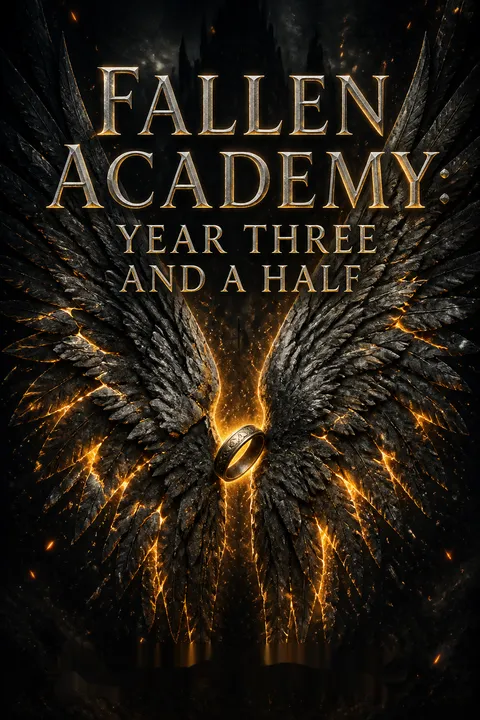


Plot Summary
A Captain's Celebration Turns Bloody
At Lincoln Grey’s captain-promotion ceremony, the Devil, Lucifer, tears open the ground, slits Lincoln’s fiancée Brielle’s throat, and drags her through a portal. Lincoln’s wings are already broken, so Brielle’s best friend Shea, a gifted portal mage, tries to open a path after her. A magical barrier shuts down Shea’s power.
Lincoln carries her beyond Angel City’s boundary into demon territory, where the stronger demon energy lets her use dark magic. When Shea enters Hell alone with the archangel Michael’s sword, she finds no sign of Brielle and kills a demon that attacks her. Lincoln can only watch from the other side. He collapses, convinced that Brielle is dead and that he has failed to protect the person he loves most.
The attack turns a public milestone into a scene of helplessness: Lincoln has earned authority, but none of it can reach Brielle across the portal. His broken wings make his body a limit rather than an instrument of rescue, while Shea’s dark magic shows that loyalty may demand crossing rules others cannot. The failed search gives grief an immediate physical shape. Lincoln is not simply mourning; he is trapped outside the place where he believes his fiancée is suffering, and that exclusion will drive the increasingly dangerous choices that follow.
The Funeral Without a Body
Lincoln wakes in the healing unit beside Shea and his friend Noah, a healer, and learns that the attack was real. Archangel Raphael organizes repeated searches of Hell, but the teams find no trace of Brielle and lose soldiers. Lincoln and Shea keep opening portals on their own, while Lincoln’s grief drives him toward alcohol and isolation.
Three months after the abduction, Brielle’s mother, Kate, arranges a funeral despite having no body. She explains that she needs a ritual to keep living for her family, but Lincoln cannot accept that kind of closure. When Raphael urges him to move forward, Lincoln flies away rather than stand beside Brielle’s empty grave. His refusal leaves the search unfinished, but his despair deepens.
The funeral separates two kinds of survival. Kate needs a ritual that acknowledges uncertainty without surrendering to it; Lincoln experiences the same ritual as a verdict that makes Brielle’s absence permanent. Their disagreement is not a lack of love but a difference in what grief requires from each of them. By fleeing the grave, Lincoln preserves hope, yet also turns hope into an obligation: if he stops searching, he fears he will have abandoned Brielle. The scene sets up the cost of that bargain, as his loyalty narrows into self-neglect.
A Ring Tugs Toward Hell
Shea uses Lincoln’s unworn wedding ring, made from the same metal as Brielle’s promise ring, to create a magical tether between them. For a brief moment, the connection carries Brielle’s voice, confirming that she may still be alive. Then someone blocks the link, leaving no location and no way to repeat the contact.
Lincoln believes Shea, though the news offers hope without a path forward. Rather than risk Shea in another reckless search, he decides to act alone. He takes his savings, enters Demon City despite the pain its demonic energy causes him, and seeks Gaf, a Mugwort demon who sells dangerous information. When Gaf demands more than money for a trip into Hell, Lincoln agrees to fight for him.
The ring converts an intimate promise into a fragile instrument of evidence. Its power matters because it answers Lincoln’s central uncertainty, but only for an instant; the blocked connection preserves hope while denying the comfort of proof. Lincoln’s decision to go alone shows how quickly hope can become compulsion. He wants to spare Shea, yet also refuses the risks that a shared search would require him to negotiate. The chapter’s emotional logic is therefore double-edged: the tether restores purpose, but it sends Lincoln deeper into danger before he has recovered enough to choose safely.
The Necklace From Below
Lincoln fights a demon-human Legion in Gaf’s underground ring, weakened by the demonic energy and already burning from his opponent’s fire magic. When the Legion falls, Lincoln kills him rather than accept the alternative of losing the fight and the information he needs.
The choice leaves him disturbed by what desperation has made him do. Gaf later returns from Hell with Brielle’s silver necklace and a trader’s account that she may have been dead when her body was taken underground.
With no location to pursue, Lincoln spirals into a suicide attempt, hoping death might let him search for her. Raphael intervenes, heals him, and explains that suicide would not send him to Hell. He leaves Lincoln alive with scars and urges him to endure the separation.
The fight marks a moral injury, not just a tactical victory: Lincoln sacrifices the compassion he associates with his former self because information about Brielle seems worth any price. The necklace then transforms uncertainty into something tangible, but its provenance is ambiguous enough to intensify rather than settle his fear. Lincoln’s attempt to reach Hell through death reveals the collapse of his distinction between devotion and self-erasure. Raphael’s intervention restores a boundary, insisting that love cannot be proven by destroying the person who feels it. The scars preserve the crisis as memory rather than allowing it to vanish into denial.
A New Name in San Francisco
After months of trying to resume his old life, Lincoln leaves Angel City to join the Fallen Resistance, which rescues people from San Francisco’s trafficking network. His friend Noah tries to stop him, but Lincoln drives away after their argument turns physical.
At the resistance safe house, General Stiger assigns him a partner: Catia, a mage whose younger sister was trafficked and killed. They enter the demon-controlled city under false identities as Tray Fox and Cat, posing as a couple.
Catia supplies a potion that lets Lincoln imitate basic magic, and they survive a week of surveillance in temporary housing. Their inside contact, James Willow, explains how brokers gain access to captives and reveals the price of trust: Lincoln must make one real sale before he can secretly smuggle others to safety.
The resistance gives Lincoln an outward purpose at the moment his private purpose has become unbearable. Yet the mission is not a clean replacement for grief: he measures rescue as a way to atone for failing Brielle. Catia complicates that pattern because she carries her own bereavement and refuses to be reduced to Lincoln’s companion or conscience. Their false romance requires performance, but their shared losses create genuine trust. James’s demand that Lincoln sacrifice one captive to save many introduces the novel’s sharpest ethical trap: a system that rewards complicity makes even resistance depend on reproducing its violence.
Broker of the Captives
James takes Lincoln to meet Marx, an Abrus demon who controls the city’s trafficking brokers. To test whether Lincoln is a Celestial, Marx cuts his arm and watches for the rapid healing that would expose him.
Lincoln uses his own healing magic to keep the wound open, convincing Marx that he is an ordinary mage and earning a place as a broker. The job gives him access to the people being sold, but it forces him to catalogue them and arrange transactions while hiding his real purpose.
Catia, meanwhile, works as a cocktail waitress and waits for a chance to enter the operation. When Lincoln learns that his first genuine sale must go to a real buyer, he and Catia confront the cost of building trust inside a business that treats children as merchandise.
Marx’s test makes Lincoln’s body the first thing he must disguise. The wound is both proof of his nature and an opportunity to turn a gift for healing into an act of concealment. Passing the test gives him access, but access is morally compromised: the broker role asks him to become legible to an abusive system by imitating its values. His power is therefore useful only when carefully withheld or redirected. The scene also sharpens the contrast between institutional success and ethical success. Lincoln can rise within Marx’s organization only by making others believe he belongs there.
Catia Boards the Slave Jet
Lincoln’s first real captive is a fifteen-year-old girl, and Catia refuses to accept that her life must be the price of later rescues. She disguises herself as a flight attendant on the girl’s private jet to Paris, where she intends to get the teenager to safety at the Paris Fallen Academy.
Before leaving, Catia tells Lincoln that a glimpse from her possible Sighted ability suggests Brielle is alive. Her warning gives Lincoln a reason to keep fighting, though Catia’s departure leaves him alone in the city.
He continues brokering secretly and later counts seventeen women and children he has smuggled to Angel City. Catia’s plan saves the girl, but her absence makes Lincoln more vulnerable when Marx discovers that their contact James belonged to the resistance.
Catia rejects the arithmetic that Lincoln has accepted: one person sacrificed now for many saved later. Her decision carries real risk, but it arises from the same concrete wound that drives Lincoln, the loss of a sister to trafficking. Her apparent vision also restores a future to Lincoln, though not a dependable one. The story refuses to make hope a guarantee; it becomes a reason to act without proof. Meanwhile, Lincoln’s growing tally of rescues shows that his undercover work can matter, but the number cannot protect him from exposure or undo the compromises that made the work possible.
The Lamp and the Warning
Marx confronts Lincoln after learning that James was part of the Fallen Resistance and recognizing Lincoln from a list of Celestials. Marx tries to force him through a portal to Hell as a test.
Lincoln knocks Marx down with the heavy lamp Catia chose for their apartment, then kills the Brimstone demon who attacks him with a shard of broken television glass. He escapes the building, but a message reports that Bernie Maximus has delivered two female captives to a nearby slave market.
Lincoln suspects the message may point to someone from his old life and runs toward the market instead of flying away. Inside, he finds Brielle, disguised with red hair, fighting demons while Shea opens a portal for the captives. Brielle is alive, and Lincoln joins the fight to get her out.
The lamp’s ordinary domestic history becomes a practical resource at the exact moment Lincoln’s undercover life collapses. The fight forces him to choose between the safest escape and the possibility that someone he loves is nearby. His choice is not a clean triumph: Marx remains alive, and the danger follows Lincoln into the market. Brielle’s return also overturns the story’s central absence without erasing its cost. She has survived, but she is no longer the untouched figure Lincoln has preserved in memory. Their reunion begins amid violence, where recognition must coexist with the fact that both have changed.
Brielle at the Slave Market
Lincoln kills the demon who has stabbed Brielle, then helps her face the attackers crowding the market. She has gained a powerful ability to immobilize enemies with a plasma-like shield, and she uses it to protect Lincoln when the Succubi close in. Shea gets the other captives through her portal and seals it before demons can follow.
With Marx and his men arriving, Lincoln carries Brielle into the sky, enduring their gunfire until they reach a hidden car beyond the city. He checks her injury and the scar on her throat, needing physical proof that she is alive. Brielle notices how grief has altered him, but accepts that they must learn each other again. Lincoln asks her to marry him the next day, and she agrees.
The rescue reverses Lincoln’s old position: he once watched from outside while Shea entered danger for Brielle; now he fights beside Brielle as she protects him in turn. Her new power is not merely spectacle but evidence of what survival has demanded of her. The escape also refuses a tidy restoration. Lincoln sees that his fiancée has returned changed, and fears that his own damaged self may no longer fit their old relationship. Brielle’s willingness to begin again makes commitment an active choice, not a claim that the lost year can be recovered.
A Wedding After Hell
Back at Fallen Academy, Lincoln and Brielle reunite with their friends and announce their plans to marry. Before the ceremony, Lincoln apologizes to Noah for shutting him out during the search and his attempt to die.
Noah forgives him, then shares news that Catia and the girl reached safety at the Paris Fallen Academy and that Matthew, the child who helped James, has been reunited with his family. Lincoln calls Catia, who is relieved to learn Brielle survived and celebrates the seventeen rescues he managed.
Raphael walks Brielle down the aisle at their hastily arranged wedding. That night, Lincoln and Brielle begin rebuilding their intimacy, while Lincoln privately commits himself to preparing Brielle to face Lucifer and intends to seek vengeance himself.
The ending resolves the novel’s interpersonal fractures without pretending that every loss has been repaired. Noah’s forgiveness lets Lincoln return to friendship rather than treating isolation as proof of strength; Catia’s safety confirms that the resistance work reached beyond his own grief. Matthew’s reunion with family gives the rescue effort a human measure more meaningful than a tally alone. The wedding offers a chosen future after a year in which Lincoln believed the future had been stolen. Yet his private vow to confront Lucifer leaves that future under threat, making happiness an earned beginning rather than a guarantee of peace.
Analysis
The novel makes grief a force that reorganizes action. Lincoln’s first response to Brielle’s disappearance is to search, but when searching fails, he treats his own body as the next instrument he can spend. His wings, healing, scars, and eventual disguise all register the same conflict: he wants to be useful, yet repeatedly equates usefulness with suffering. The story challenges that equation through Raphael’s intervention and through Lincoln’s friendships. Noah offers continuity, Shea keeps hope active, and Catia insists that care must extend beyond one beloved person.
The resistance plot widens the novel’s moral field. Lincoln enters a system that traffics children and women, then must imitate its business practices to gain access to victims. The requirement to sacrifice one captive before earning trust exposes a genuine ethical dilemma rather than a clean heroic shortcut. Catia’s refusal to accept that bargain as inevitable provides a competing form of resistance, one grounded in the irreducible worth of an individual life. The rescued captives matter not as a score but as people whose safety depends on difficult, imperfect decisions.
Brielle’s eventual return does not restore the old relationship untouched. Lincoln has changed through isolation and violence; Brielle has survived a year in Hell. Their decision to marry is therefore less a return to an earlier promise than an agreement to encounter each other again. The wedding offers intimacy and future, while Lincoln’s resolve to confront Lucifer preserves the threat of further conflict. The ending holds both truths together: love gives the characters a reason to live beyond loss, but it cannot erase what loss has made of them.
Review Summary
People Also Read


Characters
Lincoln Grey
Grieving Celestial captainLincoln is a Celestial soldier and captain whose instinct is to protect the people he loves through action. His history of family loss leaves him especially vulnerable to helplessness, and he often mistakes self-punishment for responsibility. As a warrior with healing abilities, he carries an internal tension between force and care: he can fight, but he is also capable of sustaining and repairing others. His loyalty is profound, though grief can narrow it into obsession. Relationships with Noah, Shea, and the people he serves reveal a man who needs connection even when he believes he should suffer alone.
Brielle
Defiant demon-bound heroineBrielle is Lincoln’s fiancée, a fierce young woman whose black wings and demon-bound nature make others judge her before they know her. Her instinct is to defend people who have less power, even when that places her in danger. She is loyal to Shea and deeply connected to her family, but her courage is not simple fearlessness; it comes from deciding that someone else’s freedom matters enough to risk her own safety. Lincoln’s memories of her emphasize warmth and boldness, while the wider story establishes that she has a forceful identity beyond being loved or protected.
Shea
Brielle’s portal-mage allyShea is Brielle’s closest friend and a gifted young mage, especially skilled at opening portals. Her humor and fierce stubbornness give her a direct way of caring for people: she refuses to let them surrender when she believes there is still something to do. She is brave, but not reckless without cause; her decisions emerge from personal loyalty and a keen sense of when others are being written off. Shea’s bond with Lincoln rests on shared grief and mutual commitment to Brielle, while her own life and relationships keep her from existing only as an extension of that search.
Noah
Lincoln’s healer and friendNoah is Lincoln’s closest friend and a healer who repeatedly tries to keep him grounded. His instinct is to protect through steadiness rather than confrontation, though he can act decisively when Lincoln’s choices endanger him. Noah understands Lincoln’s earlier family trauma and recognizes the signs of grief returning, which makes their friendship intimate but sometimes strained. His loyalty does not mean approving every decision; he tries to keep Lincoln connected to a future beyond the immediate crisis.
Raphael
Archangel and mentorRaphael is an archangel who leads at Fallen Academy and mentors Lincoln with both authority and paternal care. He must weigh individual rescue against the safety of the wider community, a responsibility that makes his restraint painful rather than indifferent. Raphael values Lincoln as a person, not merely as a soldier, and tries to guide him toward choices that preserve his life. His compassion is disciplined by the limits placed on celestial intervention.
Catia
Resistance mage and partnerCatia is a mage who joins the Fallen Resistance after her younger sister is taken and killed by traffickers. She is sharp, funny, independent, and deeply resistant to being treated as fragile. Her grief gives her a clear moral focus, but it does not flatten her into solemnity; she uses teasing and practical invention to manage fear. Catia becomes Lincoln’s partner in an undercover operation, building a genuine friendship inside a deliberately false romance. She brings her own judgment to the mission and insists that vulnerable people cannot be reduced to acceptable losses.
Kate
Brielle’s resilient motherKate is Brielle’s mother, a woman who has endured poverty, enslavement, and the loss of family while continuing to care for those around her. Her decision-making is shaped by the needs of her surviving children and friends, even when grief threatens to overwhelm her. She and Lincoln share a deep attachment to Brielle, but cope with uncertainty differently. Kate’s practicality is not emotional distance; it is a method of keeping herself alive for the people who still depend on her.
Michael
Archangel and army leaderMichael is an archangel and leader in the Fallen Army, known for his discipline and combat ability. He supports Raphael’s search efforts and understands the danger of entering demon territory, but he also respects the determination of younger allies. His legendary sword represents the authority and practical force he brings to a crisis. Michael’s leadership balances tactical caution with a willingness to equip others for difficult work.
James Willow
Resistance operative insideJames Willow is a young resistance operative embedded in San Francisco’s trafficking network. He understands that access depends on appearing useful to the people running the system, and he teaches new arrivals how to survive its rules. James is strategic but not detached: his protection of Matthew shows the personal commitments beneath his careful cover. He represents the danger of long-term infiltration, where a small mistake can threaten both a mission and the people an operative has managed to shelter.
Gaf
Demon information brokerGaf is a Mugwort demon who trades in information and dangerous favors. He is greedy, hard-drinking, and alert to the consequences of crossing powerful figures, but he is willing to bargain when the payment is high enough. His work gives him connections across the boundary between Demon City and Hell. Gaf is neither a trustworthy ally nor a simple villain; he treats risk as a price to be negotiated.
Marx
Abrus trafficking bossMarx is an Abrus demon who controls a powerful trafficking operation in San Francisco. He is polished, suspicious, and skilled at testing people rather than accepting their explanations. Marx understands that information and trust are forms of control, and he uses both to keep others dependent on his approval. His ability to read behavior makes him dangerous even before he acts physically. He embodies a criminal system that turns exploitation into routine business.
General Stiger
Resistance commanderGeneral Stiger founded and leads the Fallen Resistance. He is practical about security, willing to discard ordinary military protocol when equality and survival demand it. Stiger prepares operatives for the emotional and tactical difficulty of undercover work, while emphasizing that each member’s choices can protect families they may never meet. His leadership is shaped by the knowledge that resistance fighters face short, uncertain lives.
Matthew
Young undercover helperMatthew is a boy James shelters inside San Francisco’s trafficking network. He helps with daily tasks and supports the resistance despite the danger of his position. His eagerness to contribute shows how children in the story retain agency even when adults and institutions try to treat them as property.
Lucifer
Devil and abducting antagonistLucifer is the Devil, a powerful enemy whose attack on Fallen Academy changes the lives of Lincoln and Brielle. He exerts control through violence, fear, and access to Hell, making him a threat that cannot be confronted by ordinary military strength alone. His actions force the other characters to test the limits of loyalty, rescue, and survival.
Chloe and Luke
Academy friendsChloe and Luke are friends at Fallen Academy who help Lincoln and Shea search for Brielle. Their presence shows that the search is supported by a wider community, though the danger of the portals makes even their assistance costly. They are part of the network of young people whose friendships connect the academy’s personal and military worlds.
Plot Devices
Portals and magical barriers
A boundary between worldsPortals let mages move between Angel City, Demon City, and Hell, making rescue possible while also defining who can cross safely. A magical block initially prevents Shea from following Brielle, then becomes a recurring obstacle to the search. Lincoln’s Celestial body cannot survive in Hell, so his inability to enter is not simply a matter of courage. The portals therefore turn geography into an emotional and physical limit: characters can see a way through, but power, injury, and allegiance determine whether they can use it.
The paired rings
A tether to the missingLincoln’s promise ring for Brielle has a matching wedding ring made from the same metal. Shea uses the pair to create a magical connection, briefly allowing her to hear Brielle and confirm that the link reaches her. The signal is quickly blocked, so the rings provide evidence without delivering a location or an easy rescue. Their practical role grows out of their intimate meaning: a symbol of a hoped-for marriage becomes a tool for testing whether that future still exists.
Celestial vulnerability
Power with a bodily costLincoln’s Celestial nature gives him wings, healing magic, and military strength, but it also makes demon energy physically painful and Hell fatal to his body. This constraint prevents him from solving Brielle’s disappearance through force alone. His healing ability can protect him, but it can also expose his identity when Marx tests whether his wounds close too quickly. The story uses his body as both weapon and liability, forcing him to survive through judgment, concealment, and help from people with different abilities.
The resistance cover
Access through deceptionLincoln and Catia enter San Francisco using false identities and pose as a couple so they will be accepted as residents rather than exposed as resistance fighters. Temporary housing is monitored, Catia’s potion lets Lincoln imitate mage abilities, and later Lincoln adopts the role of a broker to reach trafficked captives. Every layer of cover grants access while increasing the risk of discovery. The device makes deception more than a disguise: it forces the characters to perform intimacy and complicity while trying to undermine the system from within.
Lincoln’s healing scars
A visible record of griefRaphael heals Lincoln after his suicide attempt but leaves scars on his wrists as a reminder of the crisis. Later, Marx sees them while testing whether Lincoln is a Celestial, and the marks help Lincoln maintain his cover when he prevents his arm from healing. The scars carry two meanings at once: they record a period when Lincoln believed death could reunite him with Brielle, and they become part of his survival inside the resistance mission. Their presence keeps the danger of his despair visible even as he continues working.
Fallen Academy Series




About the Author






Download PDF
Download EPUB
.epub digital book format is ideal for reading ebooks on phones, tablets, and e-readers.








