

Plot Summary
A Pack in Trouble
Chris Gordon, a demon hunter, travels to Asheville with Stacia Reynolds, a werewolf liaison, and Awasos, his enormous wolf companion. Their meeting with Alpha Ned Granger’s pack begins badly: a giant werewolf grabs Chris by the throat, and Chris hurls him across the bar without killing him.
Rose Granger interrupts the posturing with the reason she summoned help. Her twin daughters and another pack child are in danger, while Agent Krupp’s FBI team investigates a string of murders among a newly arrived werewolf group.
Chris recognizes the fear beneath the pack’s hostility and agrees to visit the Granger home. The crisis is personal for Rose, but the bar’s divided pack and watching federal agents make clear that more than one danger is gathering.
The bar scene makes Chris’s power legible before it makes his purpose clear. He can overpower the pack’s strongest-looking member, yet the decisive turn comes when Rose abandons rank and asks for help. Her desperation cuts through the performance of Alpha authority, just as Chris’s memories of a girl he once failed make him responsive to endangered children. The FBI presence adds a second system of scrutiny: Chris must work among people who suspect one another and conceal what they are. The opening therefore joins physical danger to moral attention. Chris is not drawn south by ambition or curiosity, but by a family’s fear.
The Wall Opens
At the Granger mansion, Chris senses a concentrated evil above the family’s living quarters. The children had complained of noises after Ned ordered them to sleep in their newly renovated third-floor suite.
A hidden wooden box, found inside a basement wall, had been brought upstairs; the house itself had once belonged to occult enthusiast Scott Lloyd. Chris enters the girls’ room and finds Father Preston dead, the children possessed, and a section of wall replaced by a swirling black opening.
The three demons fight as one, throwing furniture and using the children’s bodies to wound him. Chris retreats, then returns with Awasos in bear form and removes each demon without killing its host. The dead priest’s body briefly moves again, revealing that the breach is still active.
The house turns domestic protection inside out. A bedroom meant to shelter children becomes the place where they are most exposed, while Ned’s command to make them sleep there becomes part of the chain of harm. Chris’s first attempt fails because the demons exploit his reluctance to injure the girls; his retreat is not cowardice but an adjustment of method. Awasos’s transformation gives him the force to control the room without treating the children as enemies. The moving corpse then widens the problem beyond possession: saving the victims has not removed the source. The breach is now a threat to the whole household.
The Waitress Knows More
At breakfast, Ned explains that Simon Masten’s Kentucky pack has lost six men to precise gunshots, with the latest killed outside an Asheville restaurant. Chris examines the alley and infers that the shooter used a suppressed, hand-built weapon and lured the victim close.
The victims’ records reveal a pattern of assault and suspected rape, while Stacia suggests they may have harmed someone who is now retaliating. FBI agents find a murdered Kentucky couple whose children, Jetta and Mack Sutton, survived.
Chris recognizes Jetta as the teenage hotel waitress who told him her parents were murdered. Her false address and recent arrival make her a suspect, but the pattern also suggests the siblings may be hunting the werewolves responsible. Chris and Stacia return to the hotel to find Jetta has vanished.
The investigation changes the moral shape of the murders before it establishes guilt. The dead men are not presented as neutral victims: their histories suggest that Masten’s group has used supernatural strength to prey on people who could not safely testify. Chris’s reconstruction of the alley is practical rather than prophetic, grounding the case in attention to physical traces. Jetta’s disclosure matters because Chris listened to her as a person, not because he deliberately interrogated her. That accidental trust makes him an unusually useful witness, but it also complicates the investigators’ categories. A suspect may be a grieving survivor, a killer, or both.
A Spell and a Warning
After two men try to seize Stacia and the locked safe from the hotel car, Chris learns the box contains an unusually dangerous book. Witch Quinby Boklund identifies it as a seventeenth-century German grimoire, prized for its destructive magic and capable of attracting witches.
Stacia notices that teenage Erika Boklund has also used a strand of Chris’s hair to cast a love spell, explaining his recent distraction. Chris sends power back along the magical link, destroying the hair and breaking the spell without provoking the witch family.
At a church, his angelic contact Barbiel gives him a brief method for closing the Asheville breach: outline it with aura, draw the edges together, and use the God Tear necklace as a reserve. Chris leaves with a plan, though the effort may drain him dangerously.
Several kinds of influence converge here: the grimoire radiates its own power, Erika’s spell redirects desire, and Barbiel offers guidance without removing risk. Chris’s resistance to the spell protects his agency, but not through moral purity alone; Stacia’s observation helps him recognize what he cannot see in himself. His response to Erika is measured because he understands that fear could turn a foolish adolescent act into a dangerous confrontation with her mother. Barbiel’s instructions likewise preserve choice. He supplies a means, not a guarantee, and explicitly makes the cost part of the decision. Chris must act without the comfort of certainty.
The Asheville Gate Closes
Before returning to the third floor, Chris gives protective necklaces to the children and their families, then seals the grimoire inside a fire safe. At the house, he explains that years of occult practice have stored power in the building, allowing the children to complete a ritual they could not have created themselves.
Awasos enters first in bear form, while Jep, Granger’s second-in-command, changes into a towering wolf-man and Stacia takes a shotgun. Demons pour through the opening as Chris traces an aura line around its ragged edge and draws power from the God Tear.
The gate attacks his resolve with despair and sends monsters against his companions. Stacia shoots the risen, demon-ridden priest before he can reach Chris. The portal contracts and seals, leaving the house safe.
This victory depends on division of labor rather than solitary mastery. Chris performs the delicate work of closing the breach, but he cannot protect himself while doing it. Awasos and Jep meet the physical assault, and Stacia holds the position that others might dismiss as secondary. Her shot at the priest is especially significant: she protects Chris without making herself the center of the action. The gate’s emotional attack echoes the helplessness it has already inflicted on the household, trying to make despair seem like accurate judgment. Chris succeeds because he treats that feeling as an enemy tactic, not as proof that continuing is pointless.
The Feast Turns Violent
That evening, the Grangers host Kral Vrana, an influential European Alpha, and his family. Their reception brings wolves, vampires, witches, and pack members into one room, where Chris’s unusual nature and Awasos’s bear form draw attention.
The witches Samuel Cooper and Cercia Swallows reveal that they knew the house had a dangerous magical history but did not warn the Grangers; they also seek the grimoire. Before the conflict can settle, Simon Masten arrives with Jetta and Mack Sutton in custody.
He accuses them of killing his pack, but the siblings explain that Masten’s men murdered their parents. Masten confirms the killings and begins to transform. Chris stops him from attacking Jetta, while Granger’s pack restrains Masten and his remaining ally.
The reception stages competing ideas of authority. Kral’s presence gives the pack a chance to demonstrate hospitality and leadership, while Cooper and Swallows expose how easily occult knowledge can become leverage rather than responsibility. Jetta and Mack then force the room to confront the violence hidden by Masten’s title. His claim to justice collapses when he admits that his pack treated the Sutton parents as prey. Chris intervenes not to decide the siblings’ entire fate, but to prevent another killing in front of him. That boundary matters: compassion does not require pretending that the victims’ history is simple or that revenge has no cost.
A Bullet Erases Chris
At the end of the reception, Stacia discovers that the empty wooden box once used for the grimoire has been stolen from her purse. Chris and the others see a car racing away; the flashbang hidden inside the decoy box explodes, but a sniper’s high-powered bullet strikes Chris in the head.
He survives, yet wakes in the woods unable to recognize Stacia, Katrina, Awasos, or the life he has built over the past two years. He remembers his name, his hometown, and fragments of his earlier life, but not the people around him. Stacia and vampire Katrina argue over how to help him, while the pack’s doctor confirms the memory loss. They recover his belongings and prepare to take him back toward New York.
The attack makes memory, rather than bodily survival, the wound that reorganizes the story. Chris’s body heals with startling speed, but the relationships that gave his recent life meaning are inaccessible to him. This reversal strips away his established competence in social situations: others know what he has endured, while he must judge them from a blank beginning. Stacia and Katrina’s argument reflects a larger tension over who is entitled to explain him, and how much of his former identity can be claimed on his behalf. The stolen box and the shot remain connected by timing, but their exact relationship is not yet clear.
The Road Back Burns
On the drive north, Stacia and Katrina recount pieces of Chris’s missing life, while he tries to distinguish facts from the strange strength and instincts he still possesses. At a Virginia bridge, Samuel Cooper and his witch circle attack the car to seize the grimoire.
Chris’s darker combat self takes control, using coins charged with aura to cripple a truck and strike through magical defenses; Awasos joins the fight, and Stacia helps keep civilians from being crushed in the pileup.
The witches retreat, leaving the bridge damaged and several injured. News reports mistake the supernatural battle for a terrorist attack. As they continue toward New York, Chris speaks with Tanya by phone and recognizes her voice, but still cannot recover their shared history.
The bridge attack demonstrates that amnesia has not erased Chris’s embodied knowledge. His conscious self struggles to interpret events, while the combat self responds with precision and frightening force. The distinction gives him a temporary advantage, but it also unsettles him: protection can happen without his clear consent or understanding. Stacia keeps the conflict directed away from ordinary drivers, making civilian safety a concrete measure of success rather than an afterthought. The news cover story shows how institutions translate the inexplicable into familiar danger. Chris’s recognition of Tanya’s voice offers a small emotional foothold, not a restored identity.
New York’s Open Wounds
In New York, Chris meets Tanya Demidova, the vampire he knows only through flashes and a powerful bond. When Tanya attacks Stacia in jealousy, Chris stops her by making clear that hurting his friend would break what remains between them.
He then accepts Commissioner Rielly’s request to investigate a Bronx apartment building where residents slaughtered one another under demonic influence. Chris closes its small Hellgate and removes the demons, then handles a similar breach in Queens.
Director Nathan Stewart explains that the Large Hadron Collider has weakened barriers between worlds, leaving breaches across the country and beyond. Tanya negotiates payment and rest for the team. Chris begins travelling with Tanya, Stacia, Awasos, and other allies to close gates while trying to rebuild his relationships from the beginning.
The reunion refuses the usual shortcut by which recognition restores intimacy. Chris feels Tanya’s importance but cannot remember the experiences that earned it, so he must set a present boundary rather than simply obey an old bond. His insistence that Stacia be treated as a friend makes loyalty an action under pressure. The first New York cases then give Chris a stable task while his personal life remains uncertain. Stewart’s explanation enlarges the scale from a single haunted house to a weakened planetary boundary, and Tanya’s insistence on compensation counters the expectation that Chris’s moral vocation makes his labor free.
The Breaches Multiply
Over the following months, Chris’s team closes breaches in several cities, sometimes finding Hellbourne creatures left behind after their hosts have died.
A blood-written note from one creature threatens the people Chris has come to regard as family, so he protects Gina Velasquez’s household with aura-charged charms, including a powerful bear pendant for her daughter Toni. During a visit to the vampire Citadel, Tanya confronts Elders Senka and Mausya over their manipulation of Chris and the political climate that preceded his shooting.
She prepares to separate from the Coven rather than let its leaders use their relationship as a tool. Chris remains close to Tanya, Stacia, and Toni as the work expands. The danger is no longer limited to gates: someone has marked his loved ones.
The campaign’s repeated closures create a new form of pressure: success does not end the crisis, it reveals its scale. Chris’s protective charms transform affection into practical work, especially in the case of Toni, whose vulnerability becomes a specific concern rather than an abstract weakness. Tanya’s confrontation with the Elders likewise converts private loyalty into a political choice. She is willing to lose institutional backing rather than allow the Coven to treat Chris as an instrument. The section links two forms of protection, magical and relational. Neither can guarantee safety, but each makes clear whom the characters choose to stand beside.
A Goddaughter Taken
At Owls Head Park, an attack disguised as a Renaissance festival turns against Gina and Roy Velasquez. Coordinated infiltrators kill the Oracle guards and seize seven-year-old Toni, fastening her to a line that a helicopter carries away.
Chris’s combat self kills the attackers who block him, but cannot reach Toni before the aircraft escapes. He follows the pull of her protective pendant, taking trucks and then a vehicle to cross New England as quickly as possible.
Near a guarded forest compound, he and Awasos avoid patrols, disable a sensor, and enter the airfield. Chris finds the abductors’ plan: the facility belongs to Agents in Rebus, an experimental organization that wants to capture and study him. Toni is held below a former missile silo.
The abduction converts Chris’s protective instincts into a pursuit with a sharply defined cost: every delay belongs to the child being held. The park’s public setting makes the attack more disturbing, since the perpetrators turn ordinary leisure into cover and exploit the family’s trust in its security detail. Chris’s response is brutally efficient, but speed alone cannot reverse the helicopter’s head start. The pendant supplies a form of connection that survives distance and even memory loss, making a handmade protective object function as a literal path. His decision to travel without waiting for reinforcements reflects both courage and the danger of allowing urgency to narrow judgment.
The Silo and the Sky
Chris and Awasos penetrate the silo compound, where Tanya arrives by parachuting from a small plane. They fight through armed guards, hunter-killer drones, enhanced gorillas, and two human experiments before reaching Toni’s cell.
Teenagers Declan and Caeco have helped protect her, and the team gets all three children out. In the lower levels, Chris finds AIR director Hosta and operative Briana Duclair beside another Hellgate. A metal drone fires depleted-uranium flechettes into Chris as he shields Tanya; he dies, meets the angel Michael, and returns with the power to calculate an imminent catastrophe.
He warns the rescuers to flee. An asteroid strikes the facility, destroying the base and its open breach. Chris survives the blast and falls asleep aboard the escaping helicopter.
The final rescue brings the novel’s personal and cosmic scales into the same confined space. Chris’s strongest act is not defeating every opponent, but placing himself between Tanya and a weapon that can kill him. His death and return make the cost of that choice explicit, while the asteroid turns divine intervention into a consequence with physical scale. The destruction also addresses the danger of the open gate, but it does not restore the world to safety; the larger breach crisis remains. Toni’s rescue depends on the teenagers’ resistance and the whole team’s effort, not on Chris acting alone. Survival is collective, even when the final decision is his.
Epilogue
A week later, Chris watches Toni play soccer with Gina and Roy. His memories are returning in fragments, while Grim’s instincts are becoming less separate from his conscious self. Chris says that the spreading breaches require an organized team, and the Coven will help him build one.
He also admits that protecting Toni may make him less impartial than his mission demands. When a biased referee provokes him, Chris lets Grim trip the man and Awasos mark his car. Gina reminds him that even people he dislikes deserve protection. Toni scores as Chris and Awasos cheer from the sidelines.
The soccer field provides a deliberate counterweight to the missile facility. Instead of confronting demons or armed operatives, Chris watches a child participate in an ordinary game, and the plot’s scale contracts to the protections that make ordinary life possible. His recovery remains incomplete, but he is no longer only a damaged man waiting for his past to return; he is beginning to choose what kind of future to build. The playful retaliation against the referee exposes the danger of letting Grim’s judgments govern small grievances. Gina’s correction defines the ethical boundary Chris must carry into his new mission: protection cannot depend on liking the person protected.
Analysis
Fallen Stars repeatedly asks what protection requires when strength is not enough. Chris can throw a werewolf across a bar, remove demons from children, and survive wounds that would kill an ordinary person, yet his most consequential limits are not muscular. He cannot close the Asheville gate without help, cannot prevent the sniper from taking two years of memory, and cannot reach Toni before the helicopter carries her away. The novel makes vulnerability structural: power solves a problem only when it is joined to judgment, cooperation, and attention to other people.
Memory loss sharpens that argument. Chris’s former relationships remain vivid to everyone around him but are absent from his conscious experience. The people who love him must accept that familiarity does not entitle them to his trust. His bond with Tanya provides emotional knowledge without a usable shared past; Stacia’s candor gives him a basis for choosing friendship in the present. Gina names the ethical consequence: those around Chris must build relationships with the person in front of them, not demand the person they remember. Identity becomes both bodily continuity and repeated choice.
The supernatural institutions mirror this personal conflict. The Coven manipulates people for political stability, while AIR treats extraordinary beings as research material. Both systems claim that control is necessary. Against them, Chris’s protective pendants and Tanya’s refusal to surrender him to Coven strategy make care concrete rather than sentimental. The novel does not suggest that affection removes danger. Instead, affection identifies who must be defended and what costs are acceptable.
The ending’s asteroid strike is spectacular, but its moral meaning is less tidy. Chris saves Toni and closes an immediate threat by destroying the facility, yet the broader crisis of breaches remains. His epilogue therefore shifts from lone heroics toward organization, training, and shared responsibility. Even his joke at the referee reveals that integrating Grim will require restraint in ordinary life, not merely courage in extraordinary battles.
Review Summary
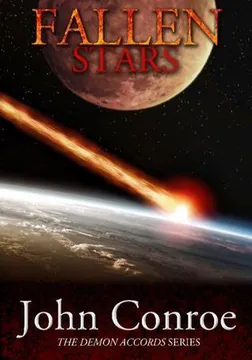
Fallen Stars receives generally positive feedback as the 5th installment in the Demon Accords series, with an overall rating of 4.33/5. Readers praise its fast-paced action, engaging characters, and supernatural world-building incorporating Native American folklore. The most divisive element is the amnesia plot device, with some finding it a creative solution to Chris's overpowered nature while others consider it forced and frustrating. The dynamic between Chris and Stacia generates significant interest, and narrator James Patrick Cronin receives consistent praise for the audiobook performance.
Characters
Chris Gordon
The demon hunterChris is a physically formidable demon hunter whose work is driven by a history of personal loss and a fierce instinct to protect children. He is practical, observant, and often uncomfortable with the attention his powers attract. His relationship with Tanya is bound by a supernatural connection, while his partnership with Stacia develops through shared danger and unusually frank trust. A darker combat self, Grim, can take control when threats become immediate, leaving Chris to reckon with the line between protection and violence. His humility is genuine, but his impatience with manipulation and his difficulty understanding his own emotional life make him less invulnerable than his strength suggests.
Tatiana Demidova
The vampire queenTatiana, usually called Tanya, is a uniquely powerful vampire and Chris’s chosen mate. She combines exceptional physical danger with political intelligence, wealth, and the instincts of a leader raised inside the Coven. Her devotion to Chris is intense and possessive, shaped by the knowledge that those close to him can become targets. She dislikes losing control, yet her capacity for strategy extends beyond force: she negotiates resources, reads institutional weakness, and knows when authority is exploiting her. Tanya’s challenge is to love Chris without treating him as something the Coven, or she herself, can direct for his own good.
Stacia Reynolds
The werewolf liaisonStacia is a young werewolf who serves as a liaison for the New York pack and accompanies Chris on dangerous assignments. Her beauty attracts constant attention, but she is intelligent, armed, and far more capable than strangers assume. She values candor and dislikes being reduced to her appearance or treated as helpless. Her feelings for Chris are openly expressed, yet she does not hide her motives or pretend that his bond with Tanya is insignificant. Stacia’s blend of flirtation, courage, and sound tactical judgment makes her a real partner rather than a romantic distraction, even when her presence sharpens tensions with Tanya.
Awasos
The shape-changing guardianAwasos is Chris’s fiercely loyal companion, usually seen as a massive wolf but able to change into a giant bear. He communicates through movement, sounds, and expressive looks, and Chris understands him with the ease of long familiarity. Awasos protects children and friends without hesitation, but his loyalty is not passive: he has his own sense of insult, humor, and retaliation. His unusual nature makes him a startling presence among werewolves, who initially have trouble placing him. For Chris, Awasos is both a formidable ally and a constant reminder that care can be expressed through action rather than explanation.
Ned Granger
The Asheville AlphaNed leads the Asheville werewolf pack and is Rose’s husband. He values order and pack authority, but the danger to his children exposes how easily a leader can mistake obedience for safety. His first encounter with Chris is defensive and proud; his later gratitude reflects his recognition that Chris has done what the pack could not. Ned also has to manage relations with the FBI, local witches, and visiting leaders, making him responsible for both family and political consequences.
Rose Granger
A mother demanding helpRose is Ned’s wife and mother to twins Polly and Cassi. She refuses to let her husband’s status or pride obscure the danger facing the children. Her direct appeal to Chris breaks through the pack’s hostile posturing and sets the rescue in motion. Rose’s distress is not helplessness: she notices what the children need and pushes the adults around her to act. Her urgency also keeps the consequences of the haunting personal, centered on frightened children rather than supernatural spectacle.
Jep
The pack’s protective secondJep is Ned’s enormous second-in-command and the father of Lindsey, one of the possessed children. His physical strength is matched by patience and practical judgment. He helps Chris contain the threat at the Granger home, then places himself between danger and his family. Jep’s gratitude is direct, but he does not confuse gratitude with surrendering responsibility. He remains an experienced pack officer, ready to protect his people and act when a crisis turns violent.
Jetta Sutton
The grieving waitressJetta is a Kentucky teenager who works at the Grangers’ hotel and keeps much of her past private. Her parents’ murder has left her without the safety of home, and her quiet manner conceals a determination shaped by the loss. Chris’s willingness to listen to her makes him one of the few people she trusts enough to reveal personal details to. Jetta is not simply a victim or a suspect: she is a young person forced to navigate danger in a world where adult institutions may not be able to protect her.
Mack Sutton
Jetta’s determined brotherMack is Jetta’s older brother and a survivor of the attack that killed their parents. He shares her resolve to confront the werewolves responsible, and his family’s knowledge of horses, tracking, and predators shapes how the siblings respond. Mack is protective without being defined by his sister’s actions; he explains the family history when Jetta cannot. His presence shows how grief can create a dangerous form of competence in young people who have been left to defend themselves.
Agent Krupp
The persistent FBI investigatorKrupp leads the FBI behavioral-analysis team investigating the werewolf murders. She is sharp, skeptical, and willing to provoke Chris to learn what he will protect. Her methods sometimes test the boundary between investigation and manipulation, but she is not careless: she studies evidence and follows leads. Krupp’s presence creates friction between law enforcement and supernatural communities, whose members have reasons to conceal their nature and their methods.
Katrina
Tanya’s blunt vampire friendKatrina is an old vampire trapped in a youthful appearance after being turned as a child. Long exclusion from vampire society has left her sharp-tongued and wary, particularly when she thinks someone is exploiting Chris. She is loyal to Tanya and brings him crucial information, but her suspicion of Stacia creates immediate conflict. Beneath the hostility, Katrina is perceptive and capable of changing her mind when someone proves trustworthy. Her unlikely friendship with Stacia begins to challenge the defensive habits she has built over decades.
Gina Velasquez
The perceptive human allyGina is a human psychologist, a friend of Chris and Tanya, and the mother of Toni. She remains composed among supernatural beings and reads emotional tension with unusual precision. Gina helps others understand what Chris’s memory loss means for their relationships, insisting that people meet the person he is now rather than demand the one they remember. Her care is warm but not indulgent; she can support Chris and still challenge his choices. She is one of the story’s clearest voices on the psychology of identity and recovery.
Toni Velasquez
Chris’s cherished goddaughterToni is Gina and Roy’s seven-year-old daughter, spirited, affectionate, and fascinated by animals and stories. Chris has made her a powerful protective pendant, and she treats Awasos as a trusted friend. Though young, Toni is observant and brave enough to warn her captors that the people who care for her will come. Her importance to Chris grows from their close bond, but her character is more than a symbol of vulnerability: she has a lively imagination and a will of her own.
Barbiel
Chris’s angelic guideBarbiel is an angel assigned to guide Chris through his work against demons. He provides knowledge and practical instruction, but his understanding of human attachment is imperfect. His conversations with Chris balance serious warnings with an unexpected curiosity about humor. Barbiel believes Chris has a larger mission, yet cannot make his choices for him. That limitation gives their relationship its tension: the angel may know more about the supernatural stakes, but Chris must still decide how to act.
Simon Masten
The lawless pack AlphaSimon is the Alpha of the Kentucky werewolf group that settles in Asheville. He treats strength as permission and his pack as an instrument of personal power. His contempt for pack law and for human safety makes him a danger even before his role in the Sutton family tragedy becomes clear. Simon’s behavior contrasts with Ned’s more responsible leadership and with Kral Vrana’s emphasis on training the next generation. He is driven by domination rather than the obligations that should accompany authority.
Kral Vrana
The European pack patriarchKral leads an old and influential European werewolf pack and brings his children, Janek and Darina, to Asheville for leadership experience. He is observant, proud of his family, and deeply interested in how packs adapt to new circumstances. Kral’s manners carry the weight of tradition, but he is willing to learn from unexpected people and events. His visit places the Asheville pack’s local emergency within a wider werewolf society.
Samuel Cooper
The ambitious Asheville warlockSamuel leads the White Oak Circle, one of Asheville’s witch groups. He presents himself as an ally of the werewolf pack, but his interest in the Granger house and its dangerous magic exposes how self-interest can coexist with polished manners. Cooper is skilled enough to wield serious power and proud enough to resent being dismissed. His conflict with Chris and the Grangers reflects the damage caused when magical knowledge is treated as an asset to acquire rather than a responsibility to manage.
Nathan Stewart
The head of OracleStewart directs Oracle, a government organization that studies and combats supernatural threats. He is a shrewd administrator with a taste for elaborate acronyms and a willingness to bargain when Chris’s expertise becomes essential. Stewart seeks to contain dangers created by forces beyond ordinary government knowledge, but his institution’s reach can also invite secrecy and control. He regards Chris as a valuable ally while struggling to accept that Chris cannot simply be ordered into service.
Briana Duclair
The dangerous AIR operativeBriana is a capable operative within the Agents in Rebus organization and is comfortable with its weapons, experiments, and disregard for ordinary limits. She knows Chris from before his memory loss and uses that history to unsettle him. Her confidence depends on preparation and control, but she understands that Chris and Tanya are far more dangerous than the facility’s plans account for. Briana embodies the personal face of an institution that treats people as research material.
Declan and Caeco
The captive young alliesDeclan and Caeco are teenagers imprisoned in the AIR facility alongside Toni. Declan can manipulate electricity, while Caeco is unusually fast and athletic. They use their abilities to resist the people holding them and help keep Toni safe. Their resourcefulness shows that the facility’s captives are not passive test subjects, even when their options are limited.
Plot Devices
Grim
A hidden combat selfGrim is the name Chris gives the darker, highly tactical aspect of himself that can take control in moments of extreme danger. It supplies speed, precision, and a readiness to use lethal force, while Chris’s conscious self tries to restrain it. After the sniper damages his brain, Grim becomes especially important because fragments of Chris’s missing memories surface during combat. The device makes power psychologically complicated: Chris’s body can save people before he can understand what it is doing, but that competence risks becoming violence without reflection. By the end, Chris begins to integrate Grim rather than treat it as a wholly separate stranger.
The God Tear
A reserve for sealing gatesThe God Tear is a black gem set in a silver necklace that allows Chris to draw on power beyond his ordinary aura. Barbiel explains that closing the enormous Asheville breach will require Chris to use it, and Chris later channels its reserve to outline and contract the opening. It is not a simple weapon: using it taxes his body and soul, and its size changes as power is drawn from it and returned. The necklace links Chris’s physical actions to the novel’s larger spiritual conflict, making each gate closure an act of effort rather than an effortless display of ability.
The Darkest Sorrow
A beacon of dangerous magicThe grimoire hidden in the Granger house is a powerful book of destructive spells, written by the witch Roswitha Maier. It is connected to the occult history of the house and to the ritual that opens a passage to Hell. Its power attracts witches who want to possess its knowledge, while its magical presence can be concealed with silk, protective wood, or saltwater. The book drives several conflicts beyond the original possession: it motivates theft attempts, a witch attack on the highway, and the need to keep it away from people who see its value but underestimate its cost.
Hellgates
Weak points between worldsHellgates are tears between Earth and Hell that allow demons to enter the physical world. They may form where dark rituals and stored supernatural energy have weakened the barrier, and the Large Hadron Collider’s operation worsens the larger crisis by weakening boundaries between worlds. A gate can possess children, unleash demons, and make a building itself feel saturated with despair. Chris closes breaches by tracing their edges with aura and drawing them together, but some gates have defenses and can demand enormous power. The recurring device turns isolated hauntings into a spreading emergency that calls for a coordinated response.
Protective fetishes
Small guardians against demonsChris charges carved animal pendants with aura to protect people from demons. The Granger children choose animal figures after their exorcism, while Toni wears a bear pendant that becomes a particularly powerful safeguard. The objects matter in different ways: they offer frightened children something tangible to hold, hide their bearers from demonic attention, and in Toni’s case give Chris a way to track her after she is abducted. Their use turns protection into a physical gift, one that carries the maker’s care into places he cannot immediately reach.
Download PDF
Download EPUB
.epub digital book format is ideal for reading ebooks on phones, tablets, and e-readers.








