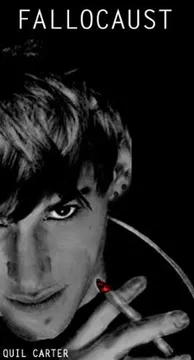


Plot Summary
Parents Become Rations
In Aras, a fortified settlement in the poisoned greywastes, sentry Reaver1 quietly watches Killian,2 a gentle newcomer who still reads books and smiles. When Killian’s parents16 contract trideath, the block’s leaders quarantine them. Reaver1 shoots them before the disease can spread, and their bodies are processed for food.
Killian2 survives the night, but his cheer disappears. Reaver1 keeps his distance while secretly tracking the grieving boy, making sure he has food and water and does not wander beyond the walls alone. He tells himself this is only a sentry’s duty. Yet Killian’s2 loss has made the silent, hard-bitten Reaver1 feel responsible for someone in a way he cannot explain.
The execution is both a public-health measure and an intimate betrayal: Reaver protects the settlement by doing the act that destroys Killian’s sense of home. The community’s use of the dead as food is not framed as individual cruelty so much as a survival system that has made tenderness difficult to recognize. Reaver’s hidden watch begins as practical care, but his attention to Killian already exceeds duty. His inability to name that attachment matters: in a world where emotional openness can be mistaken for weakness, he can act protectively long before he can admit why.
The Sentry and the Reader
Reaver1 watches Killian2 read on the canyon rocks and steals his water, expecting the quiet boy to remain oblivious. Killian2 notices, and before either can respond, they hear someone approaching. Reaver1 raises his rifle, ready to protect Killian2 from a threat, but the newcomers are block leader Greyson3 and his husband Leo.4 They announce a merchant caravan may arrive and order everyone back inside Aras.
Soon after, Killian2 follows Reaver1 to the Slaught House and volunteers to help feed the deacons, the feral guard creatures that devour live rats. Reaver1 watches Killian2 face the spectacle without running. The boy’s willingness to learn begins drawing him out of isolation, while Reaver’s1 watchfulness starts to look less like mere duty.
Their first connection is built out of surveillance, theft, and shared danger rather than easy conversation. Reaver’s water theft is a small assertion of control, but the sudden approach forces him to reveal the protective instinct beneath it. Killian, meanwhile, moves toward the slaughterhouse not because he is fearless but because grief has left him searching for a role. The deacons make Aras’s survival economy visible in its rawest form. Killian’s response unsettles Reaver because he is neither hardened like the locals nor helpless in the way Reaver expects.
The Census Finds a Target
Two years earlier, Reaver1 is posted above Aras when a census delegation arrives under Mercer Carter,11 an agent of King Silas.9 Greyson3 warns the residents to cooperate, then privately tells Reaver1 to kill Carter11 if the visit threatens the block.
During the census, Carter11 announces a new search for unregistered people and brings a hessian, a scent-tracking creature trained to find anyone without a marked wristband. Greyson3 signals Reaver1 to hide, revealing that he has been keeping Reaver1 off the official rolls because the Legion would recruit him.
Reaver1 escapes detection with Leo’s4 help. Later, Greyson3 and Leo4 explain the Fallocaust, Silas’s9 immortality, and his engineered chimeras, giving Reaver1 his first real understanding of the power ruling the wastes.
This earlier crisis establishes that Reaver’s isolation is not simply temperament. Greyson has hidden him from a state that treats unusual ability as a resource to be seized, while also training him as a soldier for Aras. The contradiction shapes their relationship: Greyson protects Reaver from Silas even as he prepares him to serve a future purpose. The census turns identity into administrative property. Reaver’s unregistered status keeps him free, but also leaves him without a clear past, a tension that will later shadow his sense of self.
A Nightmare Crosses the Window
After his parents’16 deaths, Killian2 scrubs their ruined house and suffers night terrors that replay their illness and execution. Reaver,1 who has been watching him from a nearby tree, hears him scream and climbs through his bedroom window. Killian2 is asleep, calling for his parents16 and reliving the quarantine.
Reaver1 cannot make himself touch him at first, but he stays until the nightmare eases, then slips away before Killian2 wakes. Their silent watching becomes a private habit: Killian2 longs for Reaver’s1 attention, while Reaver1 keeps telling himself the boy is simply too vulnerable to leave unguarded. Neither knows how to cross the distance between them directly.
The scene exposes the cost of Reaver’s emotional defenses. He can enter a room and face a nightmare, yet cannot offer the simple comfort of a hand on Killian’s shoulder. Killian’s trauma is not abstract grief; it returns as bodily terror, with the images of his parents’ deterioration fused to his own helplessness. Their attachment forms through asymmetry: Reaver watches without being seen, while Killian wants to be recognized. That arrangement gives Reaver safety from intimacy, but it cannot remain stable once Killian’s danger becomes real.
The Caravan's Bloody Road
When a merchant caravan reaches Aras, Killian2 sells his handmade guitar to buy a better instrument, then learns the merchants are leaving early. Desperate to recover the guitar he gave up, he slips out of the gates alone and follows their tracks. At a ruined highway crossing, he finds severed body parts and the merchants’ abandoned goods.
Legionnaires catch him, beat him, strip him, and discuss selling him alive to a factory. Killian2 claims Reaver1 is the Raven,1 a notorious sniper, hoping the name will scare them. It buys no rescue. Reaver1 returns from a patrol, discovers Killian2 is missing, and follows the bloody trail with Reno5 until they find the boy’s clothing and the massacre site.
Killian’s departure is driven by grief, but his choice to chase the guitar also shows how strongly he needs a piece of beauty he can call his own. The journey exposes the cost of his sheltered life: he knows the danger in theory, yet still believes he can outrun it for something precious. Reaver’s discovery turns his private attachment into an unbearable responsibility. The mistaken belief that Killian is dead sets up his most dangerous response: when Reaver thinks he has failed, his restraint gives way to vengeance.
The Raven Burns the Factory
Reaver1 and Reno5 track the Legionnaires to their camp. Reaver1 kills several in a brutal ambush, then learns from a captured soldier that Killian2 is alive and has been sold to the Typhus Canyon factory. He follows the delivery route to the factory, where Dek’ko workers are force-feeding captives for fois gras production.
Reaver1 finds Killian2 alive in a pod, tubes shoved down his throat and his body swollen with feed. He tears the tubes free, forces him to vomit, then detonates C4 to block the pursuing guards. Reaver1 carries him out through smoke and debris. The blast badly injures Reaver,1 but he keeps moving until Leo4 and Greyson3 find them and bring them home.
Reaver’s rescue is an act of love expressed in the language he knows best: stealth, weapons, and destruction. The factory reveals that the greywastes’ food system is not merely scavenging but industrialized bodily exploitation, with people reduced to ingredients. Reaver’s attack saves Killian while replicating the violence of the world around them; the difference lies in whom he chooses to protect. His injuries and concussion make that devotion physical, but his refusal to stop also shows the danger of a protector who cannot imagine surviving failure.
A Basement Becomes Home
After Doc10 treats their injuries, Killian2 finds Reaver1 outside the clinic and collapses into his arms. Reaver1 takes him to a concealed basement reinforced with locks, concrete, and a hidden tunnel. There Killian2 eats, sleeps, and begins recovering; Reaver1 admits his name and finally asks him to be his partner. Killian2 accepts, and they kiss.
Reaver1 gives him a magnum and later retrieves the guitar he had lost, while Killian2 learns to shoot and helps tend Reaver’s1 wounds. Their intimacy grows in fits and starts: Killian2 wants closeness, Reaver1 needs space, and both use drugs to blunt fear and pain. The basement becomes their shelter from a world that keeps trying to claim them.
The basement is a physical expression of Reaver’s psyche: sealed, fortified, and carefully controlled. By inviting Killian inside, he does more than offer refuge; he lets another person cross the boundary he built against everyone else. Their romance does not cure either man. Killian remains anxious and traumatized, while Reaver still recoils from touch and resorts to bluntness. Yet ordinary acts, sharing food, tending wounds, playing games, begin to make intimacy possible. Their relationship grows not through transformation into healthier people overnight, but through repeated choices to stay.
Donnely's Empty Streets
When Mercer Carter11 returns unexpectedly with Legionnaires and scent-tracking hessians, Reaver1 and Killian2 flee Aras to avoid exposure. They travel toward Donnely, a newly cleared city where they hope to find medicine. At a gas station, Killian2 gives food to an old scavenger despite Reaver’s1 warning, then they search abandoned shops and an apartment building.
After Reaver1 disappears during a patrol, Killian2 waits, panics, and wanders the city alone, convinced he has been abandoned. A seemingly friendly man named Asher6 approaches him and carries him to a hidden Skytech facility. There, the scientist Perish7 revives Killian2 after an overdose and reveals that he has been watching both boys through cameras.
Donnely tests the couple’s fragile balance between protection and autonomy. Killian’s kindness to the old scavenger is not naïveté alone; it is a refusal to let scarcity erase the possibility of help. Reaver’s disappearance triggers Killian’s deepest fear, abandonment, and his drug-fueled search turns that fear into danger. The hidden facility transforms the city from a place of opportunity into a surveillance trap. Perish’s cameras literalize the feeling of being watched, but the deeper threat is psychological: Killian has no way to distinguish care from control.
The Prisoner Called Perish
Perish,7 an isolated Skytech scientist and chimera, holds Reaver1 in chains beneath Donnely and threatens his life with an explosive slave collar. Killian2 discovers that Perish7 wants him as a boyfriend, so he pretends to accept in exchange for Reaver’s1 safety. He learns Perish7 has spent years alone, abused by King Silas9 and his own family, and has filled the underground complex with engineered creatures and captive arians.
Killian2 tries to win Perish’s7 trust while searching for a way out, obtaining a key card and the collar’s detonator. Reaver1 watches their meetings through surveillance feeds, sleep-deprived and increasingly unstable as Killian’s2 performance forces him to witness the intimacy he fears losing.
Killian’s bargain is both resourceful and morally costly. He recognizes that Perish’s loneliness makes him manipulable, but also sees the wounded person beneath the danger. That empathy complicates escape: he wants to protect Reaver, yet cannot stop himself from feeling responsible for Perish. Reaver’s surveillance reverses his usual role as watcher. He is trapped in a chair, forced to see without intervening, and his jealousy is sharpened by helplessness. The scene makes clear that affection can be both a genuine need and a weapon in a coercive environment.
Nero Comes to Judge
When Nero,8 another chimera and Perish’s brother,8 arrives at the laboratory, he dismisses Perish’s7 work and kills several of his creatures. He then beats and rapes Perish7 while Reaver1 watches through the surveillance system, chained and unable to intervene. The violence breaks the fragile order Killian2 had built around Perish.7
During the chaos, Killian2 reaches the cages holding captured arians and persuades Perish7 to open them. Perish7 releases the whipwolf into the room, and the starving creature attacks the prisoners. Killian2 watches the slaughter, then comforts Perish7 as he collapses over the loss of his experiments. Reaver1 frees himself and gathers his weapons while the household’s control starts to unravel.
Nero’s visit reveals that Perish’s cruelty and dependence are shaped by the same system that makes him powerful. He can imprison people and create monsters, yet remains vulnerable to the family that engineered him. Killian’s comfort of Perish after the massacre is not forgiveness so much as an attempt to manage a volatile, grieving captor. The scene’s moral ground is deliberately unstable: Perish releases the whipwolf, killing those he had held, while Killian’s sympathy remains real. Reaver’s captivity sharpens the cost of his usual strategy: force cannot always reach the person he loves in time.
A Head for the Grave
After Nero8 leaves, Killian2 understands that Perish’s7 grief and instability make him dangerous to everyone around him. He kills the scientist,7 cuts off his head, and carries it out of the facility as proof that the threat is over. Reaver,1 newly free and armed, finds Killian2 outside and initially accuses him of choosing Perish7 over their escape.
When he sees the blood-soaked coat and the severed head, his anger collapses into recognition of what Killian2 has done for them. Greyson3 and Leo4 arrive soon afterward, and they bring the pair back to Aras. Killian2 asks for Perish’s7 body to be buried rather than eaten, a final act of respect for the man he both feared and pitied.
Killian’s killing of Perish is neither a clean victory nor a simple act of revenge. He ends a dangerous captivity, but does so by killing someone whose suffering he has come to understand. The severed head is simultaneously evidence, burden, and the price of escape. Reaver’s initial accusation reflects his own terror of being betrayed, while his eventual embrace acknowledges the cost Killian paid. Burying Perish rather than turning him into food becomes Killian’s attempt to preserve a boundary between survival and desecration, even in a world that rarely allows one.
The Father in the Attic
Back in Aras, Reaver1 and Killian2 recover, resume their relationship, and try to settle into ordinary routines. While helping at the house, Killian2 searches an attic and finds baby clothes, toys, and a photograph of infant Reaver1 being held by a younger Leo.4 A Skytech lab coat marked with Leo’s4 name deepens the mystery.
Killian2 realizes Leo4 has hidden a connection to Reaver’s1 origins, but he does not tell Reaver,1 fearing what the revelation might do to him. Meanwhile, Reaver1 reluctantly takes on mayoral duties while Greyson3 and Leo4 prepare to leave Aras. Killian2 returns to work at Doc’s10 and keeps the discovery to himself, carrying a secret that may reshape the family he has just found.
The photograph converts Reaver’s vague childhood memories into evidence that his past has been actively concealed. Killian’s discovery creates a new burden: he must choose between honesty and protecting Reaver from a truth that could destabilize him. His silence is not simply fear; it is a form of care shaped by his recent experience of how knowledge can wound. Leo’s apparent role as caretaker now carries a second, hidden dimension. The scene complicates family: Reaver’s bonds may be emotionally real even when the story told about their origin is not.
Asher Joins the Circle
Asher,6 a skilled raticater with a life of scavenging behind him, begins spending time with Reaver.1 The two share patrols, weapons, drugs, and stories, and Reaver1 values Asher’s6 competence and ease in the wasteland. Killian2 watches their growing friendship with mounting jealousy, especially because Asher6 appears more capable of matching Reaver’s1 speed and appetite for danger.
Reaver1 dismisses Killian’s2 suspicions as insecurity, while Asher’s6 charm makes it difficult for Killian2 to point to any concrete offense. The tension exposes an imbalance in their relationship: Killian2 depends on Reaver1 for safety, but fears that Reaver’s1 world of violence and adventure offers more to Asher6 than it does to him.
Asher’s arrival makes Killian’s insecurity specific rather than abstract. He is not merely afraid of losing affection; he fears being outclassed in the very qualities Reaver values most, speed, toughness, and comfort with violence. Reaver’s dismissal is partly a product of his bluntness, but also of his trust in his own judgment. Killian’s suspicion may be distorted by trauma, yet it cannot be dismissed as jealousy alone. The triangle tests whether intimacy can survive unequal power and unequal competence, especially when one partner’s confidence depends on being the other’s protector.
A Mayor's Burning Verdict
While Greyson3 and Leo4 are away, Reaver1 takes charge as crime and fear rise in Aras. A family dies from trideath, then Reaver1 learns that prisoners who robbed the quarantine house have become infected and that more residents may be exposed. Rather than wait for a formal trial, he summons the town and frames the choice as collective survival.
Residents gather burning wood and help execute the prisoners in a public fire, then butcher the bodies for food. Reaver1 sees the crowd cheer and obey him, discovering how readily fear can turn a community into an instrument of his will. His authority works, but it does so by bypassing the rules Greyson3 established.
The execution is Reaver’s first public experiment in leadership, and it succeeds in the narrowest possible sense: he secures compliance and removes an infection risk. Yet the spectacle also reveals how easily his talents for command can become domination. He does not merely decide what is necessary; he stages the decision so residents participate in it. The crowd’s approval gives him a dangerous kind of validation. For Killian, who is learning that Reaver is not simply a protector but a person capable of shaping others, the event makes love and fear harder to separate.
West Aras Claims Reaver
Greyson3 returns and condemns Reaver1 for the public executions, accusing him of abandoning Aras’s laws and of hurting Killian2 while drunk and sleep-deprived. Reaver1 refuses to accept Greyson’s3 authority and declares West Aras his own territory. Their conflict is personal as well as political: Greyson3 had trained Reaver1 to lead, while Reaver1 resents being treated as a project rather than a person.
Killian2 tries to keep the two men from destroying their bond, but Reaver’s1 independence hardens into a break with the old leadership. He and Killian2 build a separate household, relying on their own work and trade. The split gives Reaver1 freedom, but leaves his origin and his future unresolved.
The rupture with Greyson turns a disagreement about procedure into a conflict over authorship. Greyson sees Reaver’s leadership as the fulfillment of a long plan; Reaver sees the same plan as another attempt to define him from outside. His new territory is therefore both political independence and an improvised answer to the question of who he is. Killian’s role is difficult: he wants Reaver safe and loved, but cannot make him accept care without making it feel like control. Their separation from Aras solves one immediate conflict while exposing a larger one.
The King Reaches Aras
Killian’s2 secret photograph suggests that Leo4 was already part of Reaver’s1 life before the story he remembers, and he learns enough to realize that Reaver’s1 origins connect to the chimeras who serve King Silas.9 He keeps the discovery from Reaver,1 afraid that the truth could endanger him or drive him toward the very power that shaped him.
At the same time, Silas’s9 influence reaches West Aras through the consequences of Reaver’s1 actions and the people searching for him. Reaver1 continues to rely on Killian2 while insisting he needs no one else. The novel closes with their intimacy intact but their safety uncertain: Reaver’s1 identity remains hidden from him, and the king’s9 claim has not been settled.
The ending leaves two kinds of knowledge dangerously separated. Killian knows enough to fear what Reaver is, while Reaver understands neither the source of his abilities nor the forces that may seek him. Their love provides real shelter, but it cannot neutralize a political power built on tracking, engineering, and ownership. The unresolved tension is not simply whether Silas will find them; it is whether Reaver can learn the truth without becoming the instrument others designed him to be. Killian’s secrecy is protective in intention, but it also repeats the concealment that has shaped Reaver’s life.
Analysis
Fallocaust builds its world from systems that make human beings useful before they are allowed to be human: geigerchips classify them, the factories process them, and Aras’s food economy turns death into routine. Reaver1 is shaped by this logic more thoroughly than he realizes. He protects people through violence because violence is the skill his world rewards, and his growing love for Killian2 does not erase that reflex. It only gives it a direction.
Killian’s2 empathy is not simple goodness. It repeatedly places him in danger, from chasing the guitar to trying to preserve Perish’s7 dignity. Yet it also gives him the capacity to see the wounded person inside a captor without confusing pity with safety. Their relationship is therefore a tension between protection and autonomy: Reaver1 wants to keep Killian2 safe by controlling the danger around him, while Killian2 wants to remain morally answerable for what he does to others.
The novel’s sharpest irony is that power and vulnerability do not divide neatly. Perish7 is a brilliant scientist and a captive of his family. Reaver1 is feared and physically formidable, yet can be made powerless by the people he loves. Greyson3 can protect Aras and still try to shape Reaver1 into a tool. Even the town’s public justice turns into a mob’s appetite once Reaver1 gives it permission. The ending leaves these contradictions unresolved. Killian2 knows more about Reaver’s1 past than Reaver1 does, while Silas’s9 reach continues beyond the walls. The question is not simply whether Reaver1 can survive the king,9 but whether he can choose who he becomes before someone else chooses for him.
Review Summary
Fallocaust receives polarizing reviews, averaging 4.2/5 stars. Fans praise its visceral world-building, compelling characters—particularly the sociopathic Reaver and emotional Killian—and its unflinching darkness involving cannibalism, rape, torture, and drug use. Many readers found it addictive despite its 800+ pages. Critics cite poor editing, gratuitous violence, and Killian's perceived whininess as major drawbacks. Most agree it is not for sensitive readers, but those who embrace dark fiction often consider it an unforgettable, genre-defining experience.
People Also Read



Characters
Reaver
The feared sentryReaver is Aras’s most capable sentry: solitary, heavily armed, quick on the canyon rocks, and more comfortable with silence than company. Raised by Greyson3 and Leo4 after arriving in the settlement as a small child, he has built his life around vigilance, scavenging, and a reputation that keeps people at a distance. His bluntness can be cruel, and violence comes too easily to him, but his attention to Killian2 reveals a protective capacity he barely understands. He values autonomy and control because the world has taught him that dependence invites danger. His struggle is not to become gentle in a simple sense, but to decide what his strength is for.
Killian
The grieving readerKillian is a bookish newcomer from Tamerlan whose education, courtesy, and care for small comforts set him apart in the greywastes. He reads psychology, plays guitar, tends animals, and notices what others overlook. His parents’16 illness and death leave him with severe nightmares and a fragile sense of safety, yet he keeps trying to learn useful skills and contribute to Aras. He is empathetic enough to see humanity in people others dismiss, a quality that can make him vulnerable but also gives him moral clarity. His bond with Reaver1 grows from longing and fear into a partnership built on mutual care, even as each struggles to understand the other’s limits.
Greyson
Aras’s hard-edged mayorGreyson leads Aras with a mixture of discipline, political caution, and genuine concern for its residents. He raised Reaver1 alongside Leo4 and trained him as a sentry, often treating him as both family and a soldier. Greyson believes survival depends on rules, preparation, and keeping King Silas’s9 attention away from the block. That pragmatism can make him protective, but also controlling: he is drawn to shaping people toward what he thinks they could become. His loyalty to Aras and his affection for Reaver1 coexist with a stubborn belief that he knows what is best, creating friction when Reaver1 insists on choosing his own life.
Leo
Reaver’s other guardianLeo is Greyson’s husband3 and one of Aras’s leaders, known for his warmth, practical intelligence, and interest in science. He helped raise Reaver1 and often softens Greyson’s3 harder approach with patience and affection. Leo is observant about people’s needs, especially Reaver’s1, and his instinct is to protect those he loves from further harm. That protective instinct also makes him reluctant to expose painful truths. He carries a history and knowledge that set him apart from the ordinary residents of Aras, while trying to maintain the ordinary routines of family life. His tension with Greyson3 comes from differing ideas about care, control, and what a loved one should be asked to bear.
Reno
Reaver’s oldest friendReno is Reaver’s1 longtime friend, a field sentry who lives in a hidden cabin and knows the greywastes as well as anyone. Loud, irreverent, and fond of drugs and bad jokes, he offers the kind of loyalty Reaver1 rarely finds elsewhere. Reno is also resourceful, dependable in a crisis, and willing to enter danger when Reaver1 needs help. His humor can hide pain, but his friendship is unusually durable: he understands Reaver’s1 roughness without excusing every choice. With Killian2, he becomes a bridge between Reaver’s1 old solitary life and the intimacy the new relationship requires.
Asher
The wandering raticaterAsher is a skilled raticater, a wasteland traveler accustomed to hunting, trading, and surviving outside settled blocks. He is agile, self-assured, and comfortable with danger, which makes him an easy companion for Reaver’s1 patrols and scavenging. His polished appearance and controlled manner contrast with the roughness expected of a wanderer, and his charm can make it difficult to tell what he is thinking. He wants a place in West Aras and presents himself as capable of earning one. Killian’s2 unease around him grows from the sense that Asher understands Reaver’s1 world in ways Killian2 does not.
Perish
The isolated scientistPerish is a gifted Skytech scientist living alone in a hidden laboratory beneath Donnely. He creates spliced creatures, grows food under artificial lights, and fills his underground world with carefully controlled systems. His loneliness and lifelong mistreatment have left him socially erratic and deeply hungry for affection, while his scientific talent coexists with frightening cruelty. He can be tender, boastful, or dangerous within moments, often without understanding the effect he has on others. Perish embodies the damage caused when a person is treated as both a tool and a disposable creation. His need to be loved is genuine, but it does not make his captivity and experiments harmless.
Nero
Perish’s powerful brotherNero is a high-ranking chimera and a forceful representative of the hierarchy that governs Skyfall. He is physically imposing, disciplined, and openly contemptuous of Perish’s7 work. He evaluates people and experiments by their usefulness, and his authority rests on the knowledge that others are expected to obey him. Unlike Perish7, Nero does not seek affection or approval; he uses fear and rank to secure compliance. His visits reveal how the chimera family can be both an elite ruling class and a source of private cruelty.
King Silas
The immortal rulerKing Silas rules Skyfall and the greywastes through the Legion, the ACL, and the companies that control food, technology, and medical supplies. He is said to be immortal and treats the surviving population as a system to monitor and manage. His authority reaches even remote settlements through censuses, geigerchips, recruitment, and economic dependence. Silas rarely appears directly in the story, but his policies shape the world Reaver1 and Killian2 inhabit. He represents power that does not need to be physically present to govern: his institutions make people comply long before his personal attention arrives.
Dr. Don
Aras’s practical doctorKnown to most residents as Doc, he treats injuries, trains Killian2, and supplies one of the few reliable sources of medical care in Aras. He is blunt, capable, and comfortable with the grim realities of the settlement, including execution and disease. His humor can be dark, but his work is careful, and he often sees the physical consequences that others would rather ignore. Doc gives Killian2 a useful role beyond being a grieving newcomer and helps Reaver1 survive his injuries. His clinic is one of the few places where skill and routine still push back against chaos.
Mercer Carter
Silas’s census agentCarter represents the authority of King Silas’s9 administration. He arrives with Legionnaires to collect blood samples and records, then announces searches for anyone outside the official census. Smooth and condescending, he understands that even routine paperwork can become a threat when backed by soldiers and scent-tracking creatures.
Redmond
Aras’s senior councillorRedmond handles records, taxes, and the practical administration of Aras. He is serious, organized, and committed to keeping the settlement running when its leaders are absent. His caution can temper Reaver’s1 impulsiveness, but he also understands how fragile the block’s systems are. He represents the less dramatic labor that keeps Aras functioning: lists, supplies, work assignments, and decisions made before a crisis reaches the gates.
Warden Hollis
Aras’s law enforcerHollis oversees arrests and enforcement in Aras. He tends toward patience and procedure, even when the residents he deals with are volatile or repeat offenders. His preference for restraint puts him at odds with Reaver’s1 instinct to make fast, severe examples of people who threaten the community. Hollis is not weak, but he believes authority works best when it remains credible rather than feared.
Matt
The teasing sentryMatt is one of Aras’s sentries and a longtime acquaintance of Reaver1. He jokes easily, sometimes at the wrong moment, but is dependable when danger comes to the walls. His irreverence makes him one of the few people who will speak casually to Reaver1, and his willingness to help reflects the quiet solidarity that keeps the block working.
Sadii
The gate sentrySadii is an Aras sentry who manages gate shifts and knows the settlement’s routines. She has known Reaver1 since childhood and can laugh at his bluntness without mistaking it for kindness. Her position places her at the boundary between the protected block and the dangers outside.
Jeff Massey
Killian’s fatherJeff is Killian’s father16, a former worker from Tamerlan who brings his family to Aras after losing his place near Skyfall. His past as a factory employee and his decision to spend the family’s savings on mercenaries shape Killian’s2 understanding of both security and loss.
Kristin Massey
Killian’s motherKristin is Killian’s mother17 and the more watchful, formal parent in his memories. She tries to preserve familiar manners and domestic order even as the family enters the harsh world beyond Tamerlan. Her care helps explain why Killian2 clings to cleanliness, books, and small rituals after arriving in Aras.
Deek
The stray deacdogDeek is a young, chipped deacdog who escapes from a merchant caravan and keeps returning to Reaver1 and Killian2. Friendly and trained to understand commands, he contrasts with the feral deacons guarding Aras. His presence gives Killian2 a small creature to care for and offers the pair a rare source of uncomplicated companionship.
Plot Devices
Geigerchips and the ACL
The census becomes a leashEvery arian is implanted with a geigerchip that filters radiation and helps King Silas9 track the population through the Arian Compliance League. The census appears routine until Mercer Carter11 brings a scent-tracking hessian and orders a search for anyone unregistered. The system turns a protective technology into a mechanism of control: staying off the rolls can preserve freedom, but it also makes a person vulnerable to recruitment, punishment, and disappearance. Reaver’s1 hidden status establishes the political danger that later follows him and explains why the leaders of Aras are so wary of attracting attention.
The Deacon Perimeter
A living wall around ArasAras keeps feral, radiation-damaged deacons in a fenced run around its concrete walls. They function as guards, alarms, and a final barrier against anyone attempting to enter the settlement. The same creatures also expose the community’s brutal food economy: unwanted people and rats are fed to them. Deacons therefore protect the residents while enforcing the very violence on which the settlement depends. For Killian2, who sees them first as terrifying creatures and later as a place where his own pet might belong, they connect fear, survival, and care in a single recurring image.
Drugs and Quills
Pain relief with a priceReaver1 and many residents use scavenged or manufactured drugs to manage pain, insomnia, and the pressure of daily life. Quils, cigarettes laced with opiates, offer a slower warmth, while crushed painkillers and stimulants can change mood and endurance. Killian’s2 first experiences with drugs help him endure trauma, but the substances also worsen his judgment and make him vulnerable during separation from Reaver1. Later, Asher’s6 use of a hidden Skyfall drug exploits the gap between what a person feels and what their body does. Drugs are comfort, habit, and a tool of control, depending on who administers them.
Perish’s Surveillance Lab
Watching becomes imprisonmentPerish’s7 hidden facility contains cameras, controlled rooms, spliced animals, and cages holding captives. He uses surveillance to watch Reaver1 and Killian2, while the explosive collar and locked doors give him power over their movements. The laboratory’s organized machinery contrasts with the chaos above ground, but its precision makes the cruelty more frightening, not less. The cameras also turn intimacy into spectacle: Reaver1 is forced to observe Killian’s2 interactions with Perish7 while unable to intervene. This device links scientific knowledge to coercion and makes the prisoners’ lack of privacy part of their captivity.
The Hidden Family History
A past concealed in keepsakesA box of baby clothes, toys, and photographs hidden in the attic of Greyson3 and Leo’s4 house gives Killian2 the first concrete clues that Reaver’s1 childhood has been concealed. The objects matter because they are ordinary: a blanket, a toy, a photograph. They transform a vague question about Reaver’s1 origins into a tangible secret and force Killian2 to choose whether to expose what he found. The keepsakes link private family memory to the larger political world of Skytech and King Silas9, while showing how even a loving household can preserve a damaging silence.
Download PDF
Download EPUB
.epub digital book format is ideal for reading ebooks on phones, tablets, and e-readers.








