Key Takeaways
1. A Shocking Revelation: A mysterious letter unveils a hidden family history of Nazi espionage.
The word Nazi seemed to burn itself into the stationery.
Unveiling secrets. The author, Chris Schipani, lived a seemingly normal suburban life until a mysterious letter arrived in 1994, addressed to her maiden name, Christine Kuehn. The letter, from a screenwriter researching German spies in World War II, claimed her grandfather, Otto Kuehn, was involved with the Nazis and the attack on Pearl Harbor. This shocking accusation contradicted her father's vague accounts of his parents, who he claimed had unexceptional lives and died of natural causes.
Father's evasiveness. Chris's father, Eberhard, a strapping man with a thick German accent, had always told fantastical stories, but never about his past in Berlin or his parents. When pressed, he offered only "telegram-style" snippets: "My father served as a naval officer before dying in a car crash. Stop. End of discussion." This evasiveness, coupled with a cryptic warning from her Aunt Ruth years earlier—"You have a good life. You don’t want to ruin it with the past… You don’t need to know about the family, the past, or Pearl Harbor"—fueled Chris's growing suspicion.
Confirmation of dread. Initial research at a bookstore revealed multiple historical accounts linking "Kuehn, Bernard Julius Otto" to spying for the Japanese in Hawaii. Further confirmation came from the Mormon Temple's genealogy records, which definitively identified her father, Eberhard Kuehn, as the son of the infamous Pearl Harbor spy. This discovery shattered Chris's perception of her family, forcing her father to finally confess the dark truth he had suppressed for decades.
2. The Lure of Power and Wealth: Otto and Friedel's descent into Nazism and high-stakes spying.
The transformation of this ordinary German family, this very middle-class and unexceptional German family, into committed Nazis bewildered me.
Post-WWI disillusionment. Otto Kuehn, born into a privileged Berlin family, sought adventure in the German navy during WWI, only to be captured and imprisoned. Returning home to find his family's wealth gone and his mother and older brother dead, he felt rudderless. He met Friedel Birk, an ambitious woman with a history of poverty and loss, and together they dreamed of a life of wealth and status.
Financial gambles. Otto inherited a large sum, but his impulsive nature led to a series of failed business ventures, quickly depleting their fortune. Desperate for financial security, he was drawn to the rising Nazi Party, which promised prosperity and a return to German pride amidst the Great Depression. In 1930, after attending a mesmerizing Hitler rally, Otto joined the Nazis, followed by Friedel, their eldest son Leopold, and daughter Ruth.
Nazi connections. Otto's past in the naval secret police caught the attention of Heinrich Himmler, leading to an interview for a top Gestapo role. Though he lost the position to Reinhard Heydrich (the "Butcher of Prague"), Otto secured a job in the Nazi secret police. His loyalty was tested during the "Night of the Long Knives" in 1934, when he was ordered to murder an SA official but instead accepted a bribe, prioritizing money over ideology.
3. Ruth's Perilous Path: A half-Jewish daughter's affair with Goebbels and forced espionage.
Ruth had grown up under Friedel’s turbulent watch, her early childhood spent in the cobblestone streets of Munich while her mother pieced together what she could to make ends meet.
Goebbels's seduction. In 1935, Ruth, then a young woman, attended a lavish Nazi gala with her half-brother Leopold, who was a deputy in Goebbels's propaganda ministry. Joseph Goebbels, the charismatic but ruthless propaganda chief, was captivated by Ruth and began an affair with her. Ruth, young and impressionable, was drawn to the power and privileges that came with being the minister's concubine.
Hidden heritage. Ruth's secret—that her biological father was Jewish—put her in immense danger, especially as anti-Semitic violence escalated and the Nuremberg Laws were enacted, criminalizing relations between Germans and Jews. When Goebbels discovered her heritage, he needed to eliminate the liability without causing a scandal. He found a solution: a lucrative espionage assignment in Hawaii for the entire Kuehn family.
Forced into spying. The assignment, orchestrated by Goebbels, offered the Kuehns a handsome salary and a way out of Germany. Otto and Friedel, with their Nazi connections and Otto's intelligence background, were deemed suitable. Ruth's role was crucial: to use her charm and social connections to gather intelligence from American naval officers in Hawaii. This forced her into a dangerous double life, a consequence of her hidden identity and her parents' ambition.
4. Spies in Paradise: The Kuehns' lavish Hawaiian life as a cover for Pearl Harbor intelligence.
Any concerns they may have had about the dangers they were taking on as spies were completely overshadowed by the money and their new status.
Establishing a base. In 1935, Otto and Friedel left their children in Berlin and traveled to Hawaii to scout their new post. Enchanted by the island's beauty, they soon returned to Japan to meet their handlers, Captain Kanji Ogawa, who secured Otto's services as an espionage agent for Japan with a payment of $20,000. Friedel then brought Ruth, Eberhard (Chris's father), and Hans to Hawaii, leaving Leopold, the ardent Nazi, in Berlin.
Conspicuous consumption. Flush with Japanese funds (over $1 million in today's dollars over three years), the Kuehns adopted a lavish lifestyle. They bought multiple properties, hired servants, and hosted extravagant parties for high-ranking U.S. military officials at venues like the Royal Hawaiian Hotel. These social events served as a cover for Otto and Ruth to subtly extract sensitive information about the Pacific Fleet.
FBI's growing suspicion. Their conspicuous spending and frequent trips to Japan quickly drew the attention of the FBI and other U.S. intelligence units. J. Edgar Hoover himself ordered a deeper investigation. Otto's attempts to explain their wealth with fabricated inheritance stories were easily debunked. The family's activities, including Friedel's purchase of high-powered binoculars and the opening of a beauty shop as a front for gathering intel, further solidified the FBI's suspicions.
5. The Pearl Harbor Connection: Otto Kuehn's direct role in aiding the Japanese attack.
Otto was clearly important to whatever the Japanese were planning. Shivers needed to find out what.
Japanese preparations. As tensions between Japan and the U.S. escalated, Japanese intelligence officer Takeo Yoshikawa arrived in Honolulu in late 1940, posing as a vice consul. He meticulously gathered intelligence on Pearl Harbor, using methods like:
- Renting small planes for aerial reconnaissance.
- Swimming to the harbor entrance to check for submarine nets.
- Eavesdropping on officers at a teahouse.
- Picking up hitchhiking soldiers for information.
Otto's activation. Despite Otto's flamboyant lifestyle and the FBI's surveillance, the Japanese considered him too valuable to discard. In October 1941, Yoshikawa delivered $14,000 to Otto and activated him, instructing him to send a test message with his shortwave radio. Otto, now desperate for money, agreed.
The signaling system. Otto devised an elaborate system of signals to communicate with Japanese submarines:
- Lights from a dormer window in his house.
- Laundry hanging on a clothesline.
- Sailing his boat with a star on the sail.
- Flashing car headlights.
- Placing coded ads on KGMB radio.
This simplified plan, delivered to the Japanese consulate on December 2, 1941, provided critical, real-time intelligence on U.S. ship movements, directly aiding the Pearl Harbor attack.
6. Arrest, Trial, and Death Sentence: The immediate aftermath for the Kuehns and Otto's secret conviction.
"Upon secret written ballot, all of the members present at the time the vote was taken concurring in each finding of guilty," he read. "The commission sentences the accused to be shot to death with musketry."
December 7th chaos. On December 7, 1941, as Japanese planes attacked Pearl Harbor, the Kuehn family witnessed the carnage from their home. Otto and Friedel, initially unaware of the full extent of the attack, soon realized their espionage had come to fruition. Amidst the chaos, FBI Special Agent Robert Shivers, convinced the Kuehns were spies, ordered their arrest.
Family's detention. Shortly after midnight, agents stormed the Kuehn home, handcuffing Otto, Friedel, and 15-year-old Eberhard. Ruth was also arrested at her nearby home. They were strip-searched, processed, and interned, with Otto and Eberhard housed with enemy soldiers. A search of their home revealed high-powered binoculars, military clippings, and a radio convertible to a shortwave transmitter, along with $5,000 hidden on Friedel and $2,000 in Ruth's curtains.
Otto's confession and trial. Otto initially denied involvement but, after intense interrogation and sleep deprivation, confessed to spying for Japan. His secret military tribunal, held in February 1942, was swift and lacked due process. His defense attorney offered minimal resistance, and his sons, Eberhard and 9-year-old Hans, were forced to testify against him. The commission found Otto guilty on all three espionage charges and sentenced him to death by firing squad.
7. Eberhard's American Identity: The author's father chooses America, fighting against his family's past.
"You, Mutti, Hans, and Papa can and probably will go back to Germany. I can’t. My education was in America and my formative years have been in this country. You and Hans will always be German. I never again. I believe the Nazis to be in the wrong and … the Jap imperialists are just as bad if not worse … I know that America has its faults, but nothing that can’t be cured."
Internment and disillusionment. Eberhard, just 15, spent five months interned on Sand Island, labeled an "enemy alien." He witnessed the suffering of Japanese POWs, including Ensign Kazuo Sakamaki, and was sickened by the Red Cross station's carnage. This experience, coupled with his childhood memories of Nazi brutality in Berlin, solidified his hatred for the ideology his parents embraced.
Choosing America. Despite his mother Friedel's desperate pleas and even Nazi attempts to repatriate him to Germany, Eberhard refused to rejoin his family. He wrote a powerful letter to Ruth, declaring his allegiance to America and condemning the Nazis. This decision, made at 17, meant severing ties with his family and forging a new life.
Fighting for his chosen country. In 1944, Eberhard graduated high school, became a U.S. citizen, and immediately enlisted in the army. He fought in the brutal Battle of Okinawa, a harrowing experience that left him deeply traumatized but also reinforced his commitment to America. He compartmentalized his wartime horrors, much like he did his family's past, to survive.
8. The Deep Scars of Betrayal: The lasting trauma and tragic fates of the Kuehn children.
"My children have suffered enough to drive them insane," Friedel once wrote to authorities.
Hans's profound suffering. Otto and Friedel's youngest son, Hans, endured immense hardship. Used as a child spy, he was left with servants after his family's arrest, where he suffered physical and emotional abuse. His pre-existing autoimmune disease, pemphigus vulgaris, worsened in the harsh internment camp conditions. He later struggled with emotional demons, attempting suicide multiple times before succeeding in 1974.
Leopold's ultimate sacrifice. Leopold, Friedel's eldest son and an ardent Nazi, remained in Berlin, working for Goebbels. He died in the final battle for the German capital, a casualty of the ideology his parents had embraced and encouraged him to pursue. His death left his wife, Ursel, a widow with two young sons.
Eberhard's lifelong burden. The author's father, Eberhard, carried the trauma of his family's past throughout his life. He buried the secrets, choosing to live a "normal" American life, but the unspoken pain manifested in his evasiveness and the fantastical stories he told. His decision to cut ties with his family, while necessary for his survival, left him with a profound void that was only partially filled by his adoptive family.
9. Otto's Parole and Friedel's Unwavering Loyalty: The grandfather's release and the grandmother's continued Nazi allegiance.
"I hope from the bottom of my heart that you will agree with my decision. It will be for the benefit for all of us. I know that Germany will do the best for his people. We can’t be together, darling, I can’t see Eberhard, and so it does not make any difference how many miles are between us."
Commuted sentence. Otto's death sentence was commuted to fifty years at hard labor after the Supreme Court's ruling in Duncan v. Kahanamoku questioned the jurisdiction of military tribunals over civilians during peacetime. He was transferred to Fort Leavenworth, Kansas, where he endured brutal conditions alongside notorious criminals.
Friedel's repatriation. In 1944, Friedel, Hans, and Ruth were repatriated to Germany in a prisoner exchange. Friedel, still a staunch believer in the Nazi cause, hoped to rebuild their lives in the "fatherland" and desperately tried to convince Eberhard to join them. Her letters to Leopold even implored the Nazi regime to intervene and "rescue Eberhard."
Otto's parole and final years. After the war, Otto's case was reopened, and he was eventually paroled from Ellis Island in 1948. He tried to convince Eberhard to return to Germany, but his son refused. Otto then moved to Buenos Aires, working odd jobs and sending money to Friedel and Hans, who were living in poverty in Tirschenreuth. He returned to Germany in 1955, ill with cancer, and died shortly after reuniting with his family.
10. Ruth's Erased History: The aunt's desperate attempt to bury the family's dark secrets.
Ruth had always known this day was coming. She dreaded it, I’m sure, but part of her must have looked forward to it, too. Perhaps she thought then, I am free. We are all finally free.
Burning the past. In 1964, after Friedel's death, Ruth and her brother Hans drove to a field in the Bavarian Forest and burned all their family records—photo albums, letters, documents—in a desperate attempt to erase their tragic history. Ruth believed this act would free them from the past, but the secrets continued to haunt her.
Lifelong paranoia. Ruth returned to the United States in 1949, married, and lived a quiet life, working in high-end department stores. However, she remained deeply paranoid, convinced the FBI was still watching her, much like her mother Friedel. She never spoke of her past, her affair with Goebbels, or her role in espionage, even to her closest friends.
Divorce and public exposure. Ruth's marriage to J. Carson Moore ended in divorce, during which Moore publicly revealed the Kuehns' espionage and Otto's conviction. This forced the U.S. government to issue a press release, exposing the family's role in Pearl Harbor to the world. Despite this, Ruth continued to guard her secrets, taking them to her grave in 2010.
11. Unearthing the Truth: The author's decades-long quest for understanding and reconciliation.
I still wake up in the middle of the night with an overwhelming sense of dread knowing that my family played a key role in the tragedy at Pearl Harbor and that there is nothing I can do to change that.
Renewed search. After years of dormancy, Chris's quest was reignited by Ruth's death and the discovery of her aunt's hidden address book pages. This led to contact with long-lost German cousins, including Lisa (Bernhard's daughter) and Knut (Leopold's grandson), who shared new documents, photos, and stories, filling in crucial blanks in the family history.
Confronting the legacy. The author's journey revealed the full extent of her family's involvement in Nazism and espionage, and the profound, often tragic, impact on her father and other relatives. She grappled with the "banality of evil" and the realization that her family members, driven by ambition and desperation, had contributed to immense suffering.
Healing and understanding. Chris's decision to write the book, breaking a decades-long family tradition of secrecy, became a personal act of reconciliation. Visiting Germany and meeting her newfound relatives brought a sense of connection and understanding. She learned that while she couldn't change the past, she could choose her own footprint on the world, inspired by her father's choice to embrace love and move beyond his traumatic history.
Last updated:
Review Summary
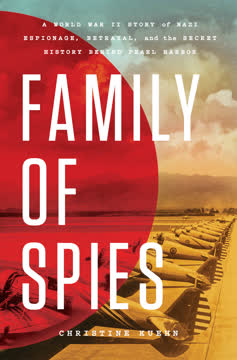
Family of Spies by Christine Kuehn reveals the shocking true story of her grandparents' role as Nazi and Japanese spies in Hawaii before the Pearl Harbor attack. Readers praise this debut memoir for its meticulous research, compelling narrative that reads like fiction, and the author's courage in exposing her family's devastating secrets. The book seamlessly weaves between historical events and Kuehn's thirty-year investigation. Reviewers found it educational, jaw-dropping, and timely, with many calling it essential reading for WWII history enthusiasts and praising narrator Erin Bennett's outstanding audiobook performance.