

Plot Summary
Blue Letter, Falcon Blood
After her marriage collapses and a drunken classroom outburst threatens her academic career, thirty-one-year-old poet Amani Hamdan moves back in with her parents and finds a blue page hidden in her father Gabe’s old book. Its poem, apparently written by his mother Natalia, mentions a lost child and a distant place.
Amani persuades Gabe to accept an invitation from his brother Hafez, a senior royal adviser, to return to Jordan for a month of King H’s birthday events and a fencing exhibition. At the Al-Mafraq falcon gathering, Gabe unexpectedly handles a bird with the ease of his youth. As Amani hurries to him, another falcon tears her shoulder. The wound is shallow, but the trip has already become more than a family visit.
The falcon’s strike turns Amani’s abstract longing into a bodily encounter with a place she has inherited only through silence. Her father’s ease with the bird unsettles her familiar picture of him as a man cut off from his past, while the injury makes her feel like an intruder in the very landscape she came to claim. The blue page offers a different invitation: not a finished family history, but a fragment that demands interpretation. Amani begins by seeking roots as reassurance. The novel immediately complicates that desire by making contact painful, uncertain, and reciprocal.
The King’s Old Partner
Hafez has spent decades close to King H, advising him through negotiations and helping shape a lavish birthday program. He proposes a fencing demonstration after the King remembers Gabe, his former sparring partner, and uses the event to draw his estranged younger brother back after thirty-five years away.
Hafez also asks Gabe to bring Il Saif, their father’s prized knife, which Gabe has guarded since Munif’s death. In Amman, Gabe’s reserved manner contrasts with Hafez’s command of rooms and titles. Their nephew Omar, restless in Jordan and drawn to Gabe’s practical skill, asks him to teach fencing. Gabe agrees, and the lessons give him and Omar a rare intimacy built through movement rather than conversation.
The planned match is both public ceremony and private instrument. Hafez presents it as a celebration of national history, but his invitation also attempts to arrange a family reunion on terms he controls, including the return of Il Saif. Gabe’s arrival exposes the gap between the brothers’ ways of inhabiting identity: Hafez converts history into influence, while Gabe carries it quietly in objects, habits, and physical memory. Omar’s training with Gabe offers a gentler model of inheritance. Skill passes between them without a ledger or a claim, suggesting that family connection can be made through attention rather than authority.
The Necklace of Natalia
While Aunt Carole prepares Amani for a palace dinner, the housekeeper Mrs. Ward hesitates over the elegant gowns and admits she knew Natalia closely. She remembers a woman who welcomed neighbors and children, and whose reading and writing made a difficult life more bearable. Mrs. Ward fears Hafez’s disapproval, yet slips Amani a gold pendant bearing Queen Nefertiti’s profile.
Later, she gives Gabe an embroidered traditional dress for Amani to wear. The clothes alter how Amani sees herself, though Gabe cannot confirm that the dress belonged to his mother. The pendant, however, gives her a tangible connection to the woman whose poem started the journey, and makes Mrs. Ward a cautious guide to the family’s withheld past.
Mrs. Ward’s knowledge comes from years of care, not official standing, and that difference matters. The family’s public story gives status to men who speak confidently about lineage; the housekeeper preserves intimate evidence through objects, labor, and remembered gestures. Her caution reflects the real risks of speaking across household hierarchies, so her small acts of trust carry more weight than a polished family account. Amani’s borrowed dress and inherited pendant do not settle who she is. Instead, they let her inhabit a history that is both material and incomplete, while showing that women have kept its most vulnerable records.
A Fencer at the Banquet
At the King’s birthday dinner, Amani meets Eduardo Attias, a fencing instructor who first saw her at the falcon event. Hafez trades seats so Eduardo can sit beside her, and the two discuss her search for a castle and cemetery mentioned in Natalia’s poem. Their conversation unfolds amid a political argument between a Palestinian professor and an Israeli guest about peace, justice, and who gets to tell history.
The King’s address mourns the recently assassinated Yitzhak Rabin and calls for regional peace. Amani applauds when a visiting writer’s awkward poem draws silence, then tells Eduardo that writing can preserve memory without trapping people in it. His interest in both her poetry and her project gives her a new companion in Jordan.
The banquet compresses the novel’s central conflict into a room where hospitality cannot keep politics outside. The guests debate peace in the same breath as Palestinian dispossession, exposing how official unity can leave unequal histories unspoken. Amani’s instinct to applaud the writer is a small act of protection for a vulnerable speaker, and it parallels her own fear of being silenced as a poet. Eduardo meets her not as a royal niece or a symbol of heritage, but as a person trying to make meaning. Their attraction begins through shared attention to what stories preserve and what they conceal.
Hafez Counts the Heirs
Behind his public role, Hafez pursues a petition over his deceased cousin Amer’s enormous estate, hoping the Church will award the inheritance to him as the family’s firstborn son. He minimizes the existence of other heirs and presents Gabe’s conversion as a reason to exclude him.
Hafez imagines exchanging some land for Il Saif, which he believes should have been his. At the same time, Lubna Waleeda presses him to help free her brother Hassan, a jailed journalist whose criticism questions royal succession.
Hafez promises assistance but fears Hassan could expose the land maneuver. His wife Carole recognizes his appetite for advantage, while Hafez’s old resentment of Gabe, including jealousy over Francesca, keeps turning family affection into competition.
Hafez does not experience greed as greed. He frames property as repair for refugee dispossession and authority as a necessary tool for stability, allowing self-interest to borrow the moral language of public service. Yet his method depends on making other people disappear from the record, just as he resents having felt overlooked by his father. The estate, the knife, and Hassan’s freedom become negotiable tokens in a private economy of favors. His marriage to Carole offers a counterpressure: she sees the calculating habit clearly, even when he wraps it in charm. His political competence and emotional evasions are not separate traits; each sustains the other.
The Room Behind the Party
At a crowded family gathering, Hafez describes Natalia to Amani as weak and consumed by the past, a judgment that jars with Mrs. Ward’s memories. Seeking the bathroom, Amani finds a neglected room in the house’s rear wing. She and Omar discover an armoire holding books, embroidered clothes, costume jewelry, and an envelope of torn blue pages.
The fragments contain Natalia’s unfinished writing and part of a photograph of a young boy who resembles Gabe. Amani takes the papers before the relatives can interrupt them. The room feels less like a family museum than a space preserved out of sight, and its contents show that Natalia’s writing was not a single stray poem. Amani now has evidence to follow, not just a family legend.
The hidden room gives physical form to the family’s selective memory. Natalia has not been wholly forgotten; instead, her books and writing have been stored where they can survive without shaping the public narrative. Hafez’s account reduces her to a cautionary figure, while the fragments show an active mind making and revising work. Omar’s presence matters because he shares the discovery rather than leaving Amani alone with its implications. Their search joins two cousins who feel misplaced in different ways. The papers also resist easy recovery: torn beginnings and a partial photograph offer traces, not a complete biography.
The Cemetery Was a Monastery
Hafez points Amani toward Amman’s Citadel when she asks about the place in Natalia’s poem, but the ruins and burial excavation do not match the page. His eagerness to guide her only deepens her suspicion that he has avoided a question about his mother. Amani and Omar travel to Qusayr Amra, where the elderly caretaker Kurti recognizes Natalia’s name and recalls helping her family flee into Jordan when he was a boy.
He studies the Arabic word Amani had mistaken for cemetery and explains that it refers instead to a place of religious retreat. The destination is a monastery near Karak. His correction changes the search from a hunt for graves to a route toward sanctuary, and Gabe joins his daughter for the journey.
The wrong translation is more than a puzzle clue. Amani’s search has been organized around loss and burial, partly because the family has presented its past as finished. Kurti redirects her toward a place of shelter, shifting the question from what vanished to who might have survived. Hafez’s false lead also shows how control can operate through helpfulness: he does not forbid Amani’s inquiry, but steers it toward a harmless monument. Kurti’s memory counters that maneuver with testimony grounded in lived experience. The novel makes translation an ethical act: choosing the right word changes not only the map, but the kind of history Amani is prepared to find.
Musa Beneath the Hill
At St. Elias Monastery, the nuns find a ledger entry for a boy called Moses, brought to them without identification decades earlier. They lead Amani, Gabe, and Omar up a hillside to a cave, where they meet Musa, an elderly man who lives alone and has little speech. Gabe recognizes a tenderness from childhood but cannot place the memory.
Musa welcomes the visitors, makes tea, and shows them white marks he has drawn on cloth, which he calls an angel. He asks whether they brought his mother. The nuns explain that he has long expected her to return. Amani offers to take him away, but Musa considers the cave home. The family leaves him there, learning that officials may soon remove cave dwellers from the area.
Musa’s cave unsettles the assumption that rescue means relocation. The nuns see both his vulnerability and his fierce attachment to the place he has made livable; Amani feels the moral force of his isolation, while Gabe cannot yet recover what he knows in his body. Musa’s question about his mother binds personal abandonment to the region’s larger history of forced movement. His cloth drawing hints at a language outside ordinary speech, and his care for guests reverses the usual roles of host and dependent. The visit offers belonging without certainty, then immediately places that fragile home under threat from official plans.
Seven Births, Three Graves
Amani meets Sitt Danya, an old midwife who remembers Natalia as a bright, bookish girl who carried her lost home within her. Danya recalls seven children, three of whom did not survive, giving Amani a human measure of the grief hidden behind Hafez’s account.
At a women’s luncheon, Amani also hears accusations that Hafez protects the King from criticism and that Farouq’s company sells a dangerous herbicide. Eduardo shares how his parents concealed his Jewish Moroccan mother’s identity, and he and Amani grow closer.
Meanwhile, the government prepares to clear cave dwellers from historic sites. Gabe gives Amani Il Saif for safekeeping, warning her that Hafez must not know. She carries the family’s most guarded object as Musa’s home becomes more precarious.
The midwife’s memory corrects the family record without pretending that memory is infallible. Her count of Natalia’s children makes loss concrete, while the discrepancy between her recollection and the family’s version keeps uncertainty alive. Amani’s conversations with Jordanian women widen her view of Hafez from charismatic uncle to political actor whose influence has costs. Eduardo’s history of concealed identity offers recognition without making their experiences interchangeable. Gabe’s handoff of Il Saif shifts the heirloom from a contested symbol of male succession into Amani’s responsibility. At the same moment, the state’s planned clearance threatens Musa’s actual home, linking private inheritance to present displacement.
Petra’s Borrowed Duel
Omar brings Musa from his cave to Petra after officials begin removing people from the area, and seats him among the spectators before Gabe’s match. Gabe, who expected a modest demonstration, discovers the event has become a real bout before the King and a large audience. The first exchange goes badly, but he remembers his old training and scores a clean hit in the second round.
The judges nevertheless declare the King the winner, and the King publicly celebrates Gabe as a friend and partner. The crowd cheers both men. Hafez, watching from the arena, sees Musa and is shaken by the sight of the supposedly vanished boy. Amani, seated beside Musa, reassures him that the match is a game, while the old man senses a coming desert wind.
The fencing match gives Gabe a brief return to a self he had not known how to describe to his daughter. His successful touch matters less as a score than as recovered bodily knowledge, while the official decision preserves the King’s symbolic authority. The crowd’s response lets the event hold both truths: the monarch wins publicly, and Gabe has genuinely met him as an equal. Musa’s presence breaks Hafez’s carefully maintained separation between past and present. Amani’s effort to explain the spectacle to Musa reflects her own partial fluency in Jordan, but his warning about the wind suggests that not every danger is visible to the assembled court.
The Brother Hafez Erased
After the match, Hafez demands Il Saif from Gabe, who reveals that he gave it to Amani. Hafez shoves and strikes his brother, accusing him of taking what should have been his. When guards seize Musa in the confusion, Hafez pays them to release the old man into his custody.
His memories expose the original crime: as a boy, he invented a rumor that Ottoman soldiers were taking sons, persuading his father to hide Musa at the monastery. Musa was not a cousin but the Hamdan brothers’ eldest sibling, and his removal let Hafez imagine himself firstborn. In Wadi Rum, Hafez tells Musa that their mother and home are beyond the desert, then leaves him with only water and an orange.
The revelation recasts Hafez’s lifelong hunger for inheritance as the afterlife of a childhood choice. He first made Musa disappear to protect his own position, then built a political and emotional identity around the absence he created. His language of home and peace repeats the original betrayal in a new form: he directs Musa away from real kin and real shelter, treating forgetting as a solution. Gabe’s refusal to surrender the knife marks a break with the family’s old competition, but it cannot prevent Hafez from acting violently. The title of eldest son proves less important than the people Hafez had to erase to claim it.
Lost in Wadi Rum
At Karak, Sister Sylvain and the family find Musa’s cave empty. Driver Samir finally admits he saw Hafez take Musa away, and red dust in the car points toward Wadi Rum. Amani, Gabe, and Omar search for them. A local guide named Daleel secretly drives Amani toward people who may know Musa’s whereabouts, but she loses him among the rocks after stopping to stare at the stars.
Alone, she follows tire tracks through the night, marks her path with identification cards, and fights thirst as morning heats the plain. A sandstorm overtakes her before she reaches shelter. A boy named Zedi finds one of her cards and then finds her, nearly buried. His family takes her in, and her father reaches her that evening.
Amani’s ordeal strips away the protective fictions that have accompanied her search: the assumption that she can enter another person’s past by finding the right place, or that effort guarantees rescue. Her decision to keep walking is both courage and misjudgment, made under incomplete knowledge. The cards she leaves behind turn her professional identity into a trail of possible connection, a practical gesture when language and technology fail. The Bedouin family’s care answers her vulnerability with hospitality rather than interrogation. Her survival does not resolve the search, but it changes her relation to uncertainty: she has learned to endure without controlling what comes next.
A Home Made Room
Kamaria’s family directs Gabe and Amani to a Bedouin healer, who has found Musa scorched and dehydrated but alive. Gabe embraces the brother he once thought lost; the family takes him back to St. Elias, where the nuns welcome him. A later letter from Hafez’s colleague Rafi confirms that local tribesmen rescued Musa after Hafez abandoned him, and the King grants him permanent residency near his cave, with a small dwelling built beside it.
Hafez steps down from government service, and the disputed estate is lost to the state. Gabe returns to Syracuse and shares the truth about Il Saif with Francesca. Amani stays in Amman, runs a café, begins writing from Natalia’s fragments, visits Musa, and cautiously renews her bond with Eduardo.
The resolution does not restore the past intact. Musa receives protection and a home, but only after a family secret, a state threat, and Hafez’s violence expose how easily belonging can be denied. The King’s intervention offers a practical correction, not a moral absolution. Hafez loses the position and estate he had tried to secure, while Gabe returns to his marriage with a renewed sense of what he can still give. Amani’s choice to remain in Jordan is deliberately modest: she serves coffee, writes from fragments, and allows a relationship to develop without demanding certainty. Her new life begins through sustained attention rather than a solved identity.
Analysis
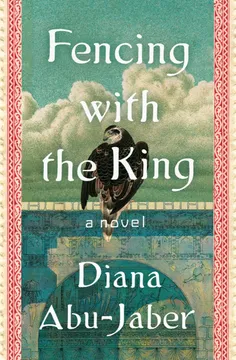
Fencing with the King asks what it means to inherit a history when the people who hold it have edited, buried, or misremembered its details. The novel makes inheritance concrete through Il Saif, Natalia’s writing, the Nefertiti pendant, Amer’s land, and Musa’s cave. Each object or place can be claimed as property, but none can supply belonging by itself. Hafez tries to convert memory into authority: he presents himself as the rightful heir, treats land as compensation for dispossession, and imagines political stability as a reason to silence uncomfortable truths. His central contradiction is that he seeks to repair historical loss by repeating its violence inside his own family. He removes Musa from the record, then spends a lifetime benefiting from the absence he created.
Gabe offers a contrasting model of inheritance. He has preserved the knife and carries memories in his body, but he does not know how to narrate them. His fencing ability survives where his explanations fail, and his return lets Amani see that a parent can contain histories he has never successfully passed on. Amani’s work begins with the hope that finding her grandmother’s birthplace will resolve her own divided identity. Instead, the search teaches her to listen across gaps: to Mrs. Ward, a caretaker, a midwife, nuns, and Bedouin families. Their memories are partial, sometimes conflicting, but their acts of care make a fuller history possible.
The political plot refuses a simple opposition between peace and conflict. Hafez’s diplomatic work seeks an end to violence, yet his version of peace requires forgetting those displaced by it. The novel suggests that reconciliation without truthful memory can become another form of control. Its final repair is practical rather than perfect: Musa receives protection, Gabe returns home with a renewed sense of kinship, and Amani builds a life through writing and service. She does not solve the past; she accepts responsibility for continuing its conversation.
Review Summary
Fencing with the King received mixed reviews, with an average rating of 3.69/5. Readers appreciated the exploration of Jordanian culture, family dynamics, and Palestinian identity. Many found the characters well-developed and the plot engaging, particularly in the latter half. Some praised the poetic writing and historical context. However, others felt the narrative was confusing or lacked depth in certain areas. The fencing aspect was less prominent than expected. Overall, the book was commended for its cultural insights and complex family story.
Characters
Amani Hamdan
The searching poetAmani is a thirty-one-year-old poet and former professor whose marriage has ended and whose writing has stalled. She is observant, intellectually restless, and inclined to investigate what others would rather leave unspoken. Her Arab American identity has often felt divided between inheritance and distance, while alcohol has become a way to quiet the disarray she cannot put into words. The blue page in her father’s book gives her a reason to travel toward family history, but she gradually learns that ancestry is not a ready-made home. Her attention to objects, stories, and people others overlook helps her build a more deliberate relation to both writing and belonging.
Gabe Hamdan
The quiet returning fatherGabe is Amani’s father, a carpenter who has spent decades building a life in upstate New York after leaving Jordan. He is warm but reticent, more comfortable with tools and physical tasks than with explaining his feelings. His fluency in Arabic and his memories of fencing connect him to a younger self that his family rarely sees. Gabe worries that his distance from Jordan left Amani without part of her inheritance, yet he also respects her independence. His bond with her is expressed through acts of care, patient listening, and a shared willingness to return to questions he once avoided.
Hafez Hamdan
The royal family strategistHafez is Gabe’s older brother, a senior adviser to Jordan’s king and a practiced host, diplomat, and storyteller. He is intellectually gifted, socially agile, and convinced that influence can be used to preserve stability. Beneath his charm lies a persistent fear of being overlooked, especially by his father and by the younger brother who seemed to receive affection more easily. Hafez treats family history as something he can organize and interpret for others, but his need to control its meaning strains his loyalties. His ambition and genuine attachment to Jordan coexist uneasily, making him both persuasive and deeply self-protective.
Musa Hamdan
The solitary cave dwellerMusa is an elderly man who lives in a cave near St. Elias Monastery, where he has made a simple home from earth, stone, and the help of local people. He speaks little and moves with a stillness that makes others unsure how to read him. He is attentive to animals, visitors, and the land around him, and he offers hospitality even when his own circumstances are precarious. Musa’s longing for his mother shapes how he understands home, while his drawings and small rituals give him ways to express what ordinary conversation cannot. His presence draws Amani and Gabe toward parts of their family past they do not yet understand.
Eduardo Attias
The fencing instructorEduardo is a former Olympic fencer who runs Jordan’s Royal Fencing Academy. He is physically controlled and attentive, with a habit of using fencing as a language for balance, risk, and response. His family history crosses religious and national boundaries, and the concealment surrounding his mother’s origins has made him wary of identities imposed by others. He recognizes Amani’s curiosity without treating it as a novelty and encourages her to trust her own perceptions. His attraction to her is shaped by directness and patience, though he must accept that her choices cannot be settled on his preferred timetable.
Omar
The restless cousinOmar is Farouq’s son and Amani’s younger cousin, raised in Amman with strong ties to American culture through his mother. He is candid, energetic, and impatient with the constraints of family expectations. His friendship with Amani grows from their shared sense of living between places. He admires Gabe’s practical confidence, trains with him, and helps Amani investigate the family’s past. Omar dreams of building a fitness business and wants a future that is not merely an extension of his father’s success.
Francesca
Gabe’s steady partnerFrancesca is Gabe’s Sicilian American wife and Amani’s mother, a school principal who is practical, perceptive, and quietly generous. She is often the person who can name what her family is avoiding, but she also knows when advice cannot substitute for experience. Her work and responsibilities keep her in Syracuse when Gabe and Amani travel to Jordan. Francesca’s compassion is active rather than sentimental: she gives time, care, and even parts of herself to others, while expecting those she loves to make their own choices.
Carole
Hafez’s clear-eyed wifeCarole is Hafez’s American-born wife, long accustomed to the social world of palace events and diplomatic gatherings. Her dry humor punctures Hafez’s self-importance, and she recognizes his tendency to turn nearly every encounter into an opportunity. She is generous to Amani, offering clothes and access to family life, but she is not blind to the tensions around her husband. Her independence and skepticism provide a counterweight to Hafez’s polished explanations.
Natalia Hamdan
The absent writerNatalia is Gabe and Hafez’s mother and Amani’s grandmother, a Palestinian refugee who was displaced as a girl and married into the Hamdan family in Jordan. She is remembered as deeply bookish, generous to neighbors, and given to writing in Arabic and other languages. The losses she carries shape her family life, but her private pages reveal a mind still reaching for expression. Though she died before Amani was born, her writing and belongings become a source of questions that challenge the stories her descendants tell about her.
Farouq
The prosperous middle brotherFarouq is Gabe and Hafez’s brother, Omar’s father, and a successful businessman with investments in property and commerce. He is genial and hospitable, proud of his ability to make money, and comfortable in Amman’s changing economy. His easy manner can conceal the effects of his business choices, which are criticized by women involved in local activism. Farouq provides Amani and Gabe with a place to stay, though his family’s loyalty to Hafez makes the household part of the tensions Amani is trying to understand.
Mrs. Ward
Natalia’s careful witnessMrs. Ward is a longtime housekeeper in the Hamdan household who knew Natalia personally. She is reserved and wary of speaking against family expectations, yet she carries memories and objects that the family’s official accounts have left aside. Her connection with Amani develops through hesitant acts of trust, including sharing a necklace and preserving Natalia’s papers. Mrs. Ward understands that care can mean keeping a story safe until someone is ready to hear it.
Samir
Hafez’s observant driverSamir is Hafez’s longtime driver, a member of the Beni-Sakhr Bedouin tribe and a practical observer of the people around him. He knows the roads and the desert by texture, not just by maps, and his judgment becomes important when the family is searching for Musa. Though Hafez has kept him at a distance, Samir has noticed more than his employer assumes. His choice to speak to Amani reflects a quiet loyalty to people rather than rank.
Sister Sylvain
Musa’s monastic guardianSister Sylvain is a nun at St. Elias Monastery who helps preserve its records and looks after people who have nowhere else to turn. She is open to outsiders but clear-eyed about the limits of the convent’s authority. Her concern for Musa is practical: she brings supplies, searches for him, and asks Amani to help when officials threaten his home. She represents care as sustained work rather than rescue as a single dramatic gesture.
Lubna Waleeda
The influential advocateLubna Waleeda is a socially prominent woman connected to Jordan’s Orthodox Church and involved in women’s organizations. She is intelligent, politically aware, and unwilling to let her brother’s imprisonment become an abstraction. Her relationship with Hafez brings private desire into contact with public bargaining, and she understands that influence can be used to press for change as well as privilege.
Sitt Danya
The village midwifeSitt Danya is an elderly woman from the vanished village of Yara who delivered children and treated the sick. Her memory of Natalia is affectionate but not idealized, and she can recall family details that official records have lost. Amani approaches her as a link to the past, but Danya also gives her a more personal measure of the people and losses behind the family stories.
King H
The monarch’s old partnerKing H is Jordan’s monarch and Hafez’s longtime political partner. He is a practiced public figure who uses ceremonial events to present an image of national unity and a commitment to peace. His old fencing connection with Gabe gives the birthday celebrations a personal dimension. The King’s authority can create opportunities for spectacle, but it also shapes the political limits within which Hafez and other officials operate.
Kurti
The castle caretakerKurti is the elderly caretaker at Qusayr Amra. As a boy, he helped guide Natalia’s family into Jordan, and he remembers her as a young person with ambitions of writing and painting. His knowledge of Arabic helps Amani correct a crucial misunderstanding in the blue page.
Kamaria
The desert hostKamaria is a Bedouin mother living with her daughter in Wadi Rum. She shelters Amani after the young woman is found exhausted in the desert and helps connect her family with people who may know where Musa is.
Zedi
The boy who finds AmaniZedi is Kamaria’s young son, who finds Amani’s identification card and then discovers her nearly buried in the desert. He shares his water and guides her back toward his family’s camp.
Father Jacob
The guarded archbishopFather Jacob is the Orthodox archbishop who must consider Hafez’s inheritance petition. He is cautious about the law and skeptical of Hafez’s smooth arguments, giving the church’s authority a necessary independence from royal and family pressure.
Plot Devices
The blue page
A map hidden in a poemA sheet of blue paper found inside Gabe’s Arabic poetry book contains Natalia’s handwritten lines about a lost child and a place of refuge. Amani uses the page to begin her search, but a mistranslated word sends her first toward a cemetery rather than a monastery. Its significance lies in how the poem creates a route while remaining incomplete: each clue requires another person’s knowledge, and the search becomes a collaboration among generations.
Il Saif
A contested family inheritanceThe old knife belonged to the Hamdan family and was given to Gabe by their dying father. Hafez associates it with birthright, cultural authority, and the inheritance he believes he was denied. Gabe’s decision to entrust it to Amani changes its meaning from an object men compete to possess into a responsibility she must protect. Its legendary history is less important than the family’s conflicting interpretations of what a legacy should demand.
The fencing exhibition
A public past made physicalThe King’s birthday match gives Hafez a reason to bring Gabe back to Jordan and gives the palace a carefully staged display of tradition. For Gabe, fencing restores a skill and identity he had put aside; for the audience, the bout turns personal history into public entertainment. Its ceremonial score and the genuine exchange between the two fencers do not quite agree, which lets the scene hold both political spectacle and emotional truth.
The Nefertiti pendant
A shape passed between generationsMrs. Ward gives Amani a pendant bearing Queen Nefertiti’s profile, an object connected to Natalia and preserved outside the family’s formal record. Musa later makes a white drawing on cloth that resembles the pendant, linking his private creative practice to the same family past. The object helps Amani recognize a connection that speech and official documents have not supplied. It becomes a portable sign of care, memory, and the possibility that inheritance can be carried without being owned.
Musa’s cave
A home under threatMusa’s cave is both shelter and an expression of his chosen way of living. He smooths its walls, prepares tea, and welcomes guests there, while the government’s plan to clear cave dwellers places his home at risk. The cave also connects family separation to the wider displacement of people whose claims are inconvenient to official accounts. The book refuses to treat the site as merely a symbol: Musa’s attachment is physical, daily, and shaped by the care of the local community.
Download PDF
Download EPUB
.epub digital book format is ideal for reading ebooks on phones, tablets, and e-readers.








