

Key Takeaways
Trace the overlooked Mossad link across the CIA, Lansky network, and Dallas.
A neglected clue. Piper says his inquiry began with an account that Cuban exiles had heard Jewish backers were involved in a plot against Kennedy. He noticed that a later book about a Mafia conspiracy omitted this detail. Newly available accounts of Kennedy’s conflict with Israel then gave the clue a possible motive and context.
The central allegation. Piper argues that Israel’s Mossad helped coordinate the assassination alongside CIA elements and Meyer Lansky’s organized-crime network. He presents this as the missing connection among familiar theories involving the CIA, anti-Castro Cubans, organized crime, and Lee Harvey Oswald. The book assembles circumstantial links; it does not establish that the Mossad ordered the killing as a documented fact.
The book’s strongest organizing move is to ask whether the familiar suspects were connected rather than mutually exclusive. That is a useful network model: separate actors can share money, contacts, or aims without belonging to one formal organization. Yet a network of associations is not automatically a conspiracy. The crucial question is whether evidence shows communication and coordinated action, not merely overlapping relationships. The distinction matters especially here, where the claim concerns specific state agencies and individuals, not Jews as a group.
Treat Kennedy’s nuclear clash with Ben-Gurion as a motive worth testing.
A hidden conflict. Piper’s key historical backdrop is Kennedy’s effort to prevent Israel from developing nuclear weapons. He recounts Kennedy pressing Prime Minister David Ben-Gurion for inspections of the Dimona facility, while Israel maintained that its nuclear work was peaceful. The book says the inspections were limited and staged, and that Kennedy remained unconvinced.
A policy reversal. Ben-Gurion resigned in June 1963 amid several pressures, including his impasse with Kennedy. Piper argues that Kennedy’s death removed a serious obstacle to Israel’s nuclear ambitions. He contrasts Kennedy’s approach with Lyndon Johnson’s presidency, when reported U.S. aid to Israel rose from $40 million in fiscal year 1964 to $130 million in 1966. Piper treats this shift as evidence of motive, not proof of assassination.
The nuclear dispute gives the book a specific geopolitical question that generic claims about a military-industrial plot often lack. In security studies, leaders can interpret the same weapons program as defensive insurance or destabilizing proliferation. That helps explain why Kennedy and Ben-Gurion could regard the issue as existential from opposite directions. But motive is only one element of a historical case. A policy change after an assassination may benefit a country without showing that its officials caused the killing.
Follow Permindex’s money trail before treating it as proof of a plot.
A corporate crossroads. Permindex, short for Permanent Industrial Expositions, was presented as an international trade venture with offices in Europe and connections to the Rome-based Centro Mondiale Commerciale. Clay Shaw, a New Orleans trade executive, served on its board. The book links Permindex’s chairman, Louis Bloomfield, to Israeli interests and its financing to Banque de Credit International, founded by Mossad-linked banker Tibor Rosenbaum.
A proposed bridge. Piper argues that Permindex connected the Mossad, CIA, Lansky’s network, and the French anti-de Gaulle milieu. He treats Shaw’s board position and New Orleans contacts as part of that larger web. The connections are worth investigating, but a board seat or financial relationship alone does not establish that a company funded or directed an assassination. The book’s strongest claim depends on interpreting these links together.
Following corporate and financial ties can reveal relationships that political histories overlook. It is a sound investigative instinct, particularly when a company’s purpose, ownership, or funding is opaque. The analytical danger is guilt by association: a person’s presence on a board does not prove knowledge of every activity linked to that organization. A strong case needs records showing decisions, payments, or communications that connect the entity to the specific crime, not only a dense map of affiliations.
Treat Oswald’s public persona as a possible operation, not settled fact.
A staged identity. Piper argues that Oswald’s public image as a pro-Castro activist may have been deliberately constructed. He points to Oswald’s activities in New Orleans, his contact with Banister and Ferrie, and the publicity provided by WDSU radio and television. He also questions the CIA’s account that Oswald visited Soviet and Cuban offices in Mexico City, describing the evidence as unreliable.
A possible patsy. In this account, Oswald may have believed he was taking part in an anti-Castro deception or another intelligence operation, while others shaped the evidence that would point toward him. The book does not prove what Oswald knew or intended. It argues that his public actions, intelligence contacts, and later role as the accused assassin should be examined as potentially connected rather than treated as unrelated facts.
The idea of a constructed public identity is a useful lens for intelligence history, where overt political activity can conceal other purposes. It also invites a basic evidentiary test: who arranged each appearance, who recorded it, and who controlled the resulting information? The book raises those questions effectively. Its weakness is that a staged persona can become an all-purpose explanation. Without independent records linking handlers to a specific plan, apparent coordination may remain an interpretation rather than a demonstrated operation.
Follow the money beyond the Mafia label to Lansky and BCI.
A broader criminal network. Piper argues that Meyer Lansky was not a minor adviser to Italian-American mob bosses but a powerful organizer and financier whose influence crossed national borders. He links Lansky’s associates, including Carlos Marcello and Santo Trafficante, to the CIA’s anti-Castro operations and to gambling and drug networks.
A financial connection. The book presents Banque de Credit International, or BCI, as a Mossad-linked bank that handled Israeli funds and allegedly laundered money for Lansky’s associates. Piper also connects the CIA and organized crime to drug trafficking in Southeast Asia during the Vietnam War. These claims widen the proposed conspiracy beyond Dallas, but the supporting evidence varies in quality. Financial and criminal associations deserve scrutiny, not automatic acceptance as proof of a shared assassination plan.
The focus on money and logistics broadens a story often reduced to famous mobsters and their motives. Network analysis is useful because financial intermediaries can connect actors who never meet directly. Still, the book sometimes treats a shared bank, business, or operation as evidence of a unified command structure. Historians need to distinguish cooperation on one project from a continuing alliance, and both from participation in a particular murder.
Treat Ruby as a hinge between Oswald, organized crime, and intelligence.
The arrest becomes a second killing. Jack Ruby shot Oswald in a Dallas police station two days after Kennedy’s assassination, preventing a public trial of the accused gunman. Piper emphasizes Ruby’s reported ties to Lansky’s criminal network, his arms dealings, his contacts with CIA-linked figures, and his visit to Cuba.
An unresolved role. The book argues that Ruby was more closely connected to Lansky and Israeli interests than standard Mafia accounts acknowledge. It also notes that Ruby claimed to help Israeli reporters at the police station and that the Warren Commission did not pursue every lead about his associates. These details make Ruby central to the cover-up theory, but they do not prove he knew of the assassination beforehand or acted under Mossad orders.
Ruby’s killing of Oswald undeniably altered the evidentiary landscape: a trial could no longer test Oswald’s account or expose possible accomplices. That makes Ruby a crucial figure even without accepting every allegation about his affiliations. The book is right to ask why investigators did not fully pursue his contacts. Yet proximity, phone calls, and criminal associations show access, not necessarily foreknowledge. The distinction between silencing a witness and participating in the original murder remains essential.
Demand evidence for media complicity, not just evidence of media silence.
A contested narrative. Piper argues that the Warren Commission’s lone-gunman conclusion was reinforced by media outlets tied to political and intelligence interests. He singles out New Orleans station WDSU, which broadcast Oswald’s pro-Castro statements, and columns by Drew Pearson and Jack Anderson that promoted a Castro-related theory. He also criticizes Oliver Stone’s film for omitting what Piper calls the Israeli connection.
Silence and framing. The book suggests that press attention and omission helped direct public suspicion toward convenient alternatives. Its examples show how coverage can shape what readers consider plausible. But limited coverage, editorial choices, and inaccurate reporting do not by themselves prove centralized coordination. Piper’s argument is strongest when it identifies specific relationships and actions; it is weaker when silence itself is treated as evidence of a coordinated cover-up.
Media framing is a genuine part of political history: repeated emphasis on one explanation can make alternatives seem marginal before they are examined. The book usefully asks who gets access to national platforms and which claims receive credibility. A further step is to test whether similar coverage arose from direct coordination, shared institutional assumptions, or ordinary editorial incentives. Those mechanisms can produce similar outcomes, but they imply very different levels of conspiracy.
Test the proposed SAVAK link to RFK’s murder independently.
A related allegation. Piper extends his argument to Robert F. Kennedy’s 1968 assassination. He draws on former CIA operative Robert Morrow’s account that Iran’s SAVAK, the Shah’s secret police, helped organize the killing in cooperation with the CIA and Israeli intelligence. Morrow alleges that Sirhan Sirhan was not the only shooter and that an additional gunman escaped.
Evidence remains disputed. Sirhan was arrested, tried, and convicted for the murder. Piper presents Morrow’s account as a significant alternative, not as an established official finding. He connects SAVAK to the CIA and Mossad through its formation and training, then argues that RFK’s death prevented him from investigating his brother’s assassination. This is a consequential claim, but it rests heavily on contested testimony and requires independent corroboration.
Linking the two Kennedy assassinations offers a compelling narrative of political succession and lost accountability. It also carries a heightened risk: a dramatic connection can make uncertain testimony feel more convincing simply because it completes a story. A careful reader should separate the documented facts of Sirhan’s arrest and conviction from claims about a second gunman, foreign intelligence direction, and motive. Each proposition needs its own evidence rather than borrowing certainty from the others.
Distinguish motive, access, and proof before naming an assassin.
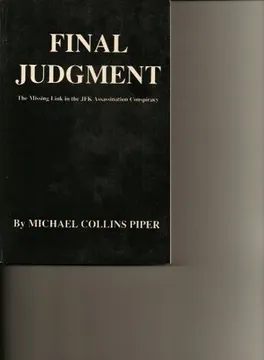
A large evidentiary mosaic. Final Judgment gathers published accounts, government documents, reported contacts, and claims from former intelligence figures. It was repeatedly expanded, reaching 768 pages in the sixth edition, with more than a thousand footnotes. Piper uses this volume of material to argue that overlooked connections form a coherent account of the assassination and its cover-up.
A necessary test. Some sources are anonymous, some claims are secondhand, and several conclusions depend on inference from who knew whom or who benefited afterward. A plausible motive and access to the scene are important leads, but neither alone proves that an agency ordered murder. The book’s allegations should therefore be separated into documented facts, disputed testimony, and Piper’s interpretations before readers accept its final conclusion.
The book’s ambition is to replace isolated theories with a connected explanation, and that synthesis is its central intellectual contribution. Its footnotes make the trail inspectable, but citation volume is not the same as independent corroboration. A rigorous assessment asks whether each link has a reliable source, whether alternative explanations fit the same facts, and what evidence could disprove the thesis. The careful distinction between Israeli institutions, individual officials, and Jewish people is equally important.
Analysis
Final Judgment is a sprawling, thesis-driven conspiracy history built from a mosaic of intelligence, organized-crime, diplomatic, and media connections. Its central contribution is to foreground an underexamined historical question: Kennedy’s conflict with Israel over nuclear development and Middle East policy. That conflict supplies a specific motive worth investigating and links the book’s account to documented changes in U.S. policy after 1963. The book’s narrative then connects Mossad, CIA figures, Meyer Lansky’s network, Permindex, New Orleans operatives, Oswald, Ruby, and the later RFK assassination.
The strongest part of the argument is its insistence that motive and institutional relationships belong in the assassination inquiry, not only ballistics and the identity of the shooter. Its weakest part is the leap from association to coordination. Shared contacts, financial ties, and political benefit may establish opportunity or context, but they do not independently prove an order to kill. Anonymous sources, retrospective testimony, and disputed claims often carry the burden of the most consequential conclusions. The book’s scale and footnotes make it appear comprehensive, yet more references do not necessarily mean independent confirmation.
A further concern is the book’s tendency to blur the Israeli state, the Mossad, the ADL, Jewish Americans, and Jewish organized crime into a single network. These are distinct actors and institutions; conflating them risks turning criticism of specific governments or agencies into broad ethnic suspicion. A careful reader can take the Kennedy-Israel conflict seriously while still requiring direct evidence for the alleged conspiracy. The most productive use of the book is therefore as a map of questions and leads, not as a settled verdict. Its challenge is to test each link against competing explanations and distinguish what is documented from what Piper infers.
Review Summary
Reviews for Final Judgment are largely positive, averaging 4.32/5. Many readers praise the book's extensive research and unique thesis linking Israel's Mossad, organized crime, and the CIA to JFK's assassination. Supporters highlight its compelling connections and extensive citations, calling it essential reading. Critics, however, argue the book makes unsupported leaps, relies on circumstantial connections, and reflects the author's apparent bias against Israel. Some note its disorganized structure and repetition, while others believe its conclusions become increasingly credible given modern political developments.
Glossary
Permindex
Trade venture alleged as a frontA Rome-based international trade venture whose name was derived from Permanent Industrial Expositions. Piper argues that Permindex was more than a commercial enterprise and served as a Mossad-linked channel connecting intelligence, financial, and organized-crime figures. Clay Shaw, the New Orleans businessman prosecuted by Jim Garrison, sat on its board. The book treats Permindex as a key link, though its alleged role in the assassination remains disputed.
Mossad
Israel’s foreign intelligence serviceIsrael’s foreign intelligence agency, which Piper argues worked alongside elements of the CIA and Lansky’s criminal network in the JFK assassination conspiracy. The book links Mossad figures to nuclear procurement, Permindex, and covert relationships with other intelligence services. Its central claim is not that Jewish people collectively participated, but that specific Israeli officials and institutions were involved.
false flags
Operations concealing their sponsorA covert tactic in which an operation is arranged to make responsibility appear to belong to someone other than its actual sponsor. Piper argues that the Mossad used this approach in other events and that Oswald’s public image as a pro-Castro agitator may have served a similar purpose in the JFK case. The book presents this as a pattern and interpretation, not conclusive proof of responsibility.
Lansky Crime Syndicate
Lansky-led transnational crime networkPiper’s term for the broad organized-crime system he believes was financially and strategically led by Meyer Lansky. It includes, but is not limited to, Italian-American Mafia figures such as Carlos Marcello and Santo Trafficante. The book argues that Lansky’s connections to Israel and the CIA have been obscured by accounts that focus only on the Mafia. The term reflects Piper’s framework, not a formal organization chart.
Banque de Credit International
Geneva bank linked to RosenbaumA Geneva-based bank founded by Tibor Rosenbaum, a financier whom Piper identifies as a former Mossad official. The book describes the bank as handling Israeli funds and alleges that it also laundered money for Lansky-linked interests. Piper uses it to connect financial operations to the Permindex network. These alleged activities should be distinguished from the bank’s documented existence and ownership.
sheep-dipping
Creating a misleading public identityA term used in the book for presenting an intelligence-linked person as an ordinary member or advocate of a political movement, thereby obscuring their actual role. Piper applies it to the claim that Oswald’s visible pro-Castro activity in New Orleans was staged or managed to create a public identity that could later direct suspicion. The book does not establish exactly who arranged every part of this process.
SAVAK
The Shah’s Iranian secret policeIran’s security and intelligence service under the Shah. Piper, drawing on Robert Morrow’s account, says SAVAK was established with help from the CIA and Mossad and later links it to the 1968 assassination of Robert F. Kennedy. The alleged SAVAK role in that killing, including the claim of a second gunman, is disputed and should not be treated as an established finding.
Operation Mongoose
CIA anti-Castro campaignThe name used for a CIA campaign against Fidel Castro’s government that included support for Cuban exile operations. Piper describes organized-crime figures as collaborators in some anti-Castro efforts and places these networks within the broader context of JFK’s conflict with the CIA. The book argues that the same circles later intersected with the assassination conspiracy, though each specific connection requires separate scrutiny.
Download PDF
Download EPUB
.epub digital book format is ideal for reading ebooks on phones, tablets, and e-readers.








