

Key Takeaways
Treat beauty as labor shaped by markets, not merely personal taste
A city as a preview. When journalist Elise Hu moved to Seoul, she found ads filled with nearly interchangeable faces, beauty shops on every block, and cosmetic procedures treated as ordinary upkeep. She was drawn in, too: after having a baby, she bought skincare products and tried spa treatments, while wondering where care ended and pressure began. Her freckles, previously unremarkable to her, became a target for unsolicited offers to remove them.
The cycle behind the products. The book argues that beauty standards and the businesses selling solutions reinforce one another. A narrow ideal makes ordinary features look like problems; products and procedures promise to fix them; widespread correction makes the ideal seem more natural and necessary. Seoul makes this cycle unusually visible, but Hu presents it as a preview of a global, image-saturated culture, not an exotic exception.
The framework is useful because it shifts attention from whether one product is good or bad to who defines the problem, who sells the remedy, and who bears the costs. That resembles a familiar economic externality: one person’s purchase can raise the standard others feel expected to meet. Yet beauty rituals are not reducible to manipulation. Pleasure, identity, sensory comfort, and social belonging are real benefits. The sharper question is whether people can decline the work without losing respect, opportunity, or safety.
K-beauty exported an aesthetic through pop culture, policy, and speed
A cultural export. Hallyu, the Korean cultural wave, carried K-dramas and K-pop to global audiences, along with the looks and products associated with their stars. After the 1997 financial crisis, South Korea deliberately invested in culture as a source of international influence and economic growth. Cosmetics exports rose from $1.6 billion in 2014 to $6.3 billion in 2018.
Fast from idea to shelf. Korean manufacturers can take a product from concept to production in months, helping brands test new formats and quickly discard what fails. K-beauty popularized budget cosmetics, BB cream, and the cushion compact, which stores liquid makeup in a sponge inside a portable case. Its market also blends heritage ingredients, such as green tea, with scientific research and novelty. The result is not just a skincare routine, but a fast-moving system for making and exporting beauty trends.
K-beauty’s expansion shows how culture and commerce can function as one distribution network. Entertainment creates familiarity and desire, while manufacturers and retailers make the desired look purchasable. That is a sophisticated export model, and it helps explain why an aesthetic can travel farther than a product advertisement alone. The trade-off is that national success stories can blur internal inequalities. A country’s cultural influence may grow even while many women face limited economic power and intense pressure to match the images being exported.
When appearance becomes a hiring credential, beauty stops being optional
Lookism at work. Lookism means prejudice or unequal treatment based on appearance. Hu describes a society where applicants may be expected to submit photos, height, and weight with résumés. A 2017 poll found that nearly 40 percent of respondents had experienced appearance discrimination when applying for jobs, and a survey of businesses found about 60 percent required a headshot. Some job listings described ideal candidates as neat or beautiful, while official guidance once suggested cosmetic surgery could help job seekers.
Unequal stakes. The pressure falls especially heavily on women in a labor market where men dominate leadership and women face a large wage gap. Beauty work can therefore seem like a rational investment in employment or marriage prospects, even when the standard is unfair. South Korean men also face grooming pressures, but women are more likely to find appearance a basic condition of entry rather than an optional advantage.
This is where personal grooming becomes a labor-market institution. If employers use photographs or coded appearance criteria, applicants must spend time and money competing on a dimension unrelated to their actual work. The incentive is self-reinforcing: once appearance becomes a screening tool, individuals have reason to comply, and employers can mistake the resulting uniformity for professionalism. The pattern is not unique to Korea, though its explicit résumé conventions make the mechanism easier to see. Removing irrelevant appearance filters is more effective than asking applicants to resist them individually.
Social platforms turn borrowed ideals into self-surveillance
The technological gaze. Hu uses this term for appearance standards shaped and circulated by digital platforms and their algorithms. A filter can smooth skin or alter a jaw; repeated exposure then makes that edited face seem ordinary. Users compare themselves with images, edit their own appearances, and return to the platform for feedback. The gaze becomes internal: people monitor themselves even when no one is visibly judging them.
From filter to procedure. South Korea’s early, widespread connectivity and dense visual advertising offer a concentrated view of this dynamic. Beauty apps and image feeds can make small bodily variations look like defects, while clinics offer physical changes that bring a face closer to its digital version. The book describes this as a feedback loop between surveillance technologies and self-improvement technologies, not simply a matter of individual vanity.
The concept connects beauty pressure to the attention economy: platforms learn which images hold attention, then deliver more of them. The user experiences a personal preference, while the system quietly shapes the menu of what looks desirable. This does not mean algorithms dictate every taste. People interpret images through culture, relationships, and their own aims. Still, the design matters: when editing tools are automatic and engagement rewards conformity, individual choice operates inside an environment built to steer it.
Cheap, routine procedures can make correction a recurring business
Gangnam’s correction market. Seoul’s Improvement Quarter, the concentrated cluster of cosmetic clinics in Gangnam, contained about 400 of the roughly 538 plastic surgery clinics in Seoul in 2020. The procedures range from surgery to injections and laser treatments, and lower prices and medical-tourism packages draw clients from abroad. By 2019, nearly half a million foreign medical tourists visited South Korea, an eightfold increase from 2009.
Small interventions add up. Hu tried injections marketed as a modest skin treatment. A dermatologist made 274 injections across her face for $625, with results expected to last about two months. The procedure smoothed her skin but also changed her smile in a way she disliked. Lower cost and lower invasiveness can make a treatment easier to repeat, while clinics have incentives to keep new procedures and clients flowing. Risks and dissatisfaction, however, remain the patient’s to manage.
The important shift is not simply that surgery becomes more accessible. It is that recurring maintenance can turn a one-time decision into a subscription-like relationship with one’s own face. Lower prices may expand access and make care less elitist, but they can also obscure cumulative cost, medical risk, and the commercial incentive to invent new areas for correction. A sound assessment should distinguish clinical benefit from cosmetic demand, and should include realistic discussion of duration, uncertainty, and possible changes a patient may not welcome.
Challenge the systems that price thinness as social belonging
A size standard with consequences. In many Korean boutiques, “free size” is roughly equivalent to a U.S. size 2, leaving larger customers with few options. Media and entertainment also define ideal proportions for legs and bodies. These expectations are more than images: K-pop trainee Kong Youjin said her group had a 46-kilogram weight limit and was weighed as many as ten times a day. She eventually fell to 42 kilograms while eating very little.
Pressure becomes personal. Matchmaking agencies score clients partly on height, weight, and attractiveness, and social media can fill young users’ feeds with extreme dieting content. Hu argues that thinness is often treated as proof of discipline and social fitness, while those who do not conform are blamed for lacking willpower. This helps explain why body dissatisfaction can persist even among women who are already very slim.
The chapter’s strongest point is that body ideals are enforced through ordinary systems: clothing stock, entertainment contracts, matchmaking, and recommendation feeds. Those structures make an arbitrary standard feel like common sense. The evidence is particularly vivid in the trainee’s repeated weigh-ins, though no single account can represent every performer or explain every eating disorder. A useful response therefore pairs cultural critique with practical support, including safer health care, less appearance-based selection, and access to clothing that does not require bodies to conform.
Keep beauty marketing from turning childhood play into lifelong upkeep
Appearance enters early. A 2016 survey of elementary-aged Korean girls found that two in five wore makeup. Children also encounter face filters, makeup tutorials, dress-up corners, toy cosmetics, and children’s spas. Some services are designed to be age-appropriate, such as water-based nail polish, and children may experience them as play or a pleasant ritual with a parent.
Play can become a sales funnel. Brands describe young customers as a new market between baby toys and adult cosmetics. Marketing often presents beauty routines as bonding between mothers and daughters, while children copy the adults and online personalities around them. Hu does not argue that every manicure harms a child. She asks how much of a child’s interest is freely formed when advertising, peer approval, and digital images continually teach girls that appearance is a central part of being a girl.
The distinction between play and grooming is not always clean. Pretending to apply makeup can be imaginative, social, and harmless; commercial systems can also attach gender expectations to the same activity. Developmental psychology emphasizes that children learn through imitation, making the surrounding examples unusually influential. That does not require treating children as passive or banning every beauty product. It does support age-appropriate advertising rules, clear product information, and adult conversations that leave room for interests unrelated to appearance.
Do not mistake constrained beauty choices for vanity or pure freedom
Agency inside a system. Hu resists the easy claim that women who alter their appearance are either dupes or wholly liberated. Earlier Korean Modern Girls and Factory Girls used makeup and fashion to express themselves and blur class boundaries, despite being criticized for doing so. Today, appearance work may help someone navigate job or marriage markets, express an identity, or feel more at home in their body. For some transgender women, feminine presentation or facial procedures can be tied to safety and social recognition.
The choice has conditions. A choice can bring real benefits while still being shaped by pressure, price, and limited alternatives. Kkotminam, or “flowerboy,” describes a soft, carefully groomed masculine style popularized through Korean pop culture. It broadens what masculinity can look like, though appearance demands remain more compulsory for women. The book’s point is not to judge each person’s decision, but to examine the system surrounding it.
This account avoids a common ethical trap: condemning individuals for adapting to incentives they did not create. A constrained choice can be meaningful and strategic without being fully free. That distinction is useful well beyond beauty, from workplace dress to health decisions. It also protects against treating empowerment as a simple label. The relevant questions are what a practice enables, what it costs, and whether people can refuse it without disproportionate penalty.
Collective refusal can reclaim time, though it carries real penalties
The Escape the Corset movement. In 2018, hundreds of thousands of South Korean women, many in their teens and twenties, publicly rejected appearance rules by cutting their hair, abandoning makeup, and sharing images of discarded cosmetics. They described relief at recovering time, money, and attention previously spent on constant grooming. The movement challenged not only the beauty industry but also the broader expectation that women should be agreeable, attractive, and available for others’ approval.
Appearance and surveillance meet. The protests overlapped with demonstrations against molka, hidden cameras used to record women without their knowledge, often in bathrooms and other private spaces. Activists connected being watched with being compelled to perform femininity. Refusing the expected look could bring ridicule, social isolation, or workplace penalties, so opting out was not a cost-free personal preference. The collective action made those costs visible and gave participants support.
A coordinated refusal changes the meaning of an individual act. One person without makeup can be dismissed as careless; many people acting together can expose the rule that made makeup feel compulsory. This is a classic collective-action problem: the benefits of a wider norm belong to many, while the early costs fall on those who challenge it. The movement’s limits matter too. Public refusal cannot by itself end sexism or digital abuse, but it can make previously invisible expectations available for argument.
Choose body care for connection and capacity, not endless correction
Care can change its purpose. Hu’s conversations with older Korean American women reveal routines that are less about chasing youth than showing respect, enjoying touch, and staying connected. One woman wore light makeup to feel appropriately presented; another enjoyed monthly facials for relaxation and the human contact. They accepted aging without treating every wrinkle as an emergency. Their example complicates the idea that rejecting beauty standards requires rejecting all grooming.
A practical test. Hu points toward body neutrality, the idea that a body need not be judged beautiful or ugly to deserve care, and sensualism, an approach that values what bodies can do and feel. A useful question is whether a ritual supports comfort, pleasure, movement, or connection, or instead intensifies monitoring and dissatisfaction. The goal is not a universal ban on beauty work, but more room to choose it without compulsion.
This ending replaces the demand to love every feature with a more attainable standard: a body can merit care without winning an aesthetic contest. That distinction can reduce the pressure to turn self-acceptance into another performance. The older women’s rituals also show that care is relational, not only commercial; touch and shared activity can matter as much as products. The test is not perfect, since the same practice can soothe one person and burden another. Attention to its actual effects is more useful than judging it by category.
Analysis
The book’s central achievement is to make South Korea legible as an intensified version of global pressures, rather than a cultural curiosity. Its beauty economy is powered by several forces that reinforce one another: rapid manufacturing, state-supported cultural exports, image-driven platforms, competitive employment, and gendered expectations. The face becomes both a personal identity and a worksite, while beauty products and procedures promise individual solutions to pressures produced collectively.
The analysis is strongest when it holds two truths together. Appearance work can provide pleasure, confidence, social mobility, and identity expression. It can also consume time and money, narrow the acceptable range of bodies, and shift responsibility from employers, platforms, and institutions onto individuals. This tension prevents a simplistic verdict on cosmetic procedures. A patient may gain something real while the normalization of the procedure raises the standard for everyone else.
The account also benefits from its attention to history. Korean beauty norms are not explained by a single imported ideal: class distinctions, Confucian legacies, colonial violence, postwar medicine, authoritarian development, and contemporary consumer culture all shape the field. That historical specificity complicates claims that Asian cosmetic surgery is simply an attempt to imitate Western faces. At the same time, a reported national case cannot establish that all Korean women experience beauty pressure identically, or that one cultural explanation accounts for every choice.
The book’s most useful practical implication is therefore institutional as well as personal. Individuals can examine the time, cost, risk, and meaning of their own routines, but durable change also requires employers to stop treating appearance as competence, platforms to account for the effects of image-based engagement, and media to widen what counts as ordinary. The aim is not to abolish adornment. It is to make care and self-expression possible without requiring people to purchase their way out of being judged.
Review Summary
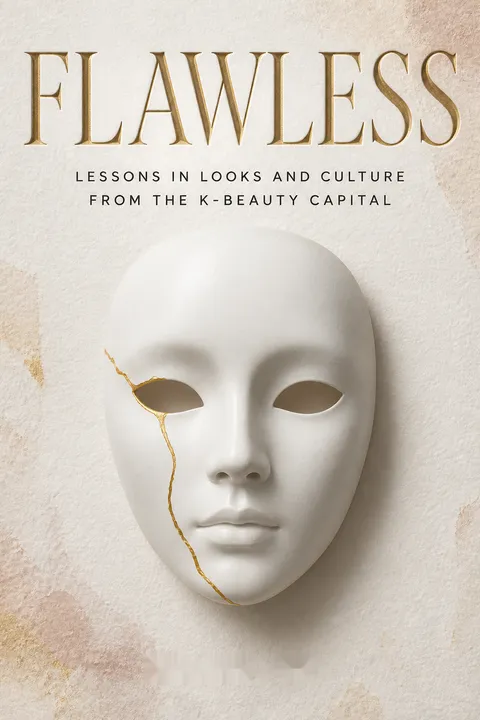
Flawless by Elise Hu explores South Korea's beauty industry and its impact on society. Readers found it eye-opening, well-researched, and thought-provoking. The book examines beauty standards, plastic surgery, and gender inequality in Korea, while also discussing global implications. Many appreciated Hu's personal experiences and balanced approach. Some felt it lacked depth for those already familiar with Korean culture. Overall, readers found it engaging and informative, praising Hu's writing style and the book's ability to spark self-reflection on beauty standards.
Glossary
Hallyu
Korean cultural waveHallyu is the international spread of South Korean popular culture, especially television dramas, music, film, and related styles. In the book, it is both a cultural phenomenon and an economic strategy: entertainment builds global interest in Korea, while that interest helps circulate Korean products, tourism, and beauty ideals.
bbali bbali
fast-fast ethosA Korean expression meaning “fast, fast,” used to describe a cultural preference for speed, urgency, and getting things done quickly. The book connects this sensibility to South Korea’s rapid economic development and to a cosmetics industry that can move products from concept to production in a matter of months.
skinfirst philosophy
skin as ongoing careAn approach that treats skin as part of everyday bodily care, not merely a surface to cover when blemishes appear. It emphasizes prevention and maintenance, including cleansing, hydration, and sun protection. In the book, this philosophy supports K-beauty’s extensive product routines while also illustrating how a health practice can become an expectation to continually improve appearance.
lookism
appearance-based discriminationPrejudice or unequal treatment based on how a person looks. The book uses the term for social and institutional practices that reward people who match accepted appearance standards and penalize those who do not. Examples include appearance-based comments, job applications requiring photographs, and hiring criteria that favor a particular look.
technological gaze
algorithm-shaped appearance pressureA beauty standard generated and reinforced through digital images, filters, social platforms, and recommendation systems. Unlike a gaze attributed only to individual viewers, it is built into technologies that circulate certain faces, measure engagement, and encourage users to compare and edit themselves. The book connects this gaze to physical procedures that can reproduce filtered appearances.
kkumim nodong
appearance display laborA Korean term meaning “display labor,” the work of grooming and modifying oneself so one’s appearance is suitable for public presentation. The book describes it as both bodily work and consumption: people spend time and money to become displayable, while the effort is often treated as a personal obligation rather than labor.
molka
hidden-camera abuseA Korean term for hidden cameras, especially cameras secretly used to record people in private or intimate settings. In the book, molka refers to a widespread form of digital sexual abuse, often involving women filmed without consent in bathrooms, changing rooms, and other spaces. Activists connected this surveillance to broader demands for women’s safety and autonomy.
Escape the Corset
beauty-norm refusal movementA South Korean feminist movement in which women rejected restrictive appearance expectations, often by cutting their hair, giving up makeup, and sharing images of discarded cosmetics. Participants described reclaiming time and money, while drawing attention to the social penalties imposed on women who refuse conventional femininity.
kkotminam
soft masculine idealA Korean term formed from words meaning “flower” and “handsome man.” It describes a polished, gentle masculine style associated with Korean popular culture, including soft features, careful grooming, and emotional openness. The book presents the flowerboy as an alternative to traditionally macho masculinity, while noting that this expansion does not erase the heavier beauty demands placed on women.
body neutrality
worth beyond appearanceAn approach that does not require a person to love or admire their body, but rejects the idea that appearance determines inherent value. It treats a body as deserving of respect and care whether or not it meets a beauty ideal. The book contrasts this with efforts that still make beauty the standard, even when celebrating diverse forms of beauty.
sensualism
value bodily capacitiesAn approach to body appreciation that emphasizes what bodies can do and feel, rather than how closely they match an appearance ideal. Examples include movement, touch, stretching, and other sensory experiences. In the book, sensualism offers a way to reconnect with bodily experience without making appearance improvement the central goal.
ajumma-fication
release from youth rulesAn informal term for the shift some women make as they age away from strict expectations to appear young, slim, and conventionally feminine. The book associates it with older Korean women who feel freer to wear practical clothes, shorter hair, or visible signs of aging, while retaining forms of grooming that support comfort and social connection.
Download PDF
Download EPUB
.epub digital book format is ideal for reading ebooks on phones, tablets, and e-readers.








