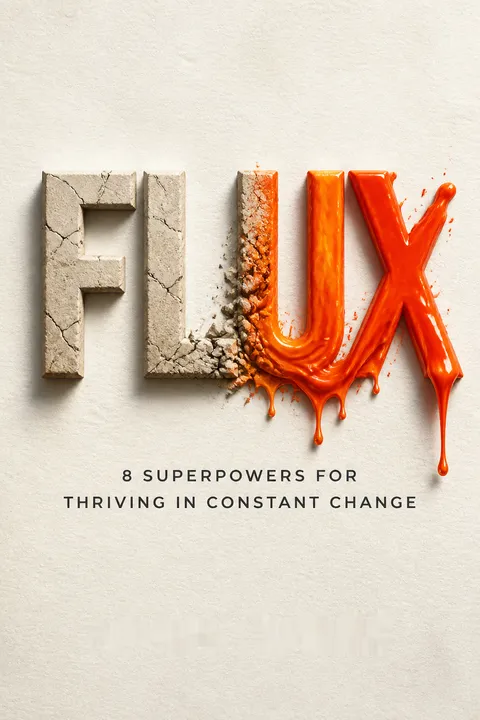


Key Takeaways
Build your own compass before the old map stops working
A map can expire. At twenty, April Rinne was preparing for a summer trip when her sister called to say their parents had died in a car accident. The future she expected vanished in an instant. That loss anchors the book’s argument: uncertainty is not an unusual interruption but a condition people need to learn to navigate.
Rinne calls a values-based inner orientation a Flux Mindset. It steadies a person when circumstances shift, making change easier to approach with curiosity rather than only fear. Her Theory of Flux has three parts: open this mindset, practice eight Flux Superpowers, then use them to write a New Script, a life direction shaped by personal values rather than inherited expectations.
The story gives the framework emotional weight: the goal is not to make grief or disruption feel beneficial, but to find a way to keep choosing and acting when familiar plans collapse. This resembles a useful distinction in resilience thinking: people may not control what happens, yet can still shape their response and sources of support. The language of opportunity needs care, though. For someone facing danger or deep loss, first finding safety and help may matter more than reframing the experience.
Pause before speed turns urgency into an expensive mistake
Speed can blur judgment. Rinne argues that working faster is a poor default when the situation is unclear. She cites research finding that people spend 47 percent of waking hours thinking about something other than what they are doing, and points to research associating delayed layoffs with better long-term company performance. The point is not to avoid decisive action; it is to distinguish urgency from wisdom.
Running slower means making space to notice, think, and respond. Rinne recommends brief stillness, waiting without reaching for a phone, spending time in nature, or creating a not-to-do list. She also draws on niksen, a Dutch practice of doing nothing without trying to make it productive. A pause can improve attention to what matters, including the body’s signals of stress.
The argument connects attention to decision quality: when people are rushed, they are more likely to default to familiar answers, even when the conditions have changed. A deliberate pause can function like a small reset, not an escape from responsibility. The harder question is who has the freedom to pause. Some workers face deadlines, care duties, or financial pressure they did not choose. Slowing down is most useful when paired with changes to the systems that keep people in permanent urgency.
Train your attention toward what your usual script leaves out
Attention has blind spots. The book’s example of sawubona, a Zulu greeting meaning I see you, suggests a deeper kind of seeing: recognizing another person’s dignity and humanity. Rinne argues that culture, upbringing, profession, and privilege all shape what people notice and what they overlook. Looking beyond what is immediately visible can reveal neglected skills, needs, risks, or possible solutions.
She recommends widening peripheral vision, listening to perspectives unlike one’s own, and questioning what gets measured. For instance, economic measures may count purchases while missing unpaid care and volunteering. Optionality, the ability to keep choices open, grows when people notice possibilities beyond their usual path. Seeing people as citizens and contributors, rather than only customers, is one way to change what receives attention.
This is a strong account of how attention is socially trained, not merely an individual talent. A broader field of view can help teams notice overlooked knowledge and challenge assumptions that appear neutral only because they are familiar. But inclusion cannot stop at noticing. People who have been excluded need real influence over decisions, not simply a place in someone else’s expanded perspective. The insight is most powerful when better seeing changes who gets heard, what gets counted, and how resources are allocated.
Treat detours as information, not proof you have failed
Disorientation can teach. While traveling alone in Romania, Rinne was invited into the home of a grandmother who assumed she was lost and needed help. The family’s concern came from a different set of expectations about travel and independence. Their meal became an encounter between two life scripts, each revealing something the other had not considered.
Rinne distinguishes getting lost from suffering a loss or failing. Getting lost means entering unfamiliar territory, where new information and relationships may become possible. She uses coddiwomple for purposeful movement toward a destination that is not yet known. This is not a call to seek danger or abandon direction. It is an invitation to tolerate uncertainty, explore beyond familiar routines, and learn from people with different experiences.
The Romanian encounter shows how a detour can expose assumptions on both sides, rather than simply offering the traveler a colorful story. That makes getting lost a practice in humility as much as exploration. Unfamiliarity can widen a person’s options, especially when it brings contact with different perspectives. Yet uncertainty is not automatically enriching. A detour may be unsafe, imposed, or exhausting. The useful question is not whether every disruption is a gift, but what support and learning can make an unwanted disruption more navigable.
Design for trustworthy people, then build safeguards for exceptions
Trust shapes the system. Rinne describes a widespread default of suspicion, visible in surveillance, restrictive workplace rules, and legal protections that often substitute for human connection. Starting with trust means treating dishonesty as an exception, not assuming everyone is unreliable. It does not mean abandoning judgment or protection.
Examples include open-source software, where people collaborate on shared tools, and a company expense policy that gives employees broad discretion. The book also links inequality with mistrust: in 2019, the average US CEO earned 320 times the average worker’s pay. Rinne suggests organizational trust audits, greater transparency, and policies that give employees meaningful responsibility. These approaches aim to make trustworthy behavior easier to practice and easier to recognize.
Trust is not just a feeling between individuals; it is also a property of rules, incentives, and the distribution of power. Systems that presume everyone will cheat can make cooperation costly, while transparent arrangements can invite people to contribute responsibly. The counterweight matters: trust without accountability can leave less powerful people exposed to abuse. A sound design therefore pairs a generous default with clear remedies, visible decision-making, and ways to challenge misconduct. Trust grows not by pretending risk is absent, but by handling risk fairly.
Define enough before comparison keeps moving the finish line
More has no natural endpoint. Rinne traces the pressure to acquire more money, status, and possessions to a consumer culture that links worth with accumulation. Knowing your enough means deciding what sufficiency looks like in areas that matter, from money and time to care, relationships, and contribution. It is not the same as telling people with unmet basic needs to settle for less.
A practical start is to subtract: cancel an unnecessary commitment, remove a distracting app, or make room for rest. The book also describes generosity as a source of shared abundance. In Sweden, the government’s stated approach to automation is to protect people, not specific jobs, through income support and retraining. That example shows how individual security can depend on collective choices, not personal attitude alone.
The idea of enough can interrupt the comparison cycle because it replaces a moving external target with a question of sufficiency. It also connects personal consumption to shared resources and social conditions. Still, enough cannot be reduced to a private mindset: a person cannot budget their way out of inadequate housing or an insecure wage. The book is strongest when it joins inner clarity to public responsibility. Defining enough for oneself should sharpen the question of what others need to live with dignity.
Build a career from your combination, not one fragile job title
A career can be curated. A portfolio career is a changing mix of roles, skills, paid work, and unpaid experience, rather than a single job title or linear climb. Rinne profiles people who combine fields, such as a lawyer who represents musicians while producing documentaries. The value lies in the particular combination, not in being the best at each separate skill.
To begin, list every role, ability, interest, and experience that could help someone else. Then look for intersections between what you do well, what interests you, what others need, and what can support you financially. The book cites a 2019 estimate that 35 percent of the US workforce did freelance work. A portfolio is not identical to gig work: it is a deliberately developed professional identity that can evolve as circumstances change.
The portfolio model treats adaptability as an asset built from accumulated capabilities, not as repeated reinvention from zero. It also challenges the idea that a job title should carry a person’s entire identity. The model can diversify opportunity, but it can also shift risk from employers onto workers, who may lack stable benefits or bargaining power. A resilient portfolio therefore needs more than variety. It needs financial planning, supportive professional communities, and institutions that make nontraditional work livable.
Use technology deliberately, and let human connection do what it cannot
Tools are not substitutes. Rinne warns that digital technology can connect people while also consuming attention, weakening privacy, or displacing face-to-face contact. Her answer is not to reject technology, but to stay responsible for how it is used. Digital intelligence, or DQ, means the skills needed to participate safely and thoughtfully online, including managing one’s digital identity, screen time, and communication.
The chapter also treats vulnerability, empathy, and service as human capacities that support people through grief and change. Rinne uses yin and yang as complementary energies: focused action needs balance from collaboration and care. Practices such as disconnecting from screens and showing up for someone in distress make that balance tangible. The aim is to use technology as a means while protecting attention, relationships, and agency.
The distinction between a tool and a substitute is valuable because digital systems often make convenience feel like progress. Attention and relationship quality are not automatically improved by more connection or information. At the same time, online communities can provide meaningful support, especially when distance or disability limits in-person contact. The relevant measure is not screen time alone, but whether technology expands people’s agency and connection or narrows them. A humane digital life requires individual habits and design choices that respect users.
Prepare for several futures instead of betting your life on one
Prediction is not control. Rinne argues that plans are useful, but expecting them to unfold exactly as intended creates avoidable distress. She proposes shifting from prediction to preparation, treating change in plans as normal, and looking beyond what is already familiar. Scenario mapping helps: choose two uncertainties, place them on intersecting axes, and imagine four plausible futures. The exercise is meant to prepare responses, not identify which future will happen.
Letting go of the future does not mean giving up responsibility. It means releasing the demand to control external events and focusing on choices available now. For anxiety, Rinne recommends a three-part practice: notice the fear, welcome it without self-judgment, and ask what it may be pointing toward. This makes room for action grounded in present values rather than panic about a single imagined outcome.
Scenario thinking is useful because it separates preparation from prophecy. It encourages people to test plans against multiple conditions and notice assumptions that a single forecast hides. The practice also has limits: imagined scenarios cannot encompass every surprise, and planning can become another way to avoid uncertainty. Its value is not a complete map of the future, but greater flexibility when the map proves incomplete. Letting go works best alongside concrete planning, support, and clear choices about what remains within a person’s control.
Analysis
Flux is organized around a compelling inversion: the habits commonly praised as responsible, speed, certainty, accumulation, specialization, and control, can become liabilities when the environment keeps changing. Rinne offers a counter-script built around attention, perspective, trust, sufficiency, plural work, humanity, and release. The book’s architecture is memorable because each practice challenges a familiar reflex rather than adding another productivity technique.
Its most important move is from personal psychology to social design. Anxiety is not treated only as an individual flaw; it is linked to relentless work, consumer pressure, mistrustful institutions, inequality, and technology that captures attention. Likewise, trust and enough are not merely virtues. They are questions about pay structures, public protections, organizational transparency, and how societies define value. That scale shift prevents the book from becoming a simple exhortation to stay positive.
The framework also has tensions worth keeping in view. Treating change as opportunity can help people regain agency, but an imposed crisis may involve real harm that should be resisted, not reframed away. Portfolio careers can provide variety while transferring insecurity to workers. Trust can release creativity, but it needs accountability. Slowing down may clarify priorities, yet many people have little control over their pace. These are not reasons to discard the practices; they show why individual adaptation must be paired with fair institutions and material support.
The most useful reading is therefore neither as a promise of control nor as a demand to welcome every disruption. Flux is a discipline for responding without confusing uncertainty with helplessness. Values provide orientation, while the eight practices broaden the available responses. The result is not certainty about what comes next, but a way to remain observant, connected, and capable of revising one’s plans without surrendering one’s agency.
Review Summary
Flux receives mostly positive reviews (3.93/5), praised as a timely guide for navigating constant change through eight "superpowers" including running slower, seeing what's invisible, getting lost, starting with trust, knowing your "enough," creating a portfolio career, being human, and letting go of the future. Readers appreciate Rinne's personal storytelling, practical wisdom, and challenges to "old scripts" about productivity and success. Some critics found it too abstract, lacking specificity, or more self-help than expected. The book resonates particularly with those experiencing career transitions or seeking to embrace rather than fear uncertainty.
People Also Read




Glossary
Flux Mindset
Values-based orientation to changeA state of mind, body, and spirit that helps a person stay grounded when circumstances shift. It draws on personal values to provide stability and clarity, and encourages a view of change as an opening for possible action rather than only a threat. It is the foundation for practicing the book’s eight Flux Superpowers.
Theory of Flux
Three steps for adaptingRinne’s overall approach to thriving amid continual change. It proceeds by opening a Flux Mindset, using that mindset to develop eight Flux Superpowers, and applying those practices to write a New Script. The theory treats adaptation as an ongoing practice shaped by personal values, not as a one-time solution to a particular disruption.
New Script
Self-authored life directionA person’s evolving account of what matters and how they want to live, work, and respond to change. Unlike an inherited script shaped by social expectations, the New Script is written around the individual’s values and circumstances. It is not a fixed plan, but a grounding orientation that can be revised as life changes.
Flux Superpowers
Eight practices for changeThe eight disciplines Rinne presents for responding to continual uncertainty: run slower, see what is invisible, get lost, start with trust, know your enough, create a portfolio career, be more human and serve others, and let go of the future. Each can be practiced independently, but the book presents them as mutually reinforcing.
optionalitiy
Keeping choices availableThe capacity to preserve or expand possible choices, especially when the future is unclear. The book associates optionality with keeping an open mind, considering backup possibilities, and noticing options beyond one’s usual perspective. It is useful because a wider range of choices can make a person or organization better able to respond to change.
coddiwomple
Purposeful travel toward unknownA term used for moving purposefully toward a destination that is not yet known. In the book, coddiwompling describes a willingness to explore without treating a fixed endpoint as the only measure of progress. Purpose and curiosity remain, while the route and eventual destination are allowed to change.
Portfolio career
Evolving mix of workA professional life built from a curated combination of roles, skills, interests, and experiences, rather than a single job or linear career path. Its elements may occur one after another or at the same time. The portfolio can include paid and unpaid work, and it evolves as a person learns, changes direction, and finds new ways to contribute.
DQ
Responsible digital participationDigital intelligence: the abilities needed to participate safely and thoughtfully in digital life. The book describes competencies such as managing digital identity, understanding digital rights, communicating responsibly, recognizing cyberbullying, and maintaining a healthy relationship with devices. DQ is not simply technical skill; it includes knowing when technology helps and when to step away.
Scenario mapping
Exploring plausible futuresA planning method that lays out multiple possible futures rather than predicting one outcome. A typical exercise selects two important uncertainties as axes, creating four scenarios to examine. Participants consider likely effects, obstacles, and responses in each. The purpose is to improve preparation and flexibility, not to claim that any one scenario will occur.
Download PDF
Download EPUB
.epub digital book format is ideal for reading ebooks on phones, tablets, and e-readers.








