

Key Takeaways
Find the one high-value action that changes the whole system.
Aim before adding effort. Tracy’s central idea is the focal point: the most important action available in a particular area at a particular time. He opens with a consultant who spent two days inspecting a malfunctioning power plant, marked the faulty gauge, and charged most of his fee for knowing which gauge mattered. The point is not that one action always solves everything. It is that diagnosis can be more valuable than more activity.
Focus concentrates capacity. Tracy compares attention to sunlight gathered through a lens: focused ability can produce more than scattered effort. The practical question is, “What is the one thing I can do now that would make the greatest difference?” Ask it about work, health, finances, and relationships, not just the job in front of you.
The consultant story distinguishes visible labor from expert judgment. In complex systems, the hardest task is often identifying the bottleneck, not applying force everywhere. That insight connects productivity to diagnosis: attention is a limited resource, so choosing where to direct it is itself a high-value skill. Still, a single focal point should be treated as a current hypothesis, not a permanent answer. Systems change, and a once-critical task can lose importance. The useful discipline is to reassess the target as conditions shift, rather than turn focus into tunnel vision.
Quit commitments you would refuse if you were starting today.
Reconsider before recommitting. Zero-based thinking is Tracy’s method for testing an existing activity, relationship, or responsibility against present knowledge: if you were not involved already, would you choose to begin now? If the answer is no, consider reducing it, delegating it, or leaving it. This question challenges the quiet force of habit and sunk costs, which can keep obsolete obligations alive simply because they are familiar.
The costs can hide in handoffs. Tracy describes an insurer whose application approvals took six weeks because paperwork passed through 22 people, although the actual review took less than an hour. After the process was simplified, the company reportedly cut the turnaround to 24 hours. The lesson is to question not only what you do, but also which inherited steps still serve a purpose.
This is a practical defense against the sunk-cost trap: past investment does not, by itself, justify future investment. The question forces attention back to current benefits, costs, and alternatives. It also gives people a repeatable way to notice commitments that survive through inertia rather than value. But an honest answer is not always an immediate exit plan. Duties to colleagues, family, or clients may require a careful transition. The test helps identify what needs reconsideration; judgment is still needed to decide how to change it responsibly.
Choose work by consequences, then finish it in one focused stretch.
Rank by consequence, not noise. Tracy recommends identifying work whose completion or failure would have significant effects, then giving it priority over tasks that are merely pleasant or pressing. His ABCDE Method is a daily sorting technique: distinguish essential tasks from worthwhile but lower-priority ones, identify work that can be delegated, and remove tasks that need not be done. He also separates urgent demands from important work. A ringing phone may feel pressing; exercise, a key report, or time with children may matter more over the long term.
Protect completion. Once the most valuable task is selected, work on it without switching until it is finished. Tracy argues that interruptions and restarts add time. Written plans and lists help keep attention on the chosen result rather than whatever happens to arrive next.
The distinction between urgency and importance is useful because human attention is easily captured by immediate signals. A task’s loudness is not evidence of its value. Ranking work by consequences helps counter that bias, while single-task focus reduces the mental cost of repeatedly changing context. The method works best when priorities are negotiated with people affected by them. A worker cannot always declare incoming requests unimportant, and some jobs demand responsiveness. The deeper skill is to make tradeoffs explicit, rather than confuse busyness with progress.
Cut steps before adding effort: complexity multiplies with every handoff.
Improve the route first. Tracy calls his model the law of complexity: each added step can increase the chance of delay, expense, or misunderstanding. He illustrates it with a life insurance process that sent applications through 22 hands. Reorganizing the work reportedly reduced approval time from six weeks to one day. A similar mortgage process at Citibank was also shortened from weeks to about a day after its steps were reduced.
Redesign before accelerating. Tracy’s broader advice is to inspect a process from beginning to end, combine tasks where possible, change their order, assign responsibility more clearly, and eliminate steps that no longer contribute to the result. He presents this as a more durable response to overload than simply asking people to work faster. Less friction can improve both speed and reliability.
Process design shifts the question from “How can people work harder?” to “Why does the work require so many transfers?” That shift is valuable in organizations, where delays often accumulate between tasks rather than within them. Fewer handoffs can also clarify ownership. Yet simplification is not automatically safer: some reviews exist to catch errors, protect clients, or meet legal duties. The aim is not minimum steps at any cost. It is to remove friction while preserving checks that genuinely reduce risk.
Translate values into a five-year vision, measurable goals, and daily actions.
Plan across the whole life. Tracy’s Focal Point Process begins by clarifying values, then imagining a desired future, defining goals, identifying needed skills and habits, choosing daily activities, and committing to an immediate action. He applies this sequence across seven areas: career, family, money, health, personal development, community, and spiritual life. The purpose is to prevent career ambitions from silently crowding out every other priority.
Use questions to expose gaps. He asks readers to picture life five years ahead, assess how things are going now, and identify obstacles between the two. A company he coached set a sales target of $100 million from a $75 million base, then reached $125 million after strategic planning. The example illustrates the value of shared clarity, though it does not prove planning alone caused the growth.
This framework links identity to execution: values help determine what deserves attention, while measurable goals make intentions testable. Planning across life domains also makes tradeoffs visible before a neglected area becomes a crisis. The framework’s strength is its coherence, not a promise that a written plan controls the future. Goals can become stale, and measurement can distort what matters if the easiest metric replaces the real aim. Periodic review keeps the plan responsive and prevents a dashboard from becoming a substitute for judgment.
Turn small daily learning into compounding competence.
Practice what matters. Tracy argues that people improve by deliberately developing the knowledge, skills, and habits their most important goals require. He recommends written goals, advance planning, daily priorities, focused work, exercise, learning, and time for important relationships. His 1,000 Percent Formula emphasizes modest, repeated improvements rather than waiting for a dramatic transformation. Its proposed routines include studying one’s field, reviewing goals, planning the day, and learning from experience by asking what worked and what could be improved.
Build skill through repetition. Tracy also argues that habits become easier through consistent practice. His example of a business owner who bought an educational audio program and later increased his income is an anecdote, not evidence that a particular purchase will produce similar results. The durable point is to invest regularly in useful learning and apply it to real work.
The emphasis on repetition fits how skill is built: information becomes useful when practice turns it into reliable performance. Reflection can sharpen that process by making people notice what they did and what they might change next time. The compounding metaphor is motivating, but the book’s precise productivity projections should not be mistaken for guaranteed outcomes. Learning can also become a polished form of procrastination. Its value depends on whether new knowledge changes decisions, practice, or results.
Build one scarce skill that makes your contribution hard to replace.
Own your working life. Tracy urges readers to think of themselves as responsible for their own services and development, even when employed by an organization. In an economy he describes as increasingly centered on knowledge work, rewards depend more on useful results than on hours spent. That makes it important to understand what a role actually requires and which contributions matter most.
Become distinct through value. Tracy’s career advice is to specialize in a useful area, become notably capable in it, identify the people who benefit most from that ability, and focus on serving them well. He describes an insurance executive who redirected effort toward a small group of high-value clients, cut his workweek from seven days to five, and reported a large income increase. It is an illustrative case, not a universal forecast.
Treating a career as a portfolio of skills encourages agency: workers can identify where their abilities meet real needs and invest accordingly. Specialization can make contribution easier to recognize and reward. But the self-employed metaphor has limits. Employees do not control every market condition, staffing decision, or opportunity, and personal responsibility should not be confused with sole responsibility. A strong career strategy combines skill development with realistic attention to bargaining power, organizational constraints, and the value of transferable expertise.
Give relationships protected time, not whatever work leaves over.
Make care visible in calendars. Tracy argues that relationships need more than proximity. Conversation, shared activity, and sustained attention show people they matter. He contrasts work time, which should be judged by results, with personal time, where unhurried presence matters. He recommends protecting time away from work and planning family activities rather than hoping they fit around unfinished tasks.
Invite honest feedback. Tracy suggests asking loved ones what they want more of, less of, started, or stopped. He tells of his wife asking him to stop accepting weekend speaking engagements. After initially resisting, he changed his schedule and says family life improved without significant harm to his business. The story makes the tradeoff concrete: saying yes to one demand often means saying no to time with someone else.
The distinction between shared space and genuine attention is important in a world where devices and work can occupy the same room as family life. Protected time creates conditions for conversation that spontaneous availability may not. Asking for feedback also replaces guesswork with direct information. Still, scheduled time is not automatically caring time, and people’s needs differ. The value lies in creating reliable opportunities for attention, then being responsive within them, rather than treating a calendar block as proof that a relationship is healthy.
Save part of every raise before expanding your lifestyle.
Make saving automatic. Tracy’s financial plan centers on earning, controlling spending, saving and investing, and protecting against setbacks. He warns that spending tends to rise with income, leaving people no closer to independence after a raise. His proposed countermeasure is to save and invest half of each increase in compensation. He also recommends paying yourself first, tracking expenses, and beginning with a small regular contribution if a larger one is not yet possible.
Think in decades. Tracy illustrates compounding with an estimate that saving $100 each month from age 20 to 65, invested at an assumed average annual return of 10.8 percent, could grow to more than $1.2 million. That is an example based on a particular return assumption, not a guaranteed result. The general lesson is to start early, contribute consistently, and understand the risks of any investment.
The key behavioral insight is to separate saving from whatever happens to remain after spending. Automatic contributions make the intended choice easier to sustain, while delaying lifestyle expansion helps preserve the benefit of higher income. Compounding rewards time, but the book’s illustrative return should not be treated as a forecast. Actual results depend on costs, taxes, market performance, and the investor’s choices. A sensible financial plan pairs consistency with diversification, emergency reserves, and advice suited to an individual’s circumstances.
Make exercise, sleep, and recovery visible in your weekly plan.
Treat health as a priority. Tracy asks readers to set a long-term health vision, establish a baseline, and track useful measures such as weight, sleep, and exercise. He describes habits including regular physical activity, adequate rest, nutritious food, and avoiding smoking and excessive alcohol. His suggested exercise target is 200 to 300 minutes per week, alongside regular days off and vacations that allow recovery.
Measure without obsessing. Tracy uses his waist measurement as a personal indicator for how his eating, exercise, and sleep habits are working together. He also recounts a seminar participant who lost weight after changing his diet. These examples support the book’s emphasis on learning and consistent action, but they are personal reports. Health needs vary, so medical guidance matters, especially when changing diet, exercise, or supplements.
Placing health on the calendar counters a common planning bias: work tends to feel urgent, while prevention feels postponable. Tracking can make patterns visible and help someone notice whether routines are sustainable. But a single body measure cannot capture overall health, and health advice should not be reduced to willpower or appearance. Genetics, disability, income, and access to care all shape what choices are available. The useful principle is to give health regular attention while adapting goals to individual circumstances and professional guidance.
Give time or money to causes you have researched and genuinely value.
Turn concern into contribution. Tracy asks readers to identify problems they care about, imagine what improvement would look like, and choose a practical way to help. He describes Albert Schweitzer leaving a successful musical career to train in medicine and serve in Africa, and Andrew Carnegie directing wealth toward libraries and foundations. These stories show how a long-term commitment can organize a life around service. Tracy also notes that giving time can matter when money is limited.
Give with discernment. He cautions readers to research organizations and consider whether contributions are being used effectively. His spiritual advice emphasizes solitude, inner reflection, treating others with respect, and examining behavior by asking what kind of workplace, country, or family would result if everyone acted similarly. The shared thread is deliberate conduct, not a single required faith or cause.
Service can widen a person’s frame of reference, connecting personal ambition to the needs of other people. The book’s examples suggest that commitment becomes more meaningful when it is specific enough to guide choices and sustained enough to produce practical work. Its appeal to inner peace complements that outward focus: reflection can clarify motives and correct behavior. Yet good intentions do not guarantee good outcomes. Research, humility, and willingness to learn from the people a cause serves help turn generosity into responsible contribution.
Analysis
Focal Point is a broad personal-management program organized around a single recurring task: deciding what deserves attention now. Its distinctive contribution is not one isolated time-saving trick, but an attempt to apply the same decision logic across work, family, money, health, learning, service, and inner life. The book makes productivity answer to a wider question: what kind of life should the increased capacity serve?
Its most persuasive ideas are concrete and operational. Reassess commitments instead of preserving them by inertia. Judge tasks by consequences. Reduce unnecessary steps. Convert priorities into observable routines. The stories give these claims momentum, though anecdotes about sharp income growth or rapid business gains cannot establish that the methods caused those results or that most readers should expect them. The book’s confident arithmetic and universal language sometimes outrun the evidence presented.
A modern reading also needs to separate personal agency from total control. Planning, skill-building, and disciplined attention can improve a person’s choices, but they cannot erase economic constraints, caregiving demands, illness, discrimination, or organizational power. Advice to accept responsibility is most useful when it expands action without turning every setback into personal fault. Likewise, focusing on high-value work can improve output, but value must be defined ethically and not only by income or employer preference.
The book’s strongest practical use is as a periodic audit, not a command to optimize every hour. Choose a few domains that matter, identify one meaningful bottleneck in each, make a realistic plan, and review whether the plan still fits. The focal point is valuable precisely because attention is finite. A good system protects what matters from the urgent, the inherited, and the merely familiar.
Review Summary
Focal Point receives mostly positive reviews for its practical advice on productivity and goal-setting. Readers appreciate Tracy's clear writing style and actionable strategies, particularly the focus on high-value activities and time management. Some find the content repetitive or overly focused on financial rewards. Critics note that much of the information is not new but presented effectively. Many readers report feeling motivated and gaining valuable insights, especially regarding work-life balance and personal development. The book is generally recommended for those seeking to improve their productivity and achieve their goals.
People Also Read









Glossary
Focal Point
Highest-impact current actionThe focal point is the action or activity that offers the greatest useful result in a particular area at a particular time. Tracy uses it as a way to direct attention away from scattered effort and toward the most consequential available choice. It is meant to be identified repeatedly as goals and circumstances change.
Zero-based thinking
Reassessing existing commitmentsZero-based thinking asks whether a person would choose to begin an existing activity, relationship, or responsibility if they were deciding with current knowledge. If the answer is no, the commitment becomes a candidate for change, reduction, delegation, or ending. The technique challenges inertia and the tendency to keep investing in something merely because it already exists.
Grand Slam Formula
Four-part productivity approachTracy’s Grand Slam Formula describes a way to increase results by simplifying work, drawing on resources beyond one’s own effort, improving speed, and coordinating other people’s abilities. It applies the broader idea that productivity can rise through better design and cooperation, rather than by increasing working hours alone.
ABCDE Method
Daily task-priority sortingThe ABCDE Method is Tracy’s technique for marking tasks by relative importance and deciding which deserve attention first. It distinguishes work with significant consequences from lower-priority tasks, work that can be assigned to someone else, and work that can be removed. The method is intended to keep people from doing minor tasks while consequential work remains unfinished.
Law of complexity
Steps increase process riskTracy’s law of complexity proposes that adding steps to a task increases the potential for extra time, cost, and mistakes. He illustrates the idea by comparing a direct action with processes involving multiple people and handoffs. The practical implication is to examine a workflow and remove steps that do not contribute to the required result.
Focal Point Process
Life-wide personal planning systemThe Focal Point Process is Tracy’s personal planning method for defining priorities across major areas of life. It moves from clarifying values and envisioning a preferred future to setting goals, identifying required skills and habits, choosing daily activities, and committing to action. Its purpose is to connect long-range aims with choices made in ordinary routines.
1,000 Percent Formula
Incremental self-improvement routineThe 1,000 Percent Formula is Tracy’s approach to sustained improvement through repeated daily practices. It emphasizes learning, reviewing written goals, planning ahead, focusing on valuable work, reflecting on experience, and treating people well. Tracy presents small gains as capable of accumulating over time, though the numerical projections in the book depend on assumptions rather than guaranteed results.
Sigmoid curve
Learning, growth, decline cycleTracy uses the sigmoid curve to describe a common pattern in careers, products, relationships, and organizations. A new effort begins with a difficult learning period, rises through growth, levels off, and may then decline. The model encourages periodic review so that people notice when a successful approach has stopped producing the same results.
FAQ
What's "Focal Point" about?
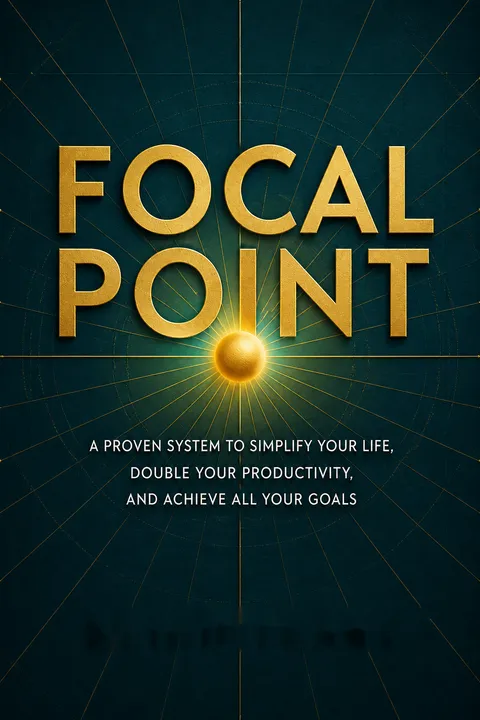
- Purpose and Focus: "Focal Point" by Brian Tracy is about simplifying your life, doubling your productivity, and achieving all your goals by focusing on what truly matters.
- Systematic Approach: The book introduces a proven system that helps individuals identify their most important tasks and concentrate their efforts on these areas to maximize results.
- Personal and Professional Growth: It covers strategies for personal development, career advancement, financial independence, and improving relationships.
- Holistic Development: Tracy emphasizes the importance of balancing work, family, health, and personal growth to achieve overall success and happiness.
Why should I read "Focal Point"?
- Proven Strategies: The book offers practical, time-tested strategies that have been used by successful people to achieve their goals.
- Comprehensive Guidance: It provides a step-by-step guide to improving various aspects of life, including career, finances, health, and relationships.
- Focus on Results: Tracy's methods are designed to help you achieve better results faster by focusing on high-value activities.
- Personal Empowerment: Reading this book can empower you to take control of your life, make better decisions, and achieve your full potential.
What are the key takeaways of "Focal Point"?
- Clarity and Focus: Achieving clarity about your goals and focusing on the most important tasks is crucial for success.
- Time Management: Effective time management involves prioritizing tasks that offer the greatest value and eliminating low-value activities.
- Continuous Improvement: Personal and professional growth requires ongoing learning, skill development, and self-discipline.
- Balance and Simplification: Simplifying your life and maintaining a balance between work and personal life leads to greater satisfaction and success.
What is the "Focal Point Process" in "Focal Point"?
- Seven-Step Process: The Focal Point Process consists of seven steps: values, vision, goals, knowledge and skills, habits, daily activities, and actions.
- Values and Vision: It starts with identifying your core values and creating a vision of your ideal future.
- Goal Setting: Setting specific, measurable goals that align with your values and vision is essential.
- Action-Oriented: The process emphasizes taking consistent, focused actions to achieve your goals and improve your life.
How does Brian Tracy suggest doubling your productivity in "Focal Point"?
- Prioritize High-Value Tasks: Focus on tasks that contribute the most value and eliminate or delegate low-value activities.
- Single-Minded Concentration: Work on one task at a time without distractions to complete it faster and more efficiently.
- Daily Planning: Plan each day in advance, set clear priorities, and work from a list to stay organized and productive.
- Continuous Learning: Invest in personal development to enhance your skills and increase your productivity over time.
What are the best quotes from "Focal Point" and what do they mean?
- "You become what you think about most of the time." This quote emphasizes the power of focus and positive thinking in shaping your life and achieving your goals.
- "Your life only gets better when you get better." It highlights the importance of personal growth and self-improvement as the foundation for success.
- "The acceptance of personal responsibility is what separates the superior person from the average person." This quote underscores the significance of taking responsibility for your actions and outcomes.
- "The more you use and practice these time management principles, the better and more easily they will work for you." It stresses the importance of consistent practice in mastering time management skills.
How does "Focal Point" address financial independence?
- Long-Term Perspective: Tracy emphasizes the importance of having a long-term perspective and setting clear financial goals.
- Saving and Investing: He advocates for saving a portion of your income consistently and investing wisely to build wealth over time.
- Frugality and Spending: The book encourages careful spending and living below your means to accumulate savings.
- Financial Education: Continuous learning about money management and investment strategies is crucial for achieving financial independence.
What is the "Grand Slam Formula" in "Focal Point"?
- Simplification: Focus on reducing and eliminating activities that do not contribute significantly to your goals.
- Leverage: Use other people's knowledge, energy, and resources to achieve more with less effort.
- Acceleration: Act quickly to satisfy the needs of others and move to the front of the line in your field.
- Multiplication: Organize and work with others to multiply your efforts and achieve greater results.
How does "Focal Point" suggest improving family and personal life?
- Value Clarification: Identify and live by your core values in your relationships to enhance harmony and satisfaction.
- Quality Time: Invest time in your relationships, as the quality of time spent with loved ones is crucial for building strong bonds.
- Communication: Practice open and honest communication to improve understanding and connection with family members.
- Balance: Strive for a balance between work and personal life to ensure that both areas receive the attention they deserve.
What role does personal responsibility play in "Focal Point"?
- Empowerment: Accepting personal responsibility empowers you to take control of your life and make positive changes.
- Decision-Making: It involves making conscious decisions and taking actions that align with your goals and values.
- Accountability: Being accountable for your actions and outcomes leads to greater self-discipline and success.
- Proactive Approach: Embracing responsibility encourages a proactive approach to challenges and opportunities.
How does "Focal Point" address health and fitness?
- Holistic Health: Tracy emphasizes the importance of maintaining physical, mental, and emotional health for overall well-being.
- Exercise and Nutrition: Regular exercise and a balanced diet are key components of a healthy lifestyle.
- Rest and Relaxation: Adequate rest and relaxation are essential for maintaining energy and productivity.
- Preventive Measures: Taking proactive steps to prevent health issues is crucial for long-term health and fitness.
What is the significance of the "Law of Increasing Returns" in "Focal Point"?
- Focus on High-Value Activities: Concentrating on high-value tasks leads to better results and increased efficiency.
- Compounding Effect: Small, consistent improvements in productivity can lead to significant gains over time.
- Skill Development: As you become more skilled in key areas, your ability to achieve results improves exponentially.
- Continuous Improvement: The law encourages ongoing learning and development to maximize your potential and success.
About the Author
Other books by Brian Tracy








Download PDF
Download EPUB
.epub digital book format is ideal for reading ebooks on phones, tablets, and e-readers.








