

Key Takeaways
Treat the 1929 crash as a symptom of a war-made crisis, not its cause.
The peace stayed unstable. Kennedy begins with the aftermath of World War I: the Versailles settlement burdened Germany with reparations and restrictions, while Allied war debts tied European recovery to American credit. When that credit contracted, the international system had little resilience. The crash was dramatic, but the deeper vulnerabilities had been building for years.
A crisis gathered slowly. Fewer than 3 percent of Americans owned stocks in 1929, and the crash did not immediately produce the Great Depression. The decisive collapse came later, as banking failures, deflation, and Europe’s financial crisis reinforced one another. Kennedy’s point is not that the crash mattered little, but that it cannot explain the whole disaster.
What's striking is the book's refusal to give history a neat starting gun. A crash makes a compelling opening scene, but the international debt system and the damage left by war explain why the shock spread so far. That distinction is useful beyond this episode: visible events often trigger crises whose vulnerabilities were already in place. The account also avoids a single-cause explanation, even while giving World War I unusual weight.
Build mass production on broad purchasing power, not thin consumer demand.
Prosperity was uneven. Urban workers experienced real gains in the 1920s, with industrial wages rising nearly 25 percent. Farmers, already burdened by falling crop prices and debt, did not share in that prosperity. By 1928, average income among nonagricultural employees was about four times farmers’ income. The country was modernizing quickly, but large parts of it could not afford the goods its factories produced.
Output outran buyers. Automobiles, radios, and household appliances spread through cities, while advertising and installment credit tried to extend demand. But mass production depended on mass consumption. Insecure employment, low farm incomes, and unevenly distributed gains left the economic engine vulnerable when buying slowed.
The book makes an important distinction between producing more and creating durable prosperity. High output can conceal a narrow customer base, especially when people who need goods cannot afford them. That tension connects the rural crisis to the industrial one: farmers were not a separate problem but potential buyers whom the broader economy had neglected. The account also cautions against treating the 1920s as uniformly prosperous simply because urban consumer life looked modern.
Judge Hoover by his bold experiments and the relief he still withheld.
Hoover acted early. His response was not simple laissez-faire. He convened business leaders, urged employers to maintain wages, accelerated public works, supported farm prices, and later created the Reconstruction Finance Corporation to lend federal money to struggling institutions. Those measures pushed beyond the federal government's limited role and helped establish precedents used by the New Deal.
His limits were real. Hoover relied heavily on voluntary cooperation and resisted direct federal relief for the unemployed, even as joblessness and hunger overwhelmed local charities. His commitment to the gold standard and balanced budgets narrowed his options, while his political style made conflict with Congress difficult. His defeat reflected both those choices and a crisis larger than his tools could manage.
Hoover's record resists the easy caricature of a president who did nothing. His experiments matter because they show that the expansion of government did not begin suddenly with Roosevelt. Yet good intentions and institutional innovation were not enough when people needed immediate aid. The distinction between helping banks and resisting direct relief also helps explain why Hoover's actions could be economically adventurous and politically devastating at the same time.
Make security the New Deal's measure, even when recovery remains elusive.
Security held the reforms together. The New Deal tried to protect people and institutions against the risks exposed by the Depression: hunger, unemployment, bank failure, old age, and unstable markets. The Hundred Days reopened banks and launched programs including the Civilian Conservation Corps, federal relief, and the Tennessee Valley Authority. Social Security later established national old-age pensions and unemployment insurance.
Recovery was different. These policies changed the relationship between citizens and government, but they did not end mass unemployment. In the 1930s the jobless rate never fell below 14 percent. Kennedy therefore treats the New Deal less as a recovery machine than as an effort to make American life safer and more predictable without abandoning constitutional government or private ownership.
What's striking is that the book separates a reform's social purpose from its economic performance. Programs can reduce fear and build durable protections without quickly restoring full employment. That distinction keeps the New Deal from being judged by one test alone. It also raises a useful question: how much security can government provide when the economy that funds it remains weak? Kennedy's answer is grounded in institutions, not in claims that one administration solved every problem.
Ask who pays when reforms stabilize markets by reducing output.
Scarcity had a human cost. The Agricultural Adjustment Administration tried to raise farm prices by reducing surplus production. In 1933, that meant plowing up cotton and slaughtering piglets while millions went hungry. The payments generally went to landowners, however, not the sharecroppers and tenants whose work had made the crops possible. Many of those workers lost both their jobs and their homes.
Coverage had boundaries. The Social Security Act created important protections, but excluded agricultural laborers and domestic servants, occupations that employed many Black workers. The policy pattern was repeated across the New Deal: aid could improve conditions for some while leaving the most vulnerable exposed. The book’s account of security therefore includes its unequal distribution, not just its promised benefits.
The section is strongest when it follows policy down to the people who bore its costs. A price-support program can look successful in aggregate while pushing tenants off the land; a social-insurance law can create a national safety net while excluding whole occupations. These are not minor administrative details. They shape who counts as deserving protection and who remains invisible in the statistics.
Workers gain bargaining power when organization, law, and leverage converge.
Organizing changed the balance. Section 7(a) of the 1933 recovery law encouraged collective bargaining, but employers often resisted independent unions. The Wagner Act of 1935 gave workers a stronger legal basis to organize. As production revived, John L. Lewis and the CIO focused on mass-production industries that the craft-based AFL had largely neglected.
Flint showed the method. In 1936, autoworkers occupied General Motors plants in Flint, Michigan, using the sit-down strike to halt production. GM eventually recognized the United Auto Workers. U.S. Steel soon recognized the steelworkers’ union without a major strike. Union membership grew from about three million in 1933 to more than eight million by decade’s end, though gains remained uneven by race, gender, and region.
The account rejects both the idea that legislation alone created unions and the idea that workers succeeded without political conditions. Legal protection mattered, but so did a recovering industry, disciplined organizers, and a government willing to avoid breaking strikes by force. The same victories also contained limits: the strongest gains went to industrial workers, while many women, agricultural laborers, and Southern workers remained outside the new bargain.
Build markets on trustworthy information and shared risk, not speculation.
New rules steadied finance. The Glass-Steagall Act separated commercial banking from investment banking, while federal deposit insurance reduced the danger that a bank run would erase ordinary savings. The Securities and Exchange Commission required companies to disclose financial information and verify it through standardized accounting practices.
Housing followed a similar pattern. The Home Owners Loan Corporation refinanced troubled mortgages, and the Federal Housing Administration insured long-term home loans. These agencies did not build most houses or bring rapid recovery in the 1930s. They did make lending more predictable and encouraged longer mortgages with smaller down payments. The New Deal’s lasting financial changes often made private markets safer rather than replacing them.
This is a more specific account of regulation than the familiar image of government simply restraining business. Requiring reliable information and sharing risk can make private investment more workable, not less. The housing example shows how institutional changes can have effects well beyond the emergency that creates them. It also clarifies the book's larger claim: New Deal reform often sought to stabilize capitalism, not abolish it.
Neutrality laws can protect aggressors when they treat unequal sides alike.
Neutrality became policy. After the Italian invasion of Ethiopia, Congress required an arms embargo on belligerents. The law also weakened Roosevelt’s ability to support a victim selectively, since it treated aggressor and defender alike. During the Spanish Civil War, the embargo helped deny arms to the elected republican government while Germany and Italy continued aiding Franco.
The pattern reached Asia. When Japan invaded China, the United States avoided declaring a state of war and allowed trade in nonmilitary goods under cash-and-carry rules. Japan continued buying American materials, including goods useful to its war effort. Roosevelt sympathized with the victims but faced a public and Congress deeply opposed to intervention. Formal neutrality, the book shows, could produce practical assistance to the aggressor.
The section exposes a recurring weakness in rules designed to sound impartial: identical treatment does not create equal consequences when one side already has more power or access. Neutrality offered a reassuring formula to Americans who feared another European war, but it also narrowed the president's ability to respond to aggression. The tension is not between morality and politics alone; it is between a legal rule and the conditions under which it operates.
Do not mistake supplying allies for opening the front they need.
Aid did not end isolation. Lend-Lease supplied Britain and, after Germany invaded the Soviet Union, the Russians. But supplies were not the second front Stalin repeatedly demanded, one that would draw German divisions away from the eastern battlefield. The Western allies instead invaded North Africa in 1942 and Sicily in 1943, campaigns that did not directly relieve the Soviet struggle on the scale promised.
The invasion came late. Operation Overlord began in Normandy in June 1944, after years of disagreement about timing and strategy. The delay deepened Soviet suspicion of British and American intentions. The Western alliance depended not only on shared enemies but on difficult bargains over where to fight, which resources to commit, and who would bear the greatest losses.
The distinction between material support and military commitment is central to this account. Lend-Lease was substantial, yet it could not substitute for a second front in the eyes of a Soviet government carrying the main land war against Germany. The delays were not simply a matter of indecision: the Western powers faced real risks and shortages. Still, the alliance's political trust was shaped by what each side was asked to endure.
War orders, not New Deal programs, finally restored full employment.
Recovery came through mobilization. New Deal reforms changed institutions and eased suffering, but they did not eliminate mass unemployment. That took the enormous demand generated by the war. Government orders filled factories, expanded shipyards, and brought millions into military and civilian work. American yards produced roughly 2,700 Liberty Ships; aircraft factories and other plants turned out war materiel at a scale the country had never previously attempted.
The cost was not evenly shared. The economy could make weapons and consumer goods at once, a capacity that distinguished the United States from its allies and enemies. But wartime production also drew workers from other regions, relied on restrictive labor practices, and strengthened large corporations. The war ended the Depression through demand and production, not through a New Deal program designed to do so.
The contrast between reform and mobilization is one of the book's most important corrections to easy narratives. The New Deal built institutions and steadied parts of the economy; war spending supplied the demand that finally absorbed the unemployed. That distinction does not make the reforms irrelevant. It shows instead that the same government can play different economic roles at different moments, and that recovery can arrive through a shock whose human cost is immense.
Follow wartime migration to see opportunity and exclusion travel together.
War remade daily life. Military service and expanding industries moved millions across the country. Women entered paid work in greater numbers, and Black Americans found new jobs and left the rural South for northern and western cities. These changes weakened old patterns of local isolation and helped create new political and social possibilities.
Inclusion remained limited. Many women were expected to leave their jobs when servicemen returned. Black workers continued to face discrimination, and Japanese Americans on the West Coast were forcibly removed to relocation camps despite the absence of evidence that the community posed a collective threat. Wartime movement widened opportunity, but it also showed how quickly national security claims could override civil liberties.
The home front is not a side story in this history. Migration changed the country's population, labor force, and political expectations. Yet mobility did not mean equal freedom: women’s employment was often treated as temporary, and Japanese Americans were deprived of basic rights by ancestry. The contrast makes the war's promise of unity more complicated, and more historically revealing, than patriotic memory alone suggests.
The atomic bomb turned victory into a warning about power.
Science joined state power. The Manhattan Project gathered scientists, military officers, and industrial capacity in an unprecedented effort to build an atomic weapon. The project depended on a scale of organization and resources available in wartime America, while scientists and officials still faced uncertainty about whether the weapon could be completed in time.
The ending changed the stakes. The United States used atomic bombs against Hiroshima and Nagasaki in August 1945, bringing the Pacific war to its end. The book places that weapon at the war’s nuclear climax: a victory achieved with technology whose destructive power exceeded anything previously made. The result was not simply a conclusion to the war, but a transformed international landscape.
What's striking is the collision between the book's story of American abundance and the weapon that abundance made possible. Scientific capacity, industrial scale, and military urgency combined to produce an instrument that changed the meaning of victory itself. The chapter's broad historical frame invites a hard question: when a technology makes destruction vastly more efficient, can strategic success be separated from the moral problem of how that power is used?
Analysis
Kennedy's central interpretive move is to treat 1929 to 1945 not as three separate episodes, Depression, New Deal, and war, but as a single crisis whose causes and consequences cross national borders. World War I's unsettled debts and political grievances weakened the interwar order; the Depression exposed structural fragilities; the New Deal created institutions for security without restoring full employment; and total war finally supplied the demand that revived production. The sequence matters because it prevents two common simplifications: that the stock market crash alone caused the Depression, and that Roosevelt's domestic programs alone ended it.
The book's most useful connective idea is security. It links bank reform, labor law, old-age insurance, farm policy, and wartime mobilization, while showing that security is never distributed neutrally. AAA raised prices partly by displacing tenants. Social Security excluded many of the workers most in need of protection. Wartime jobs widened opportunity, but Japanese American incarceration and persistent racial discrimination revealed the gap between democratic claims and actual rights. This makes the New Deal neither a clean triumph nor a failed revolution. It is a durable restructuring of American government that stabilized markets and expanded claims on the state, while leaving many hierarchies intact.
The narrative also makes contingency visible. Roosevelt's leadership was energetic but often improvised; Congress, military institutions, foreign leaders, and public opinion constrained him. That complexity is a strength, though the emphasis on Roosevelt can make broader structural forces seem secondary. Most important, the war's economic success carries an unsettling implication: full employment arrived through an immense public mobilization for destruction, not through a peaceful recovery program. The postwar prosperity built on that mobilization, but the atomic bomb and the Cold War also demonstrate that victory did not resolve the political and moral problems the conflict had exposed.
Review Summary
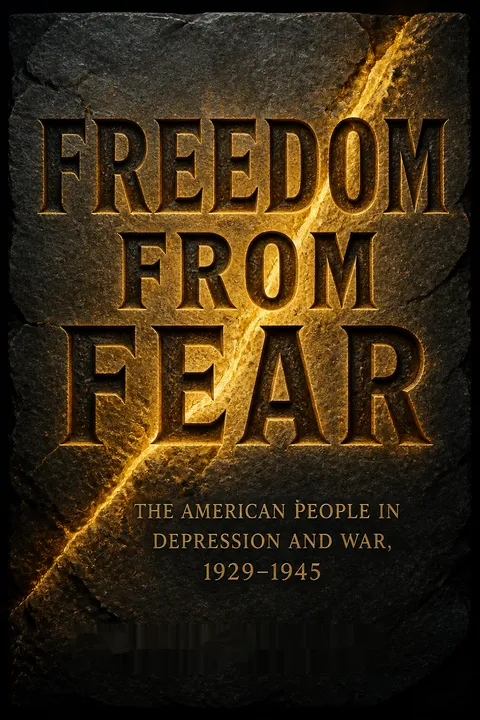
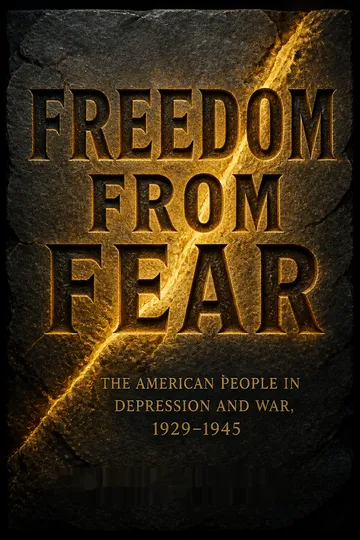
Freedom from Fear is highly regarded as a comprehensive and engaging history of the Great Depression and World War II era. Readers praise Kennedy's balanced approach, detailed analysis, and ability to weave together political, economic, and social aspects of the period. The book is noted for its focus on FDR's leadership and policies, particularly the New Deal. While some find it lengthy, most consider it an essential read for understanding this pivotal time in American history. Critics appreciate Kennedy's skill in synthesizing complex events and providing fresh perspectives on familiar topics.
Glossary
Recent Social Trends
1920s social researchA large government-sponsored study of American life, commissioned by Herbert Hoover and published in 1933. It assembled data on work, technology, education, race, migration, health, and government. Kennedy uses it to show that the country was already changing rapidly before the crash, while also revealing deep differences between urban and rural life.
Agricultural Adjustment Administration
Farm price-support agencyThe New Deal agency created in 1933 to raise farm prices by reducing surplus production. It paid farmers to limit acreage or production and used loans to keep some crops off the market. The policy improved prices for many landowners but also displaced sharecroppers and tenants, who often received little or none of the benefit.
National Recovery Administration
Industry code regulatorA New Deal agency established under the National Industrial Recovery Act of 1933. It encouraged industries to adopt government-approved codes governing prices, production, wages, and working hours. The NRA sought to reduce destructive competition and support wages, but its codes often favored large firms, restricted labor's power, and were struck down by the Supreme Court in 1935.
Social Security Act
Federal social insurance lawThe 1935 law that established federal old-age pensions and encouraged state unemployment insurance, along with aid to dependent children and indigent elderly people. Its payroll contributions were presented as insurance rather than a general tax. The original system excluded agricultural laborers and domestic servants, leaving many Black workers outside its main protections.
Wagner Act
Workers' organizing protectionThe common name for the National Labor Relations Act of 1935. It protected workers' right to organize and bargain collectively, prohibited certain employer practices such as company unions, and created the National Labor Relations Board. The law strengthened industrial union organizing, though it did not guarantee that employers would reach an agreement with workers.
cash-and-carry
Purchase and transport ruleA neutrality-law provision allowing belligerent nations to buy nonmilitary goods from the United States only with cash and by carrying them away in their own ships. The rule was intended to keep American vessels and credit out of war. In practice, it favored nations with money and shipping, particularly Britain and France in the Atlantic and Japan in Asia.
Lend-Lease
Allied supply programA 1941 program that allowed the United States to provide war supplies to countries whose defense Roosevelt considered important to American security. It removed the cash requirement that had constrained British purchases. Lend-Lease made the United States a major material supporter of Britain and the Soviet Union, even while the country remained formally outside the war.
Plan Dog
Germany-first strategyA 1940 U.S. naval planning proposal that treated Britain's survival as essential and recommended concentrating the main American effort against Germany, while remaining defensive in the Pacific. Its logic shaped later planning: aid Britain, avoid an early war with Japan, and prepare to send major American land and air forces to Europe.
Overlord
Normandy invasion operationThe Allied plan for the cross-Channel invasion of German-occupied France, launched on June 6, 1944. The operation required a vast buildup in Britain, deception to mislead German commanders, air and naval support, and a landing force large enough to establish a durable beachhead. It was the long-delayed Western front that Stalin had demanded.
Manhattan Project
Atomic bomb development programThe secret American-led wartime project to develop an atomic bomb. It brought together scientists, military officers, and enormous industrial resources at multiple sites, including Los Alamos, Oak Ridge, and Hanford. The project produced the weapons used against Hiroshima and Nagasaki in August 1945, marking the arrival of nuclear warfare.
Four Freedoms
Four wartime rightsFranklin Roosevelt's 1941 formulation of freedom of speech, freedom of worship, freedom from want, and freedom from fear. The phrase gave the war an explicitly political and social purpose beyond military victory. It connected the defense of democratic institutions abroad with the promise of greater security and opportunity at home.
FAQ
1. What is Freedom from Fear: The American People in Depression and War, 1929-1945 by David M. Kennedy about?
- Comprehensive historical overview: The book covers the United States from the onset of the Great Depression in 1929 through the end of World War II in 1945, examining economic, social, political, and military developments.
- Focus on transformation: Kennedy explores how Americans endured and responded to crises, highlighting the transformation of society, government, and the nation’s global role.
- Integration of domestic and international events: The narrative situates American experiences within the broader context of global events, including the rise of totalitarian regimes and the complexities of international alliances.
- Emphasis on leadership and ordinary people: The book analyzes the roles of key figures like Franklin D. Roosevelt and Winston Churchill, while also detailing the experiences of everyday Americans.
2. Why should I read Freedom from Fear by David M. Kennedy?
- Rich, authoritative scholarship: Written by Pulitzer Prize-winning historian David M. Kennedy, the book is grounded in extensive research and primary sources, making it both accessible and valuable for general readers and scholars.
- Balanced and nuanced perspective: Kennedy presents multiple viewpoints, addressing controversial topics such as racial discrimination, labor struggles, and ethical dilemmas, avoiding simplistic narratives.
- Holistic understanding of a pivotal era: The book connects political, economic, social, and military history, helping readers understand how the crises of the era shaped modern America.
- Insight into contemporary relevance: By tracing the roots of modern institutions and debates, the book offers lessons on government, leadership, and social change that resonate today.
3. What are the key takeaways of Freedom from Fear by David M. Kennedy?
- Profound impact of the Great Depression: The economic collapse was a social disaster that reshaped American life and led to a significant expansion of government’s role.
- World War II as a turning point: The war ended the Depression, mobilized the nation, and transformed the U.S. into a global superpower, while exposing deep social tensions.
- Leadership and political realignment: FDR’s leadership was crucial in navigating crises, and the Democratic Party underwent a major realignment, incorporating new constituencies.
- Complex legacy of reform: The New Deal and wartime mobilization laid the foundations for the welfare state and regulatory frameworks, but recovery and reform were uneven and incomplete.
4. How does David M. Kennedy explain the causes of the Great Depression in Freedom from Fear?
- Multiple contributing factors: Kennedy identifies the 1929 stock market crash as a trigger but emphasizes deeper structural problems, including international debts, reparations, and economic isolationism.
- Banking and monetary policy failures: Weaknesses in the banking system and the Federal Reserve’s adherence to the gold standard exacerbated the downturn.
- Protectionism and declining demand: Protectionist tariffs and falling consumer demand further deepened the crisis.
- Social and psychological effects: The Depression created widespread fear and uncertainty, affecting public morale and political behavior.
5. What is the significance of the New Deal in Freedom from Fear by David M. Kennedy?
- Innovative but contested reforms: The New Deal introduced unprecedented government programs for relief, recovery, and reform, including Social Security and public works agencies.
- Focus on security: Kennedy argues the New Deal’s central theme was providing economic and social security, rather than radical redistribution or revolution.
- Political strategy and opposition: FDR navigated conservative resistance, Supreme Court challenges, and internal party divisions, leading to a “Constitutional Revolution” in 1937.
- Legacy and limitations: While the New Deal alleviated suffering and redefined government’s role, it did not fully end the Depression; World War II mobilization was crucial for recovery.
6. How does Freedom from Fear by David M. Kennedy describe the American people’s experience during the Great Depression?
- Widespread suffering and resilience: Millions faced unemployment, poverty, and loss of self-respect, with Southern sharecroppers and black Americans suffering extreme deprivation.
- Urban and rural contrasts: Industrial workers in cities saw some wage gains, while farmers endured a decade-long depression with falling prices and foreclosures.
- Social and political implications: The crisis eroded traditional family roles and community ties, weakened labor unions, and fueled demands for government intervention and reform.
- Diversity of impact: The Depression’s effects varied by gender, age, race, occupation, and region, revealing tensions in American individualism and social attitudes toward poverty.
7. What were the main New Deal programs and policies discussed in Freedom from Fear and their significance?
- National Industrial Recovery Act (NIRA) and NRA: Sought to regulate industry through codes on wages and production, energizing labor organizing but ultimately declared unconstitutional.
- Agricultural Adjustment Act (AAA): Aimed to raise farm prices by controlling production, stabilizing prices but displacing many tenant farmers and sharecroppers.
- Social Security Act of 1935: Established old-age pensions and unemployment insurance, laying the foundation for the modern welfare state.
- Tennessee Valley Authority (TVA): Represented a bold experiment in regional development and public power, uplifting the South and symbolizing New Deal innovation.
8. How does Freedom from Fear portray Franklin D. Roosevelt’s leadership and political strategy?
- Visionary yet pragmatic: Roosevelt combined optimism, political skill, and a willingness to experiment with bold reforms to combat the Depression and mobilize for war.
- Balancing diverse interests: He managed complex coalitions, including labor, minorities, and Southern Democrats, while navigating opposition from conservatives and radicals.
- Direct communication: Roosevelt’s use of Fireside Chats and public speeches helped restore confidence and build public support for his policies.
- Adaptation and compromise: He adjusted strategies in response to political realities, as seen in his handling of the Supreme Court, fiscal policy, and wartime diplomacy.
9. What role did World War II play in transforming American society and the economy according to Freedom from Fear?
- Mobilization ended the Depression: The war effort created full employment, massive government spending, and rapid industrial conversion, making the U.S. the “arsenal of democracy.”
- Social changes: The war triggered the largest internal migration in U.S. history, increased women’s workforce participation, and exposed racial contradictions, sparking civil rights activism.
- Technological and strategic innovation: The development of air power, amphibious operations, and the atomic bomb showcased American industrial and scientific prowess.
- Postwar legacy: The GI Bill expanded education and homeownership, setting the stage for the postwar economic boom and the rise of the American middle class.
10. How does David M. Kennedy address the moral and ethical dilemmas of World War II in Freedom from Fear?
- Japanese American internment: The book critically examines the violation of civil liberties and racial discrimination inherent in the internment policy, highlighting legal and moral controversies.
- Strategic bombing and civilian casualties: Kennedy discusses the ethical implications of area bombing campaigns, including the firebombing of German cities and the atomic bombings of Hiroshima and Nagasaki.
- Racial segregation and discrimination: The persistence of Jim Crow laws, segregation in the military, and racial violence during the war reveal contradictions between American ideals and practices.
- Balancing security and rights: The book explores the tension between national security and constitutional rights, especially in times of crisis.
11. What were the major challenges and dynamics of the Grand Alliance during World War II as described in Freedom from Fear?
- Divergent goals and suspicions: The U.S., Britain, and the Soviet Union had differing political systems, war aims, and mutual suspicions, making cooperation essential but fraught with tension.
- Strategic disagreements: Disputes over the timing and location of the second front, with Stalin pressing for early action in Europe and Churchill favoring Mediterranean campaigns, complicated alliance dynamics.
- Diplomatic conferences: Key meetings at Teheran and Yalta shaped military strategy and postwar arrangements, but also sowed seeds for the Cold War.
- Legacy of cooperation and conflict: The alliance’s uneasy cooperation laid the groundwork for the postwar order and the emergence of the U.S. as a global leader.
12. What are the most notable quotes from Freedom from Fear by David M. Kennedy and what do they mean?
- "Freedom from fear": The book’s title and leitmotif, expressing the goal of economic and social security for all Americans, encapsulating the desire to protect citizens from uncertainty.
- Roosevelt’s inaugural: "The only thing we have to fear is fear itself," symbolizing Roosevelt’s leadership style and the psychological dimension of recovery.
- Churchill’s resolve: "We shall fight on the beaches..." epitomizes British tenacity and the importance of Allied unity.
- On civil rights: "All legal restrictions which curtail the civil rights of a single racial group are immediately suspect," from Justice Hugo Black in Korematsu v. United States, highlighting the constitutional tension during national emergencies.
- Postwar reality: "The United States stand at this moment at the summit of the world," from Churchill in 1945, capturing America’s new global dominance and responsibility.
The Oxford History of the United States Series Series
Download PDF
Download EPUB
.epub digital book format is ideal for reading ebooks on phones, tablets, and e-readers.








