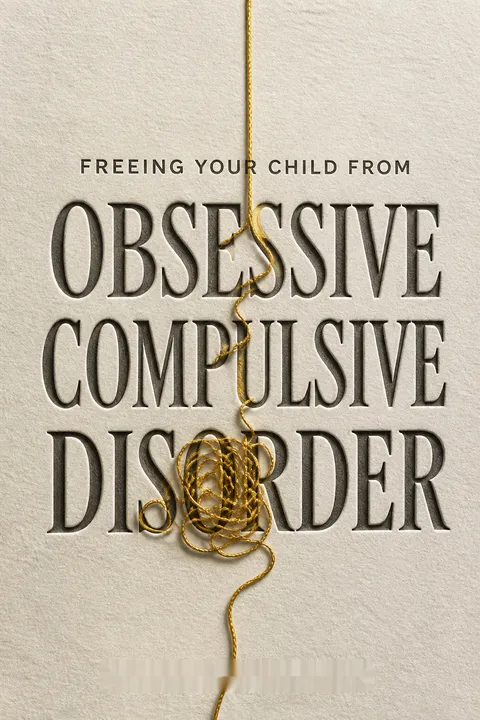


Key Takeaways
Separate your child from OCD, then fight the disorder together.
Blame points the wrong way. OCD can make ordinary tasks feel dangerous or unfinished, while the child is often distressed by the rituals and wants them to stop. Chansky urges parents to see the disorder as a problem affecting the child, not as the child’s personality or a deliberate attempt to control the family. This externalizing approach gives parent and child a shared target. A child who believes strange thoughts mean they are bad or “crazy” may hide symptoms; learning that OCD is a recognized, treatable condition can reduce shame and make asking for help easier.
Stay connected to the child. The parent’s role is not to dismiss distress or declare every concern irrational. It is to take the child’s suffering seriously while helping distinguish the child’s wishes from OCD’s demands. The book’s guiding image is a parent who knows the terrain well enough to help the child find another route.
The distinction between a person and a problem is not merely comforting language. It can change the emotional geometry of a household: parents and children stop treating each other as opponents and can examine the pattern together. That shift also guards against a common overcorrection. Externalizing OCD should not erase the child’s individuality or turn every preference into a symptom. The most useful version is flexible: the diagnosis explains some painful patterns, while the child remains a whole person with tastes, opinions, and ordinary conflicts.
Every ritual buys brief relief, then raises the price of doubt.
Relief reinforces repetition. An obsession is an unwanted, intrusive thought, image, or doubt that causes distress. A compulsion is a repeated action or mental ritual used to reduce that distress. A child fears contamination, washes, and feels temporary relief. That relief teaches the brain that washing was necessary, so the doubt returns and the ritual may grow more elaborate. Chansky calls this negative reinforcement: a behavior becomes more likely because it briefly removes an unpleasant feeling.
The pattern can spread. One girl’s number rituals began with checking page numbers, then extended to counting letters, brushing, and hockey drills. She knew the rules were excessive but felt unable to risk breaking them. The content varies, from germs to harm, religious fears, or symmetry, but the repeating sequence is similar: intrusive doubt, anxiety, ritual, short-lived relief, and renewed doubt.
This account helps explain why arguing about whether a feared event is likely often misses the mechanism. The ritual is not sustained by a persuasive theory so much as by the immediate drop in distress. That is a useful distinction for families: the question is not only what the child fears, but what action temporarily quiets the alarm. At the same time, the pattern is a clinical model, not a complete explanation of every child’s behavior. Careful assessment matters, especially when symptoms overlap with other difficulties.
Practice uncertainty in steps instead of waiting to feel safe.
Let the alarm settle. Exposure and ritual prevention, often abbreviated ERP, is a form of cognitive-behavioral treatment in which a child gradually faces a feared situation while resisting the ritual that usually follows. The goal is not to prove that danger is impossible or to force the child into an overwhelming challenge. It is to help the child learn that anxiety can be endured without obeying OCD. Chansky compares this to staying in cold pool water: discomfort may fade as the person remains in the situation rather than escaping it.
Build a manageable ladder. A therapist and child can list feared situations and begin with a challenge the child considers difficult but possible. The child might delay a ritual, shorten it, or do it differently, then track how distress changes. The book says many children find anxiety subsides within minutes, though timing varies. Treatment should be guided by a qualified professional, especially for severe or complex symptoms.
The practical strength of this approach is that it makes recovery observable. Instead of waiting for confidence to arrive before acting, a child gathers experience by acting while uncertain. Small, chosen challenges also preserve agency, which matters when OCD already makes daily life feel dictated by rules. The pool comparison clarifies the learning process, but it should not be mistaken for a promise that every exposure feels brief or easy. The point is repeated, supported practice, not a stopwatch or a test of toughness.
Stop feeding reassurance loops while keeping your child emotionally safe.
Answer the distress, not the demand. Reassurance is a normal part of parenting, but repeated answers to the same certainty-seeking question often do not last. A child who asks whether a fork is clean may receive an answer, then ask again because the underlying doubt remains. Chansky recommends acknowledging that the child is stuck and naming the OCD pattern, rather than repeatedly certifying that the fork is safe or finding a replacement.
Change one pattern at a time. Parents can work with the child and therapist to reduce repeated answers or other accommodations gradually. The child should know the plan in advance, and the parent should remain kind and steady when anxiety rises. When a ritual is interrupted, the child may initially intensify the request or protest. The book calls this an extinction burst, a temporary increase in a behavior when the response that used to reinforce it is withheld.
This is a difficult balance because reassurance expresses care, yet repeated certainty can become part of the ritual. The book’s strongest practical insight is that warmth and accommodation are not the same thing. A parent can communicate solidarity without supplying another guarantee. Consistency also matters: if a family sometimes refuses and sometimes answers after prolonged pressure, the child has reason to keep asking. Still, abrupt changes can overwhelm a child or worsen conflict, so plans should be collaborative and matched to the child’s readiness.
Make the child a co-author of each recovery challenge.
Agency makes hard work usable. Chansky advises parents to let children help choose which symptom to tackle and how challenging the first step should be. A therapist can help organize difficulties from easier to harder, while the child identifies what they most want back: time for friends, a less exhausting morning, or the freedom to eat with family. That goal gives the work a purpose beyond pleasing adults.
Reward effort, not perfection. The book recommends noticing attempts and partial successes, rather than treating anything short of complete success as failure. Small rewards may help children begin, while praise can recognize persistence. If a challenge repeatedly overwhelms the child, reduce its difficulty instead of escalating pressure. The aim is to help the child practice resisting OCD while building confidence, not to make treatment another rigid set of rules.
Shared decision-making is especially apt here because the treatment itself asks a child to tolerate uncertainty and discomfort. Participation can turn a parent’s demand into a goal the child recognizes as their own. The distinction between effort and outcome also prevents the recovery process from acquiring the same perfectionistic logic it is meant to loosen. Incentives are best understood as temporary scaffolding, not proof that the child is unmotivated without prizes. The child’s own reasons for wanting a fuller life should remain central.
Expect symptoms to change, and treat setbacks as signals, not verdicts.
The theme can move. Chansky describes OCD as changing its subject while repeating familiar patterns. A child who has made progress with washing may later struggle with checking, counting, or a new form of uncertainty. A new symptom does not automatically mean that earlier gains have vanished. The book argues that recognizing the underlying pattern can help families respond without treating each new theme as an entirely new disorder.
Prepare rather than panic. Symptoms may flare during illness, fatigue, stress, or changes in routine, but sometimes no clear trigger appears. Chansky distinguishes a brief lapse from a more sustained return of symptoms and a severe collapse in functioning. Parents are encouraged to notice changes early, review strategies, and contact the child’s therapist when needed. Calm, specific explanations of a difficult period can help prevent one bad day from becoming a judgment about the child’s future.
This perspective replaces the misleading picture of recovery as a smooth upward line with a more usable one: progress can include detours without being erased. That matters because parental alarm can itself become part of the family’s crisis, making a manageable slip feel catastrophic to the child. The framework also encourages observation rather than blame. A recurrence deserves attention, but it does not by itself prove that treatment failed, that a parent caused the problem, or that the child is back at the beginning.
Seek assessment when rituals steal time, cause distress, or disrupt life.
Quirks are not diagnoses. Children commonly have preferences, routines, and superstitions. Chansky distinguishes these from OCD by asking whether a behavior is hard to control, distressing, time-consuming, or disruptive to school, sleep, relationships, and family life. The book gives more than an hour a day as one indicator, but emphasizes impairment and distress as important too. A child who enjoys a routine is different from one who feels compelled to repeat it despite wanting to stop.
Find an OCD-informed professional. Assessment should explore intrusive thoughts, rituals, avoidance, and the effect on daily functioning, while considering other possible explanations. The book strongly recommends a clinician experienced in childhood OCD and describes cognitive-behavioral treatment as central, with medication considered by a qualified prescriber when appropriate. Sudden, dramatic symptom changes or thoughts of self-harm also warrant prompt professional evaluation, rather than assumptions based on a book or a family’s interpretation.
The threshold based on distress and interference is more helpful than judging a behavior by how strange it looks. It directs attention to the child’s experience and functioning, rather than to a parent’s discomfort with an unusual habit. The book also makes an important case for specialist knowledge: children may conceal symptoms or lack the words to describe them. Its diagnostic and medical descriptions date from 2000, however, so current assessment and treatment decisions should rely on contemporary clinicians, not historical figures or labels alone.
Make home and school allies without making the child a diagnosis.
OCD travels with the child. Symptoms can consume attention in class, slow written work, interfere with transitions, or make social activities difficult. Whether to tell the school depends on the child’s needs and the family’s judgment. When school involvement is useful, parents and clinicians can explain the problem, identify practical barriers, and agree on discreet supports. Examples in the book include shorter assignments, clearer time limits, or a trusted staff member who can help a child regroup.
Include siblings without assigning them the cure. Brothers and sisters may feel worried, embarrassed, angry, or overlooked. A family conversation can explain that OCD is not the affected child’s fault while also validating the impact on everyone else. Siblings may offer help when they want to, but they should not be made responsible for treatment. Privacy, dignity, and ordinary family activities remain important even when some routines need temporary adjustment.
The book treats recovery as a system-level effort, not a private contest between one child and one therapist. That is valuable because school routines and family responses can either increase friction or make participation possible. Yet support should be tailored rather than automatic: accommodation can protect access to learning, but too much can accidentally preserve avoidance. A useful plan therefore asks both what the child needs now and what capacity the support is meant to build, while protecting the child from stigma and unnecessary disclosure.
Protect the parent's stamina; recovery is a family marathon.
Caregivers are part of the treatment environment. Chansky describes how guilt, exhaustion, anger, isolation, and grief can build when a family organizes its days around OCD. Parents are encouraged to acknowledge those feelings without treating them as evidence of bad parenting. Taking breaks, asking for help, maintaining some meaningful activities, and lowering nonessential demands can preserve the energy needed to support a child.
Keep a life beyond symptoms. The book warns against becoming an OCD monitor who constantly checks whether the child is improving. Parents can stay attentive without making every conversation about symptoms. The disorder may wax and wane, but setbacks do not cancel the child’s identity or the family’s other relationships. A steady parent is not one who never gets frustrated; it is one who can pause, repair after mistakes, and return to practical support.
Caregiver wellbeing is not a decorative extra in this account. A parent who is depleted may find it harder to respond consistently, while a family that talks only about symptoms can make the diagnosis feel like the child’s whole identity. The book’s invitation to preserve ordinary pleasures is therefore both humane and strategic. Its framing should not imply that parents can control recovery by being calm enough. They can influence the environment, but OCD is not a measure of parental competence.
Analysis
Chansky’s book is a parent-focused guide that combines clinical explanation, treatment orientation, family coaching, and case stories. Its most durable contribution is relational: it gives parents a way to take a child’s suffering seriously without confusing the child with the disorder. That reframing is not cosmetic. It makes room for empathy and limits at the same time, replacing blame with a shared effort to reduce rituals and avoidance.
The practical core is behavioral. Reassurance and ritual completion can bring immediate relief, which helps explain why well-meaning accommodation can keep the cycle going. Gradual exposure and resistance to rituals offer a way to learn through experience rather than through endless argument about probabilities. The child’s participation, manageable steps, attention to daily functioning, and recognition of partial progress make this framework more respectful than a command to simply stop.
The book’s scope is unusually broad for a treatment guide. It follows OCD from the bathroom and bedroom into classrooms, sibling relationships, and caregiver exhaustion. This is a strength because childhood symptoms do not occur in isolation. Its advice about school support and family communication also recognizes that a child’s available time and attention are shaped by the surrounding environment.
The source was published in 2000, and some of its biological explanations, prevalence figures, medication details, and discussion of PANDAS reflect the knowledge and terminology of that period. Those sections should not be treated as current medical guidance. In particular, intrusive thoughts about suicide or harm should never be assumed harmless solely because OCD is present. A qualified clinician must assess immediate safety and distinguish unwanted thoughts from intent or plans. The book itself says it cannot replace individualized care. Its best use today is as a compassionate orientation to family experience and behavioral principles, alongside contemporary professional assessment and treatment.
Review Summary
Freeing Your Child from Obsessive Compulsive Disorder receives overwhelmingly positive reviews (4.2/5 stars), with parents praising its practical, comprehensive approach to helping children with OCD. Readers appreciate the book's focus on parenting strategies, behavior therapy techniques, and self-care for parents. Many found it life-changing, reporting significant improvements in their children's symptoms. The book explains OCD as "brain hiccups" and teaches children to "boss back" their intrusive thoughts. Some criticism notes repetition and limited coverage of internal OCD. Overall, reviewers highly recommend it as an essential resource for parents, teachers, and clinicians.
People Also Read







Glossary
Obsessions
Unwanted recurring thoughtsIn the book, obsessions are intrusive, unwanted thoughts, images, or impulses that recur and cause distress. They may involve contamination, harm, symmetry, religion, sex, or other themes. A thought’s disturbing content does not by itself show that the child wants it or considers it true. The clinical significance lies in its persistence, distress, and effect on the child’s life.
Compulsions
Rituals that ease distressCompulsions are repeated behaviors or mental acts that a child feels driven to perform in response to an obsession or a rigid rule. Washing, checking, counting, praying, repeating, and seeking reassurance are examples. They may briefly reduce anxiety, but that relief can reinforce the ritual and allow doubt to return. Some compulsions are private mental acts and may not be visible to others.
Exposure and ritual prevention
Face fears without ritualsA cognitive-behavioral treatment approach in which a person gradually encounters a feared thought, object, or situation while resisting the ritual or avoidance that usually follows. The aim is to help the person learn that distress can be tolerated without performing the compulsion. In Chansky’s account, challenges are selected and paced with the child and therapist rather than imposed as a one-size-fits-all exercise.
Brain lock
A stuck danger signalA term associated in the book with psychiatrist Jeffrey Schwartz, describing the repetitive, stuck quality of OCD thoughts and danger signals. Chansky uses the idea to help families picture a brain process that keeps returning to doubt or threat even when the child recognizes that the concern is excessive. It is an explanatory metaphor, not a complete account of OCD’s causes.
Extinction burst
Temporary increase after resistanceA term from behavioral psychology for a short-term surge in a behavior after the response that used to reinforce it is withheld. In the book’s example, a child may ask more insistently for reassurance when a parent begins following a planned limit. The concept helps parents anticipate protest, but it does not mean every escalation should be ignored or handled without clinical guidance.
Fear temperature
A rating of distressA simple way described in the book for a child to rate anxiety during a challenge, often on a numerical scale. The child records distress before and after resisting a ritual or facing a feared situation, observing whether the feeling changes. The rating is meant to support awareness and track experience, not to demand that anxiety reach zero before the child can move on.
PANDAS
A proposed strep-related subtypeThe book uses this acronym for Pediatric Autoimmune Neuropsychiatric Disorders Associated with Streptococcal infections. It describes a proposed subgroup of children whose OCD or tic symptoms begin or worsen sharply in connection with strep infection. Because the book’s discussion reflects research and terminology available in 2000, families should consult current medical professionals rather than use its description to diagnose or treat a child.
Show and Tell
Act against OCD's ruleChansky’s phrase for demonstrating resistance to OCD through behavior and self-directed language. A child might delay, shorten, or alter a ritual, then identify the demand as an OCD pattern and continue with a chosen activity. The purpose is not to prove that danger is impossible, but to practice acting according to the child’s goals despite uncertainty and discomfort.
Download PDF
Download EPUB
.epub digital book format is ideal for reading ebooks on phones, tablets, and e-readers.








