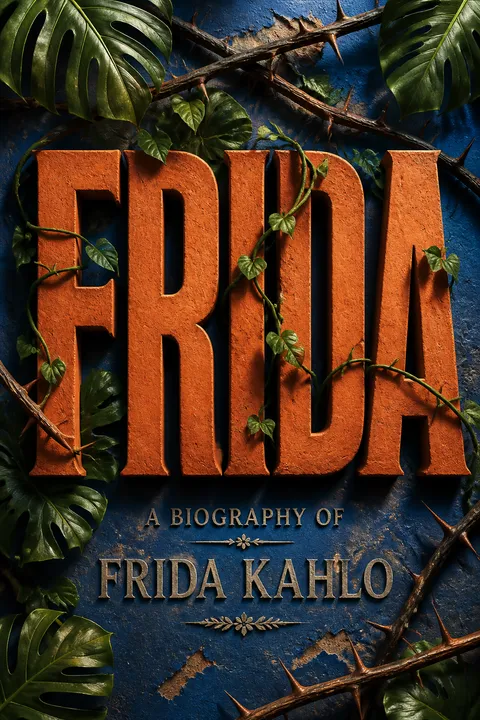


Key Takeaways
Read Kahlo’s paintings as a life story, not detachable symbols
Life entered the gallery. In 1953, too ill to walk, Kahlo arrived at her first major exhibition in Mexico by ambulance and was carried inside on her bed. Friends gathered around her as if the opening were both an art show and a public farewell. The scene condensed her career: she made her own body, pain, humor, clothes, and relationships central material for her art.
Biography is not a key. Most of her roughly two hundred paintings are self-portraits, but they are not simply illustrations of events. They transform lived experience into precise, often strange images. The Coyoacán home where she was born, lived, and died became a museum, complete with objects that make her imagined world feel continuous with the physical one.
What's striking is how the exhibition makes spectators confront the boundary between art and life without dissolving either. The bed is not merely a symbol, and Kahlo is not merely performing illness: she is arranging the terms on which the public may encounter her. That distinction matters in any biographical reading. A painting can carry evidence of experience without serving as a transparent medical record. The book’s most useful invitation is therefore to treat the pictures as crafted acts of self-presentation, not as puzzles with one hidden answer.
Treat the body’s limits as material, not the end of agency
A sudden wreck changed everything. In 1925, when Kahlo was eighteen, a bus collided with a streetcar. A metal handrail pierced her pelvis; her spine and pelvis were fractured, and her right leg and foot were badly damaged. She survived, but pain and medical treatment shaped the rest of her life. Earlier, polio had left her right leg thinner, marking her out among other children.
Stillness redirected her. Before the crash she had planned to study medicine and enjoyed sports. During recovery, she began painting in bed with an easel made for her. Her records describe at least thirty-two operations, though treatments did not reliably help. Paintings such as The Broken Column make bodily vulnerability visible, but their impassive figures also insist on the artist’s continued power to look, choose, and make.
The account resists the tidy idea that adversity automatically produces strength. Kahlo’s body was not a metaphor that she could simply master; it imposed real limits, repeated pain, and dependence on other people. Yet she found a medium in which observation remained hers. Disability studies often distinguishes impairment from the social meanings imposed on it. Kahlo’s art makes that distinction vivid: the damaged body is neither hidden nor reduced to a lesson in courage. Its visibility can challenge shame, while the cost of living with pain remains visible too.
Use self-presentation to reclaim authorship when others define you
The mirror became a working tool. Kahlo’s first serious self-portrait, painted in 1926 while she was ill, was a gift to her former boyfriend Alejandro Gómez Arias. It offered an image of herself when she could not be beside him. Across her career, repeated self-portraits let her inspect and revise how she appeared, from solitary young woman to wounded patient, lover, political figure, or companion to animals.
Clothing spoke publicly. She carefully assembled Tehuana skirts, embroidered blouses, jewelry, and elaborate hairstyles. The costumes could conceal her injured leg and draw attention away from her scars, but they also made her presence unmistakable. Her portraits often hold the face steady while the body or surrounding objects reveal distress. This tension between public composure and private pain became one of her most recognizable artistic strategies.
Self-portraiture here is less a search for a stable identity than a repeated negotiation with the gaze of others. Kahlo controls some parts of the image, while pain, aging, and relationships disrupt that control. This resembles a broader insight from performance studies: presentation is not necessarily false because it is deliberate. Clothes and pose can be tools for agency, even when they also conceal vulnerability. The tension deserves care, though. A striking persona may invite audiences to admire the performance and overlook the person who had to sustain it.
Make cultural inheritance a chosen language, not a costume alone
Mexican identity was a decision. Kahlo was born in Coyoacán to a German-born photographer father and a Mexican mother of mixed Indigenous and Spanish ancestry. She later chose 1910, the year the Mexican Revolution began, as her birth year, aligning her personal story with the country’s upheaval. Her paintings and home drew on Indigenous objects, folk art, popular colors, and the traditions of Mexico’s working people.
Dress carried several meanings. Kahlo adopted Tehuana clothing after marrying Diego Rivera, who admired its association with strong women and Mexican culture. For her, the garments could express political belonging, personal style, and a wish to hide physical damage. Yet she was a city-raised woman from a middle-class family, not a representative of rural Indigenous life. Her Mexican identity was powerful partly because it was constructed, not simply inherited.
What's compelling is the difference between cultural belonging and claims of cultural purity. Kahlo’s identity draws strength from a real connection to Mexican history, while her use of Indigenous dress also involves selection, performance, and social privilege. That complexity makes the image more interesting, not less authentic. Cultural symbols can become tools for resisting colonial standards, but they can also flatten diverse communities into a single emblem. The account encourages readers to ask who gets to represent a culture, and what contradictions remain inside even a deeply sincere act of identification.
Let precise autobiography carry fantasy without escaping reality
A retablo records distress. A retablo is a small votive painting, often made to thank a saint for rescue from danger. Kahlo borrowed its compact scale, careful detail, and direct account of suffering, then replaced religious rescue with images from her own life. In Henry Ford Hospital, painted after a miscarriage in Detroit, a bed floats in an empty landscape while symbolic objects hover near her body. The scene is fantastical, yet tied to medical and emotional experience.
The fantastic stayed concrete. Kahlo was welcomed by Surrealists, but she resisted being defined by the movement. Her images of exposed organs, injured bodies, animals, and plants were not simply dream puzzles. The Broken Column, for example, turns her damaged spine into a visible architectural fracture. Fantasy gave her a way to render what ordinary portraiture could not show.
The paintings resemble a form of visual testimony: they organize experience into images that can be witnessed, even when the experience itself resists ordinary explanation. This connects with narrative medicine, which treats stories and images as ways to make illness communicable without pretending that representation cures it. Kahlo’s symbols are often legible, but not entirely settled. The same image can carry physical, sexual, cultural, and spiritual associations. That openness is a strength, provided viewers do not mistake interpretation for access to the artist’s complete inner life.
Recognize that sustaining love can still demand boundaries
Their marriage resisted simple labels. Kahlo married Rivera in 1929, when she was twenty-two and he was forty-two. Their linked homes in San Angel gave them separate studios and private space, but they remained closely involved. Rivera’s repeated affairs, including one with Kahlo’s sister Cristina, caused deep hurt. They divorced in 1939 and remarried in 1940. Rivera later said Kahlo set terms that included supporting herself and avoiding sex, though accounts of their private life differ.
Paintings tracked the changing bond. In early portraits, Kahlo presents herself as Rivera’s partner; later images show his face embedded in her forehead, or the couple joined into one uneasy figure. Their affection was real, as were jealousy, dependence, conflict, and unequal freedom. Neither the story of a perfect romance nor the story of simple victimhood can explain their relationship.
The marriage is most revealing when it is not turned into a verdict. Rivera’s infidelity and double standard are real features of the account, but so are artistic respect, mutual care, and Kahlo’s own relationships outside the marriage. Attachment theory offers a useful lens here: closeness can provide security while intensifying fear of abandonment. That lens does not excuse harmful behavior or make the couple’s arrangement a model. It helps explain why affection and injury could coexist, and why Kahlo’s paintings register love as both connection and exposure.
Give grief a form when the future you wanted disappears
Motherhood remained an open wound. Kahlo experienced miscarriages and abortions and never had a child. Her fractured pelvis and other medical problems made pregnancy difficult, while Rivera was not eager to raise another child. In Henry Ford Hospital, she places the lost pregnancy among floating images that include a fetus, a medical model, and a flower. My Birth later joins her own birth to the death of her mother and the loss of a hoped-for child.
Art did not erase the loss. Kahlo surrounded herself with dolls, cared for her sister’s children, and treated pets and plants with tenderness. These attachments offered forms of care, not substitutes that made grief disappear. In Me and My Doll, she sits beside a lifeless toy infant, smoking and facing forward. The image refuses the sentimental scene of a woman made whole by maternal feeling.
This material is powerful because it does not force bereavement into a story of recovery. Creative work can give grief structure, but it cannot restore the future that was lost. Kahlo’s paintings also complicate familiar assumptions that fulfillment must pass through motherhood. Her care for children, animals, and plants is substantial, yet it does not cancel her longing for a child. The distinction matters: honoring alternative forms of kinship should not require denying the pain of an unrealized desire.
Bring art into public life without pretending politics are simple
Mexico’s revolution changed the art world. After years of upheaval, public education and mural projects promoted Indigenous culture and national history. Rivera became a leading muralist, painting for government institutions and, later, American industrial patrons. His work mixed social criticism with commissions from powerful institutions, a contradiction that provoked disputes with Communist allies. Kahlo joined the Communist Party and shared commitments to Mexican culture and left politics, though her paintings remained intensely personal.
Teaching made politics practical. In the 1940s, Kahlo taught at La Esmeralda, an art school that sent students into markets, neighborhoods, and the countryside rather than confining them to academic models. Four pupils who continued working with her at home became known as Los Fridos. She encouraged close looking, popular art, and independent styles. With students, she helped paint murals for a pulquería, a tavern serving fermented agave drink, and a public laundry.
Kahlo’s political life shows why an artist’s commitments cannot be measured only by whether each artwork delivers a clear slogan. Her paintings rarely function as conventional propaganda, yet her teaching, public appearances, and choices of cultural reference were political acts. The tension between intimate art and collective purpose is productive: personal experience can expose what abstract political language leaves out. At the same time, political affiliation does not guarantee consistency. The biography presents a person shaped by causes, friendships, and changing loyalties rather than a perfectly coherent ideological symbol.
Make your last statement an act of life, not a denial of death
Illness narrowed her world. In 1953, doctors amputated Kahlo’s right leg below the knee after worsening circulation and gangrene. She struggled with pain, drugs, and depression, but learned to walk short distances with an artificial leg and decorated boots. Her first major Mexican exhibition that year became a public event; too ill to stand, she attended on a stretcher in her bed, greeting visitors and singing with them.
The work kept its color. Kahlo joined a 1954 protest against the overthrow of Guatemala’s president despite recovering from pneumonia. Her final painting, Viva la Vida, shows cut and whole watermelons against a vivid sky. She signed it shortly before her death at forty-seven. The cause was reported as a pulmonary embolism, though the biography notes uncertainty about her final hours. The painting’s red fruit faces death without pretending that suffering has vanished.
The ending resists two tempting distortions: treating Kahlo as a triumphant symbol who transcended disability, or reducing her final years to decline. Her public appearances and late paintings show deliberate acts of participation, but they also carry a steep physical cost. The watermelons can be read as an affirmation of sensory life, not proof that pain was conquered. This distinction is ethically important whenever illness becomes art: audiences may find inspiration in the work, while still recognizing that the artist’s suffering was not a price that art needed to demand.
Analysis
Herrera’s biography is strongest when it treats Kahlo’s art as neither a symptom nor a self-contained aesthetic object. The paintings emerge from a particular life, but they also remake that life into a sequence of deliberate images. Kahlo’s repeated self-portraits are not simply evidence of narcissism or a record of injury. They show an artist testing how the self can be seen, concealed, multiplied, and connected to others. The book’s recurring tension is between bodily confinement and imaginative range: a bed can become a studio, a hospital room, a political stage, or a miniature universe.
The account also complicates the idea that personal art must be politically private. Kahlo’s imagery remains intimate even as her clothing, teaching, party membership, and defense of Mexican popular culture place her within public struggles. Her relationship with Rivera presents a parallel contradiction. Their devotion cannot be separated from unequal power, infidelity, rivalry, and practical dependence. Herrera preserves these inconsistencies rather than forcing a clean moral judgment, although her close readings sometimes assign meanings to individual details that remain interpretive rather than certain.
That caution matters because Kahlo’s fame can turn her into the very kind of fixed icon her art resisted. The embroidered costume, joined brows, and visible wounds are easily repeated as a recognizable brand. The biography offers a more demanding view: these were choices made by a changing person, not timeless traits. Her late work is especially important because it prevents the earlier image of flamboyant control from swallowing the reality of exhaustion, addiction, and loss. The result is not a neat lesson that suffering produces genius. It is a portrait of an artist who found ways to make experience visible, while remaining vulnerable to the conditions she represented.
Review Summary
People Also Read
Glossary
Mexicanidad
Mexican cultural identityA post-revolutionary emphasis on Mexican history, Indigenous heritage, popular culture, and national identity, set against the older prestige of European models. In Kahlo’s life, it shaped her clothing, home, politics, and art. The term does not mean she embodied every Mexican experience; her identity was also a deliberate artistic and political choice.
retablo
Votive story paintingA small devotional painting, often commissioned after someone survives illness, injury, or danger. A retablo typically depicts the event and the holy figure believed to have helped, with an inscription naming the people and circumstances. Kahlo adapted its intimate scale and plainspoken record of distress, while replacing conventional religious rescue with autobiographical imagery.
Los Fridos
Kahlo’s student circleThe nickname for four students who continued studying with Kahlo at her home after her health made regular teaching at La Esmeralda difficult. Arturo García Bustos, Guillermo Monroy, Arturo Estrada, and Fanny Rabel learned through observation, discussion, trips, and work with Mexican popular art. They developed distinct styles rather than simply copying Kahlo’s.
corrido
Mexican narrative balladA popular song that tells a story, often about political conflict, crime, disaster, or notable events. Corridos served as a form of musical news and were closely tied to Mexican popular life. Kahlo sang them with friends and students, and their direct storytelling helped shape the lively cultural world she valued.
pulquería
Pulque-serving tavernA tavern serving pulque, a fermented drink made from agave. In the biography, pulquerías are working-class social spaces, sometimes decorated with murals. Kahlo helped her students paint one in Coyoacán, treating the neighborhood venue as a public place where art could meet ordinary life.
Naturaleza Viva
Living still lifeKahlo’s title for a late still life of fruit. The Spanish phrase plays against the conventional term naturaleza muerta, or still life, which literally means dead nature. By calling the work living nature, Kahlo emphasized the fruit’s vitality and connected still-life painting to her enduring attention to life, decay, and the natural world.
Download PDF
Download EPUB
.epub digital book format is ideal for reading ebooks on phones, tablets, and e-readers.








