

Key Takeaways
Living between cultures reveals society's fault lines before they break
A childhood across worlds. Jacqueline grows up in Tehran with Persian, Jewish, and English traditions woven into ordinary life. Her Iranian father is a Jewish university professor; her mother is English. Their home holds Persian rugs and English china, while family celebrations span Nowruz and Passover. The household maids teach Jacqueline Persian stories, customs, and etiquette, giving her a view of lives far beyond her comfortable neighborhood.
Fluency is not protection. A doerageh is someone whose parents come from different national backgrounds. Jacqueline is also part of a Jewish community that made up only about 0.29 percent of Iran's population at the time. Her mixed upbringing opens doors and deepens her understanding, but it also makes her a minority within a minority. As political tensions grow, she recognizes that the different worlds she loves are separated by class, religion, and power.
What's revealing is that cultural fluency works as a form of early warning. Jacqueline can read differences in dress, speech, and social behavior because she has learned from people whose lives rarely overlap: her educated parents and the women employed in their home. Yet understanding difference does not dissolve inequality. Her position offers unusual access, while her Jewish identity remains subject to forces beyond her control. The distinction matters: belonging can be layered, and a person may feel at home in several cultures while being fully protected by none.
Modernization without representation leaves prosperity standing on a fault line
Opportunity and coercion coexist. Under Mohammad Reza Shah, Jacqueline sees expanded education, professional careers, and greater freedom for women to choose how they dress. Her father is a respected professor, and her mother works at the international airport. The family benefits from a prosperous, outward-looking Iran. But the Shah also centralizes power, abolishes multiparty politics, and relies on SAVAK, the secret police, to suppress dissent.
Visible wealth hides discontent. The lavish 1971 celebration of 2,500 years of monarchy dazzles Jacqueline, but she wonders why so few ordinary Iranians share in it. Some citizens resent Western influence, economic and class divisions, and being ruled without a political voice. The overthrow of Prime Minister Mosaddegh in 1953, with help from British and American intelligence, remains part of the country's political memory. Prosperity is real, but it does not guarantee legitimacy.
The memoir resists an easy choice between a golden past and a dark future. Modernization can expand education and women's autonomy while authoritarian rule closes the channels through which citizens might shape the changes. Political science distinguishes a government's capacity to deliver benefits from its legitimacy in the eyes of the governed. Jacqueline's memories show how the two can diverge: a family may flourish while many others experience the same system as imposed. The danger is treating visible development as proof that a society feels represented.
A coalition can topple a ruler without agreeing what replaces him
One opponent, many futures. By 1978, protests against the Shah draw support from students, workers, religious conservatives, intellectuals, leftists, and others who oppose his rule for different reasons. Ayatollah Khomeini becomes a unifying figure, promising a country free of oppression and foreign interference. Jacqueline hears hopes for democracy, religious justice, and greater autonomy, often from people who imagine very different outcomes.
A shared rejection is not a blueprint. The Shah leaves Iran in January 1979, and Khomeini returns from exile two weeks later to enormous crowds. Jacqueline watches people treat his arrival as the answer to their grievances. Her family, meanwhile, is divided between her father's confidence that order will return and her own fear that the revolution's promises conceal a new kind of rule. The coalition's victory settles who has been removed, not what kind of country will follow.
Revolutions are often remembered as if a unified people made a unified choice. Jacqueline's account makes the coalition visible as a temporary alignment, not a shared political program. That distinction helps explain why sincere hopes can coexist with radically different expectations. It also cautions against assuming that a movement's most popular promises constrain its leaders once power changes hands. The narrative is strongest when it shows how ordinary people interpret the same upheaval through their own needs, rather than presenting the revolution as inevitable or universally understood.
Under authoritarianism, a public vote can document submission, not choice
The ballot offers little privacy. In March 1979, Iran holds a referendum on replacing the monarchy with an Islamic republic. Jacqueline's father urges her to vote, not because the family has freely weighed the alternatives, but because an unstamped identity document could signal disloyalty and complicate access to rationed food. At their polling place, soldiers watch as voters choose between two conspicuously colored boxes.
A result can disguise pressure. The government announces that 98 percent voted for the new system. Jacqueline sees no meaningful public space for dissent, and she later learns that Jewish voters' identity documents received a different stamp from those of Muslim voters. Her family's participation is less an endorsement than a calculation about safety and survival. The scene makes the referendum's limits concrete: the appearance of mass consent can be produced by fear, constrained choices, and the consequences attached to refusing.
The episode separates the act of voting from the conditions that make a vote meaningful. A ballot can express preference, but it can also serve as identification, a loyalty test, or a route to essential services. This is why turnout and overwhelming official results cannot, by themselves, establish popular consent. Jacqueline's experience also complicates the familiar divide between courage and complicity: her father is navigating immediate risks for his family. Under coercion, seemingly political actions may be practical acts of protection.
When law dictates women's dress, fabric becomes a measure of power
Clothing rules tighten quickly. Before the revolution, women in Jacqueline's Tehran neighborhood commonly wore Western fashions, while other women chose chadors. After Khomeini takes power, hijab is first required in workplaces and later enforced for women in public. A maghnaeh is a head-and-shoulder covering; a manteau is a long overcoat worn to cover the body. These garments become part of the enforced public dress code.
Compliance becomes self-protection. In a Tehran park, a morality patrol searches Jacqueline's bag and finds a scarf she is carrying but not wearing. She calms the officers by promising to wear a more secure covering, recognizing that arguing could put her in danger. She adapts her clothes to avoid arrest, though the choice is not freely hers. The shift from miniskirts to mandated coverings is not simply a change in fashion. It marks the state's claim over women's bodies and public presence.
Dress codes shape more than appearance. They define who may move comfortably through public space, who must anticipate scrutiny, and whose body is treated as a public problem. Jacqueline's encounter shows how enforcement can be delegated to patrols and justified as protection, while the burden falls on the woman being inspected. Her strategic compliance is neither agreement nor passivity; it is a response to unequal power. The distinction prevents a common mistake: reading visible conformity as evidence that people freely accept the rules.
War ideology follows families home, from newborn wards to classrooms
The invasion arrives at birth. Jacqueline gives birth to her daughter in Shiraz on September 21, 1980. The next morning, she hears that Iraq has invaded Iran. Air-raid warnings, blackouts, and crowded shelters become part of family life. Her husband, Ebi, is a surgeon and must serve near the front for a month each year, treating wounded soldiers before they can be moved to larger hospitals.
Patriotism reaches children. The government calls the conflict the Sacred Defense and celebrates martyrdom as a route to honor and salvation. The Basij, a volunteer paramilitary organization, recruits young men for the war effort. Murals and martyr imagery fill public space, while Jacqueline's daughter later attends a school where children practice taking cover from air raids and repeat political slogans. The war is not just a distant military campaign: it shapes family routines, childhood, education, and the stories a nation tells about death.
The memoir connects large-scale war to the small architecture of daily life: a hospital ward, a basement room, a child's schoolyard, and a spouse's absence. That scale shift makes ideology legible without reducing war to slogans. The state can frame sacrifice as noble, but families encounter the costs in fear, injury, and interrupted childhoods. Jacqueline's account also shows that civilians are not merely observers of war. Their routines and choices are reorganized by danger, even when they never enter a battlefield.
Protect private bonds and habits when public life demands conformity
Public rules reshape ordinary life. In postrevolutionary Iran, men and women sit in separate parts of public buses, and women face inspection over clothing and appearance. Jacqueline learns to keep her opinions private and to follow rules that can change without warning. For a Jewish woman, religious identity adds another layer of caution, especially as official rhetoric blurs Judaism with hostility toward Israel.
Home offers room, not safety. With trusted friends, Jacqueline removes her head covering, shares meals, and watches forbidden foreign films through a neighbor's VHS player. Some families also keep alcohol for private gatherings, though authorities raid parties and punish violations. These friendships and small pleasures preserve connection and a sense of self. But private life is not a protected refuge: it depends on discretion, trust, and the possibility that someone may report or interrupt it.
Private life can preserve forms of freedom that public institutions suppress. A film, an unguarded conversation, or a shared meal lets people maintain relationships that the official order tries to narrow. Yet such spaces are fragile, and their risks are unevenly distributed. Jacqueline can draw on friends and a home, while others may have fewer places to retreat. The account avoids romanticizing private defiance: survival sometimes means hiding, and the need to hide is itself evidence of how far power has reached.
Emigration under coercion is a sequence of barriers, not a clean escape
Leaving requires permission. By the mid-1980s, Jacqueline's family wants to leave Iran, but her expired passport and Jewish identity make travel difficult. Her husband, Ebi, asks a former student who is now a regional health minister to support their application. Within days, the children and Jacqueline are added to Ebi's passport. The family still needs an exit permit and must pass official checks.
The price is everything left behind. With only two suitcases, the family leaves their home, possessions, friends, and parents. At the airport, officials question Ebi and nearly delay them until the last call for their flight. Jacqueline boards with the children, unsure whether he will return. In March 1987, they reach the United States. Ebi must repeat much of his medical training, and Jacqueline resumes college years after her education was interrupted. Escape opens a future, but does not erase its losses.
Migration is often narrated as a decisive departure, but Jacqueline's story shows it as an administrative and emotional gauntlet. Documents, exit permissions, family separation, and the risk of confiscation determine who can leave and when. The airport scene concentrates that uncertainty into a few minutes: a family's future depends on an official's decision and a passport returned in time. The story also makes clear that arrival is not the same as restoration. Starting over requires rebuilding credentials, education, and everyday security.
Measure a regime by what it permits a six-year-old to wear to school
A uniform carries a political message. When Jacqueline's daughter Leora starts first grade in 1986, she wears a long coat and head covering in an all-girl school. The classroom begins with Quran recitation, and the curriculum reflects the Islamic Republic's priorities. Jacqueline worries about her daughter's restricted education and the pressure to repeat slogans about enemies she has never seen.
The contrast spans generations. Jacqueline remembers her own childhood in colorful clothes and a school shaped by Persian literature and secular teaching. She leaves Iran partly because she cannot accept the life imposed on Leora. In Chicago, Jacqueline helps her granddaughter Juliana choose a bright dress for her first day of school, then watches her enter alongside boys and girls. Jacqueline herself eventually earns a business degree and works as an accountant. The closing contrast turns school clothing into a measure of what each generation is allowed to imagine.
A child's ordinary freedoms offer a sharp test of political systems because they reveal what adults have normalized. Leora's uniform, lessons, and school routines show how ideology enters life before a child can evaluate it. Juliana's first day provides a counterimage, not proof that one society is flawless, but evidence of a different range of choices. The comparison is powerful because it stays concrete: childhood is where abstract claims about liberty become visible in what a child may wear, learn, and do.
Analysis
Jacqueline Saper's memoir is most valuable as a close-grained account of how political transformation travels into private life. It does not ask readers to understand Iran only through leaders, institutions, and dates. Instead, it makes history visible in a father's caution at a polling station, a woman's scarf inspected in a park, a baby born as war begins, and a family waiting for a passport at an airport. These domestic scenes show that political power is not merely exercised from above. It becomes routine through clothing rules, school curricula, access to travel, and the language people use about neighbors.
The memoir also complicates a simple before-and-after story. The Shah's Iran offered Jacqueline's family education, professional opportunity, and greater freedom in dress, but his rule was authoritarian and provoked serious resentment. The revolution mobilized people with different grievances and hopes, yet the new government rapidly constrained dissent and minority life. Neither period is reducible to a single label. That complexity is important because nostalgia can confuse personal comfort with social justice, while a story of revolutionary liberation can obscure the coercion that follows.
The author's position gives the account both reach and limits. As a Jewish woman with an English mother, an educated father, and access to domestic workers and professional circles, she witnesses social boundaries from several sides. Her narrative is especially strong on the experience of her family and the Iranian Jewish community. It is not a comprehensive account of every political faction or of ordinary Iranian Muslims, whose experiences also varied widely. Recognizing that scope does not weaken the memoir; it helps readers treat personal testimony as a lens rather than a substitute for a whole nation's history.
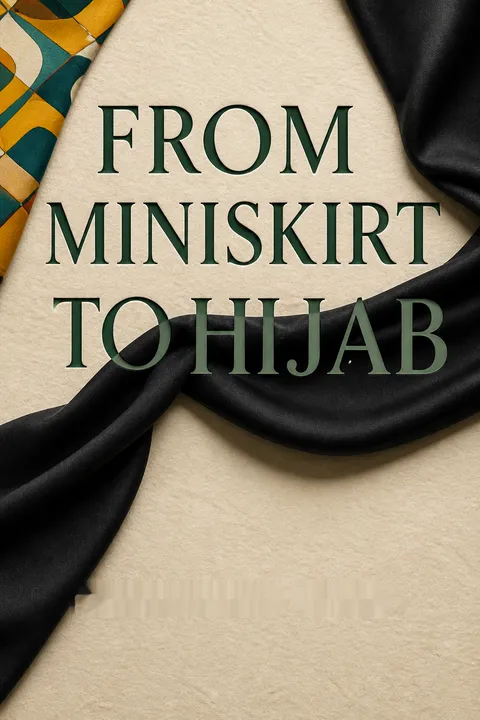
The enduring theme is the difference between adapting and consenting. Saper and her family learn to comply, conceal, negotiate, and finally leave. Those actions are forms of agency, but they occur within constraints they did not choose. The title's movement from miniskirt to hijab therefore names more than a change in dress. It traces the shrinking of public choice, the persistence of private identity, and the cost of carrying a life across borders.
Review Summary
From Miniskirt to Hijab is a compelling memoir of Jacqueline Saper's life in Iran before and after the 1979 revolution. Readers praise her unique perspective as a Jewish woman of mixed Iranian-British heritage, offering insights into the dramatic societal changes. The book provides a vivid account of the transition from a relatively liberal society to an oppressive regime. While some note repetition in the writing, most find it an engaging, informative read that sheds light on a crucial period in Iranian history and the experiences of religious minorities.
People Also Read

Glossary
doerageh
Child of different nationalitiesA Persian term for a person whose parents come from distinct national backgrounds. In Saper's account, it describes her mixed Iranian and English family identity. Such children could be seen as combining qualities of East and West, but Jacqueline's position is more complicated: she is also Jewish in a Muslim-majority country.
SAVAK
Pahlavi secret policeIran's national security and intelligence organization under the Pahlavi monarchy. SAVAK monitored and arrested people considered opponents of the regime and became widely feared for its brutality. In the memoir, its presence helps explain why Jacqueline's father warns her to avoid political involvement, even before the revolution.
hijab
Islamic covering for womenIn the book, hijab refers to the covering and modest dress required of women under the Islamic Republic. Before the revolution, women in Iran dressed in different ways, including wearing head coverings by choice. After the revolution, the government gradually made hijab compulsory in workplaces and then in public, with penalties for violations.
maghnaeh
Head-to-shoulder coveringA close-fitting covering for a woman's head, neck, shoulders, and upper body. In Saper's account, it becomes part of required workplace clothing and a practical choice for women navigating public dress enforcement. Jacqueline chooses a fabric that stays in place after a morality patrol confronts her for carrying a scarf without wearing it.
gharbzadeh
Enamored with the WestA politically charged term used to accuse someone of excessive admiration for Western culture. In the memoir, a morality patrol uses the label against Jacqueline because she resists the new dress code. The word frames Western influence as a source of corruption and helps turn personal appearance into a political judgment.
konkoor
University entrance examinationIran's national university entrance examination. Jacqueline studies for the konkoor after her high school education is disrupted, hoping to continue her studies in Shiraz. The exam represents a route to higher education, but political changes and new admissions priorities make that future uncertain.
Basij
Volunteer paramilitary organizationA volunteer paramilitary organization founded in 1980 and operating under Iran's Islamic Revolutionary Guard. In the memoir, the Basij is associated with the call for citizens, especially young men, to support the war effort. Government messaging presents sacrifice and martyrdom as signs of devotion to the Islamic Republic.
sigheh
Temporary marriage contractA legally recognized temporary marriage in which a man and a woman agree to a specified duration of union. In the account, a man may already be married, while a woman must not currently be married. The contract makes sexual relations and any resulting children legitimate under the religious legal framework described in the memoir.
najes
Ritually impure or uncleanA religious category for people or things considered ritually impure. Saper describes how the belief that non-Muslims were najes could support social exclusion, including suspicion of food or objects touched by religious minorities. Although these practices had been reduced under the Pahlavi monarchy, the underlying prejudice persists in some encounters.
Velayat-e faqih
Rule by Islamic juristThe doctrine of governance by a qualified Islamic jurist, which gives religious authority a central role in the state. In the memoir, the principle places the Supreme Leader at the center of Iran's political and religious order. It marks a major departure from the separation of religion and government taught in Jacqueline's earlier schooling.
mahram
Permitted close male relativeA male relative with whom a woman is permitted to appear without hijab under Islamic rules. The term also shapes scrutiny of unrelated men and women in public, where authorities may demand proof of a legitimate relationship. Jacqueline describes morality patrols checking couples for evidence that they are married or related.
Download PDF
Download EPUB
.epub digital book format is ideal for reading ebooks on phones, tablets, and e-readers.








