

Key Takeaways
Let weakness expose your idols, then lead from dependence rather than acclaim
A lost dream reveals a lot. Scott Sauls moved his family to New York for a role at Redeemer Presbyterian Church, where he was eventually appointed one of four future lead pastors. When plans changed and the church needed only three, he resigned. His grief was not just disappointment: he lost weight, struggled to sleep, and felt crushed. The episode exposed how much he had tied his significance to a prestigious city and influential role.
Success is a poor savior. Sauls argues that ambition can serve others, or turn work into a substitute for love and worth. His Christian response is not to pretend the loss felt good, but to trust that leadership belongs to God, and that a leader's value does not depend on a title, platform, or career trajectory.
What's useful here is the distinction between ambition as energy and ambition as identity. Work can be meaningful without being asked to prove that its worker matters. Occupational psychology describes a related risk as role engulfment, when a person's professional role crowds out other sources of identity. The story gives that idea emotional force: a setback exposes what achievement had been holding together. Yet interpreting a setback as providential can be sustaining without proving that every painful decision was divinely intended. Leaders still need to examine organizational choices, name the costs to families and teams, and learn what the disappointment reveals.
Build real friendships before leadership pressure turns privacy into danger
Fans are not a safety net. Sauls describes leaders who had public admiration but few people close enough to know when they were in trouble. He recalls two pastors who died by suicide after struggling with depression and isolation. He also points to King David, whose abuses began while he was apart from his people, and the prophet Elijah, who became despairing and alone after a major threat. Visibility did not protect either man from vulnerability.
Make accountability ordinary. Sauls notes that a survey of church members found an average expectation of 114 hours of pastoral work per week. He urges leaders to seek honest friendships, accept limits, and remain answerable to others. He calls one danger “magisterial self-pity”: treating leadership burdens as proof that one deserves special exemption from ordinary duties and safeguards.
Isolation is not only a private feeling. It is also a condition organizations can create when leaders must appear invulnerable, stay constantly available, or receive praise without candid feedback. Social support and psychological safety matter because people disclose problems sooner when relationships do not depend on their performance. At the same time, intimacy alone is no governance system. A trusted friend cannot replace clear boundaries, professional mental-health care, or independent accountability. The strongest protection combines human closeness with structures that make rest, supervision, and help-seeking legitimate rather than signs of failure.
Use criticism to inspect your character, not defend your image
Separate the signal from the fight. After a visitor criticized one of his sermons online, Sauls responded defensively and prolonged the exchange. A mentor advised him not to join a quarrel that would leave everyone worse off. But disengaging from a hostile critic does not mean rejecting all criticism. Sauls points to David, who accepted the prophet Nathan's confrontation over his abuse of power, confessed, and sought repair rather than silencing the messenger.
Ask what may be true. Sauls also recounts evangelist Dwight Moody publicly apologizing after he snapped at a heckler. The practical test is not whether a critic is fair or likable, but whether there is something worth learning. A leader can acknowledge a valid point, make amends, and still disagree with the critic's larger claims. Character matters more than winning a public exchange.
This is a useful model of feedback under power asymmetry. Leaders often control the channels through which their own mistakes are discussed, while people below them risk consequences for speaking plainly. Deliberately inviting critique can correct that imbalance. The idea of searching for a kernel of truth is powerful because it prevents an unfair delivery from automatically disqualifying useful information. It also has a limit: not every accusation deserves prolonged attention, and repeated harassment can require firm boundaries. Humility is not passive acceptance. It is the capacity to examine evidence without making self-defense the first reflex.
Celebrate another leader's rise before comparison turns it into rivalry
Envy makes achievement relative. When Israel praised the young David's victories, King Saul heard the praise as a threat and tried to remove his rival. His son Jonathan, who had more reason than most to fear losing the throne, responded differently: he supported David and surrendered symbols of his own status. The contrast shows how comparison can turn another person's success into a perceived loss.
Choose the generous response. Sauls describes envy among leaders at every scale, from small differences in church size to much larger platforms. He also points to Amy Carmichael, a missionary whose photographs documented others rather than herself, and to Jim Collins's “Level Five Leader,” marked by personal humility alongside strong professional resolve. Their example suggests a practical discipline: notice the person whose success stings, then actively support their good work.
Envy thrives where status is treated as scarce, even when the work itself could expand. In organizations, a leader who promotes capable colleagues may strengthen the whole institution, while a leader who hoards recognition limits its talent. Jonathan's choice is especially striking because he relinquishes a real claim to advancement, not merely a symbolic one. Still, humility should not become an excuse to hide talent or deny people fair credit. The point is not that ambition is always corrupt, but that ambition becomes destructive when another person's flourishing is experienced as an injury.
Anchor your worth in a deeper voice than applause
Recognition cannot settle the question. Sauls connects leaders' drive to be noticed with the biblical story of Jacob, who longed for his father's blessing and deceived him to obtain it. Later, Jacob wrestles through the night and leaves with a limp and a new name. Sauls reads the encounter as a shift from trying to extract approval from people to receiving worth from God. The story does not make Jacob's earlier deception harmless; it shows how deep the need for affirmation can run.
Fame can intensify the hunger. Pop star Madonna described achievement as failing to end her fear of being ordinary. Sauls also recalls writer Eugene Peterson declining a meeting with Bono because he was working on Isaiah. In the book's metaphor, the “approval patch” is the steady dose of outside affirmation people seek to quiet insecurity. Lasting security, Sauls argues, frees leaders to attend to others.
The distinction between being valued and being applauded connects to a basic insight from attachment theory: people need dependable acceptance, not simply repeated evaluation. A leader who relies on public approval can become unusually reactive to silence, criticism, or a colleague's success. Sauls's religious account offers a source of worth that does not fluctuate with audience response. That claim is meaningful within his Christian framework, though not every reader will share its theological basis. The practical implication still travels: cultivate relationships and commitments that do not turn every interaction into a referendum on personal importance.
Measure work by faithfulness, not whether this season feels triumphant
Achievement can end in letdown. Sauls uses “anticlimax” for the disappointment that can follow reaching a long-pursued goal when the prize fails to satisfy. Markus Persson, who sold Minecraft for $2.5 billion, wrote about feeling isolated despite parties, celebrity acquaintances, and the freedom to do as he pleased. The book's point is not that success is bad, but that money, status, and completion cannot carry the full weight of human longing.
Small work may belong to a larger whole. Sauls retells Tolkien's story of Niggle, an artist who manages to paint only one leaf of a tree before dying. In the afterlife, he sees the finished tree and recognizes his leaf within it. This image, alongside the rejected prophet Isaiah and imprisoned Paul, frames worthwhile work as potentially unfinished, unnoticed, and still meaningful within a future beyond the worker's view.
The account resembles hedonic adaptation: people can grow accustomed to improvements and discover that reaching a goal does not produce lasting satisfaction. That is a reason to avoid treating milestones as cures for deeper needs, not a reason to dismiss achievement. The Niggle story adds a second frame: contribution can matter without giving its maker complete control over the outcome. Its theological hope can steady people facing limited results. However, future meaning should not be used to excuse avoidable exploitation, chronic overwork, or poor management in the present. Faithfulness includes caring for the conditions in which people work.
Use opposition to practice neighbor-love, not defend your status
Disagreement does not cancel obligation. Sauls argues that Christian leaders facing hostility should resist fear and treat opponents as neighbors rather than enemies. He draws on Jesus's story of a Samaritan who helps an injured Jewish stranger, while religious passersby avoid him. The unexpected helper crosses a deep social divide and provides practical care instead of demanding agreement first.
Make conviction visible as service. After the Orlando nightclub massacre, Chick-fil-A employees opened on a Sunday, despite the company's usual closure, to provide food and drinks to people donating blood for victims. Sauls presents this as a model of serving people whose lives and beliefs may differ from one's own. His standard is demanding: beliefs should be expressed with gentleness, and love should be recognizable to the people receiving it.
The chapter's strongest contribution is to shift the test of conviction from how forcefully it is defended to how it shapes conduct toward people with less power or social acceptance. Intergroup cooperation is more plausible when people share concrete goals, such as caring for the injured, than when every encounter begins as a contest over identity. Service cannot erase principled disagreement, and it should not be used as a tactic to secure influence. The Samaritan image asks for something more direct: meet the need in front of you, even when the person helped does not validate your worldview.
Make room for lament without surrendering hope
Grief is not a leadership failure. Sauls rejects the idea that faith makes trouble disappear. He recalls hearing a cheerful worship song in a prison whose lyrics implied that problems vanish in God's presence, although many prisoners faced lifelong sentences. Against that kind of denial, he points to Job's protests, the Psalms' complaints, and Jesus weeping at Lazarus's tomb. Faith can include anger, sorrow, and questions.
Vulnerability can help others feel seen. Sauls describes disclosing his anxiety and depression to his church. One congregant told him that this honesty made him feel truly pastored. He also recounts students singing outside the home of terminally ill teacher Ben Ellis. These stories do not make suffering good; they show how presence, honest grief, and shared hope can sustain a community without offering easy explanations.
The refusal to rush grief toward a lesson aligns with trauma-informed care: people in acute pain often need safety, presence, and practical support before interpretation. Naming suffering honestly can also reduce the shame that keeps leaders from seeking help. The book's Christian hope gives sorrow a horizon, but that hope should not be imposed as a timetable or used to silence protest. Nor does every wound produce growth. A humane response allows suffering to remain genuinely bad while making room for companionship, treatment, lament, and whatever meaning the sufferer can claim for themselves.
Analysis
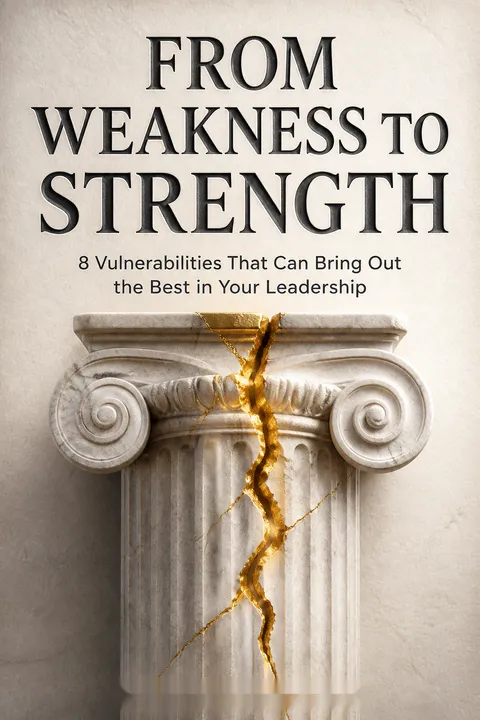
Sauls's argument is a Christian account of leadership that reverses the usual image of competence. Influence is not secured by hiding weakness, but by allowing ambition, isolation, envy, insecurity, disappointment, opposition, and grief to expose the motives that success can conceal. The recurring biblical figures make this case concrete: David's power magnifies his capacity for harm, Jonathan's relinquishment of status makes room for another leader, and Jacob's struggle becomes a story of dependence rather than self-manufactured approval. The examples are strongest when vulnerability leads to specific practices: invite candid feedback, form real friendships, make repair, serve across difference, and grieve without pretending pain is absent.
The book also sits in a productive tension with contemporary leadership culture. Many organizations reward visibility, growth, and constant availability, while Sauls measures leadership by character, generosity, and service. This countermeasure is valuable because it challenges the idea that larger platforms prove greater worth. It also reveals the need for more than personal virtue. Leaders cannot solve isolation or overwork simply by becoming humbler. Teams need sustainable workloads, independent accountability, mental-health support, and cultures where dissent is safe. The book sometimes places heavy explanatory weight on divine purpose, which can comfort believers but should not be used to declare that every harmful event was necessary or good.
Its central insight is therefore not that weakness automatically improves a leader. Weakness can instead become a truthful vantage point: it exposes dependence, makes leaders more receptive to others, and loosens the grip of status. That transformation is neither automatic nor a substitute for competence. A leader who has suffered can still act selfishly, and a confident leader can still serve generously. The value lies in what hardship makes possible when it is met with honesty, community, accountability, and hope. Sauls offers a distinctive measure of influence: whether people around a leader become more whole, not whether the leader becomes more celebrated.
Review Summary
From Weakness to Strength is praised as an insightful and vulnerable exploration of leadership challenges faced by Christian leaders, particularly pastors. Readers appreciate Sauls' honesty, biblical perspective, and practical wisdom on topics like ambition, criticism, and suffering. Many found the book encouraging and challenging, with several highlighting its focus on humility and leading through weakness. Some readers noted its primary relevance for pastors, while others felt it applicable to all Christians. A few critiqued the book's structure and depth in certain areas, but overall, it received positive reviews for its unique approach to leadership.
Glossary
magisterial self-pity
Entitled leadership self-pityA leader's belief that the burdens of the role make ordinary rules, limits, or accountability less applicable. Sauls uses the term to describe the shift from seeing leadership as a privilege of service to seeing oneself as a uniquely burdened victim who deserves special treatment.
Level Five Leader
Humble, determined executiveA leadership category from Jim Collins's work, used for leaders who combine personal humility with strong professional resolve. Sauls highlights their reluctance to seek attention and their commitment to organizational flourishing. The term describes a pattern in Collins's framework, not a guarantee that humility alone produces organizational success.
approval patch
Metaphor for needing affirmationSauls uses this image for the repeated external approval people seek to ease insecurity. Inspired by a comedian's joke about an approval device worn under a sleeve, it represents the desire for small, regular doses of praise. The metaphor suggests that outside validation may quiet the craving temporarily without resolving the deeper need for secure belonging.
anticlimax
Letdown after achieving a goalIn Sauls's use, anticlimax is the disillusionment that arrives when a person reaches a desired position, level of success, or milestone and finds it unable to provide lasting satisfaction. It exposes the limits of achievement as a source of meaning and can redirect attention toward a larger purpose and a hope not dependent on present success.
Download PDF
Download EPUB
.epub digital book format is ideal for reading ebooks on phones, tablets, and e-readers.








