Key Takeaways
1. Expert Predictions Are Consistently Unreliable
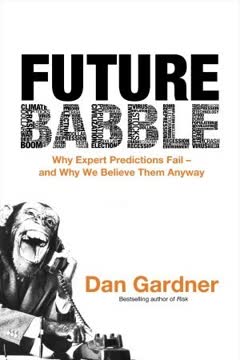
Let's face it: experts are about as accurate as dart-throwing monkeys.
A dismal track record. History is littered with spectacularly wrong expert predictions across various fields, from economics and geopolitics to technology and demographics. Examples abound: in 2008, oil experts predicted $200 a barrel, only for it to plunge to $30; in 1967, experts foresaw the USSR having one of the fastest-growing economies in 2000, a year it ceased to exist. These failures are not isolated incidents but a recurring pattern.
No better than chance. Seminal research by University of California professor Philip Tetlock rigorously tested the predictive accuracy of 284 experts over many years, collecting 27,450 judgments. His findings were stark: the average expert was no more accurate than a flipped coin or a "dart-throwing chimpanzee." This suggests that for complex, long-term phenomena, expert insight offers little advantage over random guessing.
Universal fallibility. This inaccuracy isn't confined to specific types of experts or political leanings. Whether optimists or pessimists, liberals or conservatives, economists or political scientists, the collective record of expert predictions is poor. Even Nobel laureates have made significant forecasting flops, demonstrating that high intelligence or esteemed credentials do not guarantee predictive success.
2. The World Is Inherently Unpredictable
If the real atmosphere behaved in the same manner as the model, long-range weather prediction would be impossible.
Chaos and non-linearity. The universe, particularly complex systems like weather or human societies, is not a predictable "clockwork" machine. Edward Lorenz's discovery of "chaos" (the "Butterfly Effect") showed that tiny, unmeasurable changes can lead to dramatically different outcomes, making long-range prediction impossible. Unlike linear systems (e.g., planetary motion), non-linear systems are characterized by intricate feedback loops and surprising emergent properties.
Human agency complicates. Predicting human affairs is even more challenging because people are not mere objects. Individuals possess self-awareness, complex psychological motivations, and the ability to react to predictions themselves, creating "endless chains of reciprocally conjectural reactions and counter-reactions." This makes human behavior, and thus the course of history, fundamentally unpredictable.
"Monkey bite" moments. History is full of seemingly trivial events that trigger enormous, unforeseen consequences.
- King Alexander of Greece's death from a monkey bite in 1920 escalated into a war that killed 250,000 people.
- A bungled announcement by an East German spokesman in 1989 led to the immediate fall of the Berlin Wall.
These "monkey bite factors" demonstrate that the future is shaped by countless unpredictable accidents and contingencies, making precise foresight impossible.
3. Our Brains Are Wired to Seek Order and Certainty
The left hemisphere's capacity of continual interpretation means it is always looking for order and reason, even when they don't exist.
The "Interpreter" at work. Our brains, particularly the left hemisphere, possess an "Interpreter" neural network that relentlessly seeks patterns and causal connections to make sense of the world. This innate drive to find meaning is so powerful that it will invent explanations and narratives, even when faced with randomness or contradictory evidence.
Illusion of control. Humans struggle with randomness, often perceiving patterns where none exist. This "illusion of control" leads gamblers to believe a jackpot is "due" or people to think they can influence random outcomes. This bias extends to prediction, making us believe we can foresee events even when they are purely chance-driven.
Pattern recognition bias. While pattern recognition is vital for survival, our brains are prone to over-applying it. We see constellations in random stars, faces in clouds, and canals on Mars. This hardwired tendency, a product of our Stone Age brains, leads us to draw false connections between unrelated events, often resulting in superstitions or erroneous conclusions about complex phenomena.
4. Cognitive Biases Distort Our Judgment
If one were to attempt to identify a single problematic aspect of human reasoning that deserves attention above all others, the confirmation bias would have to be among the candidates for consideration.
Confirmation bias. Once we form a belief, we actively seek out and readily accept information that supports it, while neglecting or dismissing contradictory evidence. This bias makes us hypercritical of anything that challenges our existing views, leading to a self-reinforcing cycle where beliefs become increasingly entrenched, regardless of objective reality.
Overconfidence and optimism. Most people are inherently overconfident in their judgments and possess an "optimism bias." This means we tend to believe we are less susceptible to risks than others and that our ventures will succeed. This overconfidence often increases with more information, even if accuracy doesn't improve, leading to a level of certainty "entirely out of proportion to the actual correctness of those decisions."
Status quo bias. We have a strong tendency to assume that tomorrow will be much like today, projecting current trends linearly into the future. This "status quo bias" often blinds us to radical shifts and surprises.
- Experts in 1977 predicted little change in the number of Communist governments, missing the collapse of the Soviet bloc.
- The "Japan Inc." panic of the 1980s projected Japan's economic dominance, failing to foresee its "lost decade" and America's tech boom.
This bias makes predictions most accurate when they are least needed (when trends continue) and least accurate when they are most essential (during sharp turns).
5. The Media Favors Confident "Hedgehogs" Over Cautious "Foxes"
The bigger the media profile of an expert, the less accurate his predictions are.
The "Dr. Fox" effect. Research shows that people are more impressed by confident, articulate, and authoritative speakers, even if their content is nonsensical. This "Dr. Fox effect" means that charisma and perceived authority often trump actual substance in how experts are judged.
Confidence sells. In the media landscape, certainty is prized. Pundits who offer simple, clear, and dramatic predictions are rewarded with airtime, book deals, and public attention. This creates a powerful incentive for experts to present themselves as "hedgehogs" – those who "know one big thing" and express it with unwavering conviction – rather than "foxes" who acknowledge complexity and uncertainty.
The "confidence heuristic." We intuitively equate confidence with accuracy. If someone speaks with conviction, we are more likely to believe them, even if their track record is poor. This heuristic means that experts who hedge their bets or express nuanced probabilities are often perceived as less reliable, pushing them out of the public spotlight in favor of those who "never fail to deliver the certainty that we crave."
6. Failed Predictions Rarely Harm Expert Reputations
It seems we take predictions very seriously, until they don't pan out. Then they're trivia.
The "Jeane Dixon Effect." We tend to remember successful predictions ("hits") and ignore or quickly forget failed ones ("misses"). This selective memory, named after a psychic famous for a few alleged hits despite a long list of misses, allows experts to maintain credibility even with a poor forecasting record.
Lack of accountability. There is little systemic accountability for failed predictions in media or policy circles.
- Newspaper columnists can simply switch topics when their forecasts fail.
- Politicians and policymakers often "overargue" their positions, knowing that acknowledging uncertainty would undermine their authority.
- Media outlets rarely revisit past failed predictions, preferring "new" news over retrospective analysis.
This environment allows experts to escape consequences for their errors.
Rationalization and hindsight bias. When confronted with undeniable evidence of failure, experts often employ psychological defenses.
- They may claim the prediction was "almost right" or "off on timing."
- They might attribute failure to "unforeseeable exogenous shocks."
- "Hindsight bias" causes them to misremember their past predictions, believing they were more accurate or less certain than they actually were, thus preserving their self-perception of competence.
7. Our Craving for Certainty Drives Belief, Even in Doom
Certainty is always preferable to uncertainty, even when what's certain is disaster.
Aversion to uncertainty. Humans have a profound psychological need for control and certainty. Studies show that unpredictable negative events cause more fear and stress than predictable, even severe, ones. This deep-seated aversion makes us desperately seek answers about the future, even if those answers are grim.
Negativity bias. Our brains are wired to pay more attention to bad news and remember it more vividly, a "negativity bias" that was crucial for survival in ancestral environments. When combined with the craving for certainty, this bias makes pessimistic predictions particularly compelling, as they resonate with our intuitive fears.
The comfort of knowing. In times of turmoil and uncertainty, like the 1970s "malaise" or the 2008 financial crisis, people flock to confident predictions, even those forecasting catastrophe. Knowing that a dark future is certain is often less tormenting than the gnawing anxiety of not knowing what lies ahead. This psychological relief makes us receptive to "doomsters" who offer clear, albeit bleak, narratives.
8. Accepting Uncertainty Is Crucial for Better Decisions
The future is dark, and much as we might like to see in the dark, we cannot. Imagining otherwise is dangerous.
Humility is key. Recognizing the inherent unpredictability of the world and the fallibility of the human mind demands humility. Overconfidence, as demonstrated by leaders like George W. Bush regarding the Iraq War or investors like Bernie Madoff's clients, can lead to catastrophic decisions. Acknowledging limits fosters caution and better preparation.
Skepticism is a shield. A healthy skepticism towards confident predictions, especially those about large-scale, complex, long-term social phenomena, is essential. Instead of blindly accepting forecasts, we should question their basis, consider the forecaster's track record, and be wary of narratives that offer simple, definitive answers to complex problems.
The "fox" mindset. Philip Tetlock's research shows that "foxes" – experts who are modest, self-critical, comfortable with complexity, and draw from diverse information sources – are more accurate than "hedgehogs." Their willingness to admit ignorance and revise their views in light of new evidence makes them better navigators of an uncertain world.
9. Good Decisions Prepare for a Range of Futures
While our decisions have to be made on the basis of what we think is going to happen, we must always consider how our decisions will fare if the future turns out to be very different.
Robustness over accuracy. Instead of striving for impossible predictive accuracy, good decision-making focuses on robustness: choosing actions that yield positive results across a wide range of possible futures. This approach acknowledges that while we can't know exactly what will happen, we can prepare for various plausible scenarios.
Examples of robust strategies:
- Earthquake preparedness: We can't predict earthquakes, but building codes in high-risk areas prepare for them.
- Airline security: Reinforced cockpit doors, though not predicting 9/11, were a robust safety measure against various threats.
- Energy policy: Investing in energy efficiency and diverse alternative sources reduces vulnerability to oil price spikes and geopolitical instability, regardless of specific climate change outcomes.
Learning from mistakes. The failure of past predictions, like Paul Ehrlich's dire 1970s forecasts, offers a crucial lesson: policies based on certain, but ultimately wrong, predictions can cause harm. For instance, cutting food aid to "hopeless" nations, as Ehrlich advocated, would have created the famines he predicted if his underlying forecast was incorrect. Acknowledging this possibility is vital for ethical and effective action.
Last updated:
Review Summary
Future Babble examines why expert predictions consistently fail yet remain persuasive. Reviewers appreciate Gardner's exploration of cognitive biases, hindsight, and our craving for certainty over accuracy, noting how confident "hedgehogs" attract more attention than cautious "foxes." Many found the book repetitive, suggesting it could have been shorter, with excessive examples of failed predictions. The final chapter, discussing practical approaches to better forecasting, received particular praise. Some criticized Gardner's evolutionary psychology explanations and perceived arrogance. Most recommend reading Superforecasting instead, which covers similar ground more effectively. Overall, readers value the skepticism toward predictions but desire more actionable guidance.
Similar Books