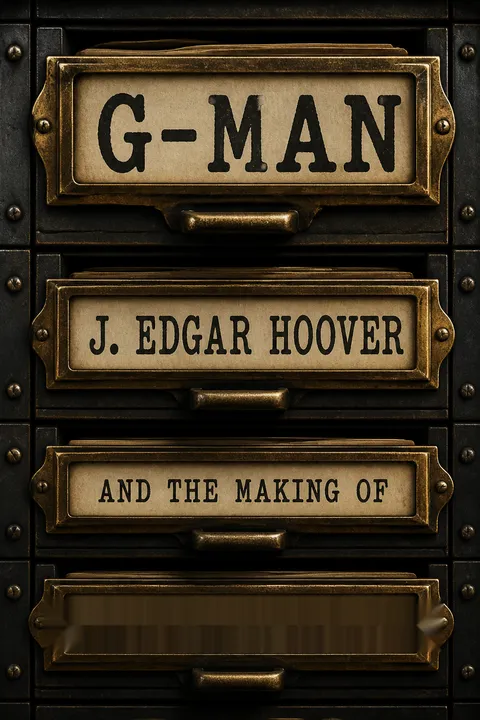


Key Takeaways
Hoover built a conservative state with the tools of liberal administration
A defining contradiction. From 1924 until his death in 1972, Hoover led the FBI under eight presidents, four Democrats and four Republicans. He championed expert management, centralized records, and professional civil service, while defending racial hierarchy, conservative Christianity, and aggressive anticommunism. The expanding federal government gave him the staff, authority, and reach to pursue both projects at once.
Power was constructed. Hoover did not simply outwit presidents from behind a desk. He built an institution, cultivated allies, and adapted as Congress expanded federal law. His career shows how administrative expertise can serve political aims even when its practitioners describe themselves as neutral.
What's striking is that professionalism and ideology do not appear here as opposites. Standardized files, trained agents, and expert procedures made the Bureau more capable, but capability alone could not determine whom it watched or whose rights mattered. Those choices reflected Hoover's politics. The book's central distinction is useful well beyond the FBI: an institution can be administratively impartial in how it works while remaining selective in what it chooses to pursue.
Read Hoover’s discipline as ambition, and as armor against family chaos
A troubled inheritance. Hoover was born in Washington in 1895, into a family marked by financial collapse, suicide, and loss. His maternal grandfather drowned himself after the failure of a family bank. His father later suffered severe depression, and an aunt was murdered when Hoover was ten. His younger sister had died before he was born.
Order became a refuge. Hoover kept lists of rules, excelled at school, led the cadets, and found purpose in church and debate. As an adult, he prized control and concealed family pain. The biography links those patterns cautiously: childhood does not explain every later choice, but it helps show why secrecy and self-command could feel like protection as well as ambition.
The family history gives the public figure texture without turning biography into diagnosis. A child facing instability may seek safety in rules, work, or achievement, but that possibility cannot establish a direct cause for a later political decision. The distinction matters: context can make Hoover more intelligible without excusing his treatment of others. His private vulnerability and public severity coexist, and neither cancels the other.
Build institutional power through records, jurisdiction, and dependable alliances
Files created leverage. At the Library of Congress, Hoover learned to classify huge collections so information could be retrieved quickly. In 1919, leading the Justice Department's Radical Division, he applied the lesson to surveillance files. His Editorial File System used index cards to sort reports by people, places, organizations, and events. The division reportedly grew from 50,000 cards to more than 100,000 in its first year.
Jurisdiction expanded the reach. Hoover's power grew when new laws made kidnapping, bank robbery, and other crimes federal concerns. New Deal administration supplied personnel and authority. He also cultivated local police, sharing fingerprints and crime information. Each practical service made the Bureau more useful, more connected, and harder for political leaders to bypass.
The files are not merely office scenery. They are infrastructure: they let an agency connect fragments, move information across jurisdictions, and turn scattered records into a usable picture. That capacity can improve investigations, but it can also concentrate judgment in the office controlling the index. Hoover's achievement was less a single masterstroke than a series of administrative choices that steadily made the Bureau indispensable.
Treat public reputation as a source of institutional power, not decoration
The Bureau became a story. In the 1930s, Hoover promoted clean-cut government agents as G-Men, using crime cases, speeches, books, radio, films, and daily public tours to define the FBI for Americans. The 1935 film G-Men was not made with Bureau approval, but Hoover eventually embraced the popular image and built a permanent public relations operation.
Admiration brought leverage. Visitors to FBI headquarters grew from small groups to as many as a thousand a day by 1936. Public enthusiasm helped Hoover defend budgets and expand federal authority. In 1964, polls showed that half of Americans sided with Hoover in his public dispute with Martin Luther King, while only 16 percent sided with King. Popularity did not reveal what the Bureau was doing in secret.
What's striking is how public relations becomes a form of institutional capacity. A popular image can attract recruits, win appropriations, and make federal power seem familiar rather than threatening. Yet a compelling story is not a transparent account. Hoover's G-Man image rested on real investigations while simplifying their methods and limits. The more an agency depends on public trust, the more important it is to distinguish trust earned from scrutiny avoided.
When crime became federal, Hoover traded restraint for armed enforcement
A new mission arrived. Hoover initially resisted taking on violent crime, arguing that most policing belonged to local authorities. New Deal laws changed that balance, making kidnapping, bank robbery, and interstate flight federal matters. The FBI's agents, hired for legal and accounting skills, were suddenly expected to carry guns and confront armed gangsters.
The transition was costly. In 1934, the botched raid at Little Bohemia killed agent Carter Baum and a civilian, while John Dillinger escaped. Hoover responded by adding experienced lawmen, authorizing informants and wiretaps, and tolerating forceful interrogations. Four Bureau agents died in shootings between June 1933 and November 1934. The crime-fighting legend grew alongside a darker change in the Bureau's methods.
The episode exposes a familiar institutional trap: expanding a mission faster than training, authority, and accountability can keep pace. Hoover had promised scientific policing and criticized coercive tactics, yet crisis pushed the Bureau toward firearms and intimidation. The shift was not inevitable, but it was encouraged by public demand for spectacular results. A successful arrest can strengthen an agency while obscuring the costs of how it was obtained.
Treat emergency surveillance as a power that must have an exit
War expanded the file cabinet. Before the United States entered World War II, Roosevelt secretly authorized FBI investigations of fascists and communists. After Pearl Harbor, Hoover used a prebuilt custodial detention index to arrest selected enemy aliens. By June 1942, the FBI reported 8,827 arrests of German, Italian, and Japanese nationals.
Restraint was selective. Hoover opposed mass incarceration of Japanese Americans, arguing that individual investigations were fairer and more useful. Yet his own operation still relied on suspicion, surveillance, and detention without ordinary criminal trials. Wartime work also produced 24 million fingerprint records by the end of 1941. The emergency receded; the files, techniques, and enlarged agency remained.
The distinction between individualized detention and mass incarceration matters, and the book gives Hoover credit for opposing the latter. It also shows that a less sweeping policy can still violate rights. Emergency powers tend to outlast the emergency because agencies retain their personnel, records, and methods. The useful question is not only whether an official shows restraint, but who can later review the decisions and require the machinery to contract.
Do not mistake selective anti-lynching work for a commitment to racial equality
Federal authority mattered to Hoover. In the 1940s, he sent agents to investigate lynchings and worked with the NAACP, despite opposition from Southern officials. He viewed mob violence as a challenge to law enforcement and American credibility, not as proof that racial equality was his goal.
Justice repeatedly failed. In the 1946 Moore’s Ford case, agents interviewed 2,790 people and identified suspects, but a federal grand jury indicted only one person, for lying to an FBI agent. Hoover also maintained a largely white agent corps, investigated civil rights organizations, and later targeted King. His record combines real investigations with deep racism and sharply limited protection for Black citizens.
This is a useful case against binary biography. Hoover could oppose a lynch mob because it defied state authority while still supporting a racial order that denied Black people equal standing. The motive does not erase the value of investigating violence, but neither does a useful action establish a broad moral commitment. Institutions should be judged by whom they protect consistently, not only by the exceptional cases in which their interests briefly align with justice.
See Hoover and Tolson’s intimacy through both affection and unequal power
A life shared. Clyde Tolson joined the Bureau in 1928 and became Hoover’s closest colleague and companion. They traveled together, attended family funerals, vacationed together, and appeared in public as a pair. Tolson rose rapidly through the Bureau, eventually becoming its associate director and remaining at Hoover’s side until Hoover died.
The relationship stayed partly hidden. Private photographs and correspondence suggest an intimacy that went beyond ordinary friendship, but the surviving evidence does not settle every question about their sexual relationship. Their bond also carried an unavoidable imbalance: Hoover was Tolson’s employer and controlled his career. The biography treats affection and institutional power as intertwined rather than forcing the relationship into a simple label.
The relationship matters not as a gossip puzzle but as a key to Hoover's private world. Tolson offered continuity, companionship, and practical support in a life organized around the Bureau. Yet the same hierarchy that made closeness possible also complicated it: affection existed alongside the director's authority over his companion. The evidence rewards careful interpretation, not certainty about private acts that the record cannot establish.
Hoover’s power rested on presidents, Congress, and citizens choosing to support him
A coalition sustained him. Hoover led the FBI for 48 years under eight presidents, four Democrats and four Republicans. Roosevelt and Johnson expanded his authority; Nixon became a close ally. Conservative Democrats and Republicans defended his budgets, while the American Legion, local police, churches, and popular media helped build a public constituency.
Support was not simple blackmail. Hoover could intimidate critics, but he also benefited from officials who wanted his expertise, citizens who admired his G-Men, and institutions that shared his priorities. Congress even cooperated with him through committees such as HUAC and SISS. His longevity was a political achievement made possible by many people, not just a director acting alone.
The account shifts attention from the myth of a lone mastermind to the mechanics of delegation. Presidents and lawmakers empowered Hoover because he delivered useful services, shared their anticommunism, or helped them manage political risk. That cooperation made him durable, but it also blurred who was responsible for abuses. When authority is distributed across a network, accountability can disappear into the same network.
A real espionage threat can coexist with unjustified secrecy and suspicion
There was evidence of Soviet espionage. FBI informants Elizabeth Bentley and Whittaker Chambers described secret networks in government. The Venona project later helped identify 349 people connected in varying ways to Soviet intelligence. Cases involving Klaus Fuchs and Julius Rosenberg showed that some fears were grounded in actual spying.
Evidence still had limits. Venona was secret, and many leads were partial or difficult to use in court. Hoover shared selected information with HUAC and other allies while shielding the source and expanding loyalty investigations. Real espionage did not prove that every left-wing activist was a spy, or that secret disruption of political opponents was justified.
The strongest version of Hoover's case is not that he imagined every threat, but that genuine espionage made counterintelligence a real public responsibility. The weakness is the leap from evidence about particular networks to suspicion of whole movements. Secrecy can protect intelligence sources, but it also prevents citizens from testing claims and distinguishing documented espionage from political association. The book keeps both realities in view.
Build oversight before a trusted director turns secrecy into personal rule
The methods grew in secret. Hoover created COINTELPRO to disrupt the Communist Party after other legal tools narrowed. He later expanded covert tactics against civil rights and New Left groups, including King and the Black Panthers. His authority depended on confidential files, informants, wiretaps, and allies who often accepted the work without meaningful review.
Longevity magnified the danger. Hoover stayed in office for nearly half a century and died in 1972 without a successor chosen. Afterward, the Church Committee exposed illegal surveillance and disruption, prompting new congressional oversight. The FBI's reputation as a professional agency could not substitute for independent checks on a director's decisions.
The ending is not simply that Hoover became a villain, but that personal authority and institutional secrecy reinforced each other until correction became difficult. His early reforms made the Bureau effective; his long tenure made it harder to challenge. Oversight is most valuable before scandal, when it can define boundaries without depending on a leader's self-restraint. The posthumous investigations show how costly it is to wait.
Analysis
G-Man is both a biography and a history of state-building. Its central achievement is to move Hoover beyond two familiar portraits: the incorruptible crime fighter and the solitary authoritarian. He was an ambitious administrator whose power depended on laws, appropriations, alliances, public approval, and an expanding federal government. His career reveals that bureaucratic expertise is not inherently liberal or neutral. The same filing systems and professional standards that improved investigations also enabled political surveillance and made Hoover difficult to supervise.
The book's strongest interpretive move is to hold Hoover's contradictions together without treating them as a puzzle to solve. He could oppose Japanese mass incarceration, investigate lynchings, and cooperate with civil rights leaders, while also preserving a racist agent corps and targeting activists. These actions were not equally consequential, but they shared a logic: federal authority mattered most when it protected the order Hoover valued. The distinction between enforcing law and advancing justice remained unstable throughout his career.
The narrative also shifts responsibility outward. Presidents, legislators, journalists, civic groups, and ordinary admirers helped Hoover endure for 48 years. Their support was not merely extracted by blackmail. Many welcomed his expertise, anticommunism, or promise of order. That broader coalition complicates any account that reduces abuses to one man's personality. It also explains why institutional checks matter: when political leaders find an agency useful, oversight can weaken even as its powers grow.
The book's final warning is therefore institutional as much as biographical. Hoover's early reputation for restraint helped legitimate an increasingly secretive agency. By the 1960s, his ideological campaigns had overwhelmed the professional neutrality he claimed to defend. His story asks readers to judge public institutions not only by their stated principles or visible victories, but by whom they monitor, whose rights they protect, and what happens when nobody can inspect their methods.
People Also Read







Glossary
G-Man
Federal agent imageA popular name for a government agent, especially an FBI agent, that became prominent during the 1930s crime era. Hoover helped shape the image: a disciplined, well-dressed, white, conservative professional who used expertise rather than old-fashioned detective theatrics. The label turned FBI agents into a recognizable national type and made federal law enforcement part of popular culture.
Editorial File System
Indexed surveillance recordsHoover’s system for organizing the Radical Division’s reports on suspected radicals. Staff created index cards sorted by names, places, organizations, publications, and events, then filed reports through a numbered classification scheme. The system made information much faster to retrieve and allowed Hoover’s office to connect records across locations and groups.
General Intelligence Division
Political intelligence officeThe name given in 1920 to the Justice Department unit Hoover had led as the Radical Division. It gathered and analyzed information about political groups and suspected subversives. The unit was shut down in 1924 under Attorney General Harlan Fiske Stone, then reestablished in 1939 as the FBI resumed domestic intelligence work.
FBI National Academy
Police training programA training program Hoover established in 1935 for selected local law-enforcement officers. Participants studied investigative methods, forensic techniques, firearms, and the FBI's preferred standards of paperwork and professional conduct. Hoover expected graduates to return home and spread those methods, creating a nationwide network of police officials familiar with FBI practices.
Uniform Crime Report
National crime statisticsA national system of crime data collection launched by the FBI in 1930. Local police departments voluntarily supplied statistics, while the Bureau compiled and published the figures. The program gave police a shared source of information and gave the FBI influence over how crime was counted and discussed.
Special Intelligence Service
FBI Latin America networkThe FBI's wartime intelligence operation in Latin America, created under President Roosevelt's direction in 1940. Agents worked under cover, collected information about espionage and political activity, and developed communications with Washington. The service later helped Hoover argue that the FBI should lead postwar foreign intelligence, a proposal Truman rejected.
Custodial detention index
Wartime arrest listA card index of people Hoover's FBI considered potential security threats in the event of war. The Bureau organized names by perceived danger and source reliability so agents could make rapid arrests after Pearl Harbor. The index helped produce swift detentions, but its judgments could rest on political associations, suspicion, or incomplete information.
Venona
Soviet message decryption projectA secret U.S. Army project that decrypted intercepted Soviet communications. The FBI worked with the decryption effort to identify people mentioned under code names and investigate possible espionage. Venona later confirmed that some Soviet spying claims were grounded in fact, but its messages were often incomplete and could not be openly used in court.
COINTELPRO
Secret disruption programThe FBI's counterintelligence program, first directed against the Communist Party in 1956. Instead of simply investigating or prosecuting targets, agents sought to disrupt organizations through informants, anonymous letters, planted rumors, and other covert tactics. The program later expanded to civil rights and New Left groups, including Martin Luther King Jr. and the Black Panthers.
Lavender Scare
Purge of gay employeesThe postwar campaign to identify and remove homosexuals from federal employment, based on the claim that they were security risks or vulnerable to blackmail. Congressional investigations and agency policies helped turn suspicion about private sexuality into grounds for dismissal. Hoover's FBI gathered and shared information about alleged homosexual employees while avoiding comparable public scrutiny of Hoover himself.


Download PDF
Download EPUB
.epub digital book format is ideal for reading ebooks on phones, tablets, and e-readers.








