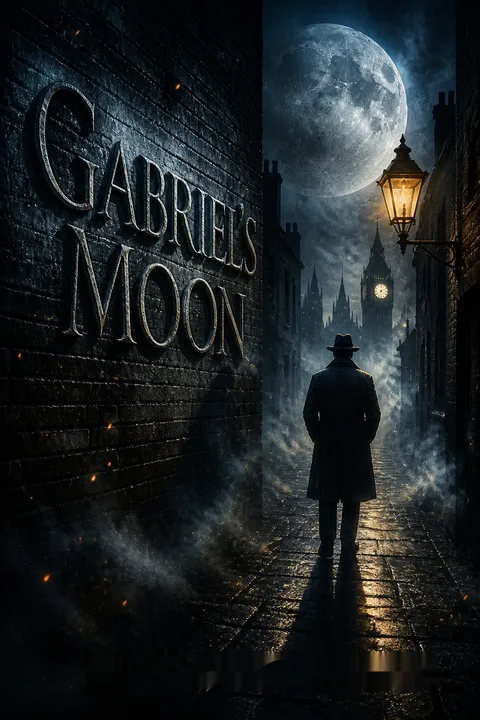


Plot Summary
Prologue
In 1936, six-year-old Gabriel Dax falls asleep beneath the glow of a glass moon, his mother’s candle-lit night-light. His father has died in a plane crash, and his mother uses the moon to comfort him with the promise that the family will one day be reunited. Smoke wakes Gabriel.
He finds the house burning and his mother dead on the ground floor, then escapes through a jammed kitchen window by smashing its latch with a telephone receiver. Outside, he watches the family home collapse into flames and searches the cloudy sky for the moon. The fire leaves him orphaned, frightened, and unsure whether his own night-light caused the disaster.
The moon begins as a child’s dependable object, a small, controlled world that helps Gabriel sleep. Its light is also entangled with loss: his mother uses it to soften the absence of his father, then the house fire makes the night-light a possible source of guilt. Gabriel’s escape is practical and resourceful, but his memory of the event remains partial, leaving him with a story about himself that he cannot verify. The prologue therefore makes recollection a physical problem as well as a psychological one. Before espionage turns his life into a maze of other people’s accounts, Gabriel is already living inside an uncertain explanation of what happened to his family.
Lumumba on Tape
In 1960, travel writer Gabriel Dax visits Léopoldville to write about the twin capitals divided by the Congo River. His university friend Thibault N’Danza, now a minister, arranges an interview with Prime Minister Patrice Lumumba.
Lumumba insists that Gabriel record their conversation, then describes threats against his life and names people he believes are plotting his assassination. Gabriel regards the warnings as alarming but uncertain. Back in London, he writes a sympathetic account, only for his newspaper to shelve it after Colonel Mobutu displaces Lumumba.
The interview seems like a missed assignment, until Gabriel returns to his flat and finds small signs that someone has entered. Anonymous silent calls deepen his unease, though he has no idea what the intruder sought.
Gabriel enters the political story by accident, and his professional habits make him a witness before he understands the stakes. The recorder matters because Lumumba wants a record that will survive a journalist’s editing, yet Gabriel initially treats the device as a convenient safeguard for his own work. The newspaper’s decision to suppress the interview demonstrates how quickly public truth can become obsolete when power changes hands. At home, the signs of intrusion translate that distant instability into private unease. Gabriel is not yet an investigator; he is a man who has preserved information without recognizing that preservation itself can become dangerous.
Faith Finds Gabriel
In January 1961, Faith Green, an MI6 operative who has tracked Gabriel from the Congo, finds him at a Chelsea café and confirms that Lumumba has been executed. She asks him to buy a drawing in Spain and deliver it to someone else, explaining that a civilian art dealer can provide deniability.
Gabriel refuses, then agrees after Faith returns with a larger payment and insists he is unusually plausible. Meanwhile, Gabriel consults Katerina Haas about his lifelong insomnia.
In their early sessions he recounts the house fire, his mother’s death, and his breakdown at medical school, which began when a cadaver reminded him of her. Haas proposes that buried memories may be essential to recovery. Gabriel accepts Faith’s assignment even as he begins to question what his past has concealed.
Faith’s recruitment works through two vulnerabilities that Gabriel experiences as separate: his attraction to her commanding certainty and his desire to understand the childhood trauma that has shaped his adult life. She offers no ideological cause, only a paid task that appears small enough to remain morally neutral. Haas, by contrast, asks Gabriel to treat uncertainty as evidence of something repressed rather than as a reason to stop looking. Both women redirect him, but in different registers: Faith toward action, Haas toward memory. His consent to the Spanish errand therefore marks the beginning of a pattern in which he gives other people authority over what he should notice.
The Drawing and the Parcel
In Cádiz, Gabriel poses as his uncle Aldous’s art-dealing representative and buys a small drawing from the fading surrealist Blanco. He delivers it in Madrid to Christopher Caldwell, the British intelligence station chief, who says that he and Blanco were once lovers.
With his official errand complete, Gabriel spends an evening with Nancy-Jo Berndlinger, an American art student who recognizes him as the author of The Wine-Dark Sea. Nancy-Jo asks him to carry a padded parcel to London for her cousin.
At the airport, Gabriel notices that the package has been carefully taped and opens it. Instead of soap, he finds heroin, throws it away, and is then subjected to a Spanish police search. The drugs are gone, so he is released, but someone has tried to make him a smuggler.
The drawing gives Gabriel a respectable cover, while the parcel exposes how easily that cover can be turned against him. His willingness to help Nancy-Jo follows the same casual code as his assignments for Sefton and Faith: a favor seems harmless when the person asking appears familiar or appealing. The airport discovery breaks that trust, but it also shows Gabriel’s capacity to interrupt a scheme before it becomes irreversible. His danger is not simply that he knows too little. It is that others can use his ordinary decency, professional identity, and appetite for novelty as instruments without needing to recruit him fully.
The Tapes Become Dangerous
Back in London, Nancy-Jo tells Gabriel that an American calling himself Raymond Queneau arranged the parcel. He had helped her after a drug arrest and wanted her to get close to Gabriel, then use his possible imprisonment in Spain as leverage to obtain the Lumumba tapes.
Nancy-Jo has heard that the recordings matter to American intelligence. Soon after their meeting, she dies of a drug overdose in her hotel room. Gabriel lies to the newspaper about the tapes, buries them beneath a holly bush, and changes his locks.
He also begins tracing the childhood fire, following advice from crime reporter Hugh Summerbee. The man who first called the fire accidental, retired fireman Henry Bullen, remembers a disputed investigation and points Gabriel toward the insurance company’s loss adjuster.
The heroin plot reveals an intelligence contest that is willing to exploit addiction, debt, and personal affection without making its participants fully informed. Nancy-Jo is neither a simple villain nor a trustworthy ally; her confession is compromised by fear and by the coercion that brought her into Gabriel’s life. Her death closes off the possibility of an easy explanation and intensifies Gabriel’s sense that everyone around him may be expendable. His decision to hide the tapes is a first act of independent judgment. At the same time, turning toward the fire investigation shifts his search for facts from the international crisis to the private catastrophe that has governed his sleep.
What the Fire Left
Gabriel visits Manley Dryden, the retired loss adjuster whose findings were rejected after the Yeomanswood Farm fire. Dryden says the house contained an unusual refrigerator that survived the blaze, with three empty bottles of Serenital, a powerful sedative, inside.
He believes Gabriel’s mother had taken an overdose before the fire and may have started it, deliberately or by accident; the evidence cannot settle her intention. Gabriel tells his brother Sefton what Dryden suspects, and they consider their mother’s grief and her dependence on pills.
In therapy, Gabriel begins to connect her bleak promise about joining his father on the moon with the possibility that she meant to die. Yet the telephone call to the fire brigade suggests she may also have tried to save her son.
Dryden’s evidence replaces the neat accusation against Gabriel’s night-light with a more painful uncertainty about his mother. The refrigerator, the empty medication bottles, and the fire brigade call are material traces, but none can make her inner state transparent. Gabriel must hold incompatible possibilities together: that his mother was in despair, that she may have intended a fatal act, and that she still tried to summon help. This is a more mature form of inquiry than searching for a single culprit. By sharing the findings with Sefton, he also reopens a family history both brothers have managed through partial knowledge and inherited explanations.
Blanco Names a Defector
A year later, Faith sends Gabriel back to Spain for a second Blanco drawing. Caldwell takes him to a hill overlooking a United States airbase, where Gabriel sees nuclear-capable bombers and hears about a training aircraft that dropped two inert hydrogen bombs. One vanished before turning up in a farmer’s barn, apparently inspected.
In Cádiz, Blanco sells MI6 a secret for five thousand dollars: Caldwell plans to defect to the Soviet Union aboard a Polish freighter on the fifteenth. Blanco refuses to go with him and says the British officer is a Soviet agent. Faith confirms that Caldwell has raised suspicions, then orders Gabriel to remain in Cádiz. The assignment has become a trap around a man Gabriel likes and has trusted.
The lost bomb and the proposed defection introduce the novel’s central problem of appearances: an object can be recovered but still reveal that someone reached it first, while a friendly intelligence officer may be serving an adversary. Gabriel receives these clues through people who each have reasons to shape his understanding. Caldwell’s charm encourages personal trust; Blanco’s confession arrives at a price; Faith withholds context. Their competing accounts do not let Gabriel determine the truth, but they make his emotional investment consequential. What began as a courier’s errand now demands a choice about whether loyalty belongs to an institution, a friend, or the person he believes himself to be.
The Cádiz Escape
After Blanco identifies Caldwell as a Soviet agent, Gabriel reports the claim to Faith. She dispatches an MI6 team to Cádiz, but Caldwell appears unexpectedly at Gabriel’s hotel before the planned arrest. Gabriel tells him that Blanco has betrayed him and that the port will be watched.
Caldwell asks him to drive to a village outside the city. That night Gabriel hides Caldwell in the boot of his Simca, brings him to the docks, and helps him board the Polish freighter as it pulls away. Gabriel leaves Spain before the team can find him.
A month later, Moscow announces Caldwell’s arrival and celebrates him as a Soviet hero. British newspapers erupt over the apparent intelligence failure, while Gabriel wonders who will hold him responsible for helping a traitor escape.
Gabriel’s warning is an impulsive act of loyalty, but it is also a protest against being used without consent. He believes he is choosing Caldwell over the agency that has manipulated him, and the decision gives him a brief, exhilarating sense of agency. The press coverage then supplies a public version of events that appears to confirm his choice: Caldwell has escaped and MI6 has failed. Yet the spectacle cannot tell Gabriel what the escape means or whether his intervention was genuinely his own. His action is morally serious precisely because he makes it without knowing the full design, a pattern that will later unsettle his confidence in free choice.
Southwold After Dark
Obsessed with Faith, Gabriel follows her to Southwold, where he discovers her holiday house and sees her with a man she calls Vivian. He enters the house while they are away, then returns to the town feeling ashamed of his surveillance.
Faith confronts him at the pub, but invites him back to the bungalow. They sleep together. In the morning, she explains that she helped locate Lumumba after he escaped house arrest, that American and Belgian services had planned to remove him, and that the Belgians carried out his execution.
She also reveals that Lumumba recorded the interview himself, leaving Gabriel’s tapes as the only surviving record. Gabriel tells her where he buried them. When he reaches London, he finds the earth disturbed: MI6 has already recovered the recordings.
The Southwold encounter turns Gabriel’s attraction into a dangerous confusion of intimacy and intelligence. He follows Faith without permission, then receives from her both bodily closeness and information that implicates her in a political killing. Her trust may be genuine, tactical, or both; the novel refuses to make those possibilities easy to separate. By surrendering the tapes, Gabriel hopes to protect himself and believes he has made a choice freely. The disturbed earth shows how thoroughly the agency can act around him. His private desire and the geopolitical secret now occupy the same emotional space, making it harder for him to know whether Faith’s disclosures bring him closer to her or deeper into her control.
Caldwell’s Moscow Cover
Faith sends Gabriel to Warsaw with a Blanco drawing, while a left-wing magazine provides his journalistic cover. Before he leaves, he obtains a tiny Baby Browning for protection. In a crowded dental waiting room, Caldwell meets him and explains that the drawing’s dedication carries a microscopic message for Soviet handlers.
The missing hydrogen bomb was a staged operation: its photographs are the message in this drawing, intended to convince Moscow that Western weapons work while Soviet weapons may fail.
Caldwell is not a genuine defector but a British agent placed inside Soviet intelligence. Gabriel understands that his apparent betrayal in Cádiz helped make the deception convincing. He also learns that Soviet handlers now regard him as Caldwell’s London contact, whether or not he accepts that role.
The Warsaw revelation reclassifies nearly every prior event without making Gabriel’s experience unreal. His warning helped Caldwell escape, the press scandal strengthened the cover, and the artwork provided a covert channel, but Gabriel acted without knowing the intended design. The plot’s intricate reversals expose a distinction between agency and authorship: he made choices, yet others arranged the circumstances in which those choices would serve their plan. Caldwell’s explanation offers Gabriel a place in the operation, though not a clean route out of it. The Soviet observer’s presence makes the new identity operationally dangerous, not merely flattering. Gabriel is now visible to two systems that interpret him differently.
The Ferry’s Dark Deck
Rather than return through Warsaw airport, Gabriel drives across Poland and East Germany into West Germany, then travels to Cuxhaven for the ferry to England. On the dark rear deck, Raymond Queneau appears with a pistol.
He knows the Lumumba tapes are no longer in Gabriel’s possession but considers the surviving witness a threat. As Queneau prepares to kill him, Gabriel recognizes him as Hillcrest, the American name Lumumba had spoken on tape and a link to the former president.
Gabriel fires his small pistol through his coat, wounding Queneau, then forces him over the rail. Queneau falls onto a lifeboat canopy before slipping into the sea. Gabriel throws both weapons and the other evidence overboard, then returns to the bar shaken but alive.
The ferry is the point where Gabriel’s habitual observing gives way to immediate action. He has spent the novel trying to preserve distance through notebooks, professional cover, and the assumption that he is merely delivering information. Queneau’s attack removes those protections and makes survival the only meaningful choice. Gabriel’s recognition of Hillcrest links a human threat to the names on Lumumba’s tape, but the act of defending himself is not a triumphant solution to the conspiracy. It leaves him with a dead or missing attacker, no evidence, and knowledge that cannot be safely spoken. His sense of crossing a line is psychological: he can no longer imagine himself as untouched by the events he records.
Memory Finds Its Sequence
Back in London, Gabriel learns that the Cuban Missile Crisis has ended without war. Then Dryden calls with a note he found among his old files: the kitchen door at Yeomanswood was locked, the window stood open, and a telephone hung outside it. Gabriel suddenly remembers using the telephone receiver to break the stubborn window latch, then escaping through the opening.
The sequence brings back the smoke, his mother’s body, and his flight to the garden pond. His mother’s exact intention remains unknowable, but his night-light did not cause the fire. In a session with Katerina Haas, Gabriel says his sleep has improved because the memories now belong to a coherent past rather than a blank he blames himself for filling.
The recovered memory does not provide complete moral certainty; it provides sequence. Gabriel can now distinguish what he experienced from what later authorities claimed, especially the story that his candle caused the fire. Dryden’s physical note acts as a prompt that returns Gabriel to his own remembered actions. This is not a simple victory of memory over falsehood, since the mother’s motive remains unresolved and recollection is still vulnerable. The change is that Gabriel can inhabit uncertainty without turning it into self-accusation. His improved sleep follows not from discovering a perfect explanation but from recovering enough of his own history to stop treating absence as proof of guilt.
The Refulgent Signal
Faith asks Gabriel to watch for a secret signal during a meeting with an unidentified contact in Battersea Park. The contact arrives in a Humber Hawk, and Gabriel recognizes his brother Sefton. When Sefton uses the specified word, Gabriel warns him that the intelligence service is closing in.
Sefton gives nothing away and leaves. Gabriel flees to Rome rather than face Faith’s response. There, Victoria calls to say Sefton has been found hanged beneath the pergola at home. She believes he took his own life.
Gabriel returns to London for the funeral, carrying guilt over whether his warning changed anything. Their relationship had been formal and strained, but Sefton was also Gabriel’s last living link to the parents and childhood they lost at Yeomanswood.
The codeword makes Gabriel a participant in surveillance of his own family before he knows what Sefton has done. His warning is instinctive, like the earlier decision to help Caldwell, but its consequences are now intimate and irreversible. Fleeing to Rome gives him distance without relief; Victoria’s call turns absence into guilt, and the reported suicide offers an explanation that cannot settle his doubts. The brothers’ separate surnames and divergent temperaments have long made their bond feel attenuated, yet Sefton’s death reveals its historical depth. Gabriel is left to ask whether he acted from loyalty, panic, or the habit of resisting whoever tries to control him.
The Last Useful Favor
At Sefton’s funeral, Gabriel meets Faith and the Institute team. In a pub afterward, she reveals that Sefton was a Soviet source inside British government and that Caldwell’s information exposed him. The word in Battersea Park was a test arranged by MI6; Sefton’s appearance confirmed their suspicions.
Faith says the agency did not kill him, and Gabriel cannot prove otherwise. She also confirms that Sefton had recommended Gabriel for covert errands, making their long association part of the recruitment.
Though Gabriel refuses a new assignment in Guatemala, a Soviet cultural attaché soon approaches him and leaves a Chekhov volume containing money. Gabriel keeps the payment rather than return it, recognizing that Caldwell’s position has made him a contact whether he wants the role or not.
The revelation about Sefton recasts family history as an intelligence relationship without erasing brotherly attachment. Gabriel learns that Sefton’s ordinary favors helped place him inside covert operations, but the motive behind Sefton’s betrayal remains uncertain and the death remains officially explained as suicide. Faith’s insistence that the agency did not kill him cannot restore trust; she is both the person who explains the machinery and a representative of it. Gabriel refuses one assignment, yet accepting the Soviet money acknowledges his continuing exposure. His independence is real but incomplete: he can choose not to obey, while other institutions continue to assign meaning to his actions.
Epilogue
In 1963, Gabriel shows publisher Inigo Marcher the latest chapter of Rivers and prepares to travel to Hattiesburg. At Covent Garden station, he thinks of Nancy-Jo, Lumumba, Thibault, and Sefton, and wonders how a quiet writing life acquired so many dead.
He decides to leave the underground station and take a bus through the winter streets. Before he can reach the exit, someone takes his hand. Faith has appeared beside him, smiling as if their separation were only a temporary inconvenience. Gabriel’s next journey remains unwritten, and so does the shape of their connection.
The ending restores Gabriel to his profession without suggesting that the secret world has released him. Rivers is progressing, and his choice to leave the underground station for open air expresses a desire to live outside the agency’s labyrinths. Yet Faith’s return interrupts that movement before it becomes an escape. Her touch is intimate, but it also recalls the way she has repeatedly redirected his life. The conclusion does not explain what she wants or promise that Gabriel will resist. Instead, it leaves him at the threshold between authorship and participation: he can write the next journey, but Faith has once again entered the frame.
Analysis
Gabriel’s Moon binds two investigations together: the intelligence operation surrounding Lumumba and Caldwell, and Gabriel’s effort to recover what happened in the fire that orphaned him. Both turn on the difference between an event and the account later attached to it. Lumumba’s warnings are dismissed, his death is officially delayed and obscured, and Gabriel’s recordings become valuable precisely because they preserve speech outside institutional control. The fire, meanwhile, has been reduced to a convenient story in which a child’s night-light caused catastrophe. In each case, evidence survives imperfectly and must be interpreted by people with motives of their own.
Gabriel is not a trained operative whose competence steadily masters the plot. He is a writer whose chief advantages are curiosity, plausibility, and a willingness to trust people he likes. Those traits enable him to enter spaces closed to official agents, but they also make him easy to manipulate. Faith understands that his choices can be engineered without being dictated. When he warns Caldwell, Gabriel experiences the act as revolt; the later revelation that it served MI6 does not erase his choice, but it complicates the idea that choice alone proves independence.
The novel’s espionage machinery and its intimate relationships operate by similar methods. Information is withheld, affection can be genuine and instrumental at once, and a person’s public identity may conceal a private allegiance. Gabriel’s attraction to Faith intensifies this uncertainty because he seeks not only facts from her but recognition. His recovery of childhood memory offers a counter-model: evidence can restore agency without producing total certainty. He learns how he escaped the fire, yet cannot know exactly what his mother intended. Likewise, the reader can understand the machinery around Caldwell without making Gabriel’s life fully legible.
The book finally treats memory, loyalty, and freedom as practices rather than stable possessions. Gabriel can refuse an assignment, keep money, protect a friend, or leave a city, but none of these actions places him wholly outside other people’s designs. His writing remains the closest thing he has to authorship: a way to arrange experience without pretending that arrangement is the same as control.
Review Summary
Gabriel's Moon follows travel writer Gabriel Dax, who becomes entangled in Cold War espionage after interviewing Congolese Prime Minister Patrice Lumumba in 1960. Recruited by mysterious MI6 handler Faith Green, Gabriel undertakes increasingly dangerous missions while grappling with childhood trauma from a fire that killed his mother. Reviews are polarized: admirers praise Boyd's evocative writing, skillful plotting, and atmospheric 1960s settings, comparing it favorably to le Carré. Critics find the protagonist unconvincing, the spy craft implausible, and historical details inaccurate. Most agree it's an entertaining, quick read with loose ends suggesting a series continuation.
Characters
Gabriel Dax
Restless travel writerGabriel is a successful English travel writer whose curiosity is matched by insomnia, emotional reserve, and a habit of drifting into other people’s errands. Orphaned as a child, he carries an incomplete memory of the fire that killed his mother and struggles to understand how it shaped his life. He is drawn to unfamiliar landscapes and to people who seem to possess certainty he lacks. His politeness and apparent harmlessness make him useful to those seeking an unobtrusive intermediary, while his instinctive loyalty can make him unpredictable. Gabriel’s central psychological tension is between the observer’s wish to remain detached and the human need to act, even when he cannot know what his actions will mean.
Faith Green
MI6’s composed recruiterFaith is an experienced intelligence officer who recruits Gabriel for work requiring a credible civilian face. She is disciplined, observant, and difficult to read, projecting authority without explaining the larger purpose of her assignments. Her composure both attracts and frustrates Gabriel, who senses the power she exerts over him before he can name his desire. Beneath her professional self-command lies a history of wartime danger that informs her capacity to compartmentalize. Faith treats information as a resource to be distributed selectively, and she expects people to act within plans they may not understand. Her relationship with Gabriel occupies an unstable border between professional dependence, personal confidence, and emotional intimacy.
Sefton Roscommon
Gabriel’s guarded brotherSefton is Gabriel’s older brother, raised under a different surname after the family fire separated them. A senior Foreign Office man with a formal manner, he appears conventional beside Gabriel’s unsettled independence. Their relationship is cordial but emotionally distant, shaped by temperament as much as by childhood separation. Sefton’s dry humor and controlled habits make him difficult to read, and Gabriel suspects that his bland public manner conceals a more complicated working life. He is also a husband and father, embedded in a domestic world very different from Gabriel’s solitary routines. The brothers share a past that neither fully possesses: Sefton remembers their parents, while Gabriel is left to reconstruct them from fragments.
Kit Caldwell
Madrid intelligence veteranCaldwell is the British intelligence chief in Madrid, a cultivated and sociable older man whose drinking and easy charm make him seem less guarded than his profession would suggest. He has spent decades moving between diplomatic settings and intelligence work, developing a worldly manner that puts Gabriel at ease. His history with the Spanish artist Blanco gives him a personal connection to the art world Gabriel is asked to enter. Caldwell speaks of his career with humor and resignation, but also with the conviction of someone who sees himself as serving a larger cause. Gabriel’s growing affection for him complicates the boundary between a professional contact and a friend.
Katerina Haas
Gabriel’s analystKaterina Haas is a German-speaking psychoanalyst in Hampstead who invites Gabriel to examine his insomnia through his childhood memories. Elegant and self-assured, she runs sessions in a spare room equipped with microphones and a tape recorder. Her method emphasizes anamnesis, the recovery of facts and experiences that precede a symptom. Gabriel is at first skeptical of her claims and later unsettled by what he learns about her credentials, yet he values the unusually candid conversations they establish. Haas gives him a framework for investigating the fire without simply accepting the story he has lived with. Her influence lies less in certainty than in persuading Gabriel to keep asking what he can actually remember.
Lorraine Rogan
Gabriel’s lively girlfriendLorraine is a waitress at a Wimpy Bar when she meets Gabriel through her brother Tyrone. Direct, physically confident, and quick to laugh, she brings a social warmth and practical candor into Gabriel’s book-filled, solitary life. Their difference in class and education fascinates him, while she enjoys his unusual vocabulary and polished manners. Lorraine wants affection that can take a concrete form in shared daily life, not only intense visits between his travels. Her independent ambitions and appetite for change make her more than a romantic diversion, and her presence exposes Gabriel’s tendency to enjoy intimacy while protecting his freedom.
Aldous Dax
Gabriel’s affectionate uncleAldous, Gabriel’s paternal uncle, raised him after the fire and became the closest thing he had to a father. A flamboyant retired art dealer, he fills his mansion flat with paintings, books, and dried flowers. His warmth toward Gabriel is openly parental, and he is delighted to lend his name and business reputation to the Spanish art errand. Aldous’s chaotic surroundings contrast with his emotional clarity: unlike Sefton, he never hides how fond he is of Gabriel. He gives Gabriel a secure family attachment, while his art-world connections provide the respectable cover that makes the young writer’s role in Spain plausible.
Thibault N’Danza
Lumumba’s ministerial friendThibault is Gabriel’s old university friend, a Congolese doctor who becomes Minister for Health after independence. Educated abroad through missionary adoption, he belongs to a small, privileged circle of Congolese professionals and sees independence as a chance for the country to change. He arranges Gabriel’s meeting with Prime Minister Patrice Lumumba and helps create the conditions for the recorded interview. Thoughtful and alert, Thibault gives Gabriel access to a political world he otherwise barely understands. His friendship connects Gabriel’s chance assignment to the personal networks surrounding the new Congolese government.
Javier Agustín Montano, Blanco
Cádiz’s fading surrealistJavier Montano, who signs his work Blanco, is a Spanish surrealist whose reputation has declined since his success in the 1940s. He lives and works in a weather-beaten modernist house outside Cádiz with his sister Inès. His paintings distort buildings, cliffs, and trees until their proportions feel unstable, and his small preparatory drawings become the object of Gabriel’s assignment. Blanco is proud, commercially anxious, and embittered by the art establishment that once promoted him. His old relationship with Kit Caldwell gives the commission a personal history beyond the apparent business of buying a work of art.
Inès Montano
Blanco’s watchful sisterInès is Blanco’s sister and the practical presence at his Cádiz studio. She receives Gabriel, manages the sale of the first drawing, and helps maintain the appearance of a straightforward art transaction. Her fluent English and self-possession make her a more effective intermediary than her brother in some dealings. Inès is alert to the opportunities that a London gallery might offer Blanco, and she later shows Gabriel a warmer, more personal interest. She remains difficult for him to categorize, partly because she is both a family member protecting her brother and a participant in the arrangements surrounding his work.
Nancy-Jo Berndlinger
American art studentNancy-Jo is a young American fine-art student in Madrid who recognizes Gabriel as the author of a book she is reading. Small, unpolished, and emotionally intense, she seems at first to offer him a spontaneous romantic connection. She is also caught in financial and drug-related trouble, making her vulnerable to people who can trade assistance for favors. Nancy-Jo’s charm and neediness coexist with a streetwise awareness of danger. Her brief presence forces Gabriel to confront how easily affection can be used as cover for a coercive scheme.
Raymond Queneau
American with hidden purposesRaymond Queneau is an American man in his fifties who enters Gabriel’s life through Nancy-Jo’s account of the parcel scheme. He uses the name of a French writer as a private joke and presents himself as someone with influence over her drug case. Later, he seeks contact with Gabriel directly, using his knowledge of the Lumumba recordings to pressure him. Large, watchful, and capable of sudden menace, Queneau embodies the danger of an opponent who understands the value of information better than its holder does.
Victoria Roscommon
Sefton’s reserved wifeVictoria is Sefton’s wife and the quiet center of the Roscommon household. She is modest in manner, attentive to her sons, and appreciative of Gabriel’s presence despite his distance from family routines. Her gentle interest in his work and thoughtful gifts contrasts with Sefton’s dry formality. Victoria gives Gabriel an affectionate connection to a domestic family life he has never built for himself. Through her, he sees Sefton not only as an opaque brother and government official, but also as a husband and father whose private life carries its own vulnerabilities.
Tyrone Rogan
Lorraine’s locksmith brotherTyrone is Lorraine’s brother, a locksmith who sometimes supplements his earnings through questionable work. Boastful, quick-witted, and alert to money, he first enters Gabriel’s life after a burglary and becomes a recurring practical helper. He changes his hair, negotiates firmly over car hire, and takes pride in his ability to follow people discreetly. Gabriel finds him entertaining but cannot always decide how much to trust him. Tyrone’s street-level resourcefulness offers a sharp contrast to the polished secrecy of the intelligence services.
Manley Dryden
Retired loss adjusterDryden is the retired insurance loss adjuster who investigated the Yeomanswood Farm fire. Precise, methodical, and still irritated that his report was dismissed, he has kept detailed files from his working life. His attention to physical evidence gives Gabriel a route into a past that family memory and official explanations have left unresolved. Dryden is not a therapist, but his records and observations help Gabriel distinguish the history of the fire from later assumptions about it.
Henry Bullen
Fireman who found GabrielBullen is a retired fireman who attended the Yeomanswood Farm blaze. He remembers Gabriel as a terrified, scorched child hiding by the fish pond and recalls the devastation of the fire. His account gives Gabriel a witness’s perspective, while also reminding him that a child’s memories may not preserve chronology accurately.
Hugh Summerbee
Crime reporter and researcherSummerbee is the newspaper’s experienced crime reporter, introduced to Gabriel through foreign editor Jeff Muldoon. He offers practical advice on tracing old records, witnesses, and official reports. His investigative instincts help Gabriel turn a vague urge to understand the childhood fire into a manageable search.
Celia Bird
Communist journalistCelia is a Liverpool-born correspondent for the Daily Worker, assigned to the same Warsaw press visit as Gabriel. A committed and combative journalist, she takes the hosts’ invitation and its political implications seriously. Her suspicion of Gabriel reflects a professional culture in which access, ideology, and motive are never easily separated.
Ryszard
Warsaw’s welcoming hostRyszard is the young representative of Poland’s United Workers’ Party who welcomes Gabriel and the visiting journalists. Friendly and efficient, he arranges transport, accommodation, and the official itinerary. His practical hospitality smooths Gabriel’s passage through Warsaw while reinforcing that the visit is carefully managed.
Muir Kinross
Gabriel’s longtime doctorKinross is Gabriel’s cultured Scottish physician, who has treated his insomnia for years and renews his sleeping-pill prescription. He recognizes the persistence of Gabriel’s fire dreams and suggests a psychoanalyst who may offer a different approach.
Inigo Marcher
Gabriel’s supportive publisherMarcher is Gabriel’s friend and editor at a new publishing house. Warm, amused, and enthusiastic about Gabriel’s next book, he provides a steady professional connection to the literary life Gabriel hopes to resume.
Bennet Strum
Interzonal’s ambitious editorStrum edits the left-wing magazine New Interzonal Review and hires Gabriel to write travel pieces from places Western journalists rarely visit. His ambitions for the magazine make him willing to accept support from powerful interests, while he insists that its published opinions remain its own.
Patrice Lumumba
Congo’s embattled prime ministerLumumba is the newly independent Congo’s prime minister, whom Gabriel interviews during the country’s political crisis. He is urgent, politically exposed, and determined to place his own account on the record. His warnings about an assassination plot seem to Gabriel difficult to assess at the time, but the recorded interview becomes the hinge connecting Gabriel’s accidental reporting to the intelligence world.
Jeff Muldoon
Gabriel’s newspaper editorMuldoon is the foreign editor who assigns and then shelves Gabriel’s interview with Lumumba when political events overtake the article. He is personable and professionally cautious, caught between a journalist’s material and the newspaper’s institutional decisions.
Plot Devices
The glass moon
Memory’s guilty landmarkGabriel’s childhood night-light is a glass globe lit by a candle, shaped and etched to resemble the moon. It gives him a sense of order before sleep and is linked to his mother’s comfort after his father’s death. Because the official account blames the night-light for the fatal house fire, it becomes the object around which Gabriel’s guilt and fragmented memory gather. The investigation eventually replaces that simple accusation with physical evidence and a more complicated account of the fire. The moon remains an image of both childhood reassurance and the limits of what Gabriel can know.
Lumumba’s recordings
A witness that survivesGabriel records his interview with Patrice Lumumba at the prime minister’s insistence. The tapes preserve Lumumba’s warnings and the names he associates with a plan against him, making an otherwise unpublished interview valuable to intelligence services. Gabriel initially treats the reels as a journalistic safeguard, then hides them when he realizes that several groups want access. Their changing location, from his flat to his garden and ultimately to MI6 hands, drives the political mystery and gives Gabriel a dangerous role even after his reporting assignment has ended.
Blanco’s dedications
Art conceals microdotsThe small drawings Gabriel buys from Blanco carry written dedications that appear sentimental or decorative. In fact, the markings provide a place to conceal microscopic messages that can pass as genuine works of art through ordinary channels. The drawings allow the intelligence operation to use the artist’s real relationship with Caldwell and Gabriel’s plausible art-dealer cover. One message carries photographs connected to the missing hydrogen bomb, helping shape Soviet assessments of Western military technology. The device turns a personal artistic inscription into a covert communications system.
The staged defection
A betrayal becomes coverCaldwell’s apparent escape to the Soviet Union is engineered to make him a credible and valuable intelligence source inside Moscow. Gabriel’s warning in Cádiz, the public scandal, and the delivery of Blanco’s drawings all support the appearance that Caldwell has broken with Britain. Because Gabriel believes the defection is genuine when he helps Caldwell escape, his actions lend the story authenticity. The operation depends on keeping him uninformed until his choices have already strengthened the cover. Its design explores how an individual can exercise real agency while serving a plan whose authorship remains hidden from him.
Anamnesis
Facts reopen memoryKaterina Haas introduces anamnesis as a way of recovering facts and experiences that precede a symptom. Gabriel applies the idea to the childhood fire, gathering newspaper accounts, a fireman’s recollections, Dryden’s insurance files, and Sefton’s memories. The evidence does not settle his mother’s intentions, but a note about the locked kitchen door, open window, and dangling telephone unlocks the sequence of Gabriel’s own escape. The device links the thriller’s investigation of hidden identities with the more intimate question of how people construct memories around guilt.
About the Author
Other books by William Boyd




Download PDF
Download EPUB
.epub digital book format is ideal for reading ebooks on phones, tablets, and e-readers.








