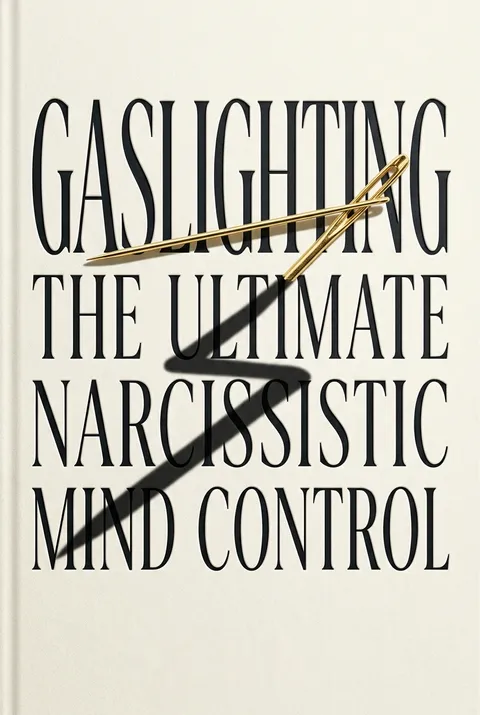


Key Takeaways
Treat persistent self-doubt as a reason to check the relationship's pattern.
Notice the shift. The book opens with a person who feels increasingly confused, exhausted, and unlike their former self. Their partner dismisses their concerns as neediness or irrationality, while friends see only the partner's charming public side. The central idea is that gas-lighting distorts another person's sense of what happened, what was said, or what their own reactions mean. It can leave someone asking whether they are the problem.
Look beyond one argument. Ordinary disagreements can involve different memories or perspectives. The book's warning is about a repeated pattern in which one person's account is denied and their confidence in their own judgment steadily erodes. Feeling upset alone does not prove manipulation, but sustained confusion is a reason to seek perspective from people who treat concerns seriously.
The strongest starting point is the difference between being distressed and being discredited. In social psychology, people rely on trusted others to help interpret ambiguous events; repeated dismissal can therefore unsettle both memory and self-trust. This is especially relevant when the dismissive partner appears credible to outsiders. Still, distress is a signal to investigate, not a diagnostic test. A careful response asks what happened repeatedly, whether there is corroboration, and whether the person can safely discuss concerns without punishment.
Judge gas-lighting by its effect, even when intent remains uncertain.
Separate harm from motive. The book distinguishes intentional gas-lighting, in which a person knowingly lies or manipulates, from unintentional gas-lighting, which it associates with memory, attention, or cognitive difficulties. In either case, the other person may be left doubting their recollection and judgment. The book's practical point is that harmful impact deserves attention even when the cause is unclear.
Keep the distinction useful. A missed conversation, a mistaken recollection, and a deliberate pattern of denial are not interchangeable. Notice whether the person acknowledges mistakes, takes steps to prevent repeats, and respects the effects on others. The label alone cannot establish intent or a mental condition. If the pattern continues, the person experiencing it can set boundaries and seek outside support without first proving what is happening inside the other person's mind.
This distinction avoids a common trap: assuming that harm only counts if malicious intent can be proven. In workplace safety and clinical ethics, systems are often assessed by both outcomes and accountability, not just motives. Yet intent still matters for choosing a response. A person who forgets and then collaborates on practical safeguards presents a different situation from someone who repeatedly denies events and retaliates against questions. The book's impact-first lens is humane; its categories should not be mistaken for a reliable clinical classification.
Track repeated denials, blame, and social isolation, not isolated arguments.
Watch the recurring tactics. The book describes a cluster of behaviors: denying events, reshaping what was said, blaming the partner for raising concerns, withholding affection, or threatening to leave. It also warns that the partner may be described to friends or family as unstable, making outside support harder to access. The problem is not simply that two people remember a conversation differently. It is the cumulative pattern of dismissal and control.
Notice recruited allies. One example involves a partner giving his mother a false account of where he spent the day, then using that account to discredit questions about his absence. Relatives may accept the version they heard first and reinforce the partner's isolation. Record patterns and seek a grounded perspective, rather than treating popularity or charm as proof that one person's account is true.
A pattern-based approach is more reliable than trying to infer character from a single episode. It resembles incident analysis in organizations: separate individual events, identify recurring conditions, and look for consequences. The example of an ally repeating an alibi also shows how social credibility can become part of the conflict. However, family members taking one person's side does not by itself prove coordinated manipulation. The useful question is whether independent, trustworthy relationships remain available and whether concerns can be examined without retaliation.
Do not mistake immaturity or trauma for proof of a diagnosis.
Treat origin stories cautiously. The book portrays some narcissistic partners as emotionally immature and suggests that childhood neglect, trauma, or overprotection can restrict later relationship skills. It also describes a Peter Pan and Wendy dynamic: one partner's playful, dependent behavior draws the other into a rescuing or caretaking role. These ideas may help explain why a relationship feels unequal, but the book does not establish a clinical assessment for any individual.
Separate explanation from excuse. Difficult childhood experiences, poor memory, or social difficulties do not prove narcissism, abuse, or a specific disorder. Nor do they remove responsibility for harmful conduct. Focus on observable behavior: whether a person respects boundaries, acknowledges the effect of their actions, and makes sustained efforts to change. A partner is not responsible for diagnosing or rehabilitating another adult.
The developmental lens can generate compassion without requiring someone to tolerate mistreatment. That balance matters: trauma may help explain defenses, but explanation is not a transfer of responsibility to the person being harmed. The book's weakness is its confident movement from childhood adversity to claims about adult personality and brain wiring. Contemporary clinical practice requires careful assessment, not a relationship partner's diagnosis. Behavior-focused language is safer and more actionable: it describes what is happening without turning a speculative backstory into certainty.
Build a reality check outside the relationship, using safe records and allies.
Create an external record. The book recommends putting important agreements in writing, keeping records of conversations, and involving a trusted third party when discussions repeatedly become distorted. Its examples include written commitments and audio or video recordings. A simple dated note about what was agreed, what happened, and how the interaction affected the person can also help clarify a pattern.
Use documentation carefully. Records can support memory and make practical matters easier to resolve, but they are not a substitute for safety. Recording laws differ, and a discovered recording device could increase danger in a controlling relationship. Choose methods that are lawful and secure, and ask a counselor or local support service about safer options. The goal is not to win every dispute; it is to preserve enough clarity to make informed decisions.
External records can reduce the burden on memory, especially when conversations are stressful or repeatedly contested. Written agreements also shift discussions from competing recollections toward concrete commitments. This resembles good documentation in medicine and project management: contemporaneous notes are usually more useful than a later reconstruction. The important limit is that documentation can provoke risk or create privacy concerns. A safety plan should come before evidence gathering, and a trusted person should help assess whether a particular method is safe and lawful.
Protect contact with trusted people before isolation becomes your normal.
Keep a wider reference point. The book warns that isolation makes it harder to check one's impressions and easier to accept a partner's version of events. It urges readers to maintain contact with friends, family, counselors, or other healthy people. A trusted person need not decide who is right; they can listen, help track changes, and remind someone that life outside the relationship still exists.
Choose support with care. Not everyone will understand abuse, and some may minimize it or pass information back to the partner. Seek people who respect privacy, take safety seriously, and do not pressure the person into a decision. If close contacts are unavailable, a professional counselor or domestic-violence service can provide a more confidential point of reference. The book's central safeguard is connection, not dependence on one supposedly perfect witness.
Connection is more than emotional comfort. It provides alternative interpretations, practical help, and a check against the narrowing of daily life around one person's demands. The book's emphasis on outside relationships is therefore one of its most useful interventions. At the same time, support networks vary in quality; a dismissive friend can deepen shame rather than relieve it. Good support preserves the person's agency, asks what they need, and avoids forcing a confrontation that could make the situation less safe.
Stop trying to parent a partner into basic mutuality.
Recognize the caretaker loop. Using the Peter Pan and Wendy comparison, the book describes a partner drawn to someone playful and charming who later relies on them to manage responsibilities. The caretaker may try to fix, nurture, or protect the other person, while the relationship becomes less reciprocal. The book argues that this imbalance can make it harder to notice when ordinary support has turned into a role of constant repair.
Measure reciprocity. A relationship does not become healthy simply because one person understands the other's wounds or supplies reminders, explanations, and second chances. Look for mutual respect, shared responsibility, and willingness to discuss problems. If one partner consistently refuses accountability, more caretaking may preserve the arrangement rather than improve it. The comparison is a metaphor, not a diagnosis, and it should not be used to reduce a complex person to a childish caricature.
The caretaker dynamic connects with research and practice around overfunctioning: when one person repeatedly compensates for another's disengagement, the relationship can settle into an unequal equilibrium. The metaphor helps readers notice their own role without blaming them for another person's behavior. Its limitation is that playful behavior or dependence alone is not evidence of manipulation. The key question is reciprocity. Support is healthy when both people can give, receive, and take responsibility, rather than when one person's needs permanently organize the other's life.
When control escalates, prioritize safety and outside help over persuasion.
Treat threats seriously. The book describes gas-lighting alongside threats, isolation, emotional abuse, and sometimes physical abuse. It warns that attempts to challenge a controlling partner can be met with punishment or further distortion. In that setting, proving the facts in one more argument may not be the safest or most useful goal. The book urges people who suspect gas-lighting to seek help rather than endure the situation alone.
Make safety the first task. If there is immediate danger, contact emergency services where available. Otherwise, consider speaking privately with a counselor or domestic-violence service about options, especially before announcing plans to leave or confronting the partner. The book lists severe psychological outcomes, including psychosis and suicide, but those claims should not be treated as inevitable consequences. Serious distress deserves professional assessment, not a prediction based on a book's description.
The shift from persuasion to safety is crucial when control or threats are present. In coercive situations, confrontation can increase risk, while confidential planning can widen a person's options. The book is right to make the stakes visible, but it sometimes presents extreme mental-health outcomes as direct consequences without establishing how common or causally linked they are. A responsible reading takes danger seriously without assuming a specific outcome. Professional assessment and individualized safety planning are more useful than a dramatic forecast.
Analysis
This short self-help book is organized around a practical warning: repeated distortion, blame, and isolation can make a person distrust their own account of a relationship. Its most useful contribution is not a clinical theory of narcissism, but a reader-centered description of how confusing interactions can accumulate. It asks readers to attend to patterns, keep a record where safe, seek outside perspectives, and treat escalating control as a safety concern.
The book also blends several different levels of explanation that should be kept separate. Gas-lighting is a behavior pattern; narcissism can refer to traits or a diagnosable personality disorder; trauma is a possible history; and memory or attention problems are possible explanations for particular mistakes. None automatically proves the others. The text sometimes moves too quickly between them, including broad claims about childhood causes, cognitive conditions, and severe outcomes such as psychosis. Those claims are not supported in the book by clinical evidence or methods, so they should not be used to diagnose a partner or predict what will happen.
Its practical suggestions are strongest when adapted to context. Written agreements, trusted witnesses, and private support can clarify events, but recordings or visible documentation may be unsafe or unlawful in some circumstances. Safety should govern evidence gathering. The book's advice to preserve outside relationships is especially valuable because it resists the isolation that makes any one person's account difficult to test. A balanced reading therefore neither dismisses the reader's confusion nor treats every conflict as abuse. It asks what repeats, whether concerns can be discussed without punishment, whether responsibility is shared, and whether the person has safe access to support. The central insight is modest but powerful: no one needs a definitive label for another person before taking persistent harm seriously and seeking help.
Review Summary
Gaslighting receives mixed reviews, with an overall rating of 3.89 out of 5. Many readers find it informative and helpful in understanding narcissistic abuse and gaslighting behaviors. They appreciate its concise nature and ability to provide perspective on past experiences. Some praise its straightforward approach and potential to aid healing. However, one critical review describes it as a brief, unoriginal compilation of information readily available online, comparing it to a Wikipedia article. Despite this criticism, the majority of reviewers recommend the book for its insights into recognizing and dealing with gaslighting.
Glossary
Gas-lighting
Reality-distorting behaviorThe book uses this term for attempts to distort another person's understanding of events, words, or their own reactions. It describes both deliberate lies and patterns that may arise without deliberate intent. The result can be confusion and reduced confidence in one's judgment. The term describes behavior, but the book's examples alone cannot establish a diagnosis or motive.
Intentional gas-lighting
Deliberate reality distortionThe book's label for knowingly manipulating, lying, omitting information, or reshaping events to control another person's understanding. Examples include denying promises, changing an account of an absence, or recruiting others to support an alibi. The category is the author's distinction, not a clinical diagnosis, and intent cannot reliably be inferred from one disagreement.
Unintentional gas-lighting
Unintended reality distortionThe book's label for behavior that resembles gas-lighting but may stem from memory, attention, or cognitive difficulties rather than deliberate deception. It mentions possible mental-health or developmental explanations. This distinction can encourage consideration of intent, but the book does not provide a basis for diagnosing those conditions or confirming that they caused a particular interaction.
Projection
Displacing blame outwardThe book uses projection to describe a person attributing their own unwanted feelings or conduct to someone else. In its account, a person who avoids shame or responsibility may accuse a partner of being the source of the problem. The term can help name a familiar interpersonal pattern, but accusations of projection should not replace examination of specific actions and evidence.
Trauma bonding
Attachment amid repeated harmThe book uses this term for a bond that can develop in an abusive relationship as harmful treatment continues and the victim adapts to the partner's control. It describes growing obedience and accommodation as part of this process. The term refers here to a relationship dynamic, not proof that every person in a harmful relationship experiences the same attachment or responds in the same way.
Duper's delight
Satisfaction at deceiving someoneThe book describes this as visible satisfaction when a person believes they have fooled someone or escaped consequences. It compares the reaction to the pleasure of getting away with a lie. The text associates it with manipulative behavior, but a facial expression or moment of apparent amusement cannot establish deception, psychopathy, or a personality disorder.
folie a deux
Shared delusional beliefA French phrase the book invokes to describe a shared psychotic state, applying it to a relationship in which one person's distorted account affects the other. The book presents this as a possible consequence of prolonged gas-lighting. That claim should be treated cautiously: the phrase has a specific psychiatric history and cannot be inferred from confusion or disagreement alone.
Download PDF
Download EPUB
.epub digital book format is ideal for reading ebooks on phones, tablets, and e-readers.








