

Key Takeaways
Treat biological energy as the bridge between living structure and health
Energy shapes structure. Peat’s central claim is that living things are not merely collections of parts carrying instructions. Their organization develops through the flow of energy: metabolism sustains structures, and those structures in turn shape how energy is used. He contrasts efficient mitochondrial respiration, which he associates with complex function, with less efficient glycolysis, which he links to simpler or stressed states. In this view, health depends partly on the organism’s capacity to produce and use energy, not just on the presence of a particular molecule or gene.
A whole-system lens. The proposal connects cell biology to development, aging, fertility, and ecology. Peat argues that feedback loops can either trap an organism in low-energy dysfunction or support further adaptation. His broad principle is compelling, but the book sometimes treats energy as a unifying explanation before establishing the specific mechanism in each case.
The framework usefully directs attention from isolated components toward rates, relationships, and context, concerns shared by systems biology and physiology. A cell’s output depends not only on its parts but on how they interact under changing conditions. Yet “energy” can become too elastic a term: it may name measurable metabolic processes in one passage and a more general force of vitality in another. The strongest use of the idea asks for a concrete pathway, a measurable outcome, and a way the proposed explanation could be disproved.
Read genes as participants, not destiny, in a changing organism
Context changes development. Peat challenges explanations that treat inherited genes as sufficient accounts of traits such as intelligence, aging, and disease. He points instead to prenatal conditions, nutrition, hormones, stress, and stimulation as influences on development across a lifetime and, in some cases, across generations. He cites animal studies in which enriched surroundings were associated with larger brains, and research reporting changes after maternal or hormonal conditions were altered. His argument is not simply that genes do not matter, but that biological outcomes cannot be understood by treating the organism as insulated from its environment.
A caution about inference. Peat uses these examples to question genetic determinism and fixed cellular lifespans. They support taking developmental conditions seriously, although they do not establish every broader claim he draws from them. The practical lesson is to examine exposures and history alongside inherited risk.
This perspective anticipates a central insight of developmental biology: genes operate within regulatory systems shaped by cells, bodies, and environments. It also guards against the mistake of treating a statistical association with family history as a complete causal account. The counterweight matters. Environmental influence does not make genetic variation irrelevant, and evidence of plasticity in animals does not automatically predict the size or direction of effects in people. The productive question is not genes or environment, but which interactions matter, for whom, and at what developmental stage.
Ask whether stress is draining energy before suppressing symptoms
A functional diagnosis. Peat proposes an energy-centered way to interpret stress: a tissue under strain may become either overactive or underactive because it lacks the capacity to respond normally. He calls the desired treatment direction a “therapeutic vector”: preserve available energy while improving its production. Sedation, in his account, can reduce wasteful energy use, while adequate nutrition and metabolic support may help restore production. He illustrates the idea with shock, arguing that treatments focused only on raising blood pressure could miss underlying metabolic failure. He discusses historical reports of glucose or ATP helping animals or patients recover, but these examples do not establish a general treatment rule.
Symptoms are clues. The model encourages clinicians to ask what system is failing and why, rather than treating every symptom in isolation. It is a framework for inquiry, not a substitute for diagnosis or evidence-based emergency care.
The distinction between reducing demand and increasing supply is a useful way to think about physiological resilience. It resembles engineering approaches that stabilize a stressed system before restoring its capacity. The danger is assuming that a broad energy narrative identifies the right intervention. Shock has multiple causes and requires urgent, cause-specific treatment. Historical experiments with metabolic substrates cannot safely be generalized into advice for patients. The framework is most valuable when it sharpens questions about mechanisms, rather than when it bypasses them.
In Peat's model, thyroid and progesterone anchor resilience and reproduction
A hormone-centered account. Peat presents thyroid hormone as a regulator of metabolic activity and progesterone as a protective steroid involved in stress resistance, pregnancy, and tissue function. He argues that estrogen dominance and inadequate thyroid activity can reinforce each other, and he interprets some aging and reproductive problems through this interaction. One example is his account of a 71-year-old man whose arthritis resolved after a physician identified low thyroid function and prescribed thyroid extract. He also describes fertility as dependent on the hormonal conditions that support oxygen and nutrient availability for an embryo.
Claims require scrutiny. These chapters reflect Peat’s physiological theory and clinical anecdotes, not a reliable basis for self-treatment. Hormone disorders, infertility, and arthritis have diverse causes. The book’s claims about supplements, hormone balance, and prevention of disease should not be taken as established medical guidance.
The section’s enduring value is its insistence that endocrine systems interact, and that reproductive physiology belongs within general health rather than in a narrow specialty. Modern endocrinology likewise studies feedback loops and tissue-specific responses. But the book often moves from plausible mechanisms to broad therapeutic claims without the clinical evidence needed to establish benefit and safety. Hormones can have substantial, dose-dependent effects, and “natural” does not mean harmless. Readers can retain the systems question while relying on qualified clinicians and current evidence for decisions about testing or treatment.
Treat light and darkness as biological conditions, not scenery
The day shapes physiology. Peat argues that darkness can increase stress-related processes and impair cellular energy production, while daylight supports recovery. He describes daily and seasonal patterns in mitochondrial structure and function, and suggests that winter darkness may compound physiological strain. He also gives penetrating red and infrared light a special role in restoring respiratory activity, proposing that copper-containing proteins and pigments may help mediate these effects. The practical thread is broader than any single mechanism: light exposure, sleep, and seasonal conditions belong in discussions of biological regulation.
Separate robust from speculative. The book connects these ideas to sleep, hormones, immunity, and aging, sometimes with sweeping certainty. Its claims about red light’s specific cellular actions and the amount of artificial light needed are hypotheses in this text, not established prescriptions. The book offers no reason to ignore eye safety or medical advice.
Light is a powerful environmental signal, and contemporary circadian research reinforces the importance of when people encounter bright light and darkness. This makes Peat’s insistence that illumination is part of physiology more durable than his proposed explanation for every effect. Light’s influence varies by wavelength, intensity, timing, and exposure, so “more light” is not a universal solution. The distinction between a sound general question and an unverified mechanism is especially useful here: acknowledge light as biology, then assess specific interventions independently.
Protect regenerative capacity by improving conditions, not blaming age
Aging as interaction. Peat rejects the idea that decline is simply an internal clock or the inevitable consequence of being alive. He describes aging as a systemic loss of adaptability, shaped by stress, nutrition, toxins, hormones, and energy metabolism. To support that view, he recounts experiments in which tissue from older animals remained healthy when placed in younger animals, and cites studies associating dietary restriction with longer animal lifespans. He also notes research suggesting that removing heavy metals from animal diets could produce a similar effect, arguing that reduced food intake may sometimes work by reducing harmful exposures rather than by starvation itself.
Regeneration has limits. These examples encourage attention to modifiable conditions, but the book’s proposed links among metabolism, puberty, brain growth, and longevity are not all established. Its useful message is to investigate specific causes of decline instead of assuming age alone explains them.
The strongest version of this argument treats aging as a biological process influenced by multiple systems, rather than as a single countdown. That approach supports prevention research and resists fatalism. It also needs careful boundaries: animal lifespan studies do not show that a particular diet or supplement extends human life, and a higher metabolic rate is not automatically beneficial. The term regeneration should not blur the difference between maintaining function, repairing damage, and reversing aging. Each is a distinct outcome requiring distinct evidence.
See an ancient forest as an energy network, not timber inventory
Complexity creates value. In his account of Pacific Northwest forests, Peat argues that an old forest is not simply a slower-growing version of a tree farm. Its layered canopy, soil, water, and living organisms form a system whose exchanges continue across day and night, seasons, and microclimates. He compares the forest’s integrated activity to an animal brain: each is more than a stock of useful material. The book also points to forests’ influence on water storage, humidity, soil retention, and local climate. Peat cites a biologist’s estimate that Oregon forests could yield at least $4,000 per acre annually in products other than timber.
Count the whole balance sheet. His critique is that extractive accounting records saleable wood while ignoring ecological functions and long-term costs. The estimate is his cited calculation, not a universal valuation, but the broader economic question remains important.
The forest argument translates the book’s biological thesis into public policy: relationships and accumulated structure can produce value that a simple inventory misses. Ecological economics makes a similar move by asking decision-makers to account for services such as water regulation and habitat. The analogy between a forest and a brain is vivid, though it should not be mistaken for a literal equivalence. Nor does every old forest provide identical benefits. The key test is to measure local ecological functions and distribute costs and gains honestly, rather than treating only harvested material as wealth.
Keep hypotheses provisional, especially when biology invites cosmic explanations
Science needs open doors. Peat argues that scientific methods can harden into dogma when researchers treat present theories as complete. He draws on Vernadsky’s view of the biosphere as a physical system in which life and human consciousness affect planetary processes. Vernadsky’s “noosphere” names a proposed stage in which human thought and society consciously shape the biosphere. Peat also considers volcanic origins of life and an expanding Earth, using them to illustrate questions he believes conventional assumptions exclude.
Possibility is not proof. These proposals vary greatly in evidential support. The book’s case for intellectual openness is stronger than its case for these particular cosmological or origin-of-life claims. A useful reader can ask what observations each theory explains, what it predicts, and whether competing accounts perform better, without mistaking unconventionality for confirmation.
Scientific progress does require room for hypotheses that initially conflict with prevailing assumptions. Yet disciplined openness is not an equal presumption that every alternative is equally plausible. A productive theory must expose itself to tests that could count against it. Peat’s pairing of ecological holism with proposals such as an expanding Earth makes this distinction essential: the former invites measurable systems analysis, while the latter requires substantial independent evidence. Intellectual humility works in both directions, toward established models and toward appealing new ones.
Make meaningful work an apprenticeship in perception and truth
Skill trains attention. Peat argues that people learn to see through sustained involvement in real work. He contrasts painters shaped by craft traditions with artists whose social position, in his interpretation, rewarded prestige more than technical mastery. He extends the contrast to science, invoking Broda Barnes’s work on thyroid function as an example of findings he believed the medical establishment ignored. The broader claim is that knowledge is not produced by abstract reasoning alone: practical engagement helps people notice details, test ideas, and acquire judgment.
Culture teaches a way of seeing. Peat worries that children separated from meaningful adult work may inherit attitudes without abilities. He imagines work organized around exploration and contribution rather than status or mere employment. That ideal links education, science, and economic life, though his sharp division between skilled makers and elites simplifies a more complicated history.
This account connects expertise to tacit knowledge: people often perceive patterns through practice that cannot be reduced to rules alone. Apprenticeship can also give learners access to feedback, standards, and a community of inquiry. The argument becomes less convincing when social class is used as a shortcut for judging the quality of art or science. Institutions can suppress useful findings, but disagreement or neglect alone does not prove a discovery correct. The strongest lesson is to value demonstrable skill and open criticism, not to romanticize any one social group.
Analysis
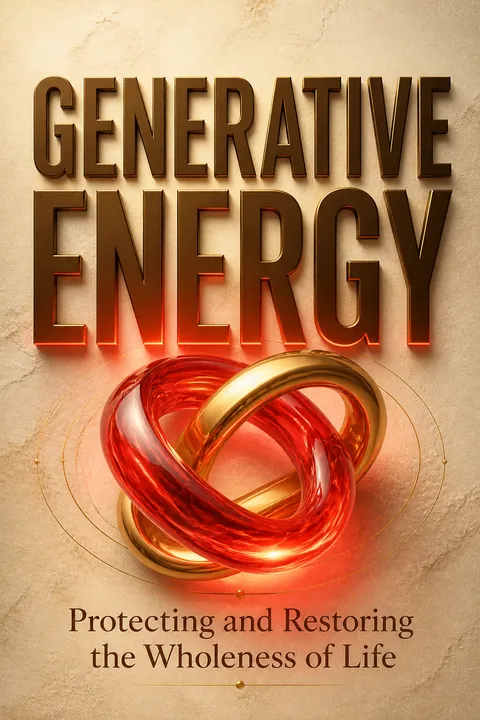
Generative Energy is an unusual hybrid: part biology, part ecological polemic, part philosophy of science, and part personal health manual. Its unifying idea is that life is an active organization of energy and matter, shaped by its history and surroundings. That lens lets Peat connect embryo development, hormone systems, aging, forest ecology, and human work. The book is most persuasive when it asks readers to widen the unit of analysis: an organism is not just genes, a forest is not just timber, and a symptom is not necessarily an isolated defect.
The same ambition creates its chief weakness. Peat often shifts from a sound question about interaction to confident explanations that the text does not establish. The book’s clinical anecdotes and proposed uses of thyroid hormones, progesterone, pregnenolone, light, and diet are not equivalent to controlled evidence of safety or efficacy. Its scientific claims also vary widely in status, from established physiological ideas to highly speculative proposals about the origin of life or the Earth’s expansion. Readers should not treat the book as medical advice or assume that a claim is reliable because it is framed as holistic or anti-establishment.
A productive reading separates the method from the verdicts. The method asks what conditions sustain function, how feedback loops shape outcomes, and which environmental factors standard accounts overlook. Those questions remain valuable across biology, medicine, and ecology. The verdicts require independent testing, especially where they imply treatment or make large causal claims. Peat’s deeper cultural argument is that knowledge advances through active engagement with the world, not through reverence for a fixed model. That argument applies to his own work, too: curiosity should make room for new explanations, while rigorous testing decides which ones deserve to stay.
Glossary
energy charge
cellular energy availabilityA measure of a cell’s available energy, discussed in the book as a factor influencing how readily cells respond to stimulation. Peat uses the idea to connect metabolism with activity in brain, muscle, immune, and other cells. He treats energy status as a possible guide to understanding whether a system can respond effectively or is operating under strain.
therapeutic vector
preserve and restore energyPeat’s term for a treatment direction that combines conserving energy with improving the organism’s capacity to produce it. He argues that recovery may require both reducing wasteful demands and supporting metabolism. The concept is offered as a general physiological framework, not as a specific clinical protocol or a substitute for diagnosis.
catatoxic
protective against toxinsA term used by Hans Selye and adopted by Peat for protective effects that help an organism resist or tolerate toxic substances. Peat attributes such effects to several steroids, including progesterone and pregnenolone, and uses the concept to explain why these substances might influence more than reproductive processes. Specific protective claims require evidence for each substance and condition.
noosphere
human thought shaping the biosphereA concept associated with V. I. Vernadsky and Edouard Le Roy, describing a proposed stage in Earth’s development in which human knowledge and organized society consciously influence the biosphere. Peat presents it as an extension of the biosphere, not as a claim that humans are separate from nature. It emphasizes the planetary consequences of collective choices.
aromorphosis
energy-linked evolutionary advanceA term Peat attributes to M. I. Budyko for the appearance of a more complex biological form when environmental energy conditions support it. In this account, new structures enable organisms to use more energy and engage in more complex interactions. Peat uses the idea to frame evolution as influenced by energetic opportunity, rather than only by random variation and selection.
pedomorphosis
retention of juvenile traitsThe preservation of features associated with an earlier developmental stage into adulthood or across evolutionary change. Peat also refers to juvenilization and neoteny in discussing this pattern. He interprets prolonged juvenile traits as potentially adaptive in supportive environments, where extended development can allow continued learning, growth, and flexibility.
rules of stability
conditions that sustain structuresPeat’s proposed way of asking what conditions allow a complex structure to exist and persist. Rather than assuming that a whole can be fully explained by listing its parts, he urges investigation of the relationships, energy flows, and histories that maintain it. He presents these rules as a possible bridge between physical science and biology.
Download PDF
Download EPUB
.epub digital book format is ideal for reading ebooks on phones, tablets, and e-readers.








