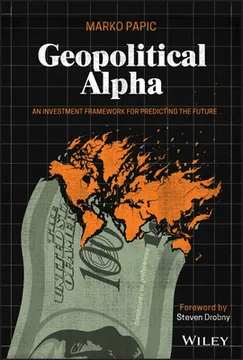


Key Takeaways
Treat politics as an investment input, not an occasional shock
A different market era. From roughly 1985 to 2008, American dominance, expanding globalization, and market-friendly policy made politics feel like background noise to many investors. That backdrop has weakened. The book’s opening story shows why: Marko Papić’s father worked for Genex, a Yugoslav trading company that profited from Cold War barter. When the Soviet Union collapsed, Genex’s business model lost its foundation, and Yugoslavia itself unraveled soon after.
Regime shifts reach portfolios. The lesson is not that every political headline moves markets. It is that political conditions can quietly support a business model for years, then change the rules beneath it. Investors trained only on interest rates, earnings, and valuation may miss the forces that made those numbers possible.
What's striking is the emphasis on hidden dependence: a company can appear successful because the surrounding political order supplies its market, customers, or stability. This resembles stress testing in engineering, where a structure is judged not only by normal operating conditions but by what happens when a key support disappears. The framework is especially useful when a portfolio relies on globalization or predictable institutions. Still, the claim that geopolitics now matters more everywhere needs qualification. Political exposure varies by industry, country, and time horizon, so analysis should identify where the change in regime actually reaches cash flows.
Forecast what leaders can do, not what they say they want
Start with the terrain. The constraint framework combines three ideas: begin with observable material conditions, favor evidence that distinguishes between competing explanations, and judge people in context rather than treating personality as destiny. Its central claim is that preferences matter only when circumstances let them become action.
Situations overpower character. In a Princeton Seminary study, students preparing sermons about helping a stranger were more likely to stop when they had time. Only 10% of those told they were late stopped, compared with 63% of those told they could take their time. In politics, President Trump wanted Obamacare repealed, but a narrow Senate majority and voters’ growing support for the law blocked it. Strong preferences did not erase those barriers.
The framework’s strength is its resistance to personality worship. Behavioral science repeatedly finds that context can shift conduct, sometimes more powerfully than stable traits; the seminary example makes that point unusually tangible. The approach also offers a useful corrective to headlines built around a leader’s temperament. Yet constraints do not make leaders interchangeable. Skill, attention, and judgment can affect which options they notice and how they respond. A sound forecast therefore treats agency as real but bounded, rather than replacing the “great person” story with a mechanical theory of circumstance.
Seek evidence that separates scenarios, not a louder insider
Measure information by usefulness. Diagnosticity means how much a piece of evidence helps distinguish among possible explanations. A fever, for example, can signal many illnesses, so it tells a diagnostician relatively little by itself. For a political forecast, a leader’s stated preference may be similarly weak evidence: it can be sincere, tactical, or impossible to enact.
Access is not a forecast. Private consultants do not possess the vast, cross-checked information available to state intelligence agencies. Their sources may be duplicated across investors, while insiders may repeat what clients want to hear. In 2019, many investors trusted upbeat reports from people close to Argentina’s government; the country’s worsening economic distress and missing public polling deserved greater weight. Prefer experts who show scenarios, probabilities, and observable signs that could change their view.
This is a lesson in evidence quality, not an argument against expertise. In medicine, a test earns its value by changing the likelihood of a diagnosis, not by sounding technical; political information should meet the same standard. Scenarios and explicit update signals also make it easier to notice when a favored view has failed. The caution is that public indicators can be noisy or manipulated too. Polls, economic statistics, and insider testimony each have distinct weaknesses. Better judgment comes from triangulating them, not simply replacing private access with a chart.
Track voters and coalitions before trusting a leader’s promises
Political room is limited. Political capital is a leader’s practical ability to win support for decisions, especially costly or unpopular ones. It depends on factors such as popularity, time in office, legislative arithmetic, the economy, and organized interests. A leader may have strong rhetoric but little room to act.
The median voter sets direction. The median voter theorem is a model in which politicians move toward the position of the voter in the middle to win or retain power. Boris Johnson’s hard line on Brexit helped him appeal to Leave voters and reclaim support from the Brexit Party, but it did not prove that a no-deal exit was feasible. The book also applies the idea to China: even without elections, leaders must consider popular expectations, especially those of a growing middle class.
The political-market analogy is useful because it separates campaign language from the coalition needed to govern. A leader’s room to maneuver can be assessed through concrete signals, such as seat counts, polling, and the timing of an election. The median voter model is strongest when one issue dominates and weaker when voters weigh several issues at once, or when institutions distort representation. In an authoritarian system, public sentiment is also harder to measure. The concept still prompts a valuable question: which groups can impose a cost on leaders if their needs are ignored?
Follow economic dependencies to see which exits are imaginary
Interdependence constrains policy. During the Euro Area crisis, commentators often treated Germany as eager to abandon the common currency and Greece as able to prosper after leaving it. The book argues that Germany depended on European customers, while Greece had weak exports, relied heavily on imported energy, and needed structural reform whether it kept the euro or not. Greece ultimately stayed and made severe fiscal adjustments; German leaders backed measures that had once seemed politically unacceptable.
Markets can mislead, then discipline. Investors first lent cheaply to weaker Euro Area economies, masking structural problems, then abruptly demanded higher returns. The same analysis applies to trade: in a multipolar world, tariffs can redirect business to other countries rather than eliminate it. Economic ties can limit conflict without guaranteeing peace.
The key contribution is to make interdependence specific. “Trade ties” become analytically useful only when they identify who depends on which customers, suppliers, or financing. This connects to network analysis, where a node’s importance depends on its position and the availability of substitutes. If alternatives are scarce, dependence can constrain behavior; if they are plentiful, the bond is weaker. The argument should not be read as a guarantee that commerce prevents conflict. Economic costs may be tolerated when leaders judge security or domestic legitimacy more important, so the relevant question is how costly a break would be, and to whom.
Use geography as a constraint, never as destiny
Maps matter, but incompletely. Geopolitical theories emphasize how geography shapes national interests: sea power and control of trade routes matter to maritime states, while control of Eurasia matters to continental powers. The book warns against turning these insights into certainty. Mountains, borders, and access to ports can shape choices, but technology and policy alter what geography permits.
Capabilities limit ambition. Russia’s intervention in Ukraine reflected Moscow’s interest in keeping influence over a strategically important neighbor. Yet the book argues that Russia’s limited economic appeal to former Soviet states and the costs of occupying hostile territory constrained further expansion. Similarly, US alliances in Europe and Asia help prevent a rival power from dominating Eurasia. Geography is one force among domestic politics, economics, and military capacity, not a standalone prophecy.
Geography is valuable because it supplies durable context that can outlast individual administrations. It is also easy to misuse: a map can make a forecast feel inevitable even when technology, alliances, and economic incentives are changing. This resembles ecological reasoning, which studies how an organism’s environment shapes behavior without claiming that the environment determines every outcome. The practical test is whether a geographic feature creates a specific cost or advantage for an actor. If no mechanism connects the map to a decision, the analysis is scenery, not explanation.
Expect laws to bend when stronger constraints collide
Rules have a hierarchy. Constitutional and legal limits can shape what policymakers do, but the book treats them as less reliable than political, economic, and geopolitical pressures. During the Euro Area crisis, European leaders worked around treaty language against member-state bailouts and built emergency lending mechanisms. In 2012, European Central Bank president Mario Draghi signaled that the bank would act to preserve the euro, and its mandate was interpreted broadly enough to support that aim.
Procedure can enable action. In the United States, the budget reconciliation process limited Senate debate and helped Republicans pass the 2017 tax cuts without a 60-vote majority. Legal details mattered, but only in combination with political support and budget rules. For investors, the point is not to ignore law; it is to ask whether law is a barrier, a tool, or a rule likely to be reinterpreted under pressure.
This view usefully distinguishes formal rules from enforcement capacity. Institutions are not just text; their force depends on incentives, legitimacy, and who can impose consequences for violations. That distinction helps explain why the same constitutional clause can matter greatly in one setting and little in another. But describing laws as easy to bend risks underestimating the cost of precedent, litigation, and loss of public trust. A legal workaround may solve an immediate problem while creating future constraints. Forecasts should include both the short-term escape route and the institutional damage it may leave behind.
Price panic and timing, not just material fundamentals
Fear can become a constraint. The framework’s weakness is timing: a society can react so strongly to a perceived danger that its response delays the outcome suggested by material conditions. The book uses the Islamic State’s rapid rise to show how dramatic attacks and social media imagery shaped public anxiety beyond the group’s military capabilities. That fear influenced politics and lasted longer than the author expected.
Markets trade the narrative too. Writing during the early COVID-19 crisis, Papić argued that collective fear and policy responses could dominate investment outcomes even if underlying conditions later changed. His broader warning is more durable than any specific pandemic forecast: a long-term analysis can be directionally sound and still lose money if the market’s attention, or the political response, moves on a different timetable.
This is a crucial complication because beliefs are not merely commentary on reality. When enough people act on a belief, it can change spending, policy, and market prices, making the perception consequential in its own right. Research on information cascades describes how individuals may follow others’ choices even when their private evidence is weak, producing abrupt shifts in collective behavior. The COVID-19 discussion is explicitly contemporaneous and should not be treated as settled medical analysis. Its methodological lesson is stronger: uncertainty about a threat and uncertainty about the reaction to that threat are separate forecasting problems.
Build a net assessment around one fulcrum and its signals
Set a starting probability. A net assessment weighs competing explanations and identifies the most important constraint. The book calls the decisive variable the fulcrum constraint. It then establishes a Bayesian prior, meaning an initial, judgment-based probability that can be updated as evidence changes. For a Brexit forecast, polling could serve as a signal to monitor; for US tax cuts, statements by fiscal conservatives could matter more.
Match method to horizon. The author distinguishes sudden events, cyclical questions such as elections, and long-term shifts in themes. For conflicts between actors, game theory can map possible choices, but only after the analyst assesses the gameboard: material power, risk tolerance, credibility, and domestic political limits. Greece’s 2015 standoff with Germany looked like a contest between equals until Greece’s economic and political constraints were included.
The operational value lies in making a forecast revisable. A stated prior, a central constraint, and a list of update signals create an audit trail rather than a story that can be retrofitted after the fact. This resembles Bayesian decision analysis, where beliefs change as evidence arrives and decisions depend on both probabilities and consequences. A single fulcrum can simplify attention, but it can also become a new fixation. Robust assessments should note what evidence would invalidate the chosen constraint and keep alternative explanations alive.
Bet against market odds, not on being politically right
The price is the opportunity. Geopolitical alpha means an investment return earned by seeing a political risk or opportunity differently from the market. The aim is not to predict the winner of an election for its own sake, but to find where market expectations are mispriced. Before France’s 2017 election, investors overstated Marine Le Pen’s chance of winning, despite her opposition to the euro and a large polling gap. Papić argued for a stronger euro and a relative trade favoring French over German industrial stocks.
Relative calls can be enough. In 2018, he favored Mexico over Brazil, not because he expected Mexico to be perfect, but because investors were too optimistic about Brazil’s ability to pass reforms and too pessimistic about Mexico. The suggested currency pair returned 11.2% through 2019. Such examples illustrate the method, not a promise: the edge depends on the gap between analysis and market pricing.
The distinction between being politically correct and being financially right is central to disciplined investing. Markets do not reward a forecast simply because it eventually describes events accurately; they reward it only when the difference from consensus is large enough, arrives in time, and is expressed through a suitable position. This connects to decision theory’s separation of outcome quality from decision quality: a good process can lose on an unlucky path, while a poor process can win by chance. The reported trades are compelling illustrations, but selected winners cannot establish a reliable hit rate. Investors need records of misses, costs, and risk.
Analysis
The book’s most powerful move is to replace personality-centered political commentary with a practical question: what prevents a decision-maker from doing what they say they want? This shift makes political analysis more testable. Constraints can often be observed through legislative arithmetic, trade dependence, polling, budgets, or military capacity, while motives are inferred and easily distorted by rhetoric. The framework is particularly useful for investors because it connects political mechanisms to asset prices rather than treating politics as an ornamental narrative.
Its method is deliberately plural rather than fully formal. Materialist analysis supplies a starting point, intelligence methodology asks which evidence discriminates among hypotheses, social psychology warns against over-crediting personality, and political economy clarifies who bears the cost of action. The net assessment then turns this mixture into a revisable prior. That structure is more honest than pretending that a single model can forecast every country and crisis.
The central risk is that “constraints” can become an all-purpose explanation after the fact. A forecast may cite whichever barrier best explains the outcome, while giving too little attention to the possibility that constraints change, interact, or are deliberately reshaped. Leaders can build coalitions, provoke crises, or accept costs that observers judge intolerable. Likewise, political preferences are not always mere noise: ideas can coordinate groups and alter what people regard as feasible. The framework works best when it records the forecast in advance, specifies observable update signals, and states what would prove it wrong.
The book’s own examples also counsel humility about time. A structural view can be correct yet commercially useless if the market trades panic, not the eventual adjustment. That distinction makes the method less a prediction machine than a discipline for locating assumptions, estimating probabilities, and comparing them with prices. Its lasting contribution is not certainty about the future. It is a better way to ask what must give way, who can make it give way, and whether the market has noticed.
Glossary
Constraint framework
Forecasting through limitsA way to forecast political and geopolitical outcomes by beginning with material limits on decision-makers rather than their stated preferences. It combines empirical observation, attention to evidence that distinguishes competing scenarios, and analysis of how circumstances shape behavior. The framework is a practical guide, not a fully scientific or mechanical forecasting method.
Diagnosticity
Evidence that separates hypothesesThe degree to which a piece of evidence helps distinguish among competing explanations. Information is valuable not simply because it is detailed or plentiful, but because it changes the relative plausibility of possible outcomes. A leader’s stated preference may be weakly diagnostic if the leader can choose not to act on it.
Fulcrum constraint
The decisive limiting factorThe constraint with the greatest influence on a particular forecast. It is the variable that bends other considerations toward or away from an outcome. Analysts monitor it closely because a meaningful change in the fulcrum constraint may require a substantial revision to the forecast.
Median voter theorem
Politicians follow the voter middleA model proposing that politicians seeking election or continued power tend to move toward the position of the median voter, the voter whose preference lies near the center of a particular policy distribution. The model can illuminate long-term policy direction, but its assumptions are harder to satisfy when voters weigh many issues or institutions distort representation.
Political capital
Room to pursue policyA leader’s practical capacity to secure support for decisions, especially unpopular ones. It can depend on public approval, time in office, legislative support, economic conditions, and the strength of organized opponents. The book treats political capital as contextual and difficult to reduce to one reliable numerical measure.
Buenos Aires Consensus
Populist economic policy turnThe author’s label for a shift away from the market-oriented policies associated with the Washington Consensus and toward more electorally responsive economic intervention. In the book’s account, this includes greater use of fiscal stimulus and a larger role for government in economic decisions. It is a proposed description of a political-economic trend, not a formal institution.
Net assessment
A weighing of constraintsAn analysis that compares the constraints affecting an event, country, or policy to establish an initial view. It identifies which factors matter most, which scenarios remain plausible, and what evidence should be monitored. A net assessment is a starting point for updating a forecast, not a final claim of certainty.
Geopolitical alpha
Returns from mispriced politicsInvestment performance attributed to recognizing that the market has mispriced a political or geopolitical risk or opportunity. The focus is not simply on predicting which political outcome occurs, but on comparing the analyst’s assessment with market expectations and selecting an investment expression that can benefit from the difference.
Two-level game
Domestic and foreign bargainingA model of international negotiation in which leaders bargain both with foreign counterparts and with domestic political groups. A deal must fit within the set of outcomes acceptable at home as well as abroad. Domestic constituencies therefore constrain what an international negotiator can credibly promise or accept.
Princeton Seminary experiment
Study of time pressureA 1970s social psychology experiment in which seminary students preparing to give a sermon encountered a person apparently in need of help. Students who were told they were late stopped much less often than those who had more time, despite their religious training and preparation for a sermon about helping others. The study illustrates how situational pressure can shape behavior.
Download PDF
Download EPUB
.epub digital book format is ideal for reading ebooks on phones, tablets, and e-readers.








