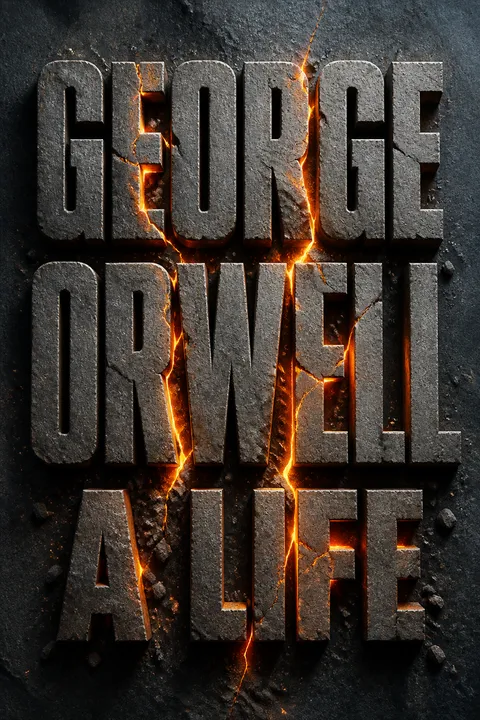


Key Takeaways
Use evidence to understand Orwell, not confident guesses about his inner life
Start with what survives. Bernard Crick builds his biography from letters, official records, published writing, and the conflicting memories of people who knew Orwell. He resists claiming access to private thoughts, especially where the record is thin. That matters because Orwell’s own writing often reshapes experience, while his later public image can tempt biographers to turn ambiguity into certainty.
Follow the work. Crick organizes much of the life around Orwell’s occupations and the making of his books. The result is not a complete portrait of Eric Blair’s interior life, but a detailed account of how experiences, political events, and writing met. It leaves some questions open rather than filling gaps with an elegant guess.
What's striking is that Crick treats uncertainty as a result, not a flaw to conceal. That resembles good historical source criticism: a memoir, a letter, and an official record answer different questions and should not be blended into one seamless story. The approach also has a limit. Archives preserve some lives and relationships better than others, so an outside-in biography can accidentally give the best-documented periods the greatest weight. Crick's restraint makes that imbalance visible, which is more useful than pretending it does not exist.
Treat childhood memories as crafted evidence, not a transcript of childhood
Two childhoods coexist. Blair’s memories of early life include both carefree fishing, animals, and summer holidays, and the loneliness and humiliation he later associated with school. His prep-school essay, “Such, Such Were the Joys,” portrays St Cyprian’s as cruel and oppressive. Letters written home as a child sound more cheerful, though their adult readers could censor them. Friends also remembered a happier boy, while accounts of bullying and harsh discipline support parts of his later indictment.
Class left a mark. Blair described himself as belonging to the “lower-upper-middle” class, a family with upper-middle status but limited money. At St Cyprian’s, a secret scholarship and the presence of wealthier boys sharpened his sense of social insecurity. Crick argues that real suffering and literary shaping can both be true.
Memory is not a filing cabinet. People reconstruct childhood through the concerns and language available to them as adults, while contemporaneous records can omit precisely what a child could not safely say. Crick avoids the opposite mistake too: a story's literary shaping does not prove that its pain was invented. The useful distinction is between emotional truth and verified detail. That distinction keeps readers from diagnosing a writer from a single remembered scene, while still taking institutional cruelty seriously.
Read Burma as the experience that made imperial power personal
Service became a moral problem. From 1922 to 1927, Blair served as a police officer in British-ruled Burma. The job meant enforcing a system he gradually came to see as despotic, while living among fellow Europeans whose racial assumptions and casual brutality troubled him. His later essay “A Hanging” turns an execution into a reflection on the wrongness of killing a living person; “Shooting an Elephant” examines how imperial authority traps even its agents in a performance of power.
Keep the uncertainty. Crick cannot verify every scene as literal fact. Orwell himself described some first-person writing as shaped or rearranged. The important evidence is the longer pattern: Burma gave him direct experience of how an institution can make ordinary people participate in domination.
The episode is a study in role morality: people can feel personally decent while carrying out harmful duties assigned by an institution. That insight travels beyond colonial administration to bureaucracies, militaries, and workplaces where responsibility is divided into small tasks. Crick's caution about whether particular scenes happened exactly as written is valuable, but it should not make the system itself seem uncertain. The moral force comes from the repeated conflict between Blair's official role and his growing judgment of what that role served.
Let hardship teach you, but do not confuse exposure with understanding
He went looking for experience. After leaving Burma, Blair tried to become a writer while short of money. He lived among tramps, spent time in poor districts, and worked as a dishwasher in a Paris hotel. These experiences became the material for Down and Out in Paris and London, his first book published as George Orwell. He did not become a tramp permanently: he moved in and out of poverty and returned to safer lodgings when he needed to write.
Experience became literature. Crick calls works such as Down and Out documentaries: writing grounded in lived events but shaped through selection, rearrangement, and representative characters. Orwell initially struggled to write well, then developed a direct, observant style through repeated effort. His first book was praised, but its sales did not end his financial insecurity.
This is an early version of a problem now familiar in immersive reporting: proximity can reveal details that distant analysis misses, but it does not automatically confer understanding. Orwell's own later criticism of his method is a strength. He recognized that tramps were not a representative sample of ordinary workers. The literary transformation also raises an ethical question: when real hardship becomes a compelling narrative, the writer gains authority and an audience. Accuracy, disclosure, and humility matter as much as courage.
Use social investigation to expose your own class assumptions
The North changed his scale. In 1936 publisher Victor Gollancz sent Orwell to investigate unemployment and poverty. For about two months he visited Manchester, Wigan, Sheffield, and Barnsley, gathered statistics, entered working-class homes, and went underground in coal mines. He saw miners' dangerous labour and the indignity of unemployment. He also lodged in a notably dirty house in Wigan, an image that some local readers felt unfairly linked poverty with filth.
His politics sharpened. Orwell had already encountered socialist ideas, but the journey made social inequality concrete and helped clarify his commitment to democratic Socialism: an egalitarian politics that also protects liberty and open debate. His criticism of socialist intellectuals grew alongside his sympathy for workers. He believed the Left had to win ordinary people, not merely denounce them or classify them.
The Wigan journey shows the difference between gathering evidence and choosing what that evidence means. Orwell's notes, measurements, and conversations give the book documentary force, while the tripe-shop setting became a memorable frame that risked overgeneralizing from one unusually squalid home. This tension matters in social research today: vivid cases attract attention, but representative claims require broader evidence. His sharper lesson is that an investigator's class position does not disappear through travel. It has to be examined throughout the work.
Let Spain test your politics against the conduct of your own side
The revolution felt real. Orwell went to Spain in late 1936, joined the P.O.U.M. militia, and fought on the Republican side. In the trenches, he experienced a striking equality between officers and ordinary fighters, which made socialism something lived rather than merely argued about. He was badly wounded in the neck. During leave in Barcelona, he saw fighting between Republican factions and then watched Communist propaganda portray the P.O.U.M. and anarchists as Fascist agents.
Allegiance did not excuse lies. Before the May 1937 conflict, Orwell had considered the Communist argument that winning the war should come before revolution. The arrests, repression, and fabricated accounts changed his view. Homage to Catalonia records his effort to describe the events accurately, though he also acknowledged that his knowledge of Spain was limited and his loyalties shaped his account.
Spain sharpened a demanding form of political loyalty: solidarity does not require silence about misconduct by allies. That principle helps explain Orwell's later distrust of propaganda and party discipline. It also protects against a simple hero narrative. Orwell's own perspective was partial, formed in Catalonia and among the P.O.U.M., not across all Republican Spain. A witness can be both unusually honest and necessarily situated. The strongest reading preserves his evidence while recognizing the limits of his vantage point.
Make political writing art by joining clear prose to moral purpose
Style carried the argument. Orwell believed political writing could be literature when precise language made a moral conflict vivid. His plain prose emerged gradually, especially in essays such as “A Hanging,” “Shooting an Elephant,” and “Politics and the English Language.” He attacked vague, inflated language because it could conceal confused thought or political dishonesty. He also insisted that political commitment alone could not excuse bad writing.
The two aims belonged together. Orwell moved among novels, reportage, reviews, essays, and journalism, often using personal experience without simply reproducing it. In his view, literature should remain free from party control, yet writers should not pretend that public life is irrelevant. His ideal was not propaganda dressed as art, but writing whose craft and political purpose strengthened each other.
Plain language can lower the cost of scrutiny: a reader can see who did what, and what claim is being made, without first decoding ornamental fog. That is a genuine democratic advantage. But simplicity is not automatically honest. Complex policy can be made falsely simple, and a polished sentence can persuade before it proves. Orwell's standard works best as a discipline of accountability: clear prose should make claims easier to test, not merely make the writer sound trustworthy.
Make patriotism answer to equality, not to national superiority
Country and nationalism differ. Orwell argued that love of one's home, landscape, language, and shared customs need not imply that one's nation is naturally superior. He called for a revolutionary patriotism: a democratic, egalitarian attachment to a country understood as belonging to ordinary people, not just its governing class. This position was unusual among left-wing intellectuals, many of whom treated patriotism as inherently reactionary.
War changed his policy. Orwell had opposed war before the Nazi-Soviet pact of 1939. He then supported resistance to Hitler, while insisting that the war should bring social change and not simply preserve the old order. In The Lion and the Unicorn, he argued that planning and shared sacrifice could coexist with liberty, and that working people and the lower middle class should shape the country after victory.
The distinction between attachment and superiority is politically useful because it separates care for a place from claims to dominate outsiders. It also helps explain why Orwell could oppose empire yet feel patriotic. The risk is that patriotic language can be recruited by governments to silence dissent, especially in wartime. Orwell's insistence that patriotism must serve equality is the safeguard, though the book offers no foolproof test for when national solidarity becomes exclusion or obedience.
Expect political fables to be claimed by readers their authors oppose
A short book carried a long argument. Orwell wrote Animal Farm to expose how a revolution against oppression could be captured by a new ruling group. The animals' promise of equality is gradually rewritten to justify privilege. Orwell had considered the idea for years, but the story's form made the political critique accessible beyond specialist debate.
Reception changed the meaning. Several publishers rejected the manuscript during the wartime alliance with the Soviet Union. After publication in 1945, many British readers recognized Orwell's socialist criticism of Stalinism. Some American reviewers instead treated the fable as an argument against socialism itself. Orwell objected to that reading, but a political story can travel beyond the context and audience for which it was written.
Fable is an unusually portable form: simple characters and a compact plot cross language and education barriers, but that portability also invites selective appropriation. Readers can accept the warning about tyranny while ignoring the story's original hope for equality. This is not evidence that the author has no control over meaning; the text still constrains plausible readings. It does show that political communication depends on context, prior beliefs, and who circulates the work. A successful parable can outgrow its intended use.
Treat Nineteen Eighty-Four as a warning about power, not a prophecy
The idea preceded the illness. Orwell's notes from 1943 outline the novel's central concerns: state lies, rewritten records, leader worship, sexual control, and a loss of confidence in objective truth. Nineteen Eighty-Four turns those concerns into a fictional society where a ruling party controls both public information and private thought. Orwell drew on Stalinism and Nazism, but the regime is not simply a portrait of one government.
A model, not a calendar. The book asks what could happen if centralized power, permanent conflict, and organized falsification reinforce one another. Orwell called it a satire and a warning, not a guaranteed forecast. Crick argues that readers should not treat Winston Smith as Orwell's confession or the novel as his final political creed. The book tests a political danger through fiction.
The novel's power comes from making an abstract institutional problem experiential: altered records, controlled vocabulary, and surveillance become pressures on one person's memory and attachments. That is a political model, not a prediction that every detail will arrive on schedule. Its reach also creates a risk: the label Orwellian can be used as a shortcut for any disliked policy, draining the term of analytical value. The more useful question is specific: who controls evidence, and what happens when correction becomes impossible?
Remember the journalist kept planning books while illness narrowed his life
Work continued through decline. Orwell's tuberculosis and recurrent respiratory illness interrupted his career, but he repeatedly planned new projects rather than treating Nineteen Eighty-Four as a deathbed testament. He drafted its first version on Jura, revised it while seriously ill, and told friends he hoped to write more. He also adopted Richard after Eileen's death and worked to provide for him, even as his health deteriorated.
Do not romanticize the cost. Crick rejects the claim that Orwell's political vision simply sprang from a death wish or childhood trauma. The biography also shows the burden his drive placed on his health and relationships. His life joined intense public commitment to modest pleasures, practical routines, and a stubborn attachment to ordinary things. Illness shaped his circumstances, but it does not explain away his ideas.
The distinction between a writer's physical condition and the meaning of a work matters because illness invites a tidy, tragic story: the final novel becomes a confession, and the author's death appears to validate every dark idea. Crick resists that hindsight. At the same time, the biography shows how a work-first ethic can become costly to both body and family. Admiring persistence should not require treating preventable exhaustion as proof of artistic seriousness.
Analysis
Crick's central achievement is to make Orwell's life intelligible without pretending it is simple. The biography follows a writer who repeatedly entered unfamiliar worlds: imperial policing, poverty, mining communities, revolutionary Spain, wartime institutions, and isolated rural life. Each encounter altered the material he wrote about, but none supplies a single key that unlocks the whole person. Crick's method is therefore less a psychological portrait than a history of decisions, work, political commitments, and changing audiences.
The deepest continuity is not ideological certainty. Orwell's positions changed, sometimes sharply: he opposed the coming war, then supported resistance to Hitler; he believed in socialism, then attacked socialist organizations when they compromised truth or liberty. The continuity lies in the test he applied to political causes: do they preserve ordinary people's freedom, tell the truth about power, and reduce the inequalities that make freedom hollow? His suspicion of intellectuals was part of this test, though it sometimes encouraged overgeneralization and unfair personal attacks.
Crick also shows why Orwell's writing cannot be separated from its reception. Animal Farm could be read as a socialist warning against a captured revolution or as a conservative rejection of socialism. Nineteen Eighty-Four could be treated as prophecy, confession, or a model of how power might control knowledge. Those readings reveal both the works' force and their openness to political reuse.
The biography's restraint is valuable, but its evidence is uneven, and some conclusions remain conjectural. That is not a defect to conceal. It is part of the subject: Orwell shaped experience into writing, guarded his privacy, and left records that cannot fully reconcile the public persona with the private man. The result is not a saint's life or a diagnosis. It is a persuasive account of how a politically committed writer made clarity, dissent, and artistic craft serve one another.
Review Summary
George Orwell: A Life is widely regarded as the definitive biography of Orwell, praised for its meticulous research, scholarly depth, and balanced perspective. Reviewers appreciate Crick's reliance on documented evidence over psychological speculation, and his ability to dispel common myths — particularly that Orwell abandoned socialism. Some critics find the book overly detailed or dry, and occasionally uncharitable toward Orwell's earlier works. Despite minor shortcomings, most readers consider it essential reading for anyone interested in understanding Orwell's complex politics, literary development, and remarkable life.
People Also Read




Glossary
documentary
experience shaped as nonfictionCrick uses documentary for Orwell's nonfiction works that combine lived experience, description, and argument while also using literary selection and arrangement. Works such as Down and Out in Paris and London and The Road to Wigan Pier are grounded in events Orwell encountered, but should not be treated as unedited records. Their truth can be experiential and political without every detail being literal.
Tory anarchist
traditionalist anti-authoritarianA label Blair used for himself before his mature socialist position had taken shape, and which friends also applied to him. It describes an individualist distrust of authority combined with conservative or traditional sympathies, rather than membership in a conventional Tory or anarchist movement. Crick uses the phrase to show that Orwell's early anti-authoritarianism did not yet amount to a settled socialist doctrine.
democratic Socialism
equality with political libertyOrwell's name for a socialist politics that seeks greater equality while preserving democracy, civil liberty, and open disagreement. He opposed the idea that equality requires authoritarian rule, and he judged socialist movements by whether they respected the freedoms they claimed to defend. Crick emphasizes that Orwell's commitment was moral and political, not a systematic Marxist theory.
totalitarianism
state control of public and private lifeA form of rule in which a centralized party or ruling group seeks power over institutions, information, and private life, using propaganda, coercion, and control of history. Orwell saw Stalinism and Nazism as distinct movements with important shared methods and ambitions. His fiction explores how such power might persist by weakening independent thought and making truth politically subordinate.
oligarchical collectivism
collective economy ruled by elitesThe political structure Orwell imagined in which ownership and economic organization are centralized, yet control rests with a small, self-perpetuating ruling group rather than the public. The term captures his fear that state ownership alone cannot guarantee equality or liberty. Without democratic control, collective resources can support a new hierarchy whose main purpose is preserving its own power.
Download PDF
Download EPUB
.epub digital book format is ideal for reading ebooks on phones, tablets, and e-readers.








