

Key Takeaways
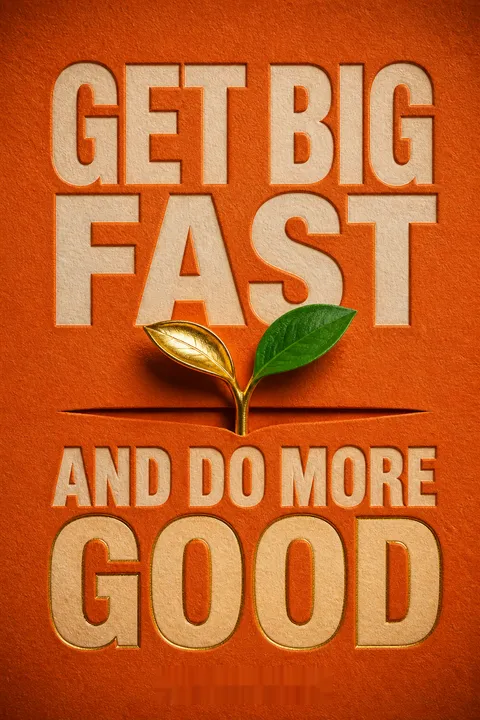
Build big, move fast, and make doing good part of the business model
A small brand, huge leap. Yes To began as a quirky Israeli beauty line sold in roughly ten stores. The founders helped turn it into a brand carried in about 25,000 stores across 25 countries, with nearly 80 products and a number two position in U.S. natural beauty. Their ambition was not growth for its own sake. They wanted products customers valued, a business that treated workers and partners ethically, and less harm to the environment.
Purpose belongs in operations. The founders argued that a company could grow quickly without treating responsibility as a charitable afterthought. They wanted the idea of doing good built into product choices, manufacturing standards, and community programs from the beginning. For them, scale mattered because a tiny brand could not shift a category, while speed mattered because opportunities do not wait.
The useful tension here is that scale is presented as a tool for impact, not proof of virtue. That distinction prevents purpose from becoming a flattering slogan: the actual test lies in how products are made, how people are treated, and whether the offering helps customers. This resembles stakeholder-based management, where business decisions account for groups beyond shareholders. Yet a stated mission can also obscure costs or tradeoffs if nobody measures outcomes. The founders' strongest implication is practical: values should constrain everyday choices, especially when those choices are expensive or inconvenient.
Find a neglected gap, then make the unfamiliar feel mainstream
A market hiding in plain sight. The founders saw that many natural beauty brands spoke mainly to consumers already committed to green living. They imagined a broader customer who wanted effective, affordable products without adopting a particular lifestyle or identity. At the time, natural beauty was growing about 8 percent annually, compared with 2 to 3 percent for conventional beauty, but remained small and expensive. Yes To's playful, accessible presentation aimed to make natural products feel ordinary rather than niche.
Test the whole experience. The founders' Four Love Points are four reasons a customer might embrace a product: how well it works, how it looks, what it costs, and whether the customer wants to recommend it. This checklist connected formulation and packaging to price and word of mouth. The founders also partnered with an existing Israeli brand instead of bearing the full cost and uncertainty of inventing one from scratch.
This is a sharp positioning insight: the opportunity was not simply to sell natural ingredients, but to remove the cultural and practical friction surrounding them. In innovation terms, the product had to fit the customer's existing routines while making a new choice feel appealing. The four-part checklist is useful because it resists the common founder bias toward features alone. Still, a fast-growing category is not automatically a durable market. Rising demand can attract imitators, and accessible pricing only works if production economics support it.
Earn the meeting by making buyers feel understood, not cornered
Open a door honestly. Before Trendtrade had a track record, Ido called Fudge, an established Australian hair-care company, and asked to meet its sales leader. He made the shortness of his visit clear, sounded prepared, and used a polite, confident manner to earn a chance. In the meeting, he offered to take on only a few brands, even though his client list was still small. Fudge gave him a trial territory, creating the first credible reference for future pitches.
Trust beats pressure. The founders treated a sales conversation as the start of a relationship. They tried to understand the other person's interests, tell a memorable account of what they were building, meet in person, and follow up with a clear next step. They also learned not to encourage retailers to order more than they could sell: one oversized order worth about $2 million led to costly returns.
The method works because it combines a clear ask with a reason to remember the person making it. In organizational life, trust lowers the perceived risk of working with an unknown supplier, while a good first interaction can create access to people and information that a formal pitch cannot. The important distinction is between confidence and manipulation. Urgency is persuasive only when it is truthful, and warmth is not a substitute for delivering what was promised. The oversized order story shows that protecting the buyer's interests can also protect the seller's long-term reputation.
Pair bold selling with disciplined numbers and let each partner challenge the other
Complementary strengths compound. Ido excelled at presenting products, reading people, and generating sales. Lance brought financial analysis, operational judgment, and a willingness to question optimistic assumptions. Their partnership began after a soccer mix-up, but it lasted because each could do work the other was less suited to do. They backed each other in public and handled disagreement privately, rather than letting a buyer watch them undermine one another.
Choose an ally, not just a friend. The founders advise selecting a partner who shares core values and earns trust, while bringing different abilities. Their early business also showed the cost of losing focus: they took on more than 70 brands and found themselves spreading effort across too many projects. A partner can help identify which opportunities deserve attention, but only if the pair can make decisions together and clearly define roles.
This partnership illustrates productive cognitive diversity: one person expands the set of possibilities, while another checks whether those possibilities can be financed and executed. Difference helps only when both partners can revise their views without treating disagreement as disloyalty. Their public unity and private debate are therefore more than etiquette; they create a stable interface for customers while preserving internal scrutiny. The caution is that chemistry can hide structural problems. Written agreements about ownership, authority, and exits remain important precisely because trust cannot predict every future conflict.
Stress-test forecasts for triple costs, triple delays, and lower sales
Plan for the ugly version. Lance's Kalish Rule of Three is a planning check for early ventures: costs may reach three times the estimate, launch may take three times as long, and revenue may reach only about two-thirds of the forecast. It is not a promise that every project will follow those ratios. It is a way to ask whether the business can survive if reality is substantially worse than the spreadsheet.
A unit can become a crisis. In Yes To's first Walgreens order, a misunderstanding turned a request for 800 units of each product into an order for 800 cases, or 9,600 units per product. The founders scrambled to find manufacturers and air freight, including chartering two aircraft for the shipment. Meeting the deadline preserved the account, but at a painful cost. The episode made cash flow and clear order definitions impossible to treat as minor details.
The rule is a compact antidote to the planning fallacy, the tendency to imagine that a project will proceed on schedule and at expected cost. Its value is not statistical precision but forcing a founder to confront downside scenarios before signing commitments. A stronger application would pair the rule with several cases: delayed payment, lower repeat purchases, and supplier failure can interact rather than occur separately. A pessimistic forecast cannot replace good contracts or cash reserves, but it can reveal whether a plan has any margin for error.
Test customer behavior before buying attention at national scale
Reach is not demand. Yes To spent $75,000 on a national magazine placement that generated little measurable sales. Its early print campaign also failed to solve a basic problem: customers did not always know where to find the product. By contrast, a college campaign built around sampling and a brand-face contest drew more than 130,000 voters. The founders learned that customers had to try the product, and retailers had to see shoppers respond.
Give people a reason to try. A Walgreens freebate, in which customers bought a product and later received a refund, sold 150,000 body butters in one month and more than $1 million in its first week. The founders estimated a cost of $13.50 per acquired customer. They also found that retailer circulars and in-store activity could lift weekly sales sharply, with some catalog placements increasing sales by 200 percent. The lesson was to favor observable behavior over impressive-looking exposure.
The contrast is between visibility and conversion. A campaign matters when it moves a customer toward trial, purchase, and ideally repeat use, not merely when it produces impressions. Sampling and refunds reduce the risk of trying an unfamiliar product, while retailer-specific promotions link attention to a place where the item can be bought. But a free offer can attract bargain hunters rather than durable customers. The relevant scorecard should include later purchasing, contribution margin, and the cost of fulfilling the promotion, not only the initial spike.
Disclose product risks early, even when the fix could cost millions
A possible defect became real. In 2009, a new manufacturer's preservative system failed a stringent challenge test on some Yes To stock intended for Sephora Europe. The test did not establish that customers had been harmed, but it showed that the product might not remain protected. The founders told Sephora, and Ido traveled to Paris to address the problem in person rather than keeping the news to a phone call.
Pay to protect trust. Yes To withdrew potentially affected products, destroyed about $2 million of inventory, and offered customers refunds. The testing found that 99.9 percent of the stock was fine, and the company received one complaint in Europe. The episode was financially damaging, but the founders maintained the retail relationship and used the event to strengthen quality procedures. Their reasoning was that uncertainty about safety should not be hidden for the sake of avoiding an immediate loss.
This is a case of trust being built through costly action. A retailer facing an uncertain product risk has to judge not only the defect but also whether the supplier will share information and cooperate under pressure. That makes transparency a form of operational reliability, not just a moral posture. There is a necessary nuance: disclosure should be supported by competent testing, clear communication, and appropriate product-safety procedures. Integrity does not mean improvising a recall alone. The founders' lasting gain came partly from converting a frightening incident into better controls.
Hire expertise before founder strengths turn into company bottlenecks
Growth changes the job. Ido enjoyed sales, marketing, and meeting customers, but as Yes To expanded he spent more time on administration, staffing issues, and routine approvals. A part-time employee's note pointed out that the energetic founder had become unhappy, and that the change was affecting the team. Ido recognized that being hands-on in every function was no longer helping the company.
Delegate the work, not the duty. The founders had already outsourced areas such as manufacturing and logistics when specialists could do them better. They eventually hired Joy Chen, who had spent 16 years at Clorox leading a multibillion-dollar division. Her experience added operational discipline, while the founders returned to representing and developing the brand. This is not an argument that founders should disappear. It is an argument to assign work according to competence as the organization becomes more complex.
The transition from founder to executive is a change in identity as much as a staffing decision. Early success often rewards direct intervention, but those same habits can make every choice wait for one person. Delegation creates capacity only when authority and accountability move with the work. The founders' example also warns against romanticizing a tiny team: a lean structure is useful until it prevents the business from meeting its obligations. Hiring senior expertise can be costly, but so can requiring founders to perform roles that drain them and slow the organization.
Focus charitable work on a measurable need linked to your brand
Good intentions need a target. Yes To began its Seed Fund with community gardens in mind, but the founders soon found themselves making small donations to many unrelated causes. They realized that scattered generosity was difficult to organize and unlikely to create a large effect. They asked their customer advocates, called Very Important Carrots, what kind of project mattered to them. Improving children's nutrition emerged as the leading suggestion.
Concentrate resources. Yes To partnered with the Environmental Media Association to build school gardens in Los Angeles, then worked with Mama Hope to support micro-farms in Africa. The book reports that the first African projects supplied food for about 10,000 children a day. The program connected the brand's natural-food identity with a concrete community need, while creating a way for employees, customers, and retail partners to participate.
The shift from scattered gifts to a defined program reflects a basic principle of collective action: coordination can make limited resources more useful. Customer input can also make a charitable effort more legitimate inside the business, rather than turning it into the founder's private cause. Linking a program to a brand can provide reach and participation, but it carries a risk of appearing self-congratulatory. Credibility depends on sustained work, transparent results, and a willingness to discuss what the program does not yet achieve.
Reassess success when your toddler starts dreading your suitcase
The business is not the whole life. After years of constant travel, Ido's young daughter began to cry when she saw him packing for another trip. The moment forced him to reconsider a career pattern he had once found exhilarating. He had helped build the company he wanted, yet the daily work had become less enjoyable and his family felt the cost of his absence.
Define enough for yourself. The founders argue that ambition should not decide personal priorities by default. They had periods when the company needed extraordinary effort, but they also recognized that an emergency phase cannot become a permanent way of living. Their standard of success changed as their families and responsibilities changed. Money, growth, and recognition mattered, but not enough to justify becoming a stranger at home or losing the life the business was meant to support.
This closing insight treats success as a moving target rather than a fixed financial milestone. Life-course changes alter the value of time: a schedule that feels acceptable before children may feel costly afterward. That does not make intense work inherently wrong, but it makes periodic reassessment essential. The founders' story is unusually vivid because the suitcase becomes a cue understood by a child, not a theory discussed by adults. Many entrepreneurs cannot simply hire a replacement, so the broader task is to make tradeoffs explicit instead of letting growth choose them silently.
Analysis
This book works best as a founder case study, not a universal recipe. Its strongest practical insight is the combination of commercial ambition with close attention to relationships: the founders seek retailers, suppliers, employees, and customers who can become invested in the brand, then try to honor that trust when it becomes expensive. The brand's growth came not from a single breakthrough but from an accumulating sequence of positioning choices, retail access, sampling, product adjustments, and operational recovery.
The narrative also exposes a contradiction at the heart of rapid growth. The founders' willingness to move before every system was ready helped them secure Walgreens, but created costly errors in order quantities, cash flow, pricing, and quality control. Their discipline did not precede boldness; it developed in response to the damage boldness could cause. The useful lesson is not to imitate their speed, but to distinguish reversible experiments from commitments whose failure can threaten customers, partners, or the firm's survival.
The book's evidence is vivid but necessarily selective. A successful company can narrate mistakes as lessons because it survived them. Other founders facing similar risks may not receive an investor, a retailer's patience, or a second chance after a product problem. The account therefore benefits from being read alongside its own cautions: stress-test cash needs, check contracts and intellectual property, verify product safety, and resist treating charisma as a substitute for evidence.
Its most durable contribution may be the portrayal of entrepreneurship as a team sport with limits. Complementary founders, supportive families, engaged employees, and trusted retail partners all supplied capacities the company could not buy quickly. Yet the authors also show that relationships require boundaries and that growth can distort the founders' lives. The title's promise is credible only when big, fast, and good remain jointly evaluated, rather than allowing the first two to crowd out the third.
Review Summary
Get Big Fast and Do More Good receives mixed reviews, with an average rating of 3.76 out of 5. Readers appreciate the entertaining storytelling, entrepreneurial insights, and the authors' focus on giving back. However, some find it lacks depth in business strategy and glosses over difficulties. The book is praised for its candid, humorous approach but criticized for being more biographical than instructional. Many readers find value in the lessons shared, even if the book doesn't meet everyone's expectations for a comprehensive business guide.
Glossary
The Kalish Rule of Three
A downside planning checkA forecasting heuristic for early ventures: costs may be three times the estimate, reaching the market may take three times as long, and revenue may be only about two-thirds of the projection. It is intended to test whether a business can endure adverse conditions, not to predict exact outcomes.
Four Love Points
Four tests of product appealA Yes To checklist for evaluating whether customers will feel positively about a product. It asks whether they will value how it works, how it looks, its price, and the prospect of telling friends about it. The framework connects product performance with appearance, affordability, and recommendation.
Freebate
A purchase refunded afterwardA promotion in which a customer buys a product, submits the required form or proof of purchase, and later receives a refund. Yes To used the offer to reduce the risk of trying an unfamiliar body butter. It generated substantial sales, but required the company to fund refunds and manage the delayed expense.
Very Important Carrots
Yes To customer advocatesThe founders' informal name for customers who loved Yes To products and actively advocated for the brand. Many first contacted the company through Facebook. The group provided a direct channel for customer conversation, and its members were asked for ideas about the company's community-giving work.
Yes To Seed Fund
The company's community programYes To's giving program, initially imagined as support for community gardens. After early donations became too diffuse, the company focused its resources on children's nutrition through school gardens and micro-farms. The program involved nonprofit partners, retailers, customers, and employees.
one-day window
An urgency-based meeting requestIdo's cold-calling approach emphasized that he was in town briefly and requested a meeting before leaving. The short deadline was meant to make the opportunity concrete while his polite, confident manner reduced pressure on the gatekeeper. The method depends on the time constraint being truthful rather than invented.
Download PDF
Download EPUB
.epub digital book format is ideal for reading ebooks on phones, tablets, and e-readers.








