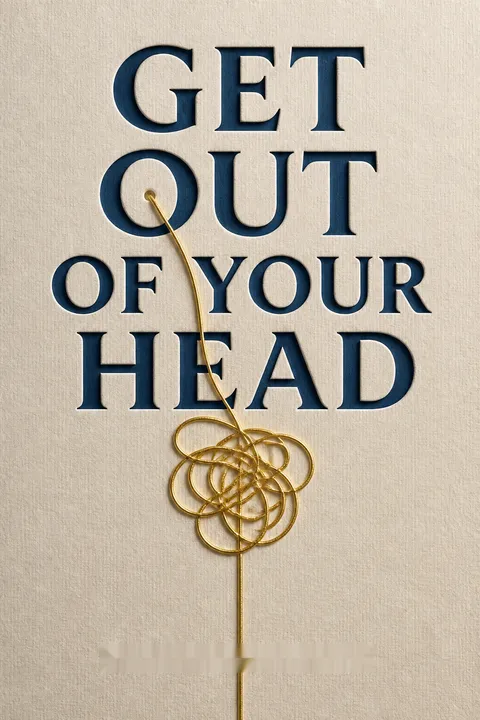


Key Takeaways
Catch the thought before it becomes your whole story
Small thoughts gather force. Jennie Allen opens with an ordinary morning: a critical email and social media comparisons lead her to decide she is inadequate, question her work, and snap at her husband. One thought becomes a story about her worth, then begins shaping her actions and relationships. The book’s central warning is that mental spirals can feel like facts while quietly narrowing a person’s sense of what is possible.
A long spiral breaks. After an unsettling encounter at a church event, Allen spends eighteen months waking in fear and doubting God. In Uganda, friends recognize her distress and a Bible reading echoes the passage she had been repeating in the dark. Their presence helps her see that the despairing thoughts are not the whole truth about her or her faith.
The opening works because it makes a spiral observable rather than mysterious: a cue, an interpretation, an emotional reaction, and a relational consequence unfold in minutes. That sequence resembles cognitive models in which interpretations mediate between events and responses. Naming the steps can create room for reflection without pretending that every painful thought is chosen. The Uganda episode also shows how another person can lend perspective when private reasoning has become circular. Its spiritual interpretation is specific to Allen’s Christian worldview; readers need not share that theology to recognize the practical value of interrupting isolation and testing a compelling inner story.
Interrupt the spiral by choosing what deserves your attention
Notice, then redirect. Allen’s practical starting point is the recognition that a thought can be challenged rather than automatically obeyed. She calls this redirection “the shift”: moving attention from a destructive interpretation toward a truth grounded in faith. Her “mental story map” asks a person to name a current emotion, list what is feeding it, and look for the assumptions beneath those thoughts. For example, work stress may conceal the belief that one missed opportunity proves a person is forgotten or worthless.
Choice is not magic. The book connects thoughts, emotions, decisions, habits, and relationships, arguing that repeated attention can reinforce mental patterns. It also states that this is not a substitute for treatment: depression, anxiety disorders, and other mental illnesses may require counseling or medication. The aim is to practice agency within one’s real limits, not blame oneself for symptoms.
This is the book’s most useful bridge between spiritual language and a practical skill. Cognitive reappraisal, the process of reconsidering what an event means, can change emotional intensity and behavior without changing the event itself. Mapping the chain makes that skill concrete. But “I have a choice” should mean some influence over attention and response, not total control over thoughts, circumstances, or biology. That distinction matters because people with intrusive thoughts may not be able to stop them on command. The book’s acknowledgment of clinical care helps protect its message from becoming a simplistic demand to think positively.
Trade distraction for quiet before trying to solve everything
Stillness restores perspective. Allen describes a friend overwhelmed by problems in her marriage, family, and friendships. Rather than immediately troubleshooting each issue, Allen urges her to spend time alone with God. The friend later admits she avoided that quiet. Allen recognizes the same escape in herself: during her season of doubt, she filled days with work and noise rather than risk facing what she felt.
Attention has a direction. Prayer, Scripture, and silence are presented as ways to notice what is happening inside and remember God’s presence. The practice is not simply sitting still for its own sake. It is deliberately turning from endless checking, scrolling, and imagined scenarios toward a relationship that can reshape perspective. Allen also draws on research suggesting meditation affects attention and stress, though the book’s theological purpose is central.
The chapter’s strongest insight is that distraction can postpone emotional contact while making problems harder to interpret. Quiet creates conditions for noticing, much as reflective practices in contemplative traditions and attention training do. Yet stillness is not equally accessible to everyone: trauma, caregiving demands, disability, or acute distress can make silence feel unsafe or impractical. A brief prayer, a walk without a phone, or guided support may serve the same purpose. The point is not to romanticize solitude, but to protect some space in which attention is chosen rather than continually captured.
Let trusted people know the part shame tells you to hide
Isolation feeds shame. Allen describes shame as the fear that being fully known will lead others to leave. That fear encourages secrecy, which then seems to confirm the belief that no one understands. The antidote is not indiscriminate disclosure, but trustworthy relationships where a person can be seen without being reduced to a mistake.
Speak the hidden part. Allen’s friend Jennifer admits she has become attracted to a coworker and begun texting him. She had not shared this with others; when she finally says the last, most concealed part aloud, the secrecy loses some of its grip. The chapter also recommends practical steps: seek emotionally healthy people, ask directly for help, accept invitations, and be willing to show up imperfectly. Counseling can help when patterns are difficult to see alone.
The argument links connection with both emotional regulation and accountability. Social support can make distress more bearable, while disclosure allows another person to challenge distorted conclusions that feel airtight in private. The example is memorable because honesty interrupts concealment before it becomes a larger pattern. Still, disclosure is not automatically safe, and the book acknowledges that people may respond poorly. Trust should be calibrated to the person and situation. In cases involving abuse, coercion, or serious risk, professional or specialized support may be more appropriate than confiding in an unprepared friend.
Answer imagined futures with what is true today
Anxiety writes forecasts. Allen describes a physical episode of tightness and panic that leads her to identify an underlying fear: what if she fails and proves she is inadequate? She argues that repeated “what if” questions can turn possibilities into vivid predictions, even when no immediate danger is present. Her Christian response is to pair the fear with what she believes about God’s care and presence.
Test the thought. The practice is to write down the anxious claim, ask whether it is actually true, and compare it with Scripture and the perspective of trusted people. Allen is careful to say that faith does not guarantee that feared events will never happen. Her example of a friend facing infertility shows a community offering hope not by promising a particular outcome, but by supporting her regardless of what comes.
The distinction between possibility and probability is central to managing worry. A feared event can be imaginable without being imminent, and writing it down can expose the mind’s leap from uncertainty to certainty. The book’s method also adds a source of meaning through faith, which can steady people when outcomes remain beyond control. Its limit is that reassurance alone may not help chronic or clinically significant anxiety, and some worries point to problems requiring concrete action. A useful application is to ask both, “What do I know now?” and, “Is there one practical step to take?”
Use beauty and worship to loosen cynicism’s grip
Guardedness can hide hurt. Allen describes cynicism as distrust that grows from fear of future disappointment or anger about past pain. During her own spiritual doubt, she becomes critical and distant, mistaking emotional self-protection for strength. A colleague’s questions and a moving essay about unexpected life changes help her name the hurt she had not admitted.
Attend to what is good. The book encourages noticing beauty, gratitude, and signs of goodness rather than scanning only for failure. Allen recalls being overwhelmed by a live musical and leading a Bible study to examine a leaf closely, using its detail to prompt wonder. She also cites research connecting awe with less self-focus and greater prosocial behavior. Delight is not a claim that the world is harmless; it is a way to remain open to what is still beautiful within it.
Awe can widen attention beyond the self, a promising counterweight to rumination and habitual suspicion. The examples make this practice accessible: beauty need not be grand to interrupt the assumption that nothing good is happening. Cynicism, however, sometimes reflects accurate perception of betrayal or unjust conditions, not merely a bad habit. The goal should not be to silence justified skepticism or lower one’s guard around unsafe people. Rather, wonder can coexist with discernment. The question is whether protection has become so total that it blocks joy, connection, and the ability to notice evidence that contradicts despair.
Choose humility before self-importance turns conflict into a courtroom
Defensiveness narrows the view. After snapping at a new colleague, Allen spends a day justifying herself: she was tired, the other person was wrong, and an apology might make things worse. She eventually recognizes that self-protection is keeping her from seeing the harm she caused. Her Christian model is Jesus, who responds to mistreatment without retaliation and entrusts judgment to God.
Repair starts with ownership. Allen apologizes, and her colleague explains that the exchange hurt. Humility, in this account, means loosening the need to be impressive or vindicated so another person’s experience can matter. It enables apology, empathy, and service. The point is not to call oneself worthless or accept every accusation. It is to stop treating one’s own pride as the only credible witness in a disagreement.
Humility here is best understood as a relational skill: the capacity to revise one’s self-protective account when another person has been harmed. That fits conflict research emphasizing perspective-taking and repair over winning. It also avoids the mistake of equating confidence with arrogance. A person can have boundaries, recognize unfair treatment, and still apologize for a harmful response. The chapter’s religious framing makes humility a response to dependence on God rather than a technique for earning approval. That distinction can prevent humility from becoming another performance of moral superiority.
Practice gratitude without pretending suffering or injustice is acceptable
Gratitude changes the lens. Allen tells the story of Brooke, who resents her retail job until listening to Paul’s letter to the Philippians, written during imprisonment. Brooke begins to see coworkers and customers as people she can care for, uses her commute to pray, and finds new purpose in the same job. Allen presents gratitude as a chosen response to circumstances, not proof that circumstances are easy.
Pain still deserves a response. Paul’s example is not used to deny suffering: the book recounts his imprisonment and other hardships, and it supports action against injustice. Allen argues that a person can seek change without letting pain define the whole self. Gratitude means looking for what remains good or meaningful, while trusting God through unresolved loss. It does not require calling harm acceptable or abandoning efforts to make things right.
Gratitude can broaden attention and interrupt the tendency to notice only what is missing. Brooke’s change also shows how a person can find agency in a job that has not changed, by investing in relationships and purpose. The crucial safeguard is the book’s distinction between gratitude and passivity. Without it, gratitude language can pressure people to minimize exploitation, grief, or injustice. A sound practice names the loss plainly, pursues needed change, and also notices sources of support or meaning. Those acts are compatible, not competing.
Move toward a useful act when comfort makes life smaller
Comfort can become a trap. Allen calls complacency the habit of accepting the status quo and numbing discomfort with familiar pleasures. During her months of doubt, she notices herself retreating into more streaming, social media, and sugar while losing desire to serve. Her proposed counter-move is to ask how she can serve God and others, rather than organizing each day around what will make her most comfortable.
Purpose can be ordinary. Service need not be dramatic or public. Allen names everyday acts such as apologizing, helping a child, doing work carefully, or showing kindness. Her theological claim is that freedom is not permission to indulge every impulse, but capacity to give oneself in love. She also connects purposeful activity with wellbeing, while treating obedience and dependence on God as more than self-improvement.
This is a behavioral insight as well as a spiritual one: action can shift mood and attention, especially when it expresses a valued purpose. Small acts are more sustainable than waiting for motivation or a grand calling. Yet service can become another route to exhaustion if it is confused with limitless availability or used to avoid one’s own needs. The strongest version of the chapter’s claim is not “ignore yourself,” but “do not let self-absorption set the entire agenda.” Rest, boundaries, and care can support service rather than oppose it.
Build a mind anchored in belonging, then live from it
Identity gives practice a home. Allen describes Christian identity as belonging to God, not as a verdict earned by success or destroyed by a bad day. She calls the Jesus-shaped way of seeing and responding the “mind of Christ”: a life marked by trust in God, humility, love, and service. This is not merely replacing a negative slogan with a positive one; it is a religious account of becoming a new person through the Spirit.
Training makes a response easier. Allen tells of astronaut Shane Kimbrough, whose delayed return from space tested his composure. He says he relied on years of preparation, then stayed in contact with his wife and continued his task. Allen uses the story to argue that repeated practices build more dependable responses under pressure. Her closing hope is that changed thinking spreads through relationships and helps others find freedom too.
The book’s final movement joins identity, habit, and purpose: a person practices responses that fit a deeper account of who they are. This resembles the way repeated behavior can become more available under stress, though the neural explanations in the book sometimes sound more certain than the evidence warrants. Its strongest claim is practical rather than neurological: preparation matters, and trusted beliefs can guide action when emotions surge. The Christian identity at its center is not interchangeable with generic self-esteem. Readers can assess the practices on their merits while recognizing that their ultimate source of hope is explicitly theological.
Analysis
Get Out of Your Head combines memoir, biblical interpretation, and practical self-guidance. Its organizing image is a spiral: thoughts shape feelings and decisions, which influence behavior and relationships, feeding the next round of thought. Allen’s personal account gives that model emotional stakes. Her eighteen-month period of nighttime doubt makes the book more than a list of techniques, while the Uganda encounter shows how scripture and trusted friends can interrupt a private narrative that has begun to feel unquestionable.
The book’s most transferable contribution is its insistence on noticing before reacting. Its seven responses target recognizable patterns: distraction, shame, anxiety, cynicism, self-importance, victimhood, and complacency. The practices are concrete enough to try: sit quietly, disclose a hidden struggle, test a fear, notice beauty, apologize, give thanks, or take a useful action. These are not presented as detached productivity tricks. Each is anchored in Allen’s Christian claim that the self is held by God and freed for love of others.
That theological center is also a boundary on the book’s audience. Its account of spiritual warfare and its confidence in biblical truth will resonate most with Christian readers. The author does make an important distinction between changeable thought patterns and mental illness, explicitly affirming counseling and medication. That caveat matters because “choose a different thought” can otherwise sound like a cure or an accusation. Agency is real, but it is not unlimited.
The neuroscience should be read more cautiously than the spiritual and practical argument. The text sometimes treats complex links between thought, brain change, health, and behavior as more settled or direct than they are. Its useful core does not depend on every biological claim: attention is trainable, relationships can offer perspective, and purposeful action can change how a person inhabits a difficult day. Overall, the book is strongest when it pairs reflection with community and action, and weakest when choice risks sounding like control over suffering. Its humane qualification is that freedom includes receiving help, not merely trying harder alone.
Review Summary
Get Out of Your Head received mixed reviews. Many readers found it encouraging and life-changing, praising Allen's vulnerability and practical advice for combating negative thoughts through scripture and neuroscience. However, some critics felt it was repetitive, overly simplistic, and too focused on the author's personal experiences. The book's informal tone and Christian perspective resonated with some readers but alienated others. While some appreciated its message of empowerment through faith, others found it lacking in depth and substance for addressing serious mental health issues.
People Also Read









Glossary
the shift
Redirecting a thought patternAllen’s name for deliberately moving attention from a destructive thought pattern toward a faith-grounded truth and response. The practice begins by noticing what is being thought and felt, then choosing a different focus, such as prayer, connection, gratitude, or service. It is intended to interrupt a spiral, not guarantee control over circumstances or replace mental health care.
mental story map
Tracing feelings to their causesA reflective exercise that starts with a current emotion, then lists the circumstances and thoughts contributing to it. The person looks for recurring assumptions or beliefs beneath the emotion and brings them into prayer, scripture, or conversation with trusted people. The map is meant to make an otherwise vague spiral visible enough to examine and redirect.
mind of Christ
A Jesus-shaped way of thinkingA Christian theological idea drawn from the New Testament and used by Allen to describe thinking shaped by Jesus and the Holy Spirit. It involves more than optimism: trust in God, humility, love, and attention to others. Allen presents it as a way of life believers can practice, not simply a set of reassuring thoughts.
last 2 percent
The most guarded disclosureAllen’s phrase for the final, most concealed part of a struggle that someone withholds even while appearing open. Naming it to a trusted person can reduce secrecy and invite support or accountability. The phrase does not mean every private detail should be disclosed to everyone; the safety and trustworthiness of the listener matter.
FAQ
What's "Get Out of Your Head" about?
- Focus on toxic thoughts: "Get Out of Your Head" by Jennie Allen addresses the issue of toxic thoughts and how they can spiral out of control, affecting our emotions and actions.
- Biblical perspective: The book offers a Christian perspective on overcoming negative thinking by aligning thoughts with biblical truths.
- Practical strategies: It provides practical strategies to capture and redirect thoughts, emphasizing the power of choice in shaping our mental and emotional well-being.
- Personal journey: Jennie Allen shares her personal experiences and struggles with toxic thoughts, making the book relatable and encouraging for readers facing similar challenges.
Why should I read "Get Out of Your Head"?
- Empowerment through choice: The book empowers readers by highlighting that they have a choice in how they think and respond to life's challenges.
- Faith-based approach: It offers a faith-based approach to mental health, integrating biblical teachings with modern neuroscience.
- Practical tools: Readers gain practical tools and exercises to help them take control of their thoughts and improve their mental health.
- Personal stories: Jennie Allen's personal stories and vulnerability make the book relatable and inspiring for those seeking change.
What are the key takeaways of "Get Out of Your Head"?
- Choice in thinking: You have the power to choose your thoughts and redirect them towards positivity and truth.
- Spiritual warfare: The battle for your mind is a spiritual one, and aligning your thoughts with God's truth is crucial.
- Community importance: Being known and loved in a community is essential for mental and spiritual health.
- Gratitude and service: Practicing gratitude and serving others can shift your focus from self-centeredness to a more fulfilling life.
How does Jennie Allen suggest we stop the spiral of toxic thoughts?
- Identify and capture thoughts: Recognize when you're spiraling and consciously capture those thoughts.
- Replace with truth: Replace negative thoughts with biblical truths and positive affirmations.
- Choose gratitude: Focus on gratitude to shift your mindset from negativity to positivity.
- Engage in community: Share your struggles with trusted friends or community members to gain support and perspective.
What is the "I have a choice" concept in "Get Out of Your Head"?
- Empowerment through choice: The concept emphasizes that you have the power to choose your thoughts and responses.
- Interrupt negative spirals: By acknowledging your choice, you can interrupt negative thought spirals and redirect them.
- Focus on truth: Choosing to focus on biblical truths and positive thoughts can transform your mindset.
- Daily practice: It's a daily practice of consciously choosing thoughts that align with God's truth and your values.
How does "Get Out of Your Head" integrate faith and mental health?
- Biblical foundation: The book uses biblical teachings as a foundation for addressing mental health issues.
- Spiritual warfare: It frames the battle for the mind as a spiritual warfare, emphasizing the need for spiritual tools.
- Prayer and meditation: Encourages practices like prayer and meditation on scripture to renew the mind.
- Community support: Highlights the importance of community and fellowship in maintaining mental and spiritual health.
What role does community play in "Get Out of Your Head"?
- Support system: Community provides a support system where individuals can share their struggles and receive encouragement.
- Accountability: Being part of a community offers accountability, helping individuals stay on track with their mental health goals.
- Shared experiences: Sharing experiences with others can provide new perspectives and insights into personal struggles.
- Biblical model: The book emphasizes that community is a biblical model for living a healthy and fulfilling life.
What are some practical exercises from "Get Out of Your Head"?
- Mind mapping: Create a mind map to identify and understand your current thoughts and emotions.
- Thought replacement: Practice replacing negative thoughts with positive affirmations or scripture.
- Gratitude journaling: Keep a gratitude journal to focus on positive aspects of your life and shift your mindset.
- Community engagement: Actively engage with a community or support group to share experiences and gain support.
What are the best quotes from "Get Out of Your Head" and what do they mean?
- "I have a choice." This quote emphasizes the power of choice in controlling your thoughts and breaking free from negativity.
- "The greatest spiritual battle of our generation is being fought between our ears." It highlights the importance of mental health and the spiritual nature of the battle for our minds.
- "We are not victims of our thoughts." This quote encourages readers to take control of their thoughts rather than being controlled by them.
- "God is at work in all the messiness of our minds." It reassures readers that God is present and active in their mental struggles, offering hope and healing.
How does Jennie Allen address fear and anxiety in "Get Out of Your Head"?
- Surrender to God: Encourages surrendering fears and anxieties to God, trusting in His control and care.
- Focus on truth: Replace fear-driven thoughts with truths about God's love and provision.
- Community support: Share fears with a supportive community to gain perspective and encouragement.
- Prayer and meditation: Use prayer and meditation to calm the mind and focus on God's promises.
What is the significance of gratitude in "Get Out of Your Head"?
- Shift in focus: Gratitude shifts focus from negative circumstances to positive aspects of life.
- Mental health benefits: Practicing gratitude can improve mental health by reducing stress and increasing happiness.
- Spiritual practice: Gratitude is a spiritual practice that aligns with biblical teachings and fosters a closer relationship with God.
- Daily habit: Encourages making gratitude a daily habit to transform your mindset and overall well-being.
How does "Get Out of Your Head" suggest we handle cynicism?
- Recognize cynicism: Identify when cynicism is affecting your thoughts and attitudes.
- Choose delight: Choose to delight in God and His creation, focusing on beauty and goodness.
- Practice optimism: Cultivate an optimistic outlook by focusing on positive aspects of life and trusting in God's plan.
- Engage in worship: Use worship as a tool to combat cynicism and refocus on God's greatness and love.
About the Author


Download PDF
Download EPUB
.epub digital book format is ideal for reading ebooks on phones, tablets, and e-readers.








