

Key Takeaways
Read ghost reports as human experiences, not automatic proof of an afterlife.
Experience is the subject. Roger Clarke begins with childhood fear in two supposedly haunted homes. In one, his mother and a visitor said they had seen a woman in a passage he dreaded. Later, at a ghost hunt in Sawston Hall, he heard knocks and recorded strange sounds, but the tape was lost. Such stories matter even when their cause cannot be established: people report apparitions, and those reports shape their lives.
The question changes. Clarke does not set out to settle whether the dead return. He asks what people perceive when they say they have seen a ghost, and how stories about those encounters are made, preserved, and revised. Ghosts, in this account, are both reported experiences and cultural histories.
The distinction between an experience and its explanation is a useful discipline well beyond paranormal claims. A witness may be entirely sincere and still be mistaken about the cause, just as a frightening dream is real as an experience without being an event in the room. This stance avoids the lazy choice between ridicule and credulity. Its limit is equally important: accumulating reports proves that ghost experiences are common, not that the dead survive. Clarke's framing makes that gap visible rather than pretending it can be closed by storytelling.
Map a ghost story's history before accepting its most dramatic version.
Legends acquire layers. Knighton Gorges, on the Isle of Wight, was said to reappear each New Year's Eve as a ghostly country house. Its popular story blamed owner George Bisset for demolishing it in revenge against his daughter. Clarke finds a less romantic record: the house burned down in 1815 or 1816, and the daughter's supposed disinheritance was not true.
The haunting came later. Writers and local storytellers added details across generations. An 1892 historical romance, later guidebooks, and accounts of phantom music helped shape the legend. One early twentieth-century witness described a house that did not match the actual building. The annual vigil survives, despite no record that the house was considered haunted while it still stood.
A legend can be historically false in its details and still reveal what a community wants from the past: a vanished house, a disobedient daughter, a dramatic villain, and a yearly ritual. This is close to the way collective memory works in many settings, where repetition lends authority to a version that began as embellishment. The useful test is not simply whether a tale is true or false, but when each detail first appears and who repeats it. That method does not explain every reported sound or sight, but it can expose how a haunting takes narrative form.
Judge hauntings by the evidence trail, not by atmosphere alone.
Hinton resisted easy answers. Mary Ricketts and her household reported years of slamming doors, footsteps, groans, and figures in the eighteenth-century manor. In 1771, her brother John Jervis and Captain Luttrell searched and secured the house, then heard unexplained sounds themselves. Yet not everyone present heard each sound, and Ricketts's children were reportedly spared the disturbance. The family eventually left, and the old house was demolished in 1793.
The record stays unsettled. No culprit was identified, and the story circulated privately before appearing in print a century later. Clarke considers whether the haunting may have helped inspire Henry James's The Turn of the Screw, but presents that link as a plausible route of transmission, not a proven source. A detailed archive can clarify who reported what without resolving what caused it.
This case illustrates why witness count alone is a poor shortcut to certainty. Multiple people can independently report a sound, while differences in what each person hears remain central evidence rather than an inconvenience to smooth over. The same principle guides careful investigation of accidents and disputed memories: preserve the disagreement, the setting, and the sequence. Historical distance adds another complication, since later retellings can sharpen or alter the original account. An unresolved case is not a failed history. It is a result with boundaries.
Notice how each era invents the kind of ghost it expects.
Ghosts have categories. Clarke draws on investigator Peter Underwood's eight types: elementals, poltergeists, historical ghosts, mental imprints, crisis apparitions, time slips, ghosts of living people, and haunted objects. Clarke adds animal ghosts. These labels organize reports, not confirmed species. A mental imprint, sometimes linked to the stone tape idea, repeats an event without awareness; a crisis apparition is reported around a loved one's death or danger; a time slip feels like entering another period.
Beliefs reshape appearances. Ancient ghosts, medieval revenants, Jacobean demons, and Victorian séance spirits do not behave alike. In Clarke's account, ghosts once corrected wrongs or supplied information, later became objects of scientific inquiry, and today are often described as moods, presences, or emotional fields. The categories help show that ghost stories change with religion, literature, and popular expectations.
Classification is valuable here because it prevents unlike reports from being lumped together. A repeated figure in a hallway, a vivid encounter near a relative's death, and a violent disturbance centered on a teenager invite different questions. The categories also expose a historical feedback loop: people interpret ambiguous events through available stories, and those stories shape what later witnesses notice. The caution is that tidy labels can create an illusion of natural divisions. They are best treated as maps of reported experience, not as proof that ghosts fall into stable biological types.
Ask who benefits when a private haunting becomes public spectacle.
Cock Lane became a media event. In 1762, London crowds flocked to hear knocks attributed to Fanny Lynes, a dead woman supposedly accusing her husband of murder. The noises came from the bed where twelve-year-old Betty Parsons lay. An investigation found her making them with her hands and a piece of wood. The parish clerk, Richard Parsons, had encouraged the story, while the clergyman John Moore helped make it famous by publicizing the accusation. The resulting libel case sent several people to prison.
Borley mixed publicity with investigation. Harry Price promoted the Essex rectory as England's most haunted house, attracting attention and visitors. Later scrutiny found serious problems, including an uncropped photograph showing a workman behind the celebrated flying brick. Commercial motives do not prove every report false, but they make incentives part of the evidence.
Publicity does not merely distribute a haunting; it can change the haunting itself. Audiences provide money, attention, social standing, and pressure to produce another event. Cock Lane shows how a local prank could become a national accusation once a respected intermediary and competitive newspapers entered the story. Borley adds the investigator's reputation to the mix. This is a familiar media dynamic: claims become more dramatic as they become more valuable. Still, identifying an incentive is not a substitute for testing each claim. It tells investigators where scrutiny should begin.
Check whose testimony gets believed, and whose gets dismissed.
Credibility followed social rank. For centuries, English ghost belief was tangled with religion. Catholic teaching allowed souls to return from Purgatory; Protestant rejection of Purgatory recast apparitions as demons, deception, or superstition. Later, Methodists such as John Wesley treated reports of spirits as possible evidence of a spiritual world. A ghost could signal religious identity as much as an account of the unexplained.
Class shaped the witness list. Victorian investigators often preferred educated witnesses and distrusted servants, even though servants frequently lived closest to the supposed activity. Working-class ghost crowds were described as disorderly, while aristocratic hauntings could be treated as family heritage. The Society for Psychical Research reflected this bias when it hesitated to accept servants' accounts. Who gets heard, then, is part of the history of what counts as evidence.
A witness's social position can affect both how a report is received and what details make it into the record. This resembles a broader problem in institutional knowledge: expertise is often confused with status, while people with less power are treated as unreliable before their evidence is examined. Clarke's history makes that hierarchy visible without implying that marginalized witnesses are automatically correct. A fair method asks consistent questions of everyone, records conflicts of interest, and distinguishes a person's credibility from the truth of a particular claim.
Read séances as negotiations over gender, intimacy, and authority.
Knocks changed the relationship. The Fox sisters' séances made the dead seem available for conversation: sitters asked questions and interpreted raps as answers. The practice moved from simple demonstrations into elaborate Victorian performances. Mediums such as Daniel Dunglas Home became celebrities, while wealthy sitters and investigators tested, supported, or accused them.
The séance was also a social space. Female mediums could speak publicly and earn money at a time when women's public roles were restricted. Yet their bodies were scrutinized, restrained, and searched by male investigators. Florence Cook's materialized spirit, Katie King, was studied by scientist William Crookes, whose relationship with the young medium was intimate and controversial. These cases mix possible performance, fraud, belief, and unequal power. The séance was not only an attempt to contact the dead; it was a scene where living people negotiated trust and control.
The séance's intimacy helps explain its social force. In a dark room, the usual rules of public conduct loosened, while the medium's body became both the source of authority and the target of surveillance. The setting could offer women a platform, but that opportunity came with economic dependence and invasive scrutiny. Similar tensions appear whenever a marginalized person gains authority through a role that more powerful people can police. Recognizing those dynamics does not settle whether a manifestation was genuine. It helps explain why the event mattered even when the evidence failed.
Technology records an era's imagination as much as the supernatural.
Every device promises access. Magic lanterns projected spectres; the nineteenth-century stage illusion Pepper's Ghost made a transparent figure appear in a room. Photography then seemed to capture apparitions, though long exposures, double exposures, and manipulation offered ordinary explanations for many spirit images. Radio and tape recording made disembodied voices seem newly plausible, and enthusiasts later listened for Electronic Voice Phenomena, or EVP, on unattended recordings.
Modern equipment changes the hunt. Ghost hunters now use electromagnetic meters, cameras, and audio recorders. Clarke's history shows that such tools can document conditions, but the device does not interpret itself. A blurred image, an anomalous reading, or a voice-like sound still needs careful controls and independent checking. Technology often gives old fears a new vocabulary, and the feeling of measurement can be mistaken for proof.
Instruments are persuasive partly because they appear detached from human expectation. Yet every measurement depends on choices about placement, calibration, noise, and interpretation. A camera can preserve an image, but not certify what produced it; a meter can register a field, but not identify a ghost. The history of spirit photography and EVP is a reminder that new media can intensify both discovery and misreading. Properly used, technology narrows possibilities. Used as a prop, it mainly lends an aura of precision to a story already believed.
Use brain science to explain apparitions without ridiculing witnesses.
Perception can produce vivid presences. In 1791, bookseller Friedrich Nicolai reported seeing figures during a period of stress and depression. He observed the visions and later connected their disappearance to bloodletting, a treatment Clarke notes had no scientific basis. Doctors John Ferriar and Samuel Hibbert proposed that memory and waking-dream states could create apparitions without treating every witness as dishonest.
The brain remains relevant. Clarke discusses sleep transitions, temporal-lobe activity, and infrasound as possible contributors to sensed presences and visual distortions. Researcher Michael Persinger's magnetic helmet reportedly induced uncanny experiences in some participants, but the results were not consistently replicated. Such mechanisms can make an apparition understandable without making it imaginary in the dismissive sense. They also cannot account for every historical report, especially when the environmental or medical evidence is missing.
A neurological explanation can preserve respect for the witness while challenging the witness's interpretation. That distinction matters because perception is an active process, sensitive to fatigue, expectation, emotion, and surroundings. The same account can therefore be psychologically real and externally mistaken. Clarke is strongest when he presents mechanisms as possibilities rather than universal answers. Correlation between a brain state and an unusual experience does not establish a single cause, and laboratory effects do not automatically explain an event reported in a centuries-old house.
In wartime, ghost stories can turn grief into national reassurance.
The Angels of Mons grew from fiction. In 1914, writer Arthur Machen published a story in which spectral archers aided British troops. Although he said it was invented, retellings transformed it into a claim that soldiers had seen angels or heavenly protectors. The story answered a need for comfort and confidence after an alarming military retreat, and its details changed as newspapers, clergy, and spiritualists repeated it.
War also modernized the haunting. The German submarine U65 acquired a ghost story built from reported deaths, accidents, and sightings aboard the vessel. Clarke traces its familiar account to later writing, rather than a secure body of wartime testimony. One tale offered supernatural rescue; the other imagined technology itself as cursed. Together they show how wartime fear can make ghosts serve national hope, private grief, or dread of machines.
Wartime ghost stories operate as emotional infrastructure. They give grief a messenger, turn survival into a sign, and make catastrophe feel less arbitrary. The Angels of Mons is especially instructive because a known work of fiction could become collective testimony through repetition, without requiring a single decisive act of deception. That process is not unique to war, but war accelerates it. The caveat is that explaining a story's social purpose does not prove that every witness invented an experience. It explains why a particular interpretation found such fertile ground.
Analysis
Clarke's central achievement is to shift ghost history away from a courtroom-style verdict on the afterlife. The book asks what people have perceived, how they have explained it, and how those explanations have changed as religion, class, media, and science changed around them. That move makes the subject more rigorous, not less. It allows a reader to take testimony seriously while withholding judgment about its cause.
The book's method is deliberately layered. A haunting is approached through testimony, family correspondence, newspaper coverage, folklore, and the later investigators who shaped its public identity. Knighton Gorges demonstrates how a local legend can acquire a past that never happened. Hinton Ampner demonstrates the opposite difficulty: a dense record can establish that people reported events, yet leave the events unexplained. Cock Lane and Borley show how publicity and personal interest can enter the evidence itself. These cases together make uncertainty a historical finding rather than an embarrassment.
The book is also strongest when it treats ghost stories as social acts. The apparition may be imagined as a dead person, a demon, an electrical residue, or a brain-generated presence, but the interpretation reveals what a community fears and values. A working-class poltergeist, a noble family's ancestral ghost, and a Victorian medium's materialized spirit inhabit different social worlds. Clarke connects those worlds without pretending that every change in belief can be reduced to class or propaganda.
There is a productive tension in the book's own storytelling. Clarke writes with the suspense and atmosphere of a ghost writer, while repeatedly warning that atmosphere can mislead. That tension is not a flaw so much as a demonstration of the subject: narrative is one of the forces that makes an encounter memorable and transmissible. The reader must therefore separate a report's emotional power from its evidentiary strength. The lasting insight is not that ghosts are real or unreal, but that ghost belief is a revealing record of how humans perceive, remember, and explain the unknown.
Review Summary
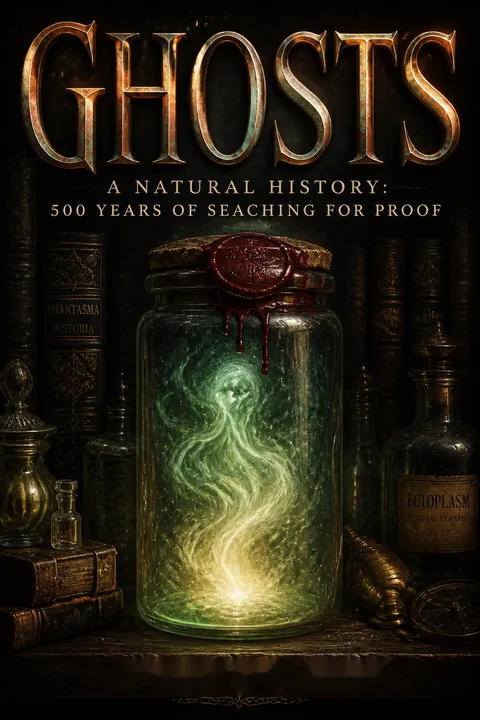
Ghosts: A Natural History by Roger Clarke explores 500 years of ghost hunting in Britain. Readers found it an informative and well-researched account of famous hauntings, though some felt it lacked cohesion. Clarke's approach is skeptical yet open-minded, examining ghost stories in their historical and social contexts. The book covers various types of ghostly phenomena, from poltergeists to séances. While some readers appreciated Clarke's scholarly tone, others found it dry at times. Overall, it offers an intriguing look at the cultural significance of ghost beliefs in Britain.
Glossary
Poltergeist
Disruptive haunting reportsA type of haunting associated with disturbances such as knocking, thrown objects, moving furniture, or unexplained voices. In accounts discussed by Clarke, the activity is often linked to a focus person, frequently an adolescent. Explanations range from spirits or demons to emotional or psychological processes. Catherine Crowe helped introduce the term into English usage.
Mental Imprint Manifestations
Repeating, non-conscious apparitionsA category of apparition in which an intense event is thought to leave a kind of imprint on a place. The figure repeats an action, often on a fixed schedule, without seeming aware of witnesses. The account is related to the later popular stone tape idea, but describes a reported type of haunting rather than an established physical process.
Crisis or Death-survival Apparitions
Apparitions near crisis or deathReports in which someone sees or senses a person with whom they have a close bond around the time that person dies or faces a life-threatening event. The experience may be vivid or image-like. Psychical researchers have treated such accounts as possible evidence of communication or survival, while psychological explanations include memory, emotion, and altered states.
Time Slips
Apparent encounters with another eraExperiences in which witnesses feel they have entered a scene from another historical period, sometimes seeing people or buildings that seem to belong to the past. Clarke notes that these reports became especially popular in the early twentieth century. Their picturesque detail can invite historical interpretation, but does not itself establish that time travel occurred.
Ostension
Folklore enacted as an eventA folkloric process in which people act out, or interpret an ordinary event through, a story they already know. In a haunting, an empty or atmospheric building may attract stories that visitors then experience as confirmation of its reputation. Clarke uses the idea to explain how fictional or embellished accounts can become attached to real places.
Electronic Voice Phenomenon
Voices heard on recordingsThe claimed detection of voices or messages from the dead on audio recordings, often made while no one is deliberately speaking. Researchers and enthusiasts listen to recordings for words within noise or ambiguous sounds. Clarke places the practice in a longer history of technologies imagined as channels to the spirit world, while noting the risks of interpretation and suggestion.
Pepper's Ghost
A stage apparition illusionA nineteenth-century theatrical effect that makes a seemingly transparent figure appear onstage. An actor or object hidden below or beside the stage is reflected in angled glass, blending the reflected image with the visible scene. The illusion became a popular ghost effect and remains a clear example of technology producing a convincing apparition without supernatural agency.
Instrumented transcommunication
Claimed spirit communication through devicesA broad term for claims that spirits communicate through modern electronic devices, including phones, computers, or clocks. Clarke describes it as a continuation of earlier efforts to use photography, radio, and recording equipment to reach the dead. The term names the practice and its claims, not a verified method of communication.
Census of Hallucinations
Survey of apparition reportsA Society for Psychical Research inquiry that collected 17,000 responses between 1889 and 1894. Investigators expected the survey to help establish the prevalence and character of apparitional experiences. The results showed that such reports were widespread, but did not provide the definitive scientific proof of survival that some researchers had hoped to find.
Epworth Scale
Clinical measure of sleepinessA standardized medical scale for assessing daytime sleepiness, devised in 1991 by physician Murray Johns at Epworth Hospital in Melbourne. Clarke notes the hospital's name ultimately links back to Epworth Rectory, the childhood home of John Wesley and the site of a famous haunting report. The scale measures sleepiness, not paranormal experience.
Download PDF
Download EPUB
.epub digital book format is ideal for reading ebooks on phones, tablets, and e-readers.








