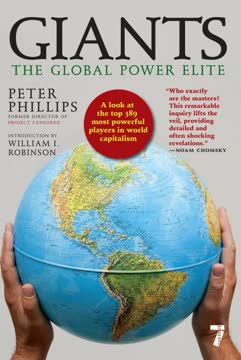
Key Takeaways
1. The Global Power Elite: A Transnational Ruling Class Emerges
Sixty-two years later, power elites have globalized and built institutions that facilitate the preservation and protection of capital investments everywhere in the world.
A globalized elite. The world is increasingly run by a "Transnational Capitalist Class" (TCC), a concept evolving from C. Wright Mills' "power elite" that once governed America. This TCC is a non-governmental network of similarly educated, wealthy individuals whose primary purpose is to manage, facilitate, and protect concentrated global wealth, ensuring its continuous growth. This compulsive enterprise, however, is spreading poverty, fueling endless wars, and terminally poisoning the Earth.
Unprecedented concentration. Wealth is concentrating at an alarming rate, with the richest 1% of humanity controlling over half of the world's wealth, and the top 30% controlling more than 95%. This extreme accumulation creates a "crisis of humanity," manifesting as:
- Poverty and starvation for billions
- Mass alienation
- Media propaganda
- Environmental devastation, reaching species-level threat
Systemic contradictions. The TCC operates under a shared belief that profit-driven consumerism and economic growth will inherently solve global problems. However, the over-accumulation of capital leads to limited safe investment opportunities, pushing the elite towards risky financial speculation, war-making, and the privatization of public assets, further exacerbating global instability and inequality.
2. Financial Giants: The Interlocked Core of Global Capital
These seventeen Giants collectively manage more than $41.1 trillion in a self-invested network of interlocking capital that spans the globe.
The financial core. Seventeen global financial firms, each managing over a trillion dollars, form the central institutions of global capitalism. These "Giants" collectively control more than $41.1 trillion in investment capital, sourced from thousands of millionaires, billionaires, and corporations. This immense wealth is invested across the globe, including significant stakes in each other, creating a tightly interlocked and consolidated capital structure.
"Too big to fail, too big to tell apart." These powerful banks and asset management firms, often deemed "too big to fail," operate with a striking lack of competition. They manipulate laws and policies to their advantage, as evidenced by scandals like the Libor price-fixing and global currency manipulation, which resulted in billions in fines but few individual prosecutions. This systemic impunity allows them to prioritize profit maximization over ethical conduct.
Mandatory growth. The Giants' primary objective is continuous capital growth, requiring average returns of 3% to 10% or more. This relentless pursuit of growth drives investments into:
- Highly speculative ventures (e.g., home loan packages leading to the 2008 crisis)
- War-making and security (e.g., investments in Lockheed Martin, Northrop Grumman, Boeing)
- Privatization of public resources (e.g., water systems, schools, highways)
- Socially destructive products (e.g., tobacco, sugary drinks like Coca-Cola)
This imperative for growth, regardless of social or environmental cost, is a core contradiction of global capitalism.
3. The 199 Managers: Architects of Concentrated Wealth
The 199 power elite managers hold 147 graduate degrees, including 59 MBAs, 22 JDs, 23 PhDs, and 35 MA/MS degrees.
The faces of power. The 199 directors on the boards of these seventeen financial Giants represent the core financial management of global capitalism. These individuals, predominantly male (70%) and white (84%), are highly educated, often from elite universities like Harvard and Stanford. They hail from twenty nations, with 59% from the United States, and regularly interact in major global cities.
Interconnected and influential. These managers are deeply embedded in global policy groups and governments, serving as advisors to institutions like the IMF, World Bank, G7, and G20, and frequently attending the World Economic Forum. Their shared backgrounds, personal wealth, and common global interests foster a strong class-consciousness, enabling them to make decisions that influence trillions of dollars and impact billions of lives.
Shared ideology, selective concern. While aware of global issues like inequality and poverty, these elites generally believe that expanding market capitalism is the best solution. Their public statements, such as those made by Larry Fink (BlackRock) and Jamie Dimon (JPMorgan Chase), emphasize the importance of economic growth for all, while condemning "extremist views and civil disruptions." This ideological unity, however, often overlooks the direct link between capital concentration and humanitarian crises.
4. Elite Forums: Shaping Global Policy Beyond Governments
In other words, for the Group of Thirty, they don’t produce mere “recommendations,” but rather “instructions,” which they expect to be followed.
Private policy centers. Beyond formal governmental bodies, non-governmental transnational policy groups like the Group of Thirty (G30) and the Trilateral Commission (TC) serve as crucial facilitators for the TCC. These privately funded organizations provide exclusive, off-the-record forums where power elites can build consensus on global capital and security issues, effectively shaping policies that are then implemented by international institutions and national governments.
G30: The financial executive committee. The G30, founded in 1978 and originally funded by the Rockefeller Foundation, is a highly influential institution in global financial governance. Its 32 members, including former central bank governors and finance ministers, are deeply connected to the IMF, World Bank, and other key financial bodies. They issue "instructions" on topics like shadow banking, monetary policy, and oil, which are widely adopted across the globe, demonstrating their direct influence on financial regulations and economic reforms.
Trilateral Commission: Broadening the elite network. The Trilateral Commission, established in 1973 by David Rockefeller and Zbigniew Brzezinski, brings together high-level elites from North America, Europe, and Asia (now globally). Its 375 members, including 55 on the extended executive committee, discuss a wide range of issues from nuclear disarmament to climate change and urbanization. Their policy papers, published through institutions like the Brookings Institution Press, lay the groundwork for international governance actions, influencing decisions from the G7 to the US State Department.
5. The Military-Intelligence Empire: Protecting Global Capital
The US military empire has long been the protector of global capitalism.
Global reach of force. The US military empire, with over 800 bases in 70 countries and Special Operations Command (SOCOM) troops deployed in 147 nations, acts as the primary protector of global capitalism. This vast military presence, often supplemented by NATO forces, ensures the free flow of capital, access to natural resources, and debt collection worldwide. The "war on terror" serves as an ideological justification for these interventions, which are often driven by economic interests rather than genuine security concerns.
War as profit. For the Global Power Elite, war is a profitable investment opportunity, providing guaranteed returns for the Giants. Major weapons producers like Lockheed Martin, Northrop Grumman, and Boeing receive billions in investments from these financial firms. This perpetual cycle of destruction and rebuilding fuels capital concentration, while simultaneously serving as a repressive mechanism to control and instill fear in the masses.
Shadowy protectors. Intelligence agencies, particularly the CIA, work closely with international counterparts to protect TCC interests, often operating outside national laws. The Atlantic Council, a powerful non-profit advisory group, combines financial capitalists, high-level security experts, and government insiders to set US-NATO policy parameters. They recommend actions, including regime changes and military interventions, to ensure compliant nation-states and safe investment opportunities for global capital, often relying on private military companies (PMCs) like Blackwater/Constellis and G4S to execute these directives.
6. Media and Propaganda: Engineering Consent for the Elite
Corporate media today are highly concentrated and fully international.
Consolidated control. Global corporate media, now dominated by a handful of transnational corporations like Comcast, Disney, Time Warner, 21st Century Fox, Bertelsmann, Viacom, and CBS, serve as ideological instruments for the Global Power Elite. These media giants, heavily invested in by the financial Giants, prioritize product sales and pro-capitalist propaganda, shaping public opinion through psychological control of desires, emotions, and values.
The propaganda model. A symbiotic relationship exists between corporate media and Public Relations Propaganda (PRP) firms, with PRP firms supplying 66% to 80% of news content. This means much of what the public consumes is pre-packaged, managed news and entertainment. This "propaganda model" ensures that corporate-friendly narratives dominate, often censoring or downplaying information that challenges concentrated wealth or capitalist goals, as seen in the coordinated efforts to sell the Iraq War.
Selling empire and products. PRP firms like Omnicom Group, WPP, and Interpublic Group, with billions in annual revenue, provide extensive services to governments, corporations, and NGOs worldwide. They engage in:
- Brand enhancement for products, including unhealthy ones (e.g., tobacco, sugary drinks)
- Crisis management and public information control
- Political consultation and lobbying (e.g., WPP's Glover Park Group influencing Washington)
- Monitoring social media for intelligence agencies (e.g., Visible Technologies for the CIA)
This pervasive ideological assault aims to encourage mass consumption, fear of "others," support for police states, and acceptance of permanent war, all while portraying private corporations as essential to democracy.
7. Humanity's Crisis: The Unbearable Cost of Unchecked Power
It is intolerable that thousands of people continue to die every day from hunger, even though substantial quantities of food are available, and often simply wasted.
Unsustainable inequality. The relentless concentration of wealth, with the world's richest 500 people increasing their fortunes by $1 trillion in 2017 alone, is economically unsustainable. While the top 0.7% of the population controls over 47% of global wealth, the bottom 70% struggles with just 2.7%. This extreme disparity leads to widespread human suffering, with tens of thousands dying daily from malnutrition and preventable diseases, despite abundant global resources.
The Juggernaut's impact. The Global Power Elite's pursuit of economic colonization and privatization of public commons disregards fundamental human rights. This unchecked power allows for the buying of ideologies, governments, law enforcement, covert activities, and wars, ultimately eroding governmental democracies, personal freedoms, and privacy. The world is hurtling towards a future where billions face economic precarity and overt repression.
A looming catastrophe. The current trajectory of wealth concentration and neoliberal austerity policies inevitably leads to mass civil unrest, environmental collapse, and global chaos. The environment cannot sustain further pollution and waste, and social unrest is already evident worldwide. The critical question remains whether the Global Power Elite will recognize the inevitability of this collapse and make necessary adjustments before widespread death and rebellion become unavoidable.
8. A Path Forward: Resistance Guided by Human Rights
The Universal Declaration of Human Rights is a document that social movements can easily adopt as a statement of moral principles for actions of resistance to wealth concentration and global inequality.
The power of resistance. Despite the overwhelming power of the Global Power Elite, resistance movements are emerging worldwide, challenging neoliberal austerity, wealth concentration, police state abuses, and ideological propaganda. Movements like Occupy Wall Street, the Arab Spring, and Black Lives Matter demonstrate a growing global consciousness of the 99% versus the 1%, highlighting the inherent unsustainability of extreme inequality.
A moral compass. The Universal Declaration of Human Rights (UDHR), adopted by the United Nations in 1948, offers a foundational moral philosophy for activism and social change. This document, crafted by representatives from diverse nations, outlines the inherent dignity and inalienable rights of all human beings, providing a powerful framework for challenging the current system. It serves as a call to action for social movements and a guide for corrective measures by the Global Power Elite.
Restructuring capitalism. As Robert Reich argues, "The market is a human creation. It is based on rules that humans devise." The current rules, shaped by corporations and the wealthy, disproportionately benefit a few. The vast majority has the power to alter these rules to meet common human needs. This requires understanding the mechanisms of power, uniting in resistance, and demanding a restructuring of capitalism itself, ensuring that wealth redistribution becomes a "river of resources" for all, rather than selective philanthropy.
Last updated:
Similar Books