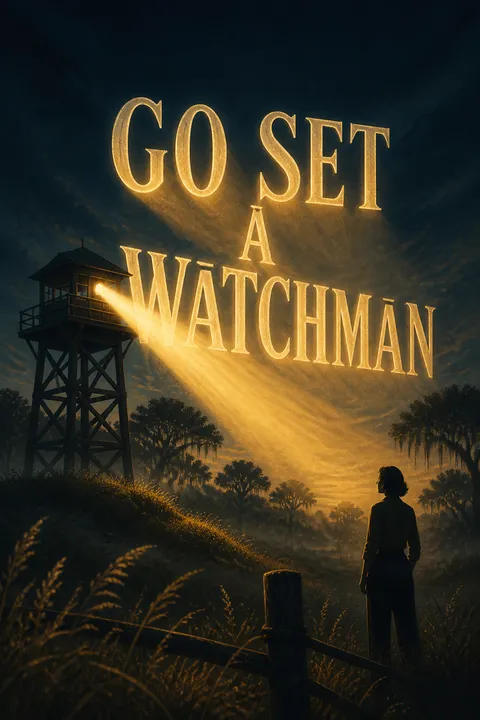


Plot Summary
Homeward by Train
At twenty-six, Jean Louise Finch makes her yearly visit from New York to Maycomb, choosing the train so her seventy-two-year-old father, Atticus, will not have to drive a long distance to collect her.
Atticus is struggling with rheumatoid arthritis, and Henry Clinton, his young law partner and Jean Louise's oldest friend, meets her at the station instead. Henry has become both Atticus's aide and a steady presence in Jean Louise's life. He presses her to marry him, but she refuses, convinced that affection is not enough if she cannot freely choose him.
Their familiar teasing restores their closeness, though her refusal leaves the question between them. Her return begins as an act of care for her aging father, but it also brings her back to a place where old loyalties are changing.
Alexandra's Line in Sand
At home, Jean Louise finds Atticus living with his sister Alexandra, who has moved in to help manage his household as his illness worsens. Alexandra disapproves of Jean Louise's clothes and independent life, while Jean Louise resists her aunt's rules for what a Finch daughter should be.
When Jean Louise suggests that she might marry Henry, Alexandra objects not to his character but to his poor family background, insisting that his origins make him unsuitable. Jean Louise answers with mockery, then regrets the hurt she has caused without withdrawing her belief that Henry deserves respect.
The exchange exposes how Alexandra's ideas of family duty and social rank can wound even when she intends to protect. Jean Louise's gratitude for her aunt's care sits uneasily beside her anger at being judged.
The Landing's New Current
On their drive to Finch's Landing, Jean Louise notices how much Maycomb has changed since her childhood: the old family property has been sold, and new houses and businesses have altered the county's familiar landscape.
Henry tells her he may run for the state legislature, hoping to challenge the local political machine with Atticus's support. Jean Louise admires his drive but is uncertain whether she can belong to the life he is building in Maycomb. After they swim in the river with their clothes on, a car carrying Black passengers speeds past.
Henry calls its occupants a danger on the road, and Jean Louise questions his assumptions about licenses and safety. His dismissive answer unsettles her. For the first time, she glimpses a difference between the man she loves and the town's conventional judgments.
The Courthouse Balcony
At church the next day, a changed hymn and a sermon about a watchman leave Jean Louise thinking about who sees clearly. At home, she finds a racist pamphlet among Atticus's papers and learns from Alexandra that he and Henry belong to Maycomb's Citizens' Council.
She hurries to the courthouse, where she watches from the balcony as a visiting segregationist delivers a speech filled with contempt for Black people. Atticus and Henry sit at the speaker's table, lending the gathering their standing.
Jean Louise remembers Atticus's earlier defense of a Black man accused of rape, a case he won by proving the charge false. Now she sees her father beside men promoting the very racial hostility she thought his conduct opposed, and leaves the courthouse sick with disbelief.
The Water Tower Promise
As Jean Louise tries to absorb what she has seen, memories return to a childhood shaped by loss and by the adults who cared for her. Her mother died when she was young, and Calpurnia, the family's Black cook, helped raise her alongside Atticus and her brother Jem.
At twelve, Jean Louise misunderstands what she learns about kissing and pregnancy, grows convinced that she is carrying a baby, and secretly plans to die rather than bring shame on her family.
On the day she intends to kill herself, Henry finds her perched high on Maycomb's water tower and brings her down. Calpurnia then explains the facts she had never been told. The episode shows how Jean Louise's fierce trust in her family was built from practical acts of rescue and care, not from abstract lessons.
Calpurnia's Closed Door
The morning after the courthouse meeting, Atticus learns that Frank, Calpurnia's grandson, has driven drunk and killed an elderly white man. Henry initially expects Atticus to refuse the case, but Atticus agrees to represent Frank, arguing that a local lawyer can keep the case from being taken over by outside civil-rights lawyers.
Jean Louise is relieved that Atticus will help, yet disturbed by the reasoning she hears. She visits Calpurnia to offer support and finds her surrounded by relatives and neighbors.
Calpurnia treats Jean Louise with the formal distance she uses for white visitors, then makes clear that Frank must answer for what he did and that her own people are being treated differently now. Jean Louise leaves unable to restore the intimacy she remembers.
Coffee with Maycomb
Alexandra hosts a welcome coffee for Jean Louise, drawing women whose conversation reveals how thoroughly fear has entered ordinary Maycomb life. They repeat claims that the NAACP, Communists, Catholics, and Black activists are conspiring to destroy the South, often confusing one accusation with another.
When Hester Sinclair describes integration as a threat to white families, Jean Louise challenges the language of racial mixing and asks why white people speak as if they have nothing to fear from equality. Hester cannot answer her directly and retreats to distinctions between respectable people and those she labels trash.
Jean Louise watches her old schoolmate repeat ideas supplied by her husband and realizes that politeness cannot make the claims harmless. The gathering turns her sense of isolation into a question about how a town teaches its people what to believe.
Uncle Jack's Long View
Jean Louise visits her uncle, Dr. John Hale Finch, and demands an explanation for Atticus's place on the Citizens' Council. Instead of defending his brother plainly, Dr. Finch traces the South's history as a society shaped by kinship, land, pride, defeat, and fear of federal power.
He argues that older Southerners see the Council as a means of resisting outside control, though he does not pretend the institution or the men around it are admirable.
His wide historical account frustrates Jean Louise because it explains the climate without settling the moral question she has brought him. Before she leaves, Dr. Finch makes her promise to return when she can no longer bear the conflict. His refusal to give her a ready-made judgment forces her to face the limits of explanation.
Henry's Price of Belonging
While waiting near the ice-cream shop, Jean Louise remembers her first school dance: Henry helped her learn to dance, brought her camellias, and rescued her from embarrassment when her borrowed figure enhancers shifted. That old tenderness makes the present confrontation harder.
At the drugstore, she tells Henry she cannot marry him after seeing him at the Council meeting. Henry explains that Maycomb grants Jean Louise unusual freedom because she is a Finch, while he risks being dismissed as poor white trash if he defies local expectations.
He wants to serve the town and keep the trust that gives his legal work influence. He also says Atticus once joined the Ku Klux Klan to learn who was behind its masks. Jean Louise hears compromise where Henry sees strategy, and ends their engagement.
Atticus on Trial
When Jean Louise confronts Atticus in his office, he explains that he opposes federal intervention and believes full political rights should follow a person's capacity for responsible citizenship.
He fears that rapid change will destabilize Southern institutions and argues that the Council is a defense against the Supreme Court and the NAACP. Jean Louise counters that such caution denies Black people the chance to exercise the rights they are told they have not earned.
She accuses him of hiding behind abstractions about law and order while tolerating a meeting where a racist speaker could set the terms. Atticus remains calm as she attacks the man she believed him to be, and his refusal to fight back feels to her like another injury. She leaves, convinced that she has lost both her father and her home.
The Watchman Within
Jean Louise packs to leave Maycomb, lashes out at Alexandra, and then meets Dr. Finch beside the car. When she refuses to listen, he strikes her to shock her out of her spiral, then brings her inside and helps her steady herself.
He explains that she has treated Atticus's conscience as her own, mistaking her father for an infallible authority; seeing him fail her therefore felt like losing the ground beneath her. Her task is to judge with a conscience that belongs to her, not to replace worship of Atticus with contempt for everyone who disagrees.
Dr. Finch also calls her a small-minded partisan when she refuses to hear opposing motives. Jean Louise begins to understand that moral independence requires both conviction and the humility to keep looking.
Atticus Comes Back Human
After leaving Dr. Finch, Jean Louise arranges to see Henry that evening, this time as a friend saying goodbye rather than as a woman preparing to marry him. At the office, Atticus appears with his hat and walking stick, and she struggles to meet him after everything she said. He tells her he is proud that she stood up for her beliefs, even against him.
Jean Louise apologizes for the cruelty of her accusations and admits that she loves him, while still recognizing the gulf between their positions. Atticus does not retract his views, and she does not adopt them. Instead, she allows him to be a flawed person rather than the source of every answer. She drives him home, more able to belong to him without surrendering her own judgment.
Analysis
The novel makes political disillusionment intimate by locating it inside Jean Louise's closest relationships. She does not first encounter segregation as an abstract policy debate. She sees her father and Henry sitting beside a speaker who voices racial contempt, then hears similar assumptions repeated at a social coffee and translated into the supposedly practical language of local order. This progression shows how injustice can be maintained by more than explicit hatred. Respectable people may oppose a speaker's manners yet still lend their authority to the institution that gives him a platform.
Jean Louise's shock also exposes the danger of making a loved person the foundation of one's moral identity. Atticus has taught her habits of fairness, but she has mistaken his example for a guarantee that his judgment will always match her own. Her physical collapse follows from this dependence: when he acts against her understanding of his principles, she experiences not simply disagreement but the loss of her internal compass. Dr. Finch's intervention names the needed separation. Growing up means accepting that a person can embody real virtues and still hold harmful beliefs, and that love neither cancels nor resolves that contradiction.
The book complicates this lesson through Henry. His compromises arise partly from class vulnerability: Maycomb grants Jean Louise room to defy convention because her family name protects her, while he fears losing the standing he has worked to earn. His caution is not equivalent to Atticus's authority, but it reveals how social systems recruit people through unequal risks. Jean Louise is morally forceful, yet the novel also asks whether certainty becomes another form of blindness when she refuses to consider motives or listen beyond the injury.
The ending offers no political conversion and no easy return to the old Maycomb. Jean Louise accepts Atticus as human and remains his daughter, but she does not surrender her moral disagreement. The resolution is therefore relational rather than ideological: she can love without worship, judge without pretending to be untouched by prejudice, and belong without letting belonging dictate what she sees.
Review Summary
Go Set a Watchman received mixed reviews, with many readers disappointed by the portrayal of Atticus Finch as racist. Some saw it as an interesting draft that provides insight into Harper Lee's writing process, while others felt it should not have been published. The book explores themes of racism, growing up, and disillusionment. Many reviewers struggled to separate it from To Kill a Mockingbird, finding the characters and writing style different. Despite criticisms, some appreciated its historical context and complex treatment of racial issues in the 1950s South.
People Also Read





Characters
Jean Louise Finch
The searching daughterJean Louise Finch, called Scout in childhood, is a twenty-six-year-old artist living in New York who returns to Maycomb for her annual visit. Quick-witted, blunt, and resistant to social performance, she prefers direct judgment to the careful manners expected of women in her hometown. Her bond with her father has shaped her moral instincts so deeply that she rarely notices how much she relies on his example. She is also tied to Maycomb through childhood friendships and memories, even as she resists being absorbed into its expectations. Her central tension is between belonging to people she loves and thinking for herself when their beliefs trouble her.
Atticus Finch
The principled fatherAtticus is a seventy-two-year-old Maycomb lawyer and the father whose patience and integrity formed Jean Louise's moral world. He is reserved, humorous, and disciplined, rarely complaining even as rheumatoid arthritis limits the use of his hands. He raised Jean Louise and her older brother after their mother died, encouraging independence rather than requiring his daughter to remain at home. In public life, he is respected for his legal skill and steady manner. He believes civic order and local judgment matter, and he is wary of distant authority. His influence on his daughter is both a source of strength and a weight she must learn to carry without treating him as infallible.
Henry Clinton
The loyal hometown suitorHenry Clinton is Jean Louise's lifelong friend, Atticus's law partner, and a veteran who built his career through work and persistence. Orphaned young and raised in modest circumstances, he received help from Atticus and came to regard him as a father. Henry is capable, affectionate, and ambitious, with a practical understanding of the social limits Maycomb places on people without the Finch name. He wants a home, a family, and a meaningful role in local public life. His humor and patience make him one of the few people who can share silence with Jean Louise, though his desire to belong can lead him to accept compromises she finds intolerable.
Alexandra Finch Hancock
The guardian of conventionAtticus's sister and Jean Louise's aunt, Alexandra manages the household and takes pride in Maycomb's social rituals. She values family reputation, proper behavior, and inherited distinctions, often advising Jean Louise even when the advice is unwelcome. Her rigidity can conceal real devotion: she moved in to care for Atticus as his health declined. Alexandra is not simply a caricature of snobbery; her security comes from a familiar social order, and change unsettles the assumptions that have governed her life.
Dr. John Hale Finch
The eccentric family criticKnown to Jean Louise as Uncle Jack, Dr. Finch is Atticus's older brother, a retired physician, and a devoted student of Victorian literature. His sharp wit, unusual habits, and dense historical allusions make him difficult to follow, but he watches Jean Louise closely and understands her vulnerabilities. He is less interested in soothing her than in making her think. His affection for the Finch children gives his teasing a protective edge, while his willingness to question prevailing assumptions makes him a distinct presence within the family.
Calpurnia
The childhood caregiverCalpurnia is the longtime cook in the Finch household and one of the people who raised Jean Louise after her mother's death. Practical, strict, and deeply caring, she offered the girl both discipline and the plainspoken knowledge the adults around her left unexplained. She has her own family and community, and she is not merely an extension of the Finches' home. Her importance to Jean Louise comes from years of daily care, which gives their relationship a depth that cannot be reduced to employer and servant.
Jem Finch
The absent older brotherJem is Jean Louise's older brother and a powerful presence in her memories. As children, he led their games and shared the imaginative world that included their friend Dill. He later became more independent, as older siblings do, but remained part of Jean Louise's sense of family and childhood. His death before the novel's present leaves her with a household shaped by absence, and his memory connects her to the years when Atticus and Calpurnia cared for both children.
Charles Baker Harris
The wandering childhood friendCalled Dill by Jean Louise and Jem, Charles Baker Harris spent childhood summers with them in Maycomb. Imaginative, theatrical, and restless, he joined their backyard adventures and helped make ordinary days feel expansive. His playful nature also offered Jean Louise an intimate friendship outside her family. As an adult he lives abroad, a reminder that the children who once shared a neighborhood have scattered into separate lives.
Zeebo
Calpurnia's sonZeebo is Calpurnia's son and a longtime member of the Black community in Maycomb. He works as the town's garbage collector and has known the Finch family across many years. His presence links Jean Louise's childhood household to the wider lives of the people who served and lived alongside it, rather than allowing her memories to remain purely private.
Frank
Calpurnia's grandsonFrank is Calpurnia's grandson, a young man known for his mechanical skill and interest in plumbing. His family hopes he will have the chance to pursue further training. He is part of the younger generation whose choices unfold under the unequal legal and economic conditions of Maycomb County.
Grady O'Hanlon
The hired segregationist speakerO'Hanlon is a traveling speaker invited to address the Maycomb County Citizens' Council. He uses inflammatory rhetoric to rally white listeners against civil-rights demands. His crude performance makes visible the hostility that more respectable members of the gathering may prefer to express indirectly.
William Willoughby
The courthouse power brokerWilloughby is a behind-the-scenes political boss who has long influenced county offices through loyal subordinates. He represents the old courthouse machine, a local system of patronage that Henry hopes to challenge.
Hester Sinclair
The anxious Maycomb hostessHester is one of the women at Alexandra's coffee and a Maycomb contemporary of Jean Louise and Henry. She repeats alarmist claims she has absorbed from her husband, revealing how political fear travels through ordinary social conversation.
Mr. Stone
The Methodist ministerMr. Stone is the young minister of the Maycomb Methodist church. His sermon on a biblical watchman supplies an image that resonates with Jean Louise's need to see clearly, even as church traditions and congregational habits complicate his authority.
Plot Devices
The watchman image
Conscience made visibleA church sermon invokes the biblical watchman whose task is to report what he sees. Jean Louise later connects that image to the problem of moral judgment: she wants an authority to tell her what her father means and how to interpret what she witnessed. Dr. Finch redirects the image inward, framing conscience as something each person must carry independently. The device ties the book's title to Jean Louise's movement from relying on Atticus's moral example toward making judgments of her own. It also raises a difficult question the story does not settle: seeing clearly is not the same as knowing what action will be right.
The courthouse balcony
A childhood viewpoint overturnedAs a child, Jean Louise watched legal proceedings from the courthouse balcony and saw Atticus defend a Black defendant. In the present, she returns to that elevated place and watches him sit with the Citizens' Council while a segregationist speaks. The physical vantage stays the same, but what she sees has changed. The balcony turns a memory of moral certainty into a witness stand for her assumptions, making the political conflict intensely personal without leaving the public courtroom.
The Council pamphlet
A private clue to public loyaltiesA racist pamphlet left among Atticus's papers gives Jean Louise her first concrete reason to suspect that the family she trusts is involved in organized resistance to civil-rights change. Alexandra's explanation leads Jean Louise to the courthouse meeting, where the pamphlet's arguments are spoken aloud. This small printed object converts distant newspaper coverage into an immediate household discovery. It shows how political ideology enters a home not only through speeches and elections, but through papers read, collected, and treated as useful.
Childhood memories
The past tests the presentJean Louise's memories interrupt her return to Maycomb, connecting adult conflict to the experiences that formed her. Her panic about pregnancy recalls how Calpurnia gave her knowledge and comfort, while memories of Henry's kindness reveal the long history beneath their courtship. These recollections are not simple escapes from the present. They show why she trusts certain people so completely, and why a change in their behavior feels like a threat to her own identity. The past supplies evidence, but it cannot decide what she should believe now.
FAQ
Synopsis & Basic Details
What is Go Set a Watchman about?
- A homecoming reveals truths: The novel centers on Jean Louise Finch's return to Maycomb, Alabama, as an adult, where she confronts unsettling truths about her family and community.
- Challenging idealized past: It explores the disillusionment that occurs when Jean Louise's idealized childhood perceptions clash with the realities of the present, particularly regarding her father, Atticus.
- Navigating moral complexities: The story delves into themes of racial prejudice, moral compromise, and the struggle to reconcile personal beliefs with societal expectations in the changing South.
Why should I read Go Set a Watchman?
- Complex character study: It offers a nuanced portrayal of beloved characters, revealing their flaws and complexities, and challenging readers' perceptions of them.
- Exploration of moral ambiguity: The novel tackles difficult questions about justice, morality, and the nature of progress, prompting readers to reflect on their own beliefs.
- Companion to a classic: It provides a deeper understanding of Harper Lee's world and serves as an essential companion to "To Kill a Mockingbird," adding depth and context to the classic.
What is the background of Go Set a Watchman?
- Civil Rights Era South: The novel is set against the backdrop of the mid-1950s South, a time of significant social and political upheaval due to the burgeoning Civil Rights Movement.
- Racial tensions and segregation: It reflects the deep-seated racial tensions and segregation prevalent in the South, exploring the complexities of these issues through the eyes of its characters.
- Personal and political conflict: The story intertwines personal conflicts with the broader political turmoil, highlighting how these issues impact individuals and communities.
What are the most memorable quotes in Go Set a Watchman?
- "Love whom you will but marry your own kind": This quote encapsulates the societal pressures and expectations surrounding relationships and marriage, particularly within the context of Maycomb.
- "The only remedy for this is not to let it beat you": Atticus's stoic approach to his arthritis reveals his resilience and determination, reflecting his broader philosophy on life's challenges.
- "You're gonna see change, you're gonna see Maycomb change its face completely in our lifetime": Henry's observation foreshadows the inevitable social and political transformations that will impact Maycomb and its inhabitants.
What writing style, narrative choices, and literary techniques does Harper Lee use?
- Introspective third-person: The narrative is primarily told from Jean Louise's perspective, allowing readers access to her thoughts and feelings as she grapples with her disillusionment.
- Dialogue-driven scenes: Lee uses dialogue to reveal character motivations, conflicts, and the underlying tensions within the community, often employing subtle subtext and double meanings.
- Symbolism and motifs: The novel employs recurring symbols and motifs, such as the river, the old house, and the town itself, to represent themes of change, memory, and the passage of time.
Hidden Details & Subtle Connections
What are some minor details that add significant meaning?
- The train journey: Jean Louise's decision to travel by train instead of plane is not just about convenience; it symbolizes her desire to reconnect with her past and the slower pace of life in Maycomb.
- Cousin Joshua's story: The anecdote about Cousin Joshua, the eccentric poet, foreshadows Jean Louise's own struggle with societal norms and her independent spirit.
- The old putter: The blackened old wooden-shaft putter used as a poker symbolizes the blending of the past and present, and the enduring nature of certain family habits.
What are some subtle foreshadowing and callbacks?
- The conductor's joke: The conductor's predictable joke about missing the station foreshadows the unexpected absence of Atticus at the train stop, hinting at the changes in their relationship.
- The "Hot-Grease-in-the-Kitchen" game: Jean Louise's inability to fully recall the game symbolizes her fading connection to her childhood and the loss of innocence.
- The river swim: The spontaneous swim in the river with Henry mirrors their childhood escapades, highlighting the enduring bond between them while also foreshadowing their eventual separation.
What are some unexpected character connections?
- Atticus and Willoughby: The presence of Atticus at the same table as William Willoughby, a man he despises, reveals the extent of his pragmatic approach to political engagement.
- Jean Louise and Dill: The shared childhood memories of Jean Louise and Dill, particularly their revival game, highlight the innocence and camaraderie that have been lost over time.
- Alexandra and Calpurnia: Despite their different backgrounds, both Alexandra and Calpurnia share a deep concern for the well-being of the Finch family, revealing a common thread of loyalty and care.
Who are the most significant supporting characters?
- Uncle Jack Finch: He serves as a voice of reason and provides Jean Louise with a different perspective, helping her navigate her disillusionment and form her own identity.
- Henry Clinton: He represents the complexities of balancing personal beliefs with societal expectations, and his relationship with Jean Louise highlights the challenges of love and loyalty in a changing world.
- Calpurnia: Her strained relationship with the Finch family reflects the broader societal changes and challenges Jean Louise must confront, and her past connection to the family highlights the loss of innocence.
Psychological, Emotional, & Relational Analysis
What are some unspoken motivations of the characters?
- Atticus's pragmatism: Atticus's involvement with the Citizens' Council is driven by a desire to maintain order and control in a rapidly changing society, even if it means compromising his own ideals.
- Henry's desire for acceptance: Henry's actions are motivated by a need to gain acceptance and respect within his community, highlighting his struggle with his social background.
- Alexandra's need for control: Alexandra's rigid adherence to tradition stems from a need to maintain control and order in a world that is constantly changing, reflecting her own insecurities.
What psychological complexities do the characters exhibit?
- Jean Louise's disillusionment: She grapples with the psychological impact of her shattered ideals, struggling to reconcile her love for her father with his actions.
- Atticus's internal conflict: He is torn between his commitment to justice and his desire to maintain the social order, revealing the internal conflict that underlies his pragmatic approach.
- Henry's insecurity: He exhibits a deep-seated insecurity about his social standing, which drives his need for acceptance and his willingness to compromise his beliefs.
What are the major emotional turning points?
- The Citizens' Council meeting: This event shatters Jean Louise's idealized view of her father and her community, leading to a profound sense of betrayal and disillusionment.
- The confrontation with Atticus: This heated argument forces Jean Louise to confront her father's flaws and her own prejudices, marking a turning point in their relationship.
- The conversation with Uncle Jack: This dialogue provides Jean Louise with a new perspective and helps her begin to reconcile with her family and her own identity.
How do relationship dynamics evolve?
- Jean Louise and Atticus: Their relationship evolves from one of idealized admiration to one of complex understanding, as Jean Louise learns to accept her father's flaws and form her own opinions.
- Jean Louise and Henry: Their relationship deteriorates as Jean Louise struggles to reconcile her feelings for him with his political choices, ultimately leading to their separation.
- Jean Louise and Alexandra: Their relationship shifts from one of constant conflict to a more nuanced understanding, as Jean Louise recognizes her aunt's vulnerabilities and her own biases.
Interpretation & Debate
Which parts of the story remain ambiguous or open-ended?
- Atticus's true beliefs: The novel leaves some ambiguity regarding the extent of Atticus's personal beliefs about race, prompting readers to question his motivations and actions.
- The future of Maycomb: The ending does not provide a clear resolution to the racial tensions and political turmoil in Maycomb, leaving the future of the town open to interpretation.
- Jean Louise's ultimate path: While she gains a new understanding of herself and her family, the novel does not explicitly state what her future holds, leaving her ultimate path open-ended.
What are some debatable, controversial scenes or moments in Go Set a Watchman?
- The Citizens' Council meeting: This scene is controversial due to its depiction of racist rhetoric and the presence of Atticus and Henry, prompting debate about their motivations and the nature of moral compromise.
- Jean Louise's confrontation with Atticus: This scene is controversial due to its challenge to the idealized image of Atticus, sparking debate about his character and the nature of heroism.
- The ending: The ending is controversial due to its lack of clear resolution and its focus on personal growth rather than societal change, prompting debate about the novel's overall message.
Go Set a Watchman Ending Explained: How It Ends & What It Means
- Jean Louise's self-discovery: The ending focuses on Jean Louise's journey of self-discovery, as she learns to separate her own conscience from her father's influence and embrace her individuality.
- Acceptance of imperfection: She comes to terms with the fact that those she loves are not perfect, and that she must accept their flaws and form her own opinions.
- A new understanding of home: While she may not fully agree with the values of Maycomb, she recognizes its significance in her life and the importance of finding her own place within it.
To Kill a Mockingbird Series

About the Author

Download PDF
Download EPUB
.epub digital book format is ideal for reading ebooks on phones, tablets, and e-readers.








