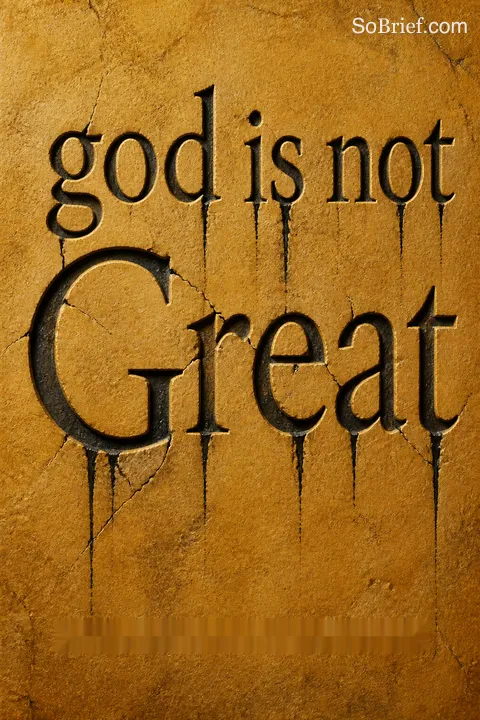


Key Takeaways
Treat every divine claim as human until evidence says otherwise
A childhood test of belief. Hitchens traces his skepticism to a lesson with Mrs. Watts, a kind teacher who argued that God made plants green because green soothed human eyes. To the nine-year-old Hitchens, the explanation had cause and effect backward: eyes adapted to the world, rather than the world being arranged for them. That small objection became a larger method: check religious claims against evidence, and do not mistake comfort for proof.
Four recurring objections. Hitchens argues that religion misstates the origins of life and the cosmos, encourages both submission and human self-importance, represses sexuality, and rests on wishful thinking. He does not reject wonder, ethics, or consolation. He argues that science, literature, and human relationships can offer these without demanding belief in revelation.
What's compelling is the change in direction: ask whether people adapted to the world, rather than assuming the world was designed around them. That is a useful test for any explanation that flatters human importance. Yet the test does not, by itself, disprove every possible idea of God. It does show why claims about nature need evidence independent of the satisfaction they provide. Hitchens's more durable challenge is methodological: keep explanations open to correction, including secular ones.
Let evidence, not revelation, settle claims about reality
Texts carry human fingerprints. Hitchens challenges the claim that sacred books are direct, coherent messages from God. He points to the Bible's competing versions of events, differing accounts of Jesus's birth and resurrection, and passages that appear to have entered the text later. He also emphasizes that the accounts were compiled after the events they describe, by human authors and editors.
The Koran has a history, too. The book recounts disagreements over how the Koran was assembled and standardized, alongside the later compilation of hadith, reports of Muhammad's words and actions. An isnad is the chain of transmitters used to support a hadith's authenticity. Hitchens's central point is that claims of perfect transmission deserve scrutiny, not exemption from it. Textual criticism can reveal how traditions change, though it cannot alone settle every question of religious meaning.
Historical criticism turns sacred texts into objects that can be compared, dated, and questioned, rather than authorities that end questioning. The same habit matters in law, journalism, and science: a source's prestige cannot substitute for examining how its claims were recorded and transmitted. There is also a limit worth keeping clear. Evidence that a text was edited or shaped by history challenges claims of perfect preservation, but does not automatically establish that every spiritual interpretation is false.
Explain life's fit through evolution before inventing a designer
Adaptation is not intention. The argument from design treats complexity, such as the human eye, as evidence of a maker. Hitchens counters that eyes can be traced through simpler forms, from light-sensitive cells to more elaborate visual systems. The human eye itself has awkward features, including a blind spot and a retina arranged in a way that makes light pass through other cells before reaching the receptors. Such imperfections fit a history of modification better than flawless engineering.
Evolution has no promised destination. Drawing on the Burgess Shale fossils, Hitchens emphasizes contingency: if the history of life were replayed, different species might survive, and humans might never appear. The book cites the estimate that about 98 percent of species that have existed are extinct. Evolution explains how complex forms can arise without implying that humanity was the goal.
This argument separates two questions often blurred together: how complexity develops, and whether the universe has an ultimate purpose. Evolution addresses the first through inherited variation and selection; it neither proves nor disproves every answer to the second. The distinction protects scientific explanation from being asked to answer metaphysical questions it cannot resolve. It also cuts against human exceptionalism: a species can be remarkable without being the reason the universe exists.
Judge a creed by the power it claims, not only its kindest adherents
Belief can become a boundary. Hitchens argues that religious identity often merges with nationality, ethnicity, and political authority. In Belfast, rival Christian communities were divided by sect and neighborhood. In Lebanon, a political system allocated offices by religious affiliation. In the Balkans, religious symbols and institutions helped mark communities during campaigns of expulsion and violence. These examples show how belief can harden into a public badge of belonging.
Conflict has more than one cause. Hitchens does not deny that nationalism, state power, and material interests also shape these events. His argument is that religious institutions and claims of divine authority can intensify division, make compromise appear sinful, and grant violence sacred justification. The practical test is not whether believers can be compassionate, but whether a creed permits equal citizenship for people who reject it.
The strongest version of this claim is institutional, not psychological: religious identity can make political boundaries feel sacred and therefore harder to negotiate. That is a real danger when law assigns status by faith or when leaders claim divine permission. But religion is rarely the sole engine of conflict. Nationalism, inequality, and state strategy matter, too. Treating faith as a multiplier rather than a complete explanation preserves Hitchens's warning without reducing every conflict to theology.
Keep public health and children's bodies outside religious vetoes
Belief can carry medical costs. Hitchens recounts a polio-vaccination campaign in northern Nigeria that was disrupted after religious leaders spread claims that the vaccine was a foreign plot to sterilize Muslims. The book says polio returned and spread to other countries. It also describes clerical opposition to condoms and other prevention measures, arguing that sexual taboos can obstruct practical responses to disease.
Children need independent protection. Hitchens extends the argument to procedures imposed on children in the name of tradition, including genital cutting and refusal of medical treatment. His principle is that adult freedom of worship should not automatically authorize preventable harm to a child. The evidence and policy details in each case require careful checking, but the ethical question is clear: when does religious liberty stop and a child's health and bodily autonomy begin?
The useful distinction is between protecting religious practice and granting it immunity from ordinary standards of evidence and harm prevention. A public-health decision should be evaluated by its medical effects, not by whether it offends a doctrine. Children's consent makes the issue especially serious because they cannot choose the risks imposed on them. At the same time, effective policy depends on reliable local evidence and trust. Condemnation alone can deepen suspicion; transparent communication and accessible care can address it.
Build ethics from reciprocity, not threats of heaven or hell
Goodness does not certify doctrine. Hitchens argues that people can act decently without religious belief, while sincere believers can commit cruelty. He contrasts the generosity of individual believers with religious defenses of slavery and segregation, and recounts how churches in Rwanda were implicated in the 1994 genocide. His point is not that every believer is dangerous, but that faith alone does not reliably produce moral conduct.
King's example is complicated. Martin Luther King Jr. drew on biblical imagery to inspire a nonviolent struggle for civil rights. Hitchens sees the moral force of that movement in its humanist commitment to justice, not in supernatural claims. Religious language can serve humane causes, but it can also support oppression. Hitchens therefore treats reciprocity and concern for other people, rather than divine reward or punishment, as a sufficient basis for ethical life.
This section usefully separates the moral value of an action from the truth of the belief motivating it. A person can act generously for religious reasons, and another can act generously without them. That makes ethics a question of conduct and consequences, not membership in a worldview. Hitchens's historical examples are vivid, but his sweeping comparisons are not a substitute for systematic measurement. His narrower conclusion is stronger: religion is neither necessary nor sufficient for moral behavior.
Reject inherited guilt and eternal torture as moral education
Fear can masquerade as instruction. Hitchens recalls the elaborate sermons in James Joyce's A Portrait of the Artist as a Young Man, where a priest frightens schoolboys with vivid descriptions of eternal punishment. He argues that telling children they inherit guilt, risk damnation for disbelief, or deserve endless torture can produce shame rather than ethical understanding.
Impossible rules invite hypocrisy. In Hitchens's account, doctrines such as original sin, vicarious atonement, and eternal punishment place responsibility on people for a primordial wrong or threaten them with consequences no finite act could justify. Rules that condemn even unwanted thoughts, he argues, encourage secret failure and public displays of purity. Moral education can instead teach responsibility, empathy, and repair without telling children that their worth depends on accepting a creed.
The distinction between moral formation and moral intimidation matters well beyond religion. Fear may secure outward compliance, but it can also make honest questions feel dangerous and turn guilt into an identity. A child should be able to ask what makes an action harmful without first accepting a doctrine about cosmic punishment. Hitchens's language sometimes treats religious upbringing as uniformly damaging, when families and traditions differ. The sharper test is whether teaching allows doubt, preserves dignity, and encourages accountability.
Watch revelation being assembled to see its human fingerprints
New faiths expose old mechanisms. Hitchens describes cargo cults in the Pacific, where islanders imitated airfields and signal fires in hopes of attracting returning cargo planes. He also recounts the career of Marjoe Gortner, a child evangelist who later demonstrated how revival performances could be staged to stir emotion and solicit money.
Joseph Smith offers another case. Smith said an angel directed him to golden plates and used special stones to translate them, though no one else was allowed to inspect the plates. Hitchens argues that the resulting Book of Mormon borrowed extensively from the Bible and that Smith's revelations could serve his interests. These stories show how charisma, social need, and authority can help build a religion. They do not, by themselves, prove every older faith false.
Watching a movement form makes its social ingredients visible: charismatic leadership, shared stories, group rituals, and hopes for a better future. That perspective helps explain how beliefs spread without assuming that every participant is gullible or every leader cynical. There is an important logical limit, though. Showing that a belief has human origins does not by itself show that its claims are false. The stronger challenge comes when specific historical or factual claims fail examination.
Defend secular pluralism, not an atheist state or substitute dogma
Secular rule is not state atheism. Hitchens anticipates the charge that nonreligious regimes have committed mass atrocities. He acknowledges the crimes of Stalinist and other authoritarian states, while arguing that they do not justify religious government. His preferred alternative is a secular state that protects both belief and nonbelief, rather than one that compels atheism.
Power can borrow religion's shape. Hitchens observes that totalitarian governments can demand obedience, punish dissent, and present a leader or ideology as infallible. He sees these as features of a closed system, not proof that secularism itself is tyrannical. His political conclusion is institutional: keep government from enforcing a sacred doctrine, and preserve freedom of conscience, inquiry, and expression for believers and skeptics alike.
The key distinction is between secularism as state neutrality and atheism imposed by the state. Conflating them lets the failures of authoritarian regimes discredit protections for religious freedom, while religious governments escape scrutiny by presenting coercion as sacred duty. Hitchens is strongest when he argues for pluralistic institutions, not when he treats secular movements as inherently innocent. Any political system needs checks on concentrated power, whether its ultimate authority is a scripture, a party, or a leader.
Choose open inquiry over certainty without surrendering wonder
Doubt has a long history. Hitchens presents Socrates as a model of inquiry: he accepted that he did not know everything, questioned confident claims, and refused to say what he did not believe. He also traces a line through Spinoza, who was excommunicated for his ideas, and Enlightenment figures who pursued knowledge despite religious pressure.
Wonder needs no supernatural guarantee. Hitchens points to Darwin's account of evolution, the scale of the cosmos, and the work of literature as sources of awe and ethical reflection. He calls for a renewed Enlightenment built on scientific inquiry, free expression, and attention to human life. The goal is not to replace religious certainty with an equally rigid secular creed, but to keep conclusions revisable and protect the freedom to ask difficult questions.
The book's positive vision is not a world without mystery. It is a world where mystery prompts investigation rather than obedience. Socratic humility and scientific revision offer a discipline for living with uncertainty: conclusions remain provisional, but evidence can still make some explanations better than others. Literature adds another resource by letting readers encounter moral complexity without pretending that every dilemma has a revealed answer. The challenge is to keep skepticism self-critical, rather than turning it into a new badge of certainty.
Analysis
Hitchens builds his case in layers. He begins with a child's ordinary question about nature, then moves from metaphysical claims to sacred texts, public institutions, bodily control, and political violence. The progression matters: religion is not criticized only as an incorrect explanation of the world, but as a system that can turn uncertain claims into authority over other people's lives. Stories about sectarian conflict, obstructed vaccination, and the teaching of damnation give the argument its moral urgency. His alternative is not mere disbelief. It is a public culture of evidence, reciprocal ethics, secular government, and human-made sources of wonder.
The book is most persuasive when it asks whether claims should be exempt from the standards applied elsewhere, and when it distinguishes freedom of belief from a right to impose belief. Its discussions of textual history and evolution likewise show how explanations improve when they can be tested and revised. Its weaker move is often to treat religion as a single actor. Traditions, institutions, and believers vary, and political violence usually has more than one cause. A devout person's courage or kindness does not validate doctrine, but neither does a cleric's crime establish that every religious community will behave similarly. Hitchens sometimes compresses these distinctions in service of polemic.
That tension does not erase the book's central warning. Institutions claiming access to absolute truth can make dissent seem not merely mistaken, but immoral or dangerous. The proper response is neither censorship of private faith nor complacency about religious power. It is consistent scrutiny, equal civic rights, and protections for people who question authority. The book's deepest challenge applies to skeptics as well: a mind committed to evidence must remain willing to revise its own convictions.
Review Summary
God Is Not Great is a controversial and polarizing book that criticizes religion and its impact on society. Hitchens argues that religion poisons everything, using historical examples and personal experiences to support his claims. Many readers praise his wit and writing style, while others find his arguments one-sided and dismissive. The book resonates strongly with atheists but can be offensive to religious readers. Overall, it's seen as a thought-provoking work that challenges religious beliefs and institutions, though some criticize its lack of nuance and selective use of evidence.
Glossary
Ockham's razor
Prefer the simpler sufficient explanationA principle of explanatory economy associated with William of Ockham: do not introduce more assumptions than are needed to explain the evidence. Hitchens uses it to argue that natural events should not be attributed to supernatural causes when a simpler account explains them, and that adding a designer may raise further unanswered questions.
antitheism
Opposition to harmful religious beliefHitchens uses antitheism for more than disbelief in God. It is the view that people should oppose religion because its doctrines and institutions can encourage submission, coercion, and cruelty. In his account, antitheism also includes relief that religious myths are not true when their supposed divine commands would authorize violence or injustice.
cargo cult
Ritual imitation seeking returned goodsA religious movement described in the book among Pacific island communities after encounters with foreign ships and military aircraft carrying goods. Some followers imitated the infrastructure and signals associated with those deliveries, hoping cargo would return. Hitchens uses the example to show how people can interpret unfamiliar events through the stories and practices available to them.
hadith
Reports about Muhammad's words and actionsHadith are reports that describe the sayings, actions, or decisions of Muhammad and his companions. In Islam, collections of hadith help shape religious practice and interpretation alongside the Koran. Hitchens emphasizes that many collections were assembled generations after Muhammad's death, making their transmission and claims to authenticity subjects for historical scrutiny.
isnad
A report's chain of transmittersAn isnad is the sequence of people through whom a hadith is said to have passed before being recorded. Assessing a report can involve evaluating the reliability of those transmitters. Hitchens notes that chains may extend across generations, so a claim's religious importance does not remove the need to examine its sources and transmission.
Burgess Shale
Fossil record of ancient lifeA fossil deposit in Canada's Rocky Mountains that preserves soft-bodied organisms from roughly 570 million years ago, including forms associated with the Cambrian explosion. Hitchens draws on Stephen Jay Gould's discussion of these fossils to emphasize evolutionary contingency: different survivals in the distant past could have produced a very different history of life, including no humans.
original sin
Inherited guilt from humanity's first disobedienceIn Christian teaching, original sin is the condition of sin or estrangement from God inherited by humanity through Adam's disobedience. Hitchens criticizes the doctrine as assigning people responsibility for an ancestral act they did not commit, then making redemption depend on accepting a religious account of that inherited guilt.
FAQ
What's God Is Not Great: How Religion Poisons Everything about?
- Critique of Religion: The book critically examines religion, arguing it is a man-made construct that has historically caused more harm than good.
- Historical Context: Hitchens discusses religious texts like the Old and New Testaments and the Koran, highlighting inconsistencies and moral failings.
- Personal Experience: Hitchens shares personal anecdotes to illustrate how his upbringing shaped his views on faith and religion.
Why should I read God Is Not Great?
- Challenging Perspectives: The book encourages readers to question established beliefs and consider religion's impact on society and individuals.
- Engaging Writing Style: Hitchens uses a witty and provocative style, making complex arguments accessible and engaging.
- Cultural Relevance: The book provides timely insights into the consequences of faith-based ideologies amid ongoing debates about religion's role in modern society.
What are the key takeaways of God Is Not Great?
- Religion as a Poison: Hitchens argues that religion "poisons everything," leading to violence, oppression, and moral confusion.
- Humanism Over Faith: He advocates for a secular humanist approach, suggesting ethical living can exist independently of religious belief.
- Critique of Religious Texts: Hitchens systematically critiques religious texts, revealing contradictions and moral issues that undermine their authority.
What are the best quotes from God Is Not Great and what do they mean?
- "Religion poisons everything.": This quote encapsulates Hitchens' central thesis that religious belief leads to societal harm and personal suffering.
- "God did not create man in his own image. Evidently, it was the other way about.": Hitchens suggests humans have constructed gods in their own image, reflecting human traits and flaws.
- "Our belief is not a belief.": This statement emphasizes that atheism is not a faith but a rejection of unfounded beliefs, advocating for reason and evidence-based understanding.
How does Hitchens critique the Old Testament in God Is Not Great?
- Moral Failings: Hitchens points out immoral directives, such as the command to kill children for disobedience, which contradict modern ethical standards.
- Historical Inaccuracies: He argues that events like the Exodus lack historical evidence and are likely fabrications for political ends.
- Divine Command: Hitchens questions the morality of a god who demands blind obedience and inflicts punishment on innocents.
What arguments does Hitchens make against the New Testament?
- Contradictory Accounts: Hitchens highlights inconsistencies in the Gospels, such as differing accounts of Jesus' birth and resurrection.
- Manipulation of Prophecy: He argues that the New Testament often retrofits events to fulfill Old Testament prophecies.
- Moral Ambiguity: Hitchens critiques Jesus' teachings, suggesting they promote passivity and submission rather than active moral engagement.
How does Hitchens address the Koran in God Is Not Great?
- Borrowed Myths: Hitchens claims the Koran borrows heavily from Jewish and Christian traditions, lacking originality and coherence.
- Historical Context: He discusses Muhammad's life and the Koran's compilation, arguing it reflects social and political issues of its time.
- Violence and Intolerance: Hitchens points out verses promoting violence and intolerance, questioning the moral authority of the text.
What is Hitchens' view on the relationship between religion and morality?
- Morality Independent of Religion: Hitchens asserts ethical behavior can exist without religious belief, advocating for secular humanism.
- Critique of Religious Morality: He challenges the idea that religion is necessary for moral guidance, citing examples of immoral actions justified by religious texts.
- Human Capacity for Goodness: Hitchens believes humans are capable of compassion and ethical behavior without divine oversight.
How does Hitchens use personal anecdotes in God Is Not Great?
- Illustrating Arguments: Hitchens shares stories from his life to illustrate his critiques of religion, making his arguments relatable.
- Reflecting on Upbringing: He discusses his early experiences with religious education, highlighting their influence on his views.
- Engaging the Reader: Personal anecdotes engage readers emotionally, encouraging reflection on their own beliefs.
How does Hitchens critique Mother Teresa in God Is Not Great?
- Questioning Her Miracles: Hitchens discusses alleged miracles attributed to her, suggesting they lack credible evidence.
- Criticism of Her Practices: He argues she prioritized spiritual over physical well-being, viewing suffering as a virtue.
- Impact on Public Perception: Hitchens highlights how her image was crafted by media and religious institutions, obscuring the reality of her work.
How does Hitchens view the impact of religion on society in God Is Not Great?
- Source of Division and Conflict: Hitchens argues religion has historically been a major source of conflict and division.
- Obstruction to Progress: He contends religious beliefs can hinder scientific and social progress by resisting new ideas.
- Encouragement of Superstition: Hitchens critiques religion for promoting superstition and irrational beliefs, leading to harmful practices.
What solutions does Hitchens propose in God Is Not Great?
- Advocacy for Secularism: Hitchens calls for a secular society where religion does not influence public policy or education.
- Promotion of Reason and Science: He emphasizes the importance of scientific inquiry and rational thought in understanding the world.
- Encouragement of Critical Thinking: Hitchens advocates for education fostering critical thinking and skepticism, leading to a more informed populace.
About the Author
Other books by Christopher Hitchens
Download PDF
Download EPUB
.epub digital book format is ideal for reading ebooks on phones, tablets, and e-readers.








