

Key Takeaways
Stop pretending all religions climb the same mountain
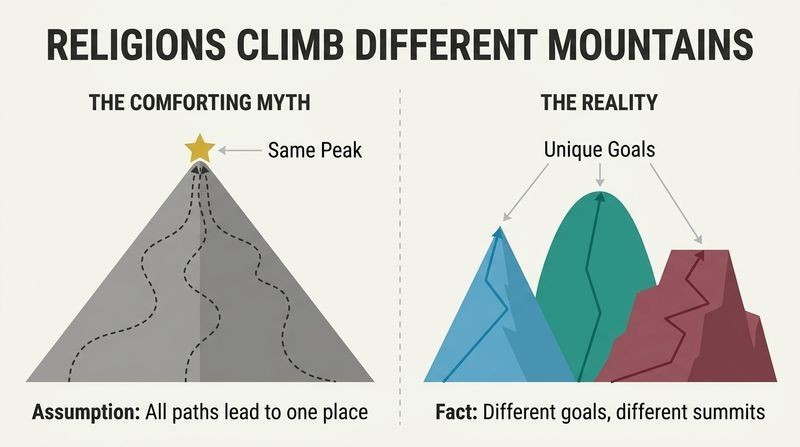
The core thesis is a rejection of religious sameness. Prothero opens by attacking what he calls Godthink: the fashionable notion, traceable to poet William Blake and popularized by Huston Smith and Gandhi, that all faiths are different paths up one mountain. He finds this idea comforting but false, disrespectful, and even dangerous.
Religions converge on ethics but diverge everywhere else. Nearly all traditions endorse a version of the Golden Rule and forbid murder and incest. Yet they split sharply on doctrine, ritual, mythology, experience, and law. A Buddhist who believes in no god, a Jew who believes in one, and a Hindu who worships thousands are not saying the same thing in different accents. Pretending otherwise, Prothero argues, blinds us to real conflicts driving violence from Kashmir to Jerusalem.
The claim lands hard against decades of interfaith diplomacy built on unity. What strengthens Prothero's case is his analogy to relationships: nobody thinks a marriage succeeds because partners are secretly identical. Political theorist Isaiah Berlin's value pluralism, that human goods are genuinely plural and sometimes incommensurable, underwrites the argument. A fair challenge: mystics across traditions (Meister Eckhart, Rumi, Shankara) do report strikingly similar experiences of ineffable oneness, which perennialists cite as evidence. Prothero's rebuttal is that these elite mystical convergences ignore what ordinary practitioners actually believe and do. The book sides decisively with the pilgrim over the philosopher.
Diagnose any religion with four questions: problem, solution, technique, exemplar

Prothero's central analytical tool is a four-part template. Every religion, he argues, identifies a human problem, offers a solution that doubles as its ultimate goal, prescribes techniques for getting from problem to solution, and holds up exemplars who model the path.
The framework exposes how different the traditions really are. In Christianity the problem is sin, the solution is salvation, the technique is faith and good works, and the exemplars are saints. In Buddhism the problem is suffering, the goal is nirvana, the technique is the Eightfold Path, and the exemplars are arhats or bodhisattvas. Asking whether Buddhists seek salvation makes no sense: they don't believe in sin. It's like asking which sport scores the most runs. Baseball wins only because runs are foreign to basketball and golf.
The sports analogy is the book's most memorable teaching device, and it does real philosophical work by exposing category errors baked into casual religious talk. The framework echoes the structure of medical diagnosis (symptom, cure, treatment, healed patient) and resembles the Buddhist Four Noble Truths generalized into a universal grammar. A limitation Prothero himself concedes: four sentences cannot capture millennia of tradition, and internal disputes (Catholic versus Protestant on how salvation works) fracture even the neat categories. Still, as a first pass for the religiously illiterate, the template is genuinely clarifying, turning a fog of exotic vocabulary into comparable, answerable questions.
Islam means submission, and its problem is self-sufficiency, not sin

Islam addresses pride, not original sin. Prothero ranks Islam the most influential religion today, growing faster than Christianity and shaping the global conversation. The word relates to both peace and submission. Muslims are born inclined toward good, so the human problem is not inherited sin but self-sufficiency, the hubris of acting as though you can live without God. The solution is surrender, achieving a soul at peace in Paradise.
Islam prizes right action over right belief. The Five Pillars structure practice: the Shahadah (profession of faith), salat (five daily prayers), zakat (charity of 2.5% of assets), sawm (fasting during Ramadan), and hajj (pilgrimage to Mecca). Prothero stresses orthopraxy over orthodoxy. The Quran repeatedly insists that submitting matters more than merely believing, since even heaven and earth already proclaim God's existence.
Framing Islam's problem as self-sufficiency rather than sin is a genuinely illuminating move that cuts against Christian projection. It aligns with sociologist of religion analyses showing Islam and Judaism as orthopraxic (defined by practice) versus Christianity's creedal emphasis. Prothero's insistence on reading jihad honestly (both spiritual struggle and regulated warfare) resists both apologists who sanitize it and critics who reduce Islam to violence. Worth adding: the Quran's careful just-war rules (protecting noncombatants, forbidding suicide) predate the Geneva Conventions by centuries, a point that complicates simplistic clash-of-civilizations narratives. The chapter's honesty about troubling texts alongside its refusal to caricature models the balanced literacy the book champions.
Christianity hallows the ordinary through a God who became human
The Incarnation is Christianity's distinctive scandal. Prothero identifies sin as the Christian problem and salvation as the solution, achieved through Jesus's death and resurrection. But he emphasizes a second theme often missed: the doctrine that God took on a human body invests everyday life with sacred meaning. Christianity is a rescue religion, but also one that sanctifies the mundane.
Its unity has always been elusive. With 2.2 billion followers, Christianity fractured repeatedly: the 1054 split between Catholicism and Orthodoxy, the sixteenth-century Reformation over whether faith alone (sola fides) or faith plus works saves. Prothero highlights the browning of Christianity: the typical Christian today is no longer a European man but a Latin American or African woman. Pentecostalism, born on Azusa Street in 1906, now claims roughly 600 million adherents worldwide.
The demographic reframing is the freshest contribution here. Scholars like Philip Jenkins and Lamin Sanneh have documented this southward shift, but Prothero makes vivid how it inverts the assumption that Christianity is white and Western. The observation that Pentecostalism liberates believers from the tyranny of belief (privileging experience over doctrine) is a sharp parallel to how Luther freed Christians from the tyranny of works. One tension: Prothero calls Christianity the doctrinal religion par excellence, yet the fastest-growing branch prizes ecstatic experience over creed. This suggests the tradition's center of gravity is migrating, and the old Protestant-Catholic-Orthodox map may be obsolete for understanding twenty-first-century faith.
Confucianism finds the sacred hidden in plain sight in social life
Confucianism treats the secular as sacred. Often dismissed in the West as etiquette or fortune-cookie wisdom, Confucianism may have shaped more people over more time than any other tradition through its Analects. Prothero frames its problem as social chaos and its solution as social harmony, achieved through education, ethics, and ritual. It refuses the Western divide between sacred and secular, locating transcendence within human relationships rather than beyond them.
We become human by becoming social. Two concepts anchor the tradition: ren (human-heartedness, right relations between people) and li (ritual propriety, doing the proper thing properly). Where Daoists see society as a cage, Confucians insist the self is not an isolated atom but the center of a web of obligations to family, community, and the world. Self-cultivation and social harmony reinforce each other.
Prothero's reframing of Confucianism as religious humanism, a tradition that infuses the everyday with sacred weight rather than pointing beyond it, is a valuable corrective to checklist definitions of religion that require a god. It anticipates debates in religious studies about whether Western categories distort non-theistic traditions. The emphasis on the relational self resonates with communitarian critiques of liberal individualism (Charles Taylor, Michael Sandel) and with cultural psychology showing East Asian interdependent versus Western independent self-construals. A fair worry the chapter voices: Confucianism's hierarchy (ruler over subject, husband over wife) is hard to redeem on feminist grounds, though the reciprocity built into the Five Relationships complicates the caricature of blind obedience.
Hinduism is an umbrella, not a creed, and love is its most popular path
Hinduism tolerates staggering internal diversity. With no founder, no single creed, and no mechanism for excommunication, Hinduism absorbs rather than repels new influences. Prothero identifies its shared problem as samsara (the cycle of death and rebirth) and its goal as moksha (spiritual liberation), which he insists is not salvation, since Hindus have no doctrine of sin.
Three paths lead to liberation, and devotion won. The Vedas prescribe karma yoga (ritual action), the Upanishads prescribe jnana yoga (the wisdom that Atman, the individual soul, equals Brahman, ultimate reality). But bhakti yoga, the discipline of heartfelt devotion to a chosen god, became dominant around the time of Jesus. It democratized moksha: no longer reserved for celibate renouncers, liberation became available to ordinary people through love and grace, without renouncing family or work.
The distinction between moksha and salvation exemplifies the book's core discipline: refusing to translate one tradition's goal into another's vocabulary. Prothero's geological metaphor (Hinduism as layered rock strata rather than a tree) captures how ancient and modern coexist without one replacing the other. The shift from self-effort (jnana) to other-power (bhakti grace) uncannily parallels the Buddhist move from Theravada arhat to Mahayana bodhisattva, and even the Protestant faith-versus-works debate, suggesting a recurring religious dynamic: elite paths of rigorous self-discipline repeatedly give way to popular paths of grace. The observation that Western yoga strips this tradition down to stress relief is a quiet indictment of spiritual consumerism.
Buddhism's radical claim: the self you defend does not exist
The problem is suffering, born of clinging to permanence. The Buddha, a pampered prince who saw sickness, old age, and death, concluded existence is marked by dukkha (suffering). Prothero presents the Four Noble Truths as observations, not dogma: suffering exists, it has an origin (ignorant craving), it can end, and the Eightfold Path leads out. Buddhism is a come-and-see tradition prizing experience over belief.
Its most vexing teaching is no-self (anatta). What we call I is not a soul but a shifting bundle of five aggregates (matter, sensations, perceptions, thoughts, consciousness), like a chariot that is only its parts. Mahayana Buddhism extended this into shunyata (emptiness): nothing has independent, permanent existence. Prothero stresses emptiness is not nihilism but freedom, and that samsara and nirvana are ultimately not two different places.
Presenting Buddhist doctrines as pragmatic tools (rafts to be discarded once they've carried you across) rather than truth-claims is philosophically astute and matches how many practitioners actually hold them. The no-self teaching has found unexpected corroboration in cognitive science and in Douglas Hofstadter's and Thomas Metzinger's arguments that the unified self is a useful illusion constructed by the brain. Prothero's psychologically savvy gloss (the ego endlessly whispers you're great and you stink) makes an abstract metaphysics concrete. A useful caution the chapter offers: most Buddhists worldwide do not meditate but practice devotional worship of Buddhas, puncturing the Western fantasy of Buddhism as a purely rational, meditation-based philosophy.
Yoruba religion diagnoses disconnection and prescribes reconnection through the orishas
A great religion hiding in the primal-religion chapter. Prothero argues that Yoruba religion, with perhaps 100 million adherents across West Africa, Brazil (Candomble), and Cuba (Santeria), deserves treatment as a major world tradition, not a footnote lumped with animism. Its problem is disconnection: from our destinies, from each other, from nature, and from the divine.
The solution is connection, worked through practice not belief. The cosmos brims with ashe, the power to make things happen. Devotees reconnect through divination, sacrifice, and spirit possession. In Ifa divination, a priest (babalawo) casts palm nuts and chants memorized verses, but the client chooses which story fits, because wisdom is recalling the destiny each soul chose before birth. The orishas are strikingly human: they marry, divorce, err, and suffer, drawing near to the human condition rather than lording above it.
Including Yoruba religion as a peer of Christianity and Islam is the book's boldest structural choice, and it directly confronts the Western scholarly bias toward literate, scripture-based traditions. The point that religion can center on flourishing and connection rather than sin and afterlife broadens the very definition of religion, echoing feminist philosopher Grace Jantzen's argument that religions concern natality (birth, flourishing) as much as mortality. The orishas' moral complexity, gods who suffer for their misdeeds unlike the unpunished Greek pantheon, offers a theodicy that sidesteps the problem of evil haunting monotheism. Yoruba's survival through slavery by disguising orishas as Catholic saints is one of history's great acts of religious creativity.
To be a Jew is to argue for the sake of God
Judaism is narrative and law, not creed. The smallest great religion (roughly 14 million people) but among the most influential, Judaism centers on story and halakha (law or way), not belief. Prothero notes you can be an atheist and a Jew. Its problem is exile, its solution is return, and its techniques are remembering the story and following the 613 mitzvot (commandments) to repair the world (tikkun olam).
Argument is a sacred act. In the yeshiva, students study in loud, gesticulating pairs, and the Talmud is designed around contradictions, preserving losing opinions alongside winning ones. The tradition distinguishes arguing for victory from arguing for the sake of God. The paradigmatic story is the destruction of the Jerusalem Temple in 586 BCE and the Babylonian exile, which turned a religion of priests and sacrifice into one of rabbis, texts, and portable practice.
The reframing of contradiction as a feature rather than a bug is Judaism's gift to intellectual culture, and Prothero connects it credibly to Freud's psychoanalysis (competing voices within the self) and to the U.S. Supreme Court's practice of recording dissents. The exile-and-return structure offers a portable template that immigrant and diaspora communities worldwide have borrowed. One might push further: the claim that Judaism has no real creed is contested, since Maimonides' Thirteen Principles function creedally for many. But Prothero's larger point holds, that a tradition tolerant of ambiguity and allergic to heresy-hunting produces a distinctive relationship to certainty, one the modern world, drowning in dogmatic confidence, badly needs.
Daoism says stop striving and flow with nature to flourish
Daoism reframes wandering as freedom, not punishment. Where the monotheisms treat wandering as exile after wrongdoing, Daoism treats it as the mark of an enlightened being. Prothero identifies its problem as lifelessness (we drain our vitality by submitting to social conventions, etiquette, and rigid thinking) and its solution as flourishing: health, longevity, even physical immortality, achieved by aligning with the Dao, the natural way of things.
The core technique is wu wei, effortless action. Like water that wears down rock by flowing around it rather than smashing through, the sage acts spontaneously without forcing. The Daodejing prizes yielding over pursuing, the valley over the peak, the uncarved block over the sculpted one. Confucian self-cultivation, Daoists counter, is actually self-destruction. Return to your natural spontaneity and you return to life itself.
Prothero's insistence that the Daodejing's famous opening is about change and creativity rather than pure mysticism (drawing on scholar Thomas Michael) is a provocative, under-appreciated reading worth flagging for readers who know only the mystical translations. The surfer catching a wave as an image of wu wei translates an ancient concept into intuitive modern terms; it resonates with psychologist Mihaly Csikszentmihalyi's concept of flow, the state of effortless absorption. A productive tension: Daoism's anti-striving ethic sits awkwardly beside its elaborate immortality techniques (alchemy, breath control, sexual practices), which are nothing if not effortful. The tradition contains both the mystic who accepts death and the adept who fights it.
The New Atheists preach their own dogmatic anti-religion
Atheism can function as a religion. Prothero treats the New Atheists (Dawkins, Harris, Hitchens, Dennett, Onfray) as running their own version of Godthink, lumping all religions into one poisonous boat just as perennialists lump them into one virtuous one. Their problem is religion itself, their solution is reason, their exemplars are heroic unbelievers from Diagoras to Freud.
Angry atheism mirrors the fundamentalism it attacks. Prothero argues militant atheism divides the world into the enlightened and the deluded, brooks little genuine conversation, and treats disagreement as evidence of stupidity or malice. He tests atheism against a functional definition of religion (creed, cultus, code, community) and finds it often qualifies. The French Revolution's Cult of Reason, with its saints and festivals, shows secular faith can be as ritualized and fanatical as any church.
The move to analyze atheism with the same functional lens applied to religions is clever and disciplined, refusing atheism a free pass from the categories it deploys against others. Prothero's distinction between angry atheism (a crusade to convert) and friendly atheism (a civil rights movement for recognition) is genuinely useful and predates much of the later intra-atheist debate. The Amanda Gulledge anecdote, an Alabama mother arguing through stories about her children's goodness rather than through invective, quietly suggests where a more persuasive nonbelief might go. Fair to note: not all atheists hold their view with religious intensity, and Prothero grants this, distinguishing ultimate-concern atheists from those who shrug.
Religious literacy, not forced agreement, is what a dangerous world needs
Understanding differences beats pretending they don't exist. Prothero's practical conclusion: interfaith peace is not built on the false dogma that all religions are one. Just as Mets and Yankees fans coexist, and marriages thrive on knowing (not erasing) differences, religious rivals can cooperate only after honestly mapping where they clash.
Learn to talk about religion the secular way. He distinguishes the religious way of talking (preaching creeds) from the secular, descriptive way that reports on religion without judging it true or false, like an art historian who need not be a painter. The Interfaith Youth Core model, which sets traditional believers of clashing theologies to shared community service rather than doctrinal debate, shows the path. The blind-men-and-the-elephant story, he argues, teaches not religious unity but the humbling limits of human knowledge.
This closing reframes the entire project: the goal is not tolerance built on a comforting lie but respect built on accurate knowledge. It connects to civic-education debates and to political theorist argument that stable pluralism requires acknowledging deep difference, not dissolving it. Prothero's reading of the elephant parable against its usual perennialist use is characteristically contrarian and apt: the blind men's error is not that they touch different parts of one truth but that each mistakes his fragment for the whole. The prescription (religious literacy as civic necessity) has only grown more urgent as religion continues to move elections, economies, and armies that purely secular analysis fails to predict.
Analysis
Prothero, a Boston University religion scholar, writes against the grain of a half-century consensus. His target is the feel-good pluralism of Huston Smith, Joseph Campbell, and Karen Armstrong, which he brands Godthink: the leap of faith that all religions are essentially one. His counter-thesis is deceptively simple, that religions are more like second cousins than identical twins, sharing family resemblances (Ninian Smart's seven dimensions) while pursuing genuinely different goals. The book's engine is a four-part diagnostic (problem, solution, technique, exemplar) applied across eight traditions ranked by contemporary impact.
The intellectual courage here is real. Ranking religions and placing Yoruba religion alongside Christianity while excluding Sikhism invites controversy, and Prothero embraces it. His governing insight, that translating one tradition's goal into another's vocabulary (calling moksha or nirvana salvation) is a category error, is the book's most durable contribution. It disciplines the reader to hear each tradition on its own terms. The book has limits worth naming. Prothero occasionally overstates difference to make his point, downplaying the real convergences mystics report and the shared ethical core he concedes but hurries past. His impact-based ranking is admittedly subjective and time-bound. And by structuring each religion around a single problem-solution axis, he risks flattening internal diversity he elsewhere insists upon.
Yet the timing is prescient. Written amid post-9/11 anxiety, the book argues that a furiously religious planet demands literacy, not the wishful erasure of difference. Its deeper move is epistemological: whether through Buddhist emptiness, the Confucian recognition of ignorance, or the elephant parable, Prothero lands on humility. The great religions, he suggests, function partly to remind us our thoughts are not God's thoughts. That is a subtler and more defensible unity than the one he demolishes, not unity of doctrine but a shared confrontation with the limits of human knowing.
Review Summary
God Is Not One challenges the notion that all religions are essentially the same. Prothero examines eight major religions, highlighting their unique problems and solutions. While some readers appreciate the book's informative overview and thesis, others criticize its superficial treatment of complex belief systems. The chapter on atheism is particularly controversial, with many finding it biased. Despite its flaws, many readers found the book enlightening, especially regarding lesser-known religions like Yoruba. Overall, it serves as a decent primer on world religions, though its main argument remains contentious.
Glossary
Godthink
Treating all religions as identicalProthero's coined pejorative for the naive assumption that the world's religions are all fundamentally the same, whether the perennialist version (all are equally true and beautiful) or the New Atheist version (all are equally false and poisonous). He argues both camps distort reality by lumping distinct traditions together, blinding people to genuine differences that drive real-world conflict and cooperation.
Four-part approach (problem, solution, technique, exemplar)
Template for comparing religionsProthero's analytical framework for understanding any religion. Each tradition names a distinctive human problem, offers a solution that serves as its ultimate goal, prescribes techniques for moving from problem to solution, and holds up exemplars who model the journey. For example, Christianity: sin, salvation, faith and works, saints. The tool reveals how differently traditions define the human predicament itself.
Orthopraxy vs. orthodoxy
Right practice versus right beliefA distinction Prothero uses to separate religions organized around correct action (orthopraxy) from those organized around correct belief (orthodoxy). Islam, Judaism, Confucianism, and Yoruba religion emphasize practice: doing prayers, following law, performing ritual. Christianity, especially since the Nicene Creed, uniquely emphasizes belief. The distinction warns against assuming all religions are, like Protestantism, primarily faith or belief systems.
Samsara and moksha
Rebirth cycle and liberationIn Hinduism (and adapted by Buddhism), samsara is the wearisome cycle of birth, death, and rebirth driven by karma. Moksha is spiritual liberation, release from that cycle. Prothero stresses moksha must not be translated as salvation, because salvation implies rescue from sin, a concept Hindus and Buddhists reject. Confusing the two is his prime example of a category error in comparative religion.
Anatta / shunyata
No-self and emptinessAnatta is the Buddhist teaching that there is no permanent soul or self; what we call I is a shifting bundle of five aggregates, like a chariot that is nothing but its parts. Mahayana Buddhism extended this into shunyata (emptiness): all things lack independent, permanent existence because everything arises interdependently. Prothero insists emptiness means freedom and openness, not nihilism.
Ashe
Power to make things happenThe central concept in Yoruba religion: sacred power or life-force, comparable to the Chinese qi, that animates the orishas (deities), priests, natural objects, words, and human beings. Its core meaning is the power to make things happen and to make things change. Devotees reconnect with ashe through divination, sacrifice, and spirit possession to flourish in this world.
Wu wei
Effortless, natural actionA key Daoist concept usually translated as non-action or non-interference, but meaning action that is spontaneous, effortless, and in harmony with the Dao (the natural way). Prothero illustrates it with a surfer catching a wave rather than paddling against the current, or water wearing down rock by flowing around it. It opposes forced, contrived, willful striving.
Tikkun olam
Repairing the worldThe Jewish concept that the human task is to repair or heal a broken world through righteous action, chiefly by observing the 613 mitzvot (commandments). For Prothero it captures Judaism's this-worldly, practice-centered orientation: redemption is accomplished here on earth through doing rather than believing, distinguishing Judaism sharply from faith-centered Christianity.
Bhakti yoga
Hindu path of devotionOne of Hinduism's three disciplines for reaching moksha, alongside karma yoga (ritual action) and jnana yoga (wisdom). Bhakti is the path of heartfelt, loving devotion to a chosen deity. Emerging around the time of Jesus, it became Hinduism's most popular path because it democratized liberation, offering moksha through grace to ordinary people of all castes and genders without requiring renunciation of family and work.
FAQ
What's God Is Not One about?
- Exploration of Religions: The book examines eight major world religions—Islam, Christianity, Confucianism, Hinduism, Buddhism, Yoruba Religion, Judaism, and Daoism—highlighting their unique beliefs and practices.
- Focus on Differences: Stephen Prothero argues against the notion that all religions are fundamentally the same, emphasizing the importance of their differences in understanding their impact on the world.
- Religious Rivalry and Ethics: The book discusses how these religions often conflict with one another, yet share common ethical teachings, illustrating the complexity of religious identity and practice.
Why should I read God Is Not One?
- Understanding Religious Diversity: The book provides a comprehensive overview of major religions, essential for anyone interested in the complexities of faith and spirituality in a global context.
- Challenging Assumptions: Prothero challenges the popular belief that all religions are essentially the same, encouraging readers to appreciate the distinctiveness of each tradition.
- Real-World Relevance: The author connects religious beliefs to real-world issues, such as violence and social justice, making the book relevant to contemporary discussions about religion's role in society.
What are the key takeaways of God Is Not One?
- Religions Are Not Uniform: Prothero asserts that "God is not one," emphasizing that each religion has its own doctrines, rituals, and goals that shape the lives of its followers.
- Ethics vs. Doctrine: While many religions share ethical principles, they diverge sharply on doctrinal issues, which can lead to significant social and political consequences.
- Importance of Context: The book highlights the necessity of understanding the historical and cultural contexts of each religion to fully grasp their teachings and practices.
What are the best quotes from God Is Not One and what do they mean?
- "The fundamentals or essentials of all religions are the same.": This quote reflects a common belief in religious unity, which Prothero critiques by arguing that such a view oversimplifies the rich diversity of religious traditions.
- "This wishful thinking is motivated in part by an understandable rejection of the exclusivist missionary view.": Prothero points out that the desire for religious harmony often leads to ignoring the real differences that can cause conflict.
- "The world’s religious rivals do converge when it comes to ethics, but they diverge sharply on doctrine.": This highlights the complexity of religious identity, suggesting that while ethical teachings may overlap, the core beliefs that define each religion are distinct.
How does Stephen Prothero define the concept of "jihad" in Islam?
- Two Types of Struggle: Jihad refers to both a spiritual struggle against pride and self-sufficiency and a physical struggle against enemies of Islam.
- Not Just Holy War: While often misinterpreted as solely a call to violence, jihad encompasses a broader range of actions, including preaching and social justice efforts.
- Contextual Understanding: Prothero emphasizes the need to understand jihad within the context of Islamic teachings and the Quran, which includes just-war principles and the protection of non-combatants.
What is the significance of the "Five Pillars" in Islam according to God Is Not One?
- Core Practices: The Five Pillars—Shahadah (faith), Salat (prayer), Zakat (charity), Sawm (fasting), and Hajj (pilgrimage)—are fundamental acts of worship that define a Muslim's faith and practice.
- Community and Identity: These pillars shape individual spirituality and foster a sense of community and shared identity among Muslims worldwide.
- Path to Paradise: Prothero notes that adherence to these practices is seen as essential for achieving a "soul at peace" and ultimately attaining Paradise.
How does God Is Not One address the topic of religious violence?
- Real-World Consequences: Prothero argues that religious differences can lead to real-world conflicts, as seen in various historical and contemporary examples of violence.
- Misunderstanding and Ignorance: A lack of understanding about the distinct beliefs and practices of different religions contributes to tensions and violence.
- Need for Realism: Prothero calls for a realistic view of religious rivalries, advocating for knowledge and dialogue rather than oversimplified notions of unity.
What role does ethics play in the religions discussed in God Is Not One?
- Common Ethical Teachings: Many religions share similar ethical principles, such as the Golden Rule, which promotes compassion and respect for others.
- Divergence in Practice: Despite shared values, each religion has its own unique ethical framework that informs how adherents live out their beliefs.
- Impact on Society: The ethical teachings of these religions have significant implications for social justice, community relations, and individual behavior in diverse cultural contexts.
How does Stephen Prothero view the relationship between religion and culture in God Is Not One?
- Interconnectedness: Religion cannot be understood in isolation from the cultural and historical contexts in which it exists, as these factors shape beliefs and practices.
- Influence on Identity: Cultural elements, such as language, art, and social norms, interact with religious teachings to form a complex identity for adherents.
- Dynamic Interaction: As cultures evolve, so too do religious expressions, leading to new interpretations and practices that reflect contemporary realities.
What insights does God Is Not One provide about Judaism?
- Narrative Centrality: Judaism is fundamentally about storytelling, with Jewish identity deeply intertwined with the narratives of the Hebrew Bible.
- Exile and Return: Themes of exile and return are central to Jewish history and identity, shaping the collective memory and practices of the Jewish people.
- Law and Ethics: The relationship between law (halakha) and narrative is crucial, as Jews strive to live according to the commandments while remembering their historical and cultural stories.
How does God Is Not One address the concept of religious pluralism?
- Critique of Pluralism: Prothero critiques the idea that all religions are essentially the same, arguing that such views overlook the significant differences that define each faith.
- Unique Paths: Each religion offers its own unique path to understanding the divine and addressing human existence, which should be respected and understood on their own terms.
- Interfaith Dialogue: Prothero advocates for interfaith dialogue that acknowledges differences rather than glossing over them, promoting a more nuanced understanding of global religions.
How does Stephen Prothero compare the practices of Daoism and Confucianism in God Is Not One?
- Daoism’s Emphasis on Nature: Daoism focuses on harmony with nature, spontaneity, and the concept of wu wei (non-action), encouraging followers to align with the natural flow of life.
- Confucianism’s Social Structure: Confucianism emphasizes social order, propriety, and the importance of relationships, advocating for a structured approach to ethics and governance.
- Complementary Yet Distinct: While both traditions originated in China and share some philosophical underpinnings, they offer different paths to understanding human existence and morality.
Download PDF
Download EPUB
.epub digital book format is ideal for reading ebooks on phones, tablets, and e-readers.








