

Key Takeaways
Treat monopoly as private government, not merely expensive shopping.
Power reaches beyond prices. Matt Stoller’s central claim is that monopoly matters because dominant firms can set the terms of work, trade, and public life. A local store, a farmer, or a small manufacturer may depend on a handful of buyers, lenders, or platforms, even when consumers see low prices. The issue is not simply whether a company is large. It is whether private power can dictate conditions without meaningful competition or public accountability.
The stakes are visible today. The book connects this history to concentrated banking, hospitals, airlines, food supply chains, and technology platforms. It argues these systems were built through choices about law and policy, not produced by an unstoppable market law.
What's striking is the shift from asking whether a firm is big to asking what people must depend on it for. That resembles a central concern in republican political thought: freedom means more than avoiding direct interference; it also means not living at another party's unchecked discretion. Still, scale can support useful coordination, lower costs, and shared infrastructure. The practical test is therefore not size alone, but whether users have alternatives, whether terms are contestable, and whether essential decisions answer to public rules.
Choose regulated competition over corporate rule or expert command.
The 1912 choice was fundamental. Theodore Roosevelt wanted strong experts to supervise large corporations. Woodrow Wilson, advised by lawyer Louis Brandeis, argued that concentrated firms should be broken up and markets structured so they could not quickly reconcentrate. Brandeis called the goal industrial liberty: people should be able to participate in commerce without submitting to private rulers. Regulated competition meant combining antitrust action with public rules that kept markets open.
The New Haven Railroad showed why. Brandeis exposed how financiers had consolidated New England transport while neglecting operations and safety. Rather than trusting the company or placing it under a single government expert, Wilson’s program used antitrust, the Federal Trade Commission, and the Clayton Act to disperse power and regulate trade.
This is a useful correction to the false choice between laissez-faire and centralized planning. A market is not an absence of rules; it is a set of rules about entry, access, contracts, and accountability. Network industries also reveal a genuine complication: uncontrolled competition among railroads had produced price wars, neglected maintenance, and crashes. The stronger lesson is institutional design. Where one provider is unavoidable, public oversight may be needed; where entry is possible, policy can protect it.
Follow credit and rescue flows to see who really governs.
Mellon’s reach was institutional. Andrew Mellon was not just a wealthy industrialist. As treasury secretary, he influenced taxes, the Federal Reserve, and the administration of his own business interests. His aluminum company, Alcoa, sat inside a wider network of banks, suppliers, utilities, and industrial firms. Stoller calls this kind of public-private financial rule Mellonism. When the Depression struck, Mellon opposed relief while millions lost jobs and homes.
Patman made the conflict public. In 1932, Texas congressman Wright Patman initiated impeachment proceedings over Mellon’s alleged self-dealing. The charges did not produce a criminal conviction, but the investigation helped expose the arrangement. Patman also championed an early payment to World War I veterans. Congress overrode Roosevelt’s veto in 1936, and an economist later estimated the payment added 2.5 to 3 percentage points to that year’s economic growth.
Patman’s example shows how oversight can connect technical questions, such as tax treatment or credit allocation, to ordinary security. It also challenges the habit of treating bailouts as neutral emergency measures: who receives liquidity, and what conditions follow, are political decisions. One caution is that scandal does not explain an entire depression. The book also describes monetary errors, weak banks, and international shocks. The broader insight is about accountability, not a claim that one financier caused every failure.
Use public power to open strategic bottlenecks, not protect incumbents.
War exposed monopoly’s costs. Alcoa controlled nearly all domestic aluminum production, a metal crucial for aircraft. During the buildup to World War II, company leaders underestimated how much aluminum the country needed, while production lagged. Antitrust officials argued that private control over a strategic input could weaken national defense as well as competition.
Government helped create alternatives. The Defense Plant Corporation financed new capacity for firms including Reynolds and Kaiser. The government owned many of the factories it financed, then used their sale after the war to broaden competition. Alcoa remained a major company, but it no longer faced the same unchecked position. The episode presents public finance and antitrust as ways to build productive capacity without handing an entire industry to one private gatekeeper.
The episode makes industrial policy concrete: public financing can create competitors when private capital will not, or when an incumbent controls access to essential inputs. That approach differs from simply subsidizing existing firms, because it can change who is able to produce. The wartime setting, however, matters. Emergencies make extraordinary coordination easier to justify, and they do not automatically prove the same tools fit every industry. The durable question is how to ensure public investment expands choice rather than cementing a new favored firm.
Protect producers from buyer power, not only shoppers from high prices.
A&P was both efficient and powerful. The Great Atlantic & Pacific Tea Company helped pioneer low-cost grocery formats and grew from fewer than 500 stores in 1914 to about 14,000 a decade later. Its scale also let it demand special payments from suppliers and undercut local competitors. Fair trade laws allowed some manufacturers to set minimum resale prices, helping retailers compete through service rather than discounting alone. The Robinson-Patman Act targeted discriminatory prices and allowances that could give large chains an unfair advantage.
The consumer argument had a blind spot. In 1975, Congress repealed federal support for state fair trade laws, presenting the change as a way to lower prices. Walmart later advertised that the repeal made its discounting possible. The book argues the shift strengthened chains and weakened independent stores and suppliers.
The book usefully distinguishes buyer power from the familiar fear of high prices. A retailer can benefit shoppers in the short term while gaining leverage over workers, suppliers, and competitors. But fair trade rules can also shelter inefficient businesses or limit genuine price competition. A sound policy has to identify exclusionary tactics and unequal bargaining power rather than treating every discount as predatory or every small shop as deserving protection. Consumer savings matter, but so do the conditions that determine who can keep producing.
Treat postwar prosperity as a political achievement, not a natural outcome.
The postwar economy had guardrails. Banking rules limited speculation and kept many lending decisions local. Antitrust policy constrained mergers, while unions, farm supports, housing finance, and public investment spread economic security more widely. By 1970, roughly one third of workers belonged to unions, and the poverty rate had fallen from more than 40 percent in 1945 to a little over 10 percent.
These gains were substantial but unequal. The New Deal and postwar order expanded access to work, education, homeownership, and health coverage, yet many programs excluded or disadvantaged Black Americans, especially in the segregated South. The book’s point is not that antitrust alone created prosperity. It is that economic growth coexisted with policies that dispersed power and made its gains more broadly accessible.
This account treats institutions as part of the economy rather than as a drag on it. Stable credit, labor bargaining, and competition rules can support investment by limiting destructive cycles and giving more people purchasing power. The racial qualification is essential: broad prosperity for many did not mean equal citizenship for all, and some programs reinforced existing exclusions. The strongest interpretation is neither nostalgia nor dismissal. It asks which institutional features widened opportunity, who was left out, and how those mechanisms might work more fairly.
Notice when economic theory turns political choices into supposed inevitabilities.
The argument shifted before the laws did. Historian Richard Hofstadter’s consensus history portrayed American politics as lacking deep, sustained conflict over economic power. Economist John Kenneth Galbraith’s countervailing power argued that concentrated firms would naturally be checked by large unions or buyers. Meanwhile, the Chicago School’s law and economics movement recast antitrust around efficiency and consumer prices, with Robert Bork claiming that this was the law’s true purpose.
These ideas narrowed the debate. If concentration was efficient, inevitable, or automatically balanced, public action could look both misguided and unscientific. Stoller argues that liberal thinkers and conservative scholars helped make questions of corporate power harder to see, even while disagreeing about who should manage large institutions.
The book highlights a subtle political effect of technical language: a choice about whose interests count can be presented as a neutral calculation. Measures such as consumer prices and productive efficiency are informative, but they do not capture every relevant value, including resilience, bargaining power, or local control. At the same time, economic analysis can reveal real costs that moral rhetoric overlooks. The useful discipline is to ask what a model measures, what it leaves out, and whose definition of welfare it quietly adopts.
Track financial innovations by the power they move, not novelty.
Walter Wriston loosened the old boundaries. In 1961, Citibank introduced negotiable certificates of deposit, instruments that could be traded, allowing banks to attract funds beyond the local deposits constrained by Regulation Q. That rule limited the interest banks could pay on deposits. CDs helped create a parallel credit system, alongside markets for Eurodollars and commercial paper, where borrowing could grow outside familiar bank controls.
Penn Central revealed the risk. The railroad borrowed heavily, hid losses, and used complex accounting while executives pursued side businesses. When it failed in 1970, officials feared that a collapse in commercial paper could spread through banks and corporations. The Federal Reserve stabilized credit. The episode showed how financial products can shift both power and risk, and how rescue can make a lightly regulated channel seem implicitly protected.
Financial innovation can solve real problems by making funds more liquid and connecting borrowers to lenders. It can also obscure who bears losses, especially when short-term funding supports long-term or risky assets. That is a governance issue, not merely a technical one. A useful test for any new instrument is whether regulators can see its exposures, whether users understand its risks, and whether the public is expected to absorb losses if it becomes essential to the system.
Reform Congress without mistaking populist expertise for obsolete obstruction.
Patman’s removal changed more than a committee chair. In 1975, newly elected Watergate Democrats helped oust the 81-year-old chairman of the House Banking Committee. Many wanted to break the seniority system and clean up Congress, but knew little about banking. Patman’s allies argued that pro-bank Democrats had used the reform mood to weaken a persistent critic of concentrated finance.
The same year, lawmakers repealed fair trade protections. Supporters described the move as consumer-friendly and anti-inflationary. Walmart, then a regional chain, later credited the repeal with enabling its discounts. Its sales rose from $44 million in 1970 to $1.2 billion in 1979. The book’s lesson is not that congressional reform was wrong, but that process reforms can redistribute power when they discard the knowledge and institutional safeguards of the people being removed.
This episode is a warning about reform by proxy. New members can have legitimate reasons to challenge entrenched leaders, while lobbyists use that opening to pursue unrelated policy goals. The book’s account also risks idealizing Patman, whose long record included political compromises on race. Institutional memory should be evaluated, not worshipped. The practical safeguard is to scrutinize who benefits from a reform, what expertise is being lost, and whether the proposed replacement can actually perform the old institution’s watchdog role.
Treat control of digital platforms as political power, not convenience.
The pattern returned online. The Clinton era expanded financial deregulation and tolerated a large merger wave. Later, Google, Facebook, and Amazon built dominant positions in search and advertising, social media, and online retail. These are not merely popular products: they mediate access to information, audiences, and customers. Amazon, for example, operates a marketplace where it also sells its own goods, giving it unusual visibility into rival merchants.
The book traces a mixed legacy. Antitrust pressure on Microsoft helped keep the browser and internet more open to new entrants, even though the company retained significant power. But enforcement weakened, and the next generation of platform firms grew through acquisitions and control of key channels. Stoller’s final concern is that private control over communication and commerce can limit citizens’ ability to understand and shape their world.
Platforms combine network effects, data, and gatekeeping in ways that older antitrust categories may not fully capture. Their scale can make services cheaper and more useful, while also allowing a company to favor its own products or shape what users encounter. The Microsoft story suggests enforcement can preserve room for innovation without abolishing a successful firm. The challenge is to protect interoperability, entry, and user choice while avoiding remedies that freeze technology or simply transfer power to another incumbent.
Analysis
The book’s most valuable move is to treat markets as political institutions. A railroad, bank, supermarket chain, or search engine does not become powerful through size alone. Its power depends on law, access to credit, control of infrastructure, and the ability to shape the choices available to others. That framework makes the recurring historical pattern legible: a crisis discredits existing arrangements, new ideas recast policy, and concentrated power returns under a fresh vocabulary.
The narrative is strongest when it connects policy design to concrete mechanisms. Mellon’s tax administration, Patman’s hearings, the government-financed aluminum plants, negotiable CDs, and Walmart’s discount model show how abstract rules alter who can act independently. Its account of intellectual change is also useful: a narrow definition of consumer welfare can make distributional and civic consequences disappear from analysis without explicitly denying that they matter.
The argument is intentionally polemical, and that sharpness has costs. It sometimes presents antimonopoly policy as the central explanation for postwar prosperity and later instability, although technological change, global competition, labor institutions, fiscal policy, and racial politics also shaped those outcomes. Its comparisons between concentrated corporate power and authoritarianism are illuminating as warnings about unchecked dependence, but they can blur important differences between democratic regulation and dictatorship. Nor does protecting small firms guarantee fairness or innovation; incumbents can use regulation to block entrants.
The most defensible conclusion is therefore not that bigness is always harmful or that one historical settlement should simply be restored. It is that economic rules allocate power, and democratic policy should make that allocation visible and contestable. Competition, public capacity, and consumer benefits are compatible goals, but none should be treated as an automatic byproduct of corporate scale. The book offers a history of how choices became obscured, and a demanding test for present policy: who gains the ability to say no, and who becomes dependent on a private gatekeeper?
Review Summary
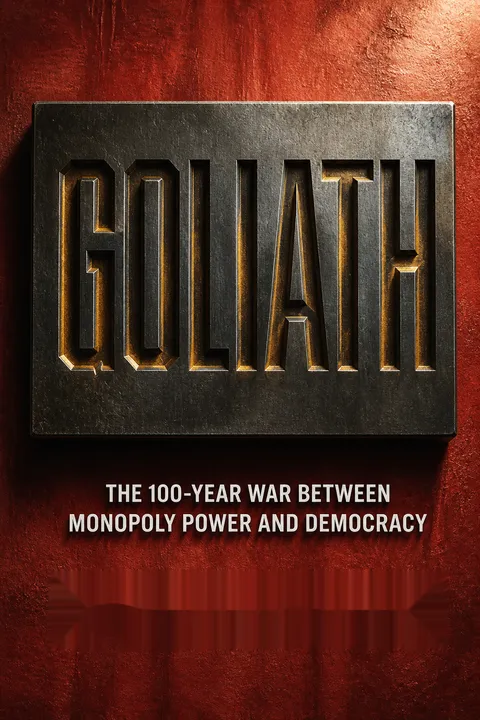
Goliath is a comprehensive history of monopoly power in the United States, praised for its detailed research and unique perspective. Readers appreciate Stoller's analysis of key figures and events in antitrust history, though some find the narrative one-sided. The book is lauded for its relevance to current economic issues and its critique of both political parties' roles in enabling monopolies. While some reviewers note the book's length and occasional tedium, most find it an important and thought-provoking read on the ongoing struggle between democracy and concentrated economic power.
Glossary
Mellonism
Finance joined to state powerStoller’s term for an order in which financiers and large corporations exercise public influence through control of credit, taxation, industry, and government administration. It refers especially to Andrew Mellon’s business empire and his role as treasury secretary. In the book, Mellonism describes a system of private economic rule, not simply the wealth or personality of one financier.
industrial liberty
Freedom to participate in commerceLouis Brandeis’s idea that political freedom is incomplete when people face unchecked private authority in economic life. Industrial liberty means that farmers, workers, shopkeepers, and businesses can participate in commerce without being controlled by a monopoly or financial overlord. Brandeis connected this freedom to public rules that preserve fair access and prevent private economic power from becoming absolute.
regulated competition
Competition supported by public rulesThe approach associated with Brandeis and Wilson: break up or constrain concentrations of private power, then use public rules to prevent markets from reconcentrating. It differs from unregulated competition, which could produce destructive price wars in network industries, and from government-managed monopoly, which places concentrated economic authority under a central expert or agency.
Robinson-Patman Act
Law restricting discriminatory pricingA 1936 federal law aimed at price discrimination that could let powerful buyers secure advantages unavailable to smaller competitors. It was designed to protect independent merchants and manufacturers from pricing practices used by large chains, including A&P. Critics saw it as protectionist or harmful to consumers; supporters saw it as a way to keep buying power from eliminating competition.
countervailing power
Power balanced by another powerful groupJohn Kenneth Galbraith’s theory that concentrated power in one part of the economy tends to produce a balancing concentration elsewhere. A large corporation might face a large union or retailer capable of bargaining against it. Stoller argues that this framework treated such balances as automatic, minimizing the role of public policy and democratic action in creating or maintaining them.
consensus history
History framed as broad ideological agreementThe historical interpretation associated in the book with Richard Hofstadter. It portrays American political actors as sharing basic entrepreneurial assumptions, with mass movements often explained as reactions to social anxiety rather than sustained conflicts over economic power. Stoller argues that this account obscured the long-running political struggle over monopoly, finance, and democracy.
law and economics
Economic analysis applied to lawA legal and academic movement, strongly associated in the book with the Chicago School, that evaluates laws and court decisions using economic concepts such as efficiency and consumer welfare. Stoller argues that it helped shift antitrust away from limiting corporate concentration and toward a narrower concern with prices and productive efficiency. The movement also trained lawyers and judges in its analytical approach.
Regulation Q
Limits on interest paid on depositsA Federal Reserve rule that limited the interest banks could pay on savings deposits and prohibited interest on checking accounts. The restrictions aimed to prevent banks from competing aggressively for deposits, which could centralize lending power and encourage risky finance. The book describes financial products such as negotiable certificates of deposit as ways banks weakened these limits.
shadow banking
Credit outside traditional bank rulesA parallel system of lending and borrowing that operates through financial markets and instruments rather than ordinary, tightly regulated bank deposits and loans. In the book, channels such as negotiable CDs, Eurodollars, and commercial paper let banks and corporations raise funds beyond older constraints. Because these markets could become essential, public authorities were pressured to support them during crises.
consumer welfare
Antitrust focused on consumer outcomesA framework that judges competition policy chiefly by its effects on consumers, especially prices and output. Robert Bork argued that antitrust should focus on this objective. Stoller contrasts that narrow measure with broader concerns about producer independence, market access, resilience, and the political power created by concentrated firms.
FAQ
1. What is Goliath: The 100-Year War Between Monopoly Power and Democracy by Matt Stoller about?
- Central conflict: The book examines the century-long battle in America between concentrated monopoly power and democratic ideals, showing how monopolies have shaped and often undermined democracy.
- Historical scope: Stoller traces this struggle from the early 1900s through the New Deal, postwar prosperity, the rise of neoliberalism, and into the digital age of tech giants.
- Key figures and events: The narrative features pivotal characters like Wright Patman, Andrew Mellon, Louis Brandeis, and Teddy Roosevelt, and covers events such as the 1912 election, the Great Depression, and the rise of companies like Google and Amazon.
- Modern relevance: Stoller connects past and present, arguing that understanding this history is crucial to addressing today’s threats to democracy from corporate and tech monopolies.
2. Why should I read Goliath by Matt Stoller?
- Uncover hidden history: The book reveals a largely forgotten tradition of American populism and antimonopoly activism, essential for understanding current economic and political challenges.
- Insight into democracy and power: Stoller connects economic structures to the health of democracy, showing how unchecked corporate power threatens political freedom and citizen agency.
- Empowerment and action: The book offers practical advice and a hopeful vision for reclaiming democracy by breaking monopolies and empowering citizens.
- Relevance to today: It provides context for contemporary debates about tech giants, financial crises, and the erosion of democratic norms.
3. What are the key takeaways from Goliath by Matt Stoller about monopoly power and democracy?
- Monopoly undermines democracy: Concentrated economic and corporate power can erode democratic institutions, control politics, and suppress competition.
- Recurring historical struggle: The book shows a cyclical battle between populist forces seeking to constrain monopolies and elites pushing for deregulation and consolidation.
- Antimonopoly tradition matters: Understanding the history of antimonopoly activism is crucial for restoring democratic governance and economic justice.
- Change is possible: Stoller emphasizes that monopolization is not inevitable; it results from political choices and can be reversed through collective action.
4. Who was Wright Patman and why is he important in Goliath by Matt Stoller?
- Populist champion: Patman was a Texas congressman and head of the House Banking and Currency Committee, fighting monopolies and financial concentration for over four decades.
- Impeachment of Mellon: He led efforts to impeach Treasury Secretary Andrew Mellon for self-dealing and corruption, symbolizing resistance to plutocratic power.
- Legacy: Patman’s work influenced New Deal reforms and continued to shape antimonopoly politics, representing a populist alternative to technocratic and corporate dominance.
- Defender of the "plain people": He believed that dispersing economic power was essential for political independence and democratic self-governance.
5. How does Matt Stoller in Goliath define and advocate for "old-school populism"?
- Democratic populism: Stoller defines it as the belief that educated, responsible citizens can unite to govern democratically and use laws to protect their rights and economic freedom.
- Against elitism: This tradition values expertise but insists it must serve the people, rejecting technocratic arrogance and plutocratic control.
- Empowerment through learning: Stoller encourages individuals to understand their fields and market structures to participate actively in shaping just commerce and democracy.
- Historical roots: This populism underpinned American democracy from its founding and was central to Patman’s vision.
6. What role did the New Deal play in the war between monopoly power and democracy according to Goliath by Matt Stoller?
- Bulwark against concentration: The New Deal era marked a high point in fighting economic concentration, with policies aimed at regulating monopolies, supporting small businesses, and protecting workers.
- Institutional reforms: It established regulatory bodies and laws (e.g., Banking Act, antitrust enforcement) that dispersed economic power and reinforced democratic governance.
- Democratizing credit and industry: New Deal policies decentralized financial power, regulated banking, and created public financing mechanisms to prevent reconcentration.
- Postwar legacy: The New Deal model underpinned decades of prosperity and peace, but its erosion since the 1970s has contributed to rising inequality and corporate dominance.
7. How does Goliath by Matt Stoller describe the impact of technology giants like Google, Amazon, and Facebook on democracy?
- Radical centralization: These companies control vast portions of global communication, commerce, and information, concentrating unprecedented power in private hands.
- Threat to free press: The decline of independent journalism is linked to these platforms’ centralization of information flow, undermining public discourse and democratic accountability.
- Surveillance and control: Stoller warns that tech monopolies use sophisticated data collection and behavioral targeting, creating new forms of social control.
- Modern monopolies: The rise of these tech giants is portrayed as a continuation of the monopoly tradition, enabled by weakened antitrust enforcement.
8. What was the significance of the 1912 election in the context of monopoly power and democracy in Goliath by Matt Stoller?
- Two visions of progressivism: The election pitted Teddy Roosevelt’s New Nationalism (centralizing corporate power under government) against Woodrow Wilson’s New Freedom (breaking up monopolies to restore competition).
- Role of Louis Brandeis: Brandeis influenced Wilson’s approach, advocating for "industrial liberty" and the breakup of trusts to empower small businesses and workers.
- Outcome: Wilson’s victory led to significant antitrust actions, the creation of the Federal Reserve, and regulatory bodies like the FTC, marking a high point in the fight against monopoly power.
- Long-term impact: The ideological split shaped American politics and antitrust policy for decades.
9. How did the Chicago School of economics and intellectual shifts challenge the antimonopoly tradition in Goliath by Matt Stoller?
- Rise of the Chicago School: Figures like Friedrich Hayek, Milton Friedman, and Robert Bork reframed monopolies as efficient or government-created, shifting focus from market structure to consumer welfare.
- Downplaying class conflict: Historians like Richard Hofstadter and economists like John Kenneth Galbraith portrayed big business as benign and antitrust concerns as outdated.
- Technocracy and elitism: These intellectual shifts promoted a vision of society led by experts and planners, sidelining populist and democratic critiques of concentrated corporate power.
- Impact on policy: The Chicago School’s influence led to deregulation, weakened antitrust enforcement, and the resurgence of corporate consolidation.
10. What are some key historical examples used in Goliath by Matt Stoller to illustrate the fight against monopoly power?
- Early 20th-century trustbusting: Figures like Theodore Roosevelt and Louis Brandeis fought monopolies such as railroads and Standard Oil to protect competition and democracy.
- Mellon impeachment and Pecora hearings: Wright Patman’s efforts to hold Andrew Mellon accountable and the Senate’s investigation into Wall Street abuses during the Great Depression are highlighted.
- New Deal and postwar antitrust: The government broke up cartels, regulated industries, and enforced antitrust laws against companies like Alcoa, A&P, IBM, and AT&T.
- Modern tech monopolies: The rise of companies like Microsoft, Amazon, Google, and Facebook is presented as a new chapter in the ongoing struggle.
11. How does Goliath by Matt Stoller explain the relationship between property ownership and democracy?
- Foundation for independence: Property ownership is seen as a responsibility and a foundation for political independence and self-governance.
- Economic independence: Citizens who own property or businesses are less dependent on elites, enabling them to say no and freely associate, which is essential for democracy.
- Historical tradition: This idea was central to American democracy from its founding and underpinned the antimonopoly vision of leaders like Patman.
- Dispersal of power: Wide dispersal of private property is presented as crucial for maintaining democratic self-governance and resisting plutocratic control.
12. What are the best quotes from Goliath by Matt Stoller and what do they mean?
- On tech power: “Facebook is more like a government than a traditional company. We have this large community of people, and more than other technology companies we’re really setting policies.” This highlights the unprecedented power of tech platforms over public life.
- On commerce and freedom: “The real question is not whether commerce is good or bad. It is how we are to do commerce, to serve concentrated power or to free ourselves from concentrated power.” This underscores the central dilemma about economic organization and freedom.
- On American identity: “We are coded for peaceful rebellion. We are born to fight against power. As a people, we expect our government to uphold justice.” This reflects the enduring spirit of American democracy and resistance to tyranny.
- On individual responsibility: Stoller urges readers to learn about their markets and use their expertise to advocate for fair commerce and democracy, emphasizing empowerment and collective action.
Download PDF
Download EPUB
.epub digital book format is ideal for reading ebooks on phones, tablets, and e-readers.








