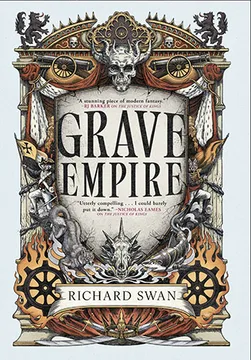


Plot Summary
Prologue
Lieutenant Peter Kleist2 writes home from the New East, where he has been sent to serve the Sovan Empire despite his misgivings and his family’s expectations. A storm has lengthened his journey to Fort Ingomar, a remote post in the disputed Alda River Valley.
On the way, his mountain guide leads him off the trail to four mutilated Sovan soldiers, their heads missing and their weapons ruined by panicked overloading. Peter2 cannot explain what killed them. Though fear tells him to turn back, shame keeps him moving, and he follows his guide toward the fort.
Peter begins as a man already divided between what he feels and what he believes he must perform. His family’s investment in his commission and his fear of appearing cowardly outweigh his own judgment, so he walks toward danger not from courage but from social pressure. The mutilated soldiers turn an abstract colonial posting into bodily evidence that the Empire cannot control this landscape. The letter home also establishes an intimate frame: Peter tries to make experience manageable by narrating it, even as the events ahead will exceed the language and institutions he trusts.
Renata Gets the Summons
Renata Rainer,1 a junior diplomat in Sova’s neglected Stygion Mer-men Office, expects another day of being mocked for working on a people the Empire barely values. Instead, a summons brings her and her superior, Ambassador Didacus Maruska,4 before Colonel Glaser.8 Two Bruta Sarkan monks, Herschel9 and Guillot,10 explain that their séances can no longer reach the dead.
They believe an ancient prophecy, the Great Silence, may be beginning. Since the Stygion and the Kasar are the world’s most accomplished magickal practitioners, Herschel9 asks Sova to help contact them. Renata1 accepts the mission, eager to practice diplomacy beyond her basement office, while Glaser8 agrees to escort them and turns a desperate appeal into an Imperial expedition.
Renata’s opportunity arrives disguised as an institutional emergency. She has spent years advocating for a diplomatic relationship that her own government treats as irrelevant, and now the very knowledge she has cultivated becomes necessary. Yet the mission is not born from Sova’s respect for other peoples. Glaser authorizes it because the risk of doing nothing seems greater than the risk of acting. That distinction matters: the party begins with competing motives, Renata’s professional hope, Herschel’s alarm, and the state’s calculation. The expedition’s central problem is already political as well as supernatural.
A Sister Shot in Sova
While Renata1 prepares to leave, her half-sister Amara5 walks with her through the fish market and worries aloud about the dangerous route ahead. An explosion tears through their coach. A gunman fires again, striking Amara5 in the shoulder, then escapes toward the Dynast’s Palace. Renata1 leaves her wounded sister5 with rescuers and chases the attacker alongside Glaser.8
In the palace’s humid, maze-like gardens, she loses her bearings and nearly walks into the killer,10 but an unidentified passerby intervenes. The assassin10 escapes. At the hospital, surgeons discover Amara’s5 wound is infected far more severely than expected. Renata1 stays beside her, afraid of losing the person whose wit and unruliness have been her closest refuge.
The attack makes Renata’s abstract commitment to diplomacy personal, then immediately complicates it with guilt. She leaves Amara at the scene because she wants to pursue the person who tried to kill them, a choice driven by anger and a need to regain agency. The wound’s unexpected infection links private vulnerability to the wider, still-unexplained crisis. Renata’s fear is not yet evidence of supernatural danger; it is the ordinary terror of loving someone whose body has become fragile. That emotional anchor will later make the afterlife’s peril more than a theological puzzle.
Fort Ingomar’s Second Enemy
At Fort Ingomar, Major Haak18 tells Peter2 that he has been sent to replace a dead captain, then orders him to lead a party back to the mutilated soldiers. The garrison is understrength, exhausted, and unwilling to explain the screams that trouble the nights. Peter’s2 expedition finds evidence that the dead men overloaded their muskets in blind panic, not that they were defeated in an ordinary skirmish.
Soon after, Peter2 sees a dying soldier appear on the fort wall, warn that something is coming, and vanish without leaving blood. Haak18 does not dismiss the vision. He assigns Peter2 to investigate the valley’s supernatural disturbances while also preparing him to confront a Casimiran force moving north.
Peter’s first test is not simply whether he can command troops, but whether he can admit that the world may not obey the explanations on which his training depends. His superiors are not confident enough to provide a clear account, yet they expect him to act. The fort’s dwindling manpower makes the supernatural threat feel inseparable from ordinary military vulnerability. Haak’s decision to investigate rather than dismiss Peter’s vision offers a brief alternative to Sovan arrogance, but it also transfers the burden of uncertainty onto a young officer who is already frightened and unprepared.
Peter Takes the Split
Peter2 marches his light company toward the Ena Split, hauling two eight-pounder cannons through rain and mud while strange voices and watchful eyes unsettle the soldiers. When Black Mountain scouts find a half-built Casimiran and Sanque fort, Peter2 and Captain Furlan12 attack before it can be completed. Peter2 hesitates when the firing begins, but he eventually leads a small detachment around the enemy’s flank and helps break the defense.
The Sovans take the position, though twelve are dead and roughly twenty are wounded. A prisoner reveals that the builders feared an attack by monsters during an approaching blood moon. With the fort reduced, Peter2 chooses to take thirty soldiers and two guides farther north to learn what the enemy feared.
The battle gives Peter a first, imperfect experience of agency. He is neither the fearless officer he imagined nor the helpless figure he feared becoming. His effective flank attack matters, but so do his hesitation and his reliance on Furlan’s initiative. The victory is therefore not a simple conversion from cowardice to courage. It exposes the gap between formal authority and practiced leadership, while the prisoner’s warning makes the ordinary war serve as a bridge to a less comprehensible danger. Peter continues north partly from duty and partly from a need to prove that his fear has not defined him.
The Kato Take Captives
Beyond the Ena Split, Peter’s2 party finds a silent forest, a decaying hall, and eyes watching from the dark. Kato, human-sized catlike beings, attack the shelter at night. Peter2 survives the assault, but most of the company is killed or captured; the survivors are carried into the mountains. The Kato devour one escapee, then bind Furlan12 to a ritual stone.
A shaman cuts open the captain and removes his organs while keeping him alive, then replaces them with unfamiliar parts and sews him shut. Furlan12 emerges as a Kato, still able to recognize Peter2 but struggling to speak. The shaman later begins Peter’s2 transformation. Before the rite can finish, something intervenes and carries him away.
The Kato’s violence is frightening partly because it has a purpose Peter cannot understand. Their ritual does not merely kill an enemy; it remakes him into a member of the group, exposing the instability of identity under bodily transformation. Furlan’s altered but recognizable presence makes survival itself morally complicated: the captain remains enough of himself to suffer, yet cannot return to his former life. Peter’s interrupted rite leaves him in a similar borderland, where the body becomes evidence of an event that ordinary Sovan explanations will refuse to accept.
Von Oldenburg Finds the Rot
As Renata’s1 party travels south, Count Lamprecht von Oldenburg3 investigates reports of a plague spreading through Draedaland. At Toutorix he finds a town abandoned but strangely intact, its market still full of food and its streets occupied by vermin. During the night, hundreds of townspeople gather in a field, vacant and motionless, then pursue him when they begin to move.
Von Oldenburg3 escapes with Yelena,11 a Draedist healer and sorcerer who has long assisted his illicit studies. In another settlement, he watches a vacant infect a soldier by touch. He decides to capture one, hoping to understand the phenomenon and exploit it, rather than report the danger to the Empire.
Von Oldenburg encounters the crisis through a lens shaped by power and opportunity. He sees the same horror that frightens others, but his first response is to classify, capture, and make use of it. His desire to understand is not false, yet it is inseparable from imperial ambition and self-enrichment. The empty market and untouched food suggest a disaster that has not simply killed a population but suspended ordinary social life. His choice to conceal the danger turns curiosity into complicity, setting up a counterplot in which a possible instrument of survival becomes a means of conquest.
Zetland’s Silent Fortress
Renata,1 Maruska,4 Glaser,8 the two monks, and engineer Bruna Ozolinsh7 cross Sova’s industrial Interior and continue toward the Kyarai. On the journey, Renata1 and Maruska4 rehearse diplomatic principles while Ozolinsh7 challenges the Empire’s self-serving language. The group also senses a growing wrongness that the monks and engineer can detect more sharply than Renata.1
At Zetland, the Bruta Sarkan fortress is deserted, its gate warning that everyone inside is dead. Herschel9 admits that he and Guillot10 left before their order attempted a dangerous summoning, hoping first to seek help from the Kasar and Stygion. The party cannot confirm what happened to the monks, so they continue toward the war zone with their trust in Herschel9 badly shaken.
The journey tests the difference between speaking about pluralism and practicing it. Renata’s training gives her a language for respecting other cultures, while Ozolinsh and Guillot expose how easily that language can coexist with conquest. The abandoned fortress sharpens the stakes: the monks acted before Renata’s group arrived, and their effort may have already cost an entire community. Herschel’s partial confession also makes the expedition less secure. The party must rely on someone whose information is incomplete, while the evidence around them suggests that delay has consequences they cannot yet measure.
The Bridge at Talaka
At Kalegosfort, Renata1 meets Captain Joseph Lyzander,6 a capable but abrasive officer who knows the Kyarai and its capital, Port Talaka. He warns that the city is close to falling to Casimir and the southern Kasar. As the party approaches, thousands of refugees jam the Ahsia Bridge, blocking both civilians fleeing west and troops moving east.
Glaser8 orders soldiers to fire volleys into the crowd, killing and injuring refugees so the bridge can be cleared. Renata1 condemns him, but he insists that the bottleneck would otherwise prevent the defense of the city and endanger everyone trapped there. The group crosses amid panic and bodies, entering a capital already under naval bombardment.
Glaser’s decision makes the mission’s moral problem immediate: state action can be defensible in strategic terms and still inflict deliberate violence on the people it claims to protect. Renata’s outrage is sincere, but she has no easy alternative that would save everyone. The bridge turns imperial logistics into a visible human cost, with civilians reduced to an obstruction in a military plan. Lyzander’s local knowledge helps the group move forward, yet his contempt for official confidence also anticipates how often the mission will depend on people willing to challenge authority.
Guillot Kills Maruska
As fighting closes around the Spiritsraad, Lyzander6 leads the party toward a hidden storm-drain entrance. Guillot10 suddenly steers Maruska4 and Renata1 away from the others, shoves Renata1 down, and repeatedly stabs the ambassador.4 Renata1 recognizes him as the assassin10 who attacked her and Amara5 in Sova.
When Guillot’s10 human face distorts and reveals a golden, rune-covered plate, an unknown passerby wounds him and gives Renata1 time to escape. Lyzander6 finds her in the streets, and she rejoins Glaser,8 Ozolinsh,7 and Herschel.9 She reports that Guillot10 killed Maruska4 and may not be human, but the others are forced to keep moving through the collapsing city before they can investigate.
Maruska’s murder destroys both a personal bond and the mission’s most experienced diplomatic judgment. Renata must continue without the mentor who taught her how to negotiate without surrendering everything, while the killer’s concealed face makes identity itself unreliable. Guillot’s violence also collapses the distinction between institutional danger and supernatural danger: a trusted member of the party becomes the threat. Renata’s escape depends on a stranger and on Lyzander, not on the systems meant to protect her, forcing her to act while grief and suspicion compete for control.
The Blood Stone Leaves Talaka
The survivors reach the Spiritsraad through its hidden drains and find Sovan and Kasar defenders fighting inside the temple. The Dwelkspreker21 refuses evacuation but gives them the Blood Stone, a powerful magickal amplifier, after confirming that the Kasar shamans have also lost contact with the afterlife. She shows them a shaman held in quarantine after a failed séance, now vacant and unresponsive.
Lyzander6 guides the party out through the storm drains as Port Talaka falls around them. Once clear of the city, Renata1 learns from him and Herschel9 that Guillot10 was connected to the Draedist death cult called the Selureii. Their escape preserves the Stone, but makes its purpose and the enemy’s interest in it urgent questions.
The Dwelkspreker’s choice is not a rescue but a transfer of responsibility. She stays with her sacred post and entrusts the Stone to outsiders who may not understand what they carry. The quarantined shaman shows that the Great Silence is already affecting practitioners, not merely appearing in prophecy or rumor. Meanwhile, the failed evacuation and the fall of the capital reveal the limits of military control. Renata’s party leaves with a crucial object, but also with a narrower margin for error and a clearer sense that the crisis crosses political borders.
The Vorr Are Named
At the Door to the Sea, Renata1 and Lyzander6 enter the water with lungfish that let them breathe and speak to the Stygion. Hostile Spears threaten them, but ambassador Sina20 protects them long enough to bring their warning to the Thrice Queen.14
A fight erupts when Stygion factions attack Sina’s20 chamber, and the Queen’s14 enormous blackfish familiar drives off a white shark. She orders the humans taken to Maris. There, the Psychic Conclave explains that the Great Silence is the work of the Vorr, interdimensional beings devouring consciousness throughout the afterlife.
Renata1 realizes that her dreams of Amara5 and Maruska4 may have carried the anguish of souls being eaten. The Conclave says the Blood Stone could open the Eye of the Sea, the sole direct passage into the mortal world.
The revelation changes the scale of every earlier event. The silent dead, the visions, and the strange contagion are not separate mysteries but consequences of a predatory force consuming the afterlife. Renata’s dreams become possible evidence, but they remain emotionally dangerous because they connect cosmic danger to Amara’s fate. The Stygion do not offer comfort or certainty. Their expertise clarifies what is happening while exposing how little anyone knows about stopping it. Renata must hold grief and new responsibility together without allowing either to substitute for evidence.
Port Gero Under Siege
The Thrice Queen14 sends Renata1 and Lyzander6 back to Port Gero to recover the Blood Stone, while her warriors create a diversion against the Casimiran landing force. The beach has become a battlefield: ships bombard the fort, marines push ashore, and poisoned bait drives white sharks into a frenzy.
Renata1 and Lyzander6 reach the cliffs and enter the fort alongside the attacking troops, disguising themselves in stolen Sovan clothing. They search for Glaser8 and the Stone as the northern wall breaks and close combat spreads through the courtyard.
Renata1 finds Glaser8 holding the chest, but he refuses to return it to the Stygion, arguing that the Empire must keep such a powerful object. His refusal turns the siege into a struggle inside the Sovan command.
The return to Port Gero forces Renata to confront the practical cost of the political principles she has been defending. She cannot persuade the Empire to trust the Stygion merely by explaining the threat; she must retrieve the Stone while the fort is under attack. Glaser’s refusal is not simple villainy. It reflects the state’s habitual belief that security means possession and control. Yet in this crisis, that instinct may make the object more dangerous. The battle compresses the mission’s central conflict into a literal contest over who gets to hold power.
A Stone Lost in Battle
Renata1 and Lyzander6 steal the Blood Stone from Glaser’s8 quarters, but the colonel8 catches them during the second assault. Herschel9 rushes Glaser8 in an attempt to disarm him, and Glaser’s8 pistol shot kills the monk. The dead man’s body reanimates under the Knackerman, which attacks Glaser8 and forces Renata1 and Lyzander6 to flee.
The entity takes the chest from Renata.1 A cannonball then obliterates Herschel’s9 body, ending the immediate attack, but the Blood Stone disappears amid the fighting. The Grasvlaktekraag Kasar arrive and help defeat the Casimirans. Though Port Gero remains in Sovan hands, Renata1 cannot find the Stone or determine who took it.
The fort’s survival is a military success and a strategic failure. Glaser’s mistrust of the Stygion leads to a fatal confrontation, and the Knackerman turns the consequences of death into a weapon against the living. Renata’s attempt to recover the Stone is nearly successful, but the battle makes possession impossible to track. The episode also shows why the Vorr threat cannot be treated as a distant afterlife problem: the act of dying has become an opening through which another force can act. Winning the fort does not mean controlling what happened there.
Peter Returns Changed
The ritual at the Kato settlement leaves Peter’s2 transformation incomplete. He escapes the execution stone with missing organs, a splinter embedded in his palm, and a new resistance to the supernatural screaming that has haunted the valley. After a long, feverish journey, he reaches Fort Kleist, where Sovan reinforcements have taken the position.
They tell him Haak18 is dead and dismiss his account of the Kato as madness. Peter2 cannot persuade them that Furlan12 survived as one of the catlike people or that the golden spearhead can transform captives. The Army sends him toward Sova, treating him as a disgraced officer rather than a witness. His body and memory remain the only evidence he has.
Peter’s return does not restore him to safety. He has crossed back into Sovan territory, but the institution he serves refuses to recognize what he experienced. The disbelief compounds the transformation: he must now endure not only bodily damage but the loss of credibility. His earlier fear of disgrace has become less important than the need to be believed, yet he cannot force recognition. The scene exposes a system that can absorb casualties as statistics while rejecting testimony that would require it to revise its account of the world.
Von Oldenburg Builds Thralls
Back in Haunerwald, von Oldenburg3 learns that blood from a vacant can power his experimental mechanism. With Yelena’s11 help, he discovers how to bind a vacant to spoken commands, then uses a heated brand to control another. Yelena11 objects to the cruelty and leaves with his notes and equipment, but von Oldenburg3 escapes with an earlier prototype and a copy of the binding symbol.
He heads north, planning to weaponize the mind rot against Casimir. Meanwhile, Broz16 follows the diplomatic party and takes the missing Blood Stone during the chaos at Port Gero. He eventually finds von Oldenburg3 in deserted Verdabaro and gives it to him. The count uses it to vacate a Selureii captive and reveals a growing army of thralls building a fort.
Von Oldenburg mistakes mastery for containment. He believes that turning victims into obedient workers can redirect the crisis, but his solution multiplies the very danger he claims to control. Yelena’s departure marks the limit of collaboration when expertise is used to normalize cruelty. Broz’s delivery of the Blood Stone gives von Oldenburg both a tool and a political fantasy: the chance to rebuild empire with bodies stripped of will. The deserted city around them is not a neutral laboratory. It is evidence that the consequences are already spreading beyond any one person’s plan.
Renata Hears Peter
On the journey back to Sova, Renata1 learns that Ozolinsh7 is gravely injured and discovers a young lieutenant with a sealed abdominal incision, a rigid hand, and no appetite or thirst. He is Peter Kleist,2 though she does not yet know what happened to him. At Zetland, Renata1 enters the abandoned fortress to investigate the dead Bruta Sarkan.
She slips into the cellar and, in the darkness, encounters Peter’s2 glowing eyes and mouth, mistaking him for an apparition. Lyzander6 finds her and helps her recover; then Peter2 wakes in the coach. Renata1 tells him they are the rare people likely to believe his account. He begins describing the Kato, giving her evidence that the New East holds another part of the crisis.
The meeting joins the novel’s separated narrative lines without resolving their mysteries. Renata has heard the Stygion explain the threat, while Peter carries direct knowledge of a remote people whose transformation seems connected to magick. Neither can yet interpret the other’s evidence. Her decision to believe him is a meaningful contrast with the Army’s dismissal, but belief is only the beginning of inquiry. The cellar encounter also shows how accumulated fear changes perception: Renata sees Peter through the lens of her recent visions, then chooses to listen once the immediate terror passes.
Sova Forms a Task Force
In Sova, Renata1 presents the mission’s findings to Empress Zelenka Haugenate,17 the Corps of Engineers, and the Imperial spymaster. The council learns that the Vorr are consuming souls, that the dead monks may have opened a path for them, and that von Oldenburg3 is converting the contagion into an instrument of conquest. Renata1 admits that the Blood Stone is missing.
The Empress17 orders Renata1 and Yelena11 to organize a task force, recruit specialists, and seek help from other nations, while ordering von Oldenburg’s3 assets seized and his arrest pursued. That evening Renata1 visits Amara’s5 grave, then prays at a temple shrine. A vision shows Amara5 within the Golden City, where Nema’s forces are fighting the Vorr.
The council finally treats cooperation as a survival strategy rather than a concession. The Empress’s order does not erase Sova’s imperial habits, but it authorizes Renata to work across borders and disciplines in a way the mission previously lacked. Von Oldenburg’s scheme makes the danger more immediate: the crisis is not only an external invasion but a human attempt to profit from it. The final vision offers Renata hope about Amara, yet not certainty. The story ends by giving grief a possible answer while leaving the larger struggle unresolved.
Epilogue
After returning to Sova, Renata1 briefs the Empress17 and senior officials. The city has already learned of a northern plague, but most people do not know its supernatural cause. The Empress17 orders Renata1 and Yelena11 to assemble experts across nations and disciplines, and directs the army to seize von Oldenburg’s3 property and arrest him.
Later, Renata1 visits Amara’s5 grave and then prays at a temple shrine. A vision shows the Golden City under attack and identifies Amara’s5 soul among those sheltered there. Renata1 leaves the shrine in a rush, carrying a fragile hope that her sister5 has not been lost to the Vorr.
The epilogue refuses a clean division between public catastrophe and private mourning. The Empire receives facts but intends to control how much the public knows, showing that information itself remains a political instrument. Renata’s vision offers a counterweight to the fear that Amara’s soul has been consumed, but the scene is not a verified rescue. Its ambiguity preserves both emotional hope and narrative danger. The final movement also revises Renata’s role: she is no longer merely a junior secretary seeking a meaningful assignment, but an ambassador charged with building cooperation against a threat that state power alone cannot defeat.
Analysis
Grave Empire makes the supernatural crisis inseparable from the machinery of empire. Sova’s officers, diplomats, engineers, and senators all approach unfamiliar peoples through habits of classification and control. That worldview is visible in the exploitation of the Kyarai, the neglect of Renata’s1 office, and Glaser’s8 decision to shoot refugees to clear a bridge. Even the most sympathetic characters carry institutional assumptions they must confront. The Stygion’s grievances are not decorative history; they explain why an appeal for cooperation begins under threat and mistrust. The novel also asks what happens when knowledge is treated as property. Sova has prohibited most magickal practice, leaving it poorly equipped to understand a crisis that other peoples have studied for generations. Von Oldenburg3 responds by collecting forbidden knowledge, but his intelligence serves a fantasy of domination. He converts discovery into a technology of coerced labor, mistaking obedience for order and exploitation for innovation. Yelena’s11 objections make clear that expertise without ethical restraint is not neutral.
Peter2 and Renata1 experience different forms of institutional failure. Peter2 returns bearing physical evidence, yet the Army dismisses him because his testimony threatens its accepted account of the frontier. Renata1 is heard at last, but only after catastrophe forces the state to value her knowledge. Their stories suggest that a society’s ability to survive depends not only on accumulating information, but on allowing inconvenient witnesses to change what it believes.
The book’s emotional center is the tension between intimate loss and collective danger. Renata’s1 fear for Amara5 and grief for Maruska4 give the metaphysical crisis a human scale; Peter’s2 longing for home makes transformation more than a grotesque spectacle. The final vision offers hope without resolution. Amara5 may be sheltered in the Golden City, but the war there continues, and the mortal world remains exposed. The ending turns survival into a shared task, while warning that political unity is hardest precisely when it is most necessary.
Review Summary
Grave Empire is widely praised as a compelling blend of flintlock fantasy, grimdark, and horror, earning strong comparisons to Joe Abercrombie. Readers highlight its rich world-building, three distinct POVs, and atmospheric dread. Many consider it superior to Swan's previous trilogy. Common praise includes memorable creatures like armored-shark-riding mermen, morally complex characters, and effective horror elements. Criticisms note slow pacing in the first half, excessive place-name stacking, and occasionally underdeveloped characters. Most agree it's an impressive series opener that leaves readers eagerly anticipating the sequel.
Characters
Renata Rainer
The reluctant world-saverRenata is a Sovan diplomat specializing in the Stygion, a people most of her colleagues regard as a curiosity. She is intelligent, politically alert, and frustrated by an empire that treats diplomacy as a lesser craft than force. Her professional confidence is real, but it coexists with a private sensitivity to ridicule and a need to prove her work matters. Her bond with her half-sister Amara5 gives her life a source of mischief and tenderness outside the Imperial Office. Renata’s diplomatic instincts make her attentive to other peoples’ grievances, yet she must contend with the fact that she represents a state whose expansion she questions but still serves.
Peter Kleist
The unwilling frontier officerPeter is a young Sovan officer sent from privilege into the exposed frontier of the New East. He is self-conscious about his place in his family and easily influenced by the expectations of people whose approval he wants. His fear does not make him inert; he continues to act even when courage feels like a performance he cannot sustain. Peter’s letters home reveal a reflective mind that struggles to reconcile military duty with the human cost of empire. He is an outsider among experienced soldiers, and his story tests whether an institution can learn from a witness whose experience does not fit its accepted account.
Lamprecht von Oldenburg
The imperial opportunistVon Oldenburg is a powerful Sovan count, senator, and covert student of forbidden magick. He is disciplined when pursuing a scheme and contemptuous of anyone he considers less intelligent or less ambitious. His curiosity is genuine, but it is fused to a belief that Sova deserves dominion over other peoples and their resources. He interprets uncertainty as a problem to be mastered and treats human beings as tools when a discovery promises political or financial gain. His confidence makes him dangerous, especially because he can mistake technical ingenuity for moral permission.
Didacus Maruska
Renata’s diplomatic mentorMaruska is the experienced Qareshian ambassador who shares Renata’s1 obscure office and teaches her to treat foreign peoples as political equals rather than administrative obstacles. He combines patience with a sharp understanding of state power, using humor and argument to challenge Renata1 without diminishing her. His diplomatic method is pragmatic rather than sentimental: he knows that understanding an opponent does not require approving of them. For Renata1, he is both a colleague and a steadying presence, someone who makes the practice of compromise feel like a form of courage.
Amara
Renata’s unruly confidanteAmara is Renata’s1 half-sister, a talented linguist and student at the University of Sova. Beautiful, clever, and difficult to intimidate, she turns teasing into a way of showing affection and punctures Renata’s1 tendency to carry the world alone. She is politically sharper than her playful manner suggests, and her private pamphleteering reflects a willingness to oppose the state from outside its official channels. Amara represents the intimate life Renata1 risks losing when public duty takes over, while her curiosity about other peoples mirrors Renata’s1 own.
Joseph Lyzander
The irreverent field captainLyzander is a Sovan captain with practical knowledge of the Kyarai, its military routes, and its Kasari allies. He is brusque, physically confident, and inclined to provoke people when he feels cornered. Beneath that swagger is a man carrying unresolved grief about a relationship with the Empress17 that the state could not accept. His skills make him essential to Renata’s1 mission, but his value is not limited to combat or local knowledge. He gradually treats her judgment as worth following, even when he disagrees with her or fears what she is asking him to risk.
Bruna Ozolinsh
The skeptical arcane engineerOzolinsh is a blunt, practical member of the Corps of Engineers who understands thaumaturgy through mathematics, wards, and material effects rather than religious doctrine. She is unimpressed by titles and impatient with abstract language, which makes her a useful counterweight to the monks and diplomats. Her professional confidence is shaken when an academic problem becomes a danger she can hear and dream about. Ozolinsh does not pretend that understanding the arcana makes her comfortable with it. She represents the limits of technical control when the underlying system itself is changing.
Colonel Glaser
The hard-minded commanderGlaser is a senior officer of the Imperial Life Guards and a Privy Councillor responsible for organizing the expedition. He is capable, decisive, and more willing than many officials to act under uncertainty. His instinct, however, is to measure decisions by military necessity and Imperial security. This makes him both a valuable protector and a source of moral conflict for Renata1. He believes the state must act before time runs out, even when the human cost of that action is immediate and visible.
Viktor Herschel
The anxious Bruta Sarkan monkHerschel is an older member of the Bruta Sarkan, a secretive religious order that practices séances despite Sova’s prohibition. He is cautious, diffident, and not naturally suited to commanding attention, but his decision to seek help shows that fear has not made him passive. He carries knowledge that the Empire has suppressed and struggles to explain it to people who distrust both his faith and his methods. His earnestness does not prevent him from withholding information when he fears how others will react.
Guillot
The guarded young monkGuillot is Herschel’s9 younger companion, a capable speaker of Kasarsprek and a man who has spent much of his life within the Bruta Sarkan. He is more direct and politically critical than his senior, willing to challenge Sovan officials about the empire’s role in the Kyarai. His conviction is entangled with impatience, and the strain of the mission makes him increasingly difficult for the others to read. At first, he appears to be a useful bridge between the diplomats and the Kasar.
Yelena Tesařik
The uncompromising healerYelena is a Draedist healer and accomplished practitioner of sorcery who has spent years assisting von Oldenburg’s3 forbidden research. She understands the costs of the arcana through practice, not theory, and is more cautious than the count3 about exposing people to forces neither of them can control. Her relationship with him is intimate, unequal, and resistant to simple labels. She does not confuse loyalty with obedience, and her judgment grows firmer as his experiments become more reckless. Her knowledge makes her invaluable, but she retains moral commitments that his ambition would rather ignore.
Captain Furlan
Peter’s blunt field guideFurlan commands Fort Ingomar’s artillery and possesses the hard-earned confidence of a soldier who has survived a difficult posting. He is gruff, often drunk, and more perceptive than his rough manner suggests. He gives Peter2 practical advice about leadership and does not mistake authority for respect. Furlan’s experience makes him a stabilizing presence when Peter’s2 nerves threaten to take over, though he has little patience for sentiment that delays action.
Olwin
The Black Mountain scoutOlwin is a guide from the Black Mountain confederation, skilled at moving through the New East’s forests and reading terrain that Sovan maps cannot explain. She is observant, self-possessed, and more accustomed than Peter2 to danger without clear rules. Her presence exposes how dependent the Empire is on local knowledge even while its soldiers treat native allies as subordinate. Peter2 is drawn to her, but her importance lies in her competence and in the possibility of trust across radically different lives.
The Thrice Queen
The Stygion sovereignThe Thrice Queen rules the Stygion and commands the respect of her people through an authority tied to their social and magickal structures. She is formidable, suspicious of Sovan motives, and unwilling to treat a diplomatic title as proof of good faith. Her control of Kaipatu, her enormous blackfish familiar, reflects both political power and practical danger. She can show restraint when protocol demands it, but the Stygion’s grievances remain more important to her than making Renata1 comfortable.
Muirgen
The Conclave’s truth-tellerMuirgen is an elder member of the Stygion Psychic Conclave, a group devoted to the study and practice of magick. His clouded eyes do not limit his ability to communicate through psychic means. He explains the Great Silence in precise, devastating terms, distinguishing what the Stygion know from what they cannot yet explain. His manner is scholarly rather than comforting; he offers Renata1 knowledge, not reassurance.
Broz
Von Oldenburg’s resourceful agentBroz is a skilled operative who works for von Oldenburg3 and can move through places where his employer would attract attention. He is practical, discreet, and accustomed to carrying out orders without asking whether they are wise. His competence makes him useful in surveillance and retrieval, but he is not immune to doubt when the consequences of his work become clearer. He measures loyalty against self-preservation and the possibility that his actions may have made a catastrophe worse.
Zelenka Haugenate
The pressured young EmpressZelenka Haugenate is the Empress of Sova, ruling a vast empire divided by war, industry, and political self-interest. She is young enough to face constant pressure from older institutions, but she understands that delay can be a decision with fatal consequences. Her relationship with Lyzander6 carries private history that the state has tried to suppress. In council, she is willing to hear unwelcome testimony and issue orders beyond the borders of Sovan authority when survival demands it.
Major Haak
The wary frontier commanderHaak commands Fort Ingomar and has learned to treat reports of supernatural disturbances as evidence rather than automatic madness. He is careful, unsentimental, and concerned with preserving the small force under his command. His decision to send Peter2 north reflects both duty and a desire to understand what is killing his soldiers.
Cathassach
The Black Mountain interpreterCathassach is one of Peter’s2 local guides, an experienced scout who speaks enough Saxan to interpret for the Sovan soldiers. He understands the valley’s dangers better than Peter2, though his warnings do not always fit the officer’s expectations. His presence shows the difference between possessing a map and knowing a place.
Sina
The Stygion ambassadorSina is the Stygion ambassador at Ozeanland and a skilled selachomancer bonded to a white shark named Teulia. She protects diplomatic procedure even while her people’s anger at Sovan violence threatens to overwhelm it. Her role requires her to mediate between Renata1 and Stygion factions who do not trust the Empire.
The Dwelkspreker
The Kasar spiritual leaderThe Dwelkspreker is an elderly Kasar spiritual leader who remains at the Spiritsraad despite the city’s fall. She communicates through visions and ritual objects more readily than through ordinary explanation. Her authority is rooted in the Kasar’s spiritual life, and her decision to entrust the Blood Stone to Renata1 reflects the urgency of the danger.
Plot Devices
The Great Silence
The vanishing afterlifeThe Great Silence is first reported by the Bruta Sarkan monks, whose séances can no longer reach the dead. The Stygion Psychic Conclave later confirms that the silence is caused by the Vorr consuming consciousness throughout the afterlife. Dreams, screams, and the sudden vacancy of practitioners become evidence of a crisis that is both spiritual and physical. The prophecy gives the separate storylines a shared threat, while the characters’ differing knowledge keeps its meaning uncertain until the Stygion explain it.
The Blood Stone
A dangerous magickal keyThe Blood Stone is a powerful Kasar artefact that amplifies magick. The Dwelkspreker21 entrusts it to Renata’s1 party, and the Stygion explain that it could open the Eye of the Sea, the only direct passage by which the Vorr could reach the mortal world. Its loss at Port Gero gives von Oldenburg3 access to a tool capable of magnifying his experiments. The Stone links the diplomatic mission to the count’s3 private ambitions and turns a relic into a contested instrument of survival and domination.
The Kato Spearhead
A ritual that remakes bodiesThe Kato use an ancient golden spearhead in a ritual that transforms captives into catlike members of their people. The rite involves a brutal removal and replacement of organs, and its effects appear to reach beyond the body. Furlan’s12 transformation and Peter’s2 interrupted ceremony suggest that the Kato are tied to old magick and to the strange immunity from supernatural disturbances that Peter2 later experiences. The spearhead gives Peter2 a physical explanation for his injuries, but not a clear account of the force behind the rite.
The Mind Rot
Contact turns people vacantIn Draedaland, people become vacant after contact with another affected person, then attempt to pass the condition onward. Von Oldenburg3 captures a victim, discovers that a sigil can bind a vacant to commands, and develops a mechanism powered by a vacant’s blood. The process is linked to the afterlife rather than an ordinary disease. It can kill the infected through neglect, spread rapidly through contact, and be deliberately weaponized. Its appearance connects the Selureii’s efforts to hasten the crisis with von Oldenburg’s3 attempt to control it.
The Diplomatic Mission
An unlikely alliance attemptRenata’s1 mission begins as an effort to ask the Stygion and Kasar whether they have noticed the afterlife’s silence. It expands into a journey through Sova’s colonies, a war zone, the Spiritsraad, and the Stygion capital. The party’s disagreements over empire, religion, and military necessity repeatedly obstruct cooperation, while the Blood Stone and the revelation of the Vorr give the mission new urgency. The diplomatic structure lets the story test whether rival peoples can share knowledge before their competing interests destroy the possibility.
About the Author
Other books by Richard Swan

Download PDF
Download EPUB
.epub digital book format is ideal for reading ebooks on phones, tablets, and e-readers.








