

Key Takeaways
Judge algorithms by how their work grows, not by one stopwatch reading.
Growth beats snapshots. Big O notation describes how an algorithm's work increases as its input grows, rather than promising a particular number of seconds. A simple search may inspect every item, so a list of a billion items can mean a billion checks. Binary search repeatedly halves a sorted list: finding one item among about four billion takes roughly 32 checks, not four billion. That speed depends on the list already being sorted and allowing direct access to its middle.
Compare the curve. Common growth rates include constant time, O(1), logarithmic time, O(log n), linear time, O(n), and quadratic time, O(n²). Big O usually describes worst-case growth and ignores constants, though constants can affect which algorithm feels faster at practical sizes.
What's useful about this lens is that it changes the first question from “How fast was my test?” to “What happens when the workload grows?” That is essential for software whose users or data may multiply. But Big O is a map, not a benchmark: it hides memory use, network delays, and constant costs. Two implementations with the same growth rate can behave very differently on real machines. Strong engineering combines asymptotic reasoning with measurement at representative input sizes.
Use arrays for jumping to data, and linked lists for frequent changes.
Storage shapes speed. An array places its elements in adjacent memory slots, so the computer can jump directly to an index. Reading an element by index is O(1). A linked list stores elements wherever memory is available, with each element pointing to the next. Reaching a particular position requires following the links one by one.
Match the operation. Arrays are convenient when an application reads or searches by position often. Linked lists are useful when items are frequently inserted or removed, especially when the relevant position is already known. Inserting into the middle of an array can require shifting many elements; a linked list can change a pointer instead. A restaurant order line, where new orders join one end and chefs remove the first, needs little random access and suits a linked structure.
The deeper lesson is to choose a data structure by the work the application performs most, not by which structure sounds more sophisticated. This is a form of workload-aware design: a finance log with many additions and occasional full reviews differs from a username collection searched constantly. The trade-off is not absolute, however. Linked-list insertion is cheap only when the insertion point is already reached; finding that point may itself take time. Counting the whole operation prevents a locally efficient step from disguising a slow process.
Shrink a problem to a simple case, then combine the smaller answers.
Recursion delegates the bookkeeping. A recursive function calls itself on a smaller version of its task. It needs a base case that stops the calls and a recursive case that makes progress toward that stopping point. To total a list, for instance, add its first value to the sum of the remaining list, until nothing remains. Without a base case, calls accumulate until the program runs out of stack space.
Divide and conquer applies the pattern. Quicksort selects a pivot, separates smaller and larger values around it, sorts each side recursively, then joins the results. Its average running time is O(n log n), while a poor pivot can produce the O(n²) worst case. The call stack stores unfinished work, which makes recursion clear but can consume memory.
Recursion is more than a coding style: it makes a problem's structure visible. If a task naturally contains smaller copies of itself, the method can reduce complex reasoning to a base case plus a repeatable step. Quicksort illustrates both the elegance and the danger. A balanced split keeps the recursive tree shallow; consistently lopsided splits erase the advantage. The practical test is whether the recursive description clarifies the problem enough to justify stack costs and whether the implementation handles unusually deep inputs.
Use hash tables when the same key-to-value lookup keeps recurring.
Turn searching into addressing. A hash table combines an array with a hash function that converts a key into a storage location. It maps keys to values, such as produce names to prices or website addresses to IP addresses. In the average case, lookup, insertion, and deletion take O(1), which makes hash tables useful for phone books, checking whether someone has already voted, and caching pages so a server can reuse stored results instead of recomputing them.
Distribution matters. Different keys can land in the same slot, creating a collision. A table can keep colliding entries together, but long groups make lookup slower. The load factor measures stored items relative to available slots; when it grows too high, resizing and rehashing spread entries across a larger array. The book offers 0.7 as a practical point to resize.
Hash tables are powerful because they replace repeated scanning with a direct lookup, but their speed depends on assumptions about distribution and resizing. That makes them a useful reminder that an interface can feel constant-time while its implementation manages collisions and occasional costly growth underneath. Caching adds another design question: stored results save work only when they remain valid. The data structure solves retrieval, not freshness. Reliable systems must decide both how to find an answer quickly and when an old answer should no longer be trusted.
Choose breadth-first search for fewest steps, Dijkstra for lowest total cost.
Model connections as a graph. A graph contains nodes and edges, representing people and friendships, places and routes, or tasks and dependencies. Breadth-first search explores outward in layers using a first-in, first-out queue. In an unweighted graph, that order finds a path with the fewest edges. It also works for questions such as whether a mango seller is anywhere in a social network. Mark visited nodes so cycles do not send the search around forever.
Weights change the question. If edges carry costs, such as travel minutes, Dijkstra's algorithm repeatedly settles the cheapest known node and updates the costs of its neighbors. It requires nonnegative edge weights. For task dependencies, a topological sort creates an order in which prerequisites appear before the tasks that depend on them.
The memorable move is translating vague language into a precise objective. “Shortest” might mean fewest transfers, least travel time, or lowest monetary cost. Those are different graph problems, so choosing an algorithm begins with defining what counts as distance. One technical clarification matters: the book restricts Dijkstra's algorithm to directed acyclic graphs, but the standard algorithm also works on graphs with cycles when edge weights are nonnegative. Negative weights invalidate its greedy settling step and require another method.
Trust a greedy choice only when the problem's structure supports it.
Local choices can be globally right. A greedy algorithm makes the best-looking move available at each step. For classroom scheduling, repeatedly choosing the class that ends earliest allows the greatest number of non-overlapping classes. Here, the local rule happens to produce an optimal overall schedule.
The same instinct can fail elsewhere. In a knapsack that holds 35 pounds, taking the single most valuable stereo can leave no room for a laptop and guitar worth more together. Greedy methods are still useful when an exact answer is too expensive. In the set-covering example, choosing the radio station that reaches the most uncovered states is a fast approximation. Approximation algorithms trade certainty of optimality for speed and a reasonably good answer.
Greedy reasoning is attractive because it is legible: each move has an immediate justification. The crucial question is whether the objective has a property that makes those local choices safe. Classroom scheduling has such a structure; the knapsack example does not. Treating every greedy rule as a universal recipe is a category error. Conversely, rejecting a heuristic because it is not perfect can waste resources when a useful answer is needed quickly. Good practice states the guarantee, or the absence of one, alongside the result.
When possibilities multiply factorially, stop demanding an instant exact answer.
Some search spaces explode. The traveling salesperson problem asks for the shortest route that visits every city. Checking every possible route takes factorial time: 10 cities already produce more than 3.6 million possible routes. The set-covering problem, which seeks the smallest collection of stations covering every state, can require examining 2ⁿ possible subsets. These are examples of NP-complete problems, for which no fast exact solution is known.
Recognize the warning signs. A method that works for a handful of items but slows dramatically as items are added may be exploring an explosive search space. Problems asking for every combination or the best ordering of many items deserve suspicion. Rather than burn time chasing perfection, use a fast approximation, such as repeatedly visiting the nearest unvisited city, and judge it by speed and closeness to the optimum.
This is a lesson in resource allocation as much as computation. Naming a problem as potentially intractable changes the engineering goal: instead of proving an ideal answer can be found quickly, the team can define an acceptable error, time limit, or quality threshold. The distinction is especially important because a heuristic's output can look convincing without being optimal. An approximation should therefore be assessed against known examples or bounds when possible. “Good enough” becomes responsible only when “enough” has been made explicit.
Use dynamic programming when independent subproblems can build an exact optimum.
Save answers to smaller choices. Dynamic programming breaks an optimization task into subproblems and stores their answers in a grid. In the book's knapsack example, a four-pound capacity can hold a one-pound guitar worth $1,500 and a three-pound laptop worth $2,000, for a total of $3,500. The table considers smaller capacities and available items, so the answer for leftover space can be reused instead of recalculated.
Check the assumptions. The method fits problems with discrete choices and subproblems that can be solved independently. It also handles string comparison: a grid can identify the longest common substring or subsequence, useful in text comparison and biological sequence analysis. If item weights need finer increments, the grid must change; if choices depend on shared conditions, the simple table may not capture them.
A dynamic-programming table is a record of what has already been learned, not merely a pile of arithmetic. Its design forces a useful question: what smaller state contains enough information to solve the larger task? That is why identifying the dimensions and meaning of each cell is often harder than filling in values. The technique can produce exact results, but exactness has a price: larger state spaces can require more time and memory. A neat grid is not proof that the chosen state captures every dependency.
In nearest-neighbor prediction, useful features matter more than the formula.
Represent before comparing. K-nearest neighbors classifies an item or predicts a value by finding the most similar examples in stored data. To distinguish oranges from grapefruit, the example uses fruit size and color. For movie recommendations, users can be represented by ratings across movie categories; nearby users' preferences help suggest films. Averaging neighbors' ratings turns the same method into regression, such as estimating bakery sales from similar past days.
Choose meaningful features. A similarity calculation is only as useful as the information it compares. Ratings of unrelated images would say little about movie taste, while a narrow set of ratings may miss important preferences. Differences in how people use rating scales can also distort distance. The book points to normalization and cosine similarity as ways to address some such mismatches.
K-nearest neighbors makes machine learning unusually tangible: predictions come from remembered examples rather than an opaque rule. That simplicity exposes a central modeling risk. A distance metric can be mathematically correct and still measure the wrong kind of similarity because the chosen features are irrelevant, biased, or on incompatible scales. More features are not automatically better; noisy dimensions can obscure meaningful proximity. The useful discipline is to ask what each feature represents, whose behavior it leaves out, and whether the resulting neighbors make sense to people who understand the domain.
Recognize the same algorithmic ideas hiding inside everyday technology.
Small concepts scale into systems. A search engine can use an inverted index, a mapping from each word to the pages where it appears. Fourier transforms break signals into component frequencies, supporting tasks such as audio processing and compression. MapReduce distributes large data jobs across machines by applying a map operation to many items and reducing the results. These examples extend the book's basic toolkit into search, media, and large-scale computing.
Sometimes approximate answers save the system. Bloom filters use little memory to test whether an item may belong to a large set, accepting false positives but not false negatives. HyperLogLog estimates the number of distinct items compactly. The book also surveys SHA for one-way hashes, Simhash for detecting similar content, Diffie-Hellman for key exchange, and linear programming for optimization under constraints.
The closing tour widens the reader's sense of what an algorithm is: not a clever trick in isolation, but a compact idea embedded in products and infrastructure. It also reveals recurring trade-offs. A Bloom filter spends certainty to save memory; distributed processing spends coordination effort to gain throughput; compression discards information to reduce storage. Those are not defects to conceal but design choices to make explicit. Knowing the names of these tools is only a beginning, yet it gives curious readers a map for asking better questions about systems they use every day.
Analysis
The book's chief achievement is not an exhaustive catalog of algorithms. It teaches a habit of translation: turn a practical question into a formal shape, then select a method whose assumptions match that shape. A phone-book lookup becomes sorted search; a social connection becomes a graph; an itinerary with limited time becomes a constrained optimization problem. The illustrated examples make these transformations memorable because each technical object has a concrete job before it has notation.
Its sequence also builds a coherent ladder. Data structures determine which operations are cheap. Complexity analysis shows what happens as inputs grow. Recursion and divide and conquer supply reusable ways to reduce problems. Graph search, hashing, greedy methods, dynamic programming, and nearest neighbors then demonstrate distinct forms of leverage. The result is less a cookbook than a vocabulary for recognizing when a problem resembles one already understood.
The simplifications are pedagogically effective, but readers should keep their boundaries visible. Big O suppresses constants and ignores memory, latency, and engineering cost. Hash-table average performance depends on implementation and workload. A nearest-neighbor system can reproduce bias embedded in its features. Most importantly, “shortest path” is not a single objective, and algorithm guarantees depend on details such as edge weights. Those caveats do not weaken the book's approach; they show why assumptions belong beside every algorithm.
The most durable lesson is to ask three questions before coding: What exactly is being optimized? What structure does the data have? What answer quality and runtime are acceptable? Sometimes the response is an exact algorithm, sometimes a carefully chosen approximation, and sometimes a different representation of the problem. That discipline remains valuable even when a language library supplies the implementation. The programmer's task is still to know what the tool promises, what it costs, and when its assumptions fit.
Review Summary
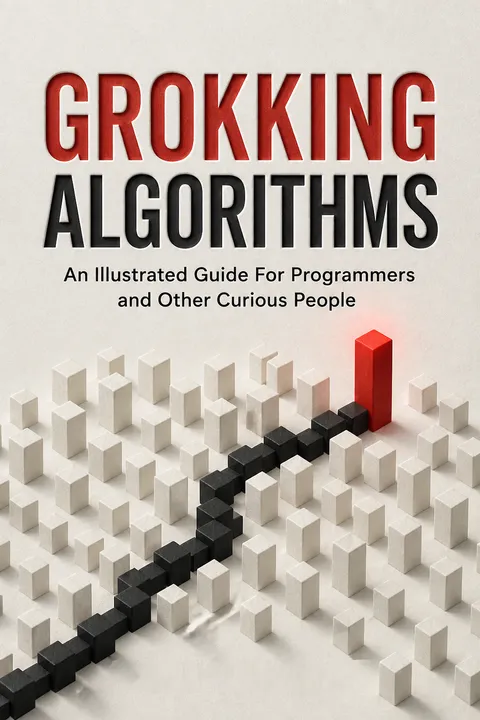
Grokking Algorithms An Illustrated Guide For Programmers and Other Curious People receives high praise for its approachable, visual approach to teaching algorithms. Readers appreciate its simplicity, engaging illustrations, and clear explanations, making it an excellent introduction for beginners and a refresher for experienced programmers. The book covers fundamental algorithms and data structures, with many finding it enjoyable and easy to understand. Some criticisms include uneven difficulty levels, occasional errors, and a lack of depth in certain topics. Overall, it's widely recommended as a friendly, accessible guide to algorithms.
People Also Read








Glossary
Big O notation
growth-rate descriptionA notation for describing how an algorithm's resource use grows as its input size increases. It supports comparisons such as linear O(n) search versus logarithmic O(log n) binary search. It commonly expresses a worst-case growth rate and omits constant factors, so it does not directly predict seconds on a particular machine.
Divide and conquer
solve through smaller problemsA problem-solving approach that reduces a task into smaller instances, solves those instances, and combines their results. It relies on defining a simple base case and a valid reduction toward that case. Binary search and quicksort illustrate the approach, though the efficiency depends on how effectively each step reduces the remaining work.
Hash table
fast key-value lookupA data structure that uses a hash function to map keys to locations where associated values are stored. It supports fast lookup, insertion, and deletion on average, and is commonly used for mappings, duplicate detection, and caching. Different keys can collide at the same location, so performance depends on handling collisions and keeping the table appropriately sized.
Breadth-first search
layer-by-layer graph searchA graph-search algorithm that explores nodes in order of their distance in edges from a starting node. It uses a first-in, first-out queue and can find a path with the fewest edges in an unweighted graph. Keeping track of already visited nodes prevents redundant work and infinite revisiting in cyclic graphs.
Dijkstra's algorithm
lowest-cost path searchA shortest-path algorithm for graphs whose edge weights are nonnegative. It repeatedly selects the unprocessed node with the lowest known cost, then updates the costs of neighboring nodes when a cheaper route is found. Negative edge weights invalidate its core assumption that a settled node cannot later receive a lower cost.
NP-complete problems
hard exact-search problemsA class of decision problems whose solutions can be checked efficiently and to which every problem in NP can be reduced efficiently. The book uses examples such as traveling salesperson and set covering to show why searching all possibilities can become impractical. No fast exact algorithm is known for these problems in general, so practical work often uses approximations.
Dynamic programming
reuse subproblem answersA method for solving problems by defining smaller subproblems, storing their results, and using those results to build a larger solution. It is often used for optimization under constraints, such as choosing valuable items that fit a knapsack. The method requires a suitable state representation and subproblems whose relationships can be captured by the recurrence.
K-nearest neighbors
predict from similar examplesA machine-learning method that finds the k examples most similar to a new item and uses them to classify it or predict a value. Classification assigns a category, while regression estimates a numeric response, such as a rating. Results depend on feature selection, the definition of similarity, and the number of neighbors considered.
MapReduce
distributed data processingA distributed computing model that applies a map operation to items in a large dataset and then combines intermediate results with a reduce operation. Work can be spread across multiple machines, making it useful for processing very large collections. The framework offers scale, but distributing work and coordinating results introduce overhead.
Bloom filters
compact set-membership testA probabilistic data structure for checking whether an item may belong to a set while using far less space than storing every item. It can report false positives, meaning an absent item may appear present, but it does not report false negatives. It is useful when compact storage matters more than a perfectly exact membership answer.
FAQ
1. What’s "Grokking Algorithms" by Aditya Bhargava about?
- Beginner-friendly algorithms guide: "Grokking Algorithms" is an illustrated introduction to algorithms, designed for programmers and curious readers who want to understand how algorithms work in practice.
- Visual and example-driven: The book uses visuals, analogies, and real-world examples to explain complex concepts in a simple, engaging way.
- Covers practical algorithms: It focuses on practical algorithms and data structures that are widely used, such as binary search, sorting, hash tables, and graph algorithms.
- Step-by-step learning: Each chapter builds on the previous one, gradually introducing more advanced topics and reinforcing learning with exercises and code samples.
2. Why should I read "Grokking Algorithms" by Aditya Bhargava?
- Accessible for beginners: The book is written for anyone with basic coding knowledge, making it ideal for self-taught programmers, bootcamp students, and those new to computer science.
- Visual learning approach: If you’re a visual learner, the book’s illustrations and analogies make abstract concepts much easier to grasp.
- Practical focus: The algorithms covered are chosen for their real-world usefulness, helping you solve common programming problems efficiently.
- Foundation for further study: It provides a strong foundation for more advanced topics in algorithms, AI, databases, and machine learning.
3. What are the key takeaways from "Grokking Algorithms"?
- Understanding algorithm efficiency: You’ll learn how to analyze and compare algorithms using Big O notation, focusing on how their performance scales.
- Core data structures: The book explains arrays, linked lists, hash tables, and graphs, highlighting their strengths and weaknesses.
- Problem-solving techniques: It introduces strategies like divide-and-conquer, recursion, greedy algorithms, and dynamic programming for tackling complex problems.
- Real-world applications: Each algorithm is tied to practical use cases, such as search engines, recommendation systems, and network routing.
4. How does Aditya Bhargava explain Big O notation and algorithm performance in "Grokking Algorithms"?
- Intuitive analogies: Bhargava uses relatable examples, like searching for a name in a phone book, to illustrate the difference between linear, logarithmic, and other time complexities.
- Visual comparisons: The book includes charts and diagrams to help visualize how different algorithms scale as input size increases.
- Focus on worst-case scenarios: Big O notation is explained as a way to describe the worst-case performance of an algorithm, helping you choose the right one for your needs.
- Practical implications: Readers learn why understanding algorithm efficiency matters in real-world programming, such as optimizing for speed or memory.
5. What is the approach to teaching recursion in "Grokking Algorithms"?
- Step-by-step breakdown: Recursion is introduced with simple, relatable problems, like searching for a key in nested boxes, to demystify the concept.
- Base and recursive cases: The book emphasizes the importance of defining clear base and recursive cases to avoid infinite loops.
- Call stack visualization: Bhargava explains how the call stack works during recursion, using diagrams and analogies like a stack of sticky notes.
- Practical examples: Readers practice recursion with exercises like calculating factorials and summing lists, building confidence through repetition.
6. How does "Grokking Algorithms" explain and compare arrays, linked lists, and hash tables?
- Memory and structure: The book uses analogies (like drawers and movie seats) to explain how arrays and linked lists store data in memory.
- Strengths and weaknesses: Arrays are shown to be fast for random access but slow for insertions/deletions, while linked lists excel at inserts/deletes but are slow for random access.
- Hash tables as hybrids: Hash tables are introduced as a powerful structure combining fast lookups with flexible storage, using hash functions to map keys to values.
- Real-world use cases: Each data structure is tied to practical scenarios, such as implementing queues, phone books, and caches.
7. What are the main sorting and searching algorithms covered in "Grokking Algorithms," and how are they explained?
- Binary search: Introduced early as a fast way to search sorted lists, with clear explanations of its O(log n) efficiency.
- Selection sort: Used to teach basic sorting concepts and Big O analysis, showing why it’s less efficient (O(n²)) than more advanced algorithms.
- Quicksort: Presented as a divide-and-conquer algorithm, with step-by-step partitioning and recursion, and a discussion of average vs. worst-case performance.
- Comparison and context: The book compares these algorithms, helping readers understand when to use each and why efficiency matters.
8. How does "Grokking Algorithms" introduce graph algorithms like breadth-first search and Dijkstra’s algorithm?
- Graphs as networks: The book models real-world problems (like finding the shortest route in a city) as graphs, making the concept tangible.
- Breadth-first search (BFS): Explained as a way to find the shortest path in unweighted graphs, using queues and step-by-step exploration.
- Dijkstra’s algorithm: Introduced for finding the shortest path in weighted graphs, with clear tables and diagrams to track costs and paths.
- Practical applications: Examples include social networks, routing, and trading scenarios, showing the relevance of graph algorithms.
9. What is dynamic programming, and how is it taught in "Grokking Algorithms"?
- Breaking down hard problems: Dynamic programming is introduced as a way to solve complex problems by breaking them into overlapping subproblems.
- Grid-based solutions: The book uses grids to visualize subproblems, such as in the knapsack problem and longest common substring.
- Step-by-step filling: Readers learn to fill in grids row by row or column by column, building up to the optimal solution.
- Common pitfalls and tips: Bhargava addresses common questions, like handling dependencies and fractional items, and emphasizes when dynamic programming is appropriate.
10. How does "Grokking Algorithms" cover greedy algorithms and NP-complete problems?
- Greedy strategy explained: The book defines greedy algorithms as those that make the locally optimal choice at each step, hoping for a global optimum.
- Classic examples: Problems like classroom scheduling, the knapsack problem, and set covering are used to illustrate where greedy algorithms work and where they fall short.
- Approximation algorithms: For NP-complete problems, the book advocates for approximation via greedy methods when exact solutions are impractical.
- Recognizing NP-completeness: Readers are given tips to identify NP-complete problems and avoid wasting time seeking perfect solutions.
11. How does "Grokking Algorithms" introduce machine learning concepts like k-nearest neighbors (KNN)?
- KNN for classification: The book explains KNN as a simple algorithm for classifying items based on the majority class of their nearest neighbors.
- Feature extraction: Readers learn how to represent data (like fruit or users) as points in multi-dimensional space using relevant features.
- Regression and recommendations: KNN is also shown as a tool for regression (predicting values) and building recommendation systems, such as for movies.
- Limitations and improvements: The book discusses challenges like feature selection, normalization, and the use of cosine similarity for better results.
12. What are the best quotes from "Grokking Algorithms" by Aditya Bhargava, and what do they mean?
- "Algorithm speed isn’t measured in seconds, but in growth of the number of operations." – Emphasizes the importance of understanding scalability over raw speed.
- "Recursion may achieve a performance gain for your programmer." – Highlights that recursion can make code clearer and easier to reason about, even if not always faster.
- "Greedy algorithms optimize locally, hoping to end up with a global optimum." – Sums up the core idea behind greedy strategies and their limitations.
- "Dynamic programming is useful when you’re trying to optimize something given a constraint." – Captures when and why to use dynamic programming in problem-solving.
- "I believe you learn best when you really enjoy learning—so have fun, and run the code samples!" – Encourages hands-on practice and enjoyment as keys to mastering algorithms.
Download PDF
Download EPUB
.epub digital book format is ideal for reading ebooks on phones, tablets, and e-readers.








