

Key Takeaways
Treat anxiety as a clue about what matters, not a verdict.
A signal worth examining. Clark reframes anxiety as a warning that something important may be at risk, alongside energy that can help protect it. Her grandmother worried constantly about her family’s comfort, while her mother tended to turn unease into activity. The contrast shows how one feeling can lead to very different responses.
The alarm can mobilize. At twelve, Clark woke to smoke filling the family cottage, roused her sister and babysitter, and escaped with them. Her fear helped direct attention and action. But a signal is not automatically a reliable explanation: anxiety can be loud, vague, or mistaken. The task is to ask what it may be pointing toward, then check the facts before acting.
The signal model gives anxiety dignity without requiring anyone to enjoy it. It also separates the feeling from the story attached to it: unease may deserve attention, while its first interpretation may not deserve belief. That distinction resembles how a warning system prompts investigation rather than delivering a complete diagnosis. The approach is most useful when anxiety is treated as evidence to examine, not proof that danger exists or that a particular life change is necessary.
Stop feeding anxiety with avoidance; approach the problem in tolerable steps.
Relief can reinforce retreat. Brian’s cat scratched a neighbor’s child. Afraid of the neighbor’s anger, he stayed home and replayed the incident. The longer he avoided checking on the child, the more frightening the conversation became. When he finally spoke with the neighbor, he learned the girl had received medical care and was doing well. Taking responsibility brought relief that waiting could not.
Approach with judgment. Clark calls the tendency for avoidance to intensify fear the avoidance fallacy. Repeatedly escaping a feared but manageable situation can teach the mind that the situation is dangerous. That does not mean every fear should be confronted: avoiding genuine danger is protective. For a manageable fear, a gradual, supported approach can replace speculation with experience.
Avoidance can relieve distress immediately, which helps explain why it becomes a habit. The cost appears later, when the feared situation remains untested and grows in imagination. Brian’s story makes the loop concrete: action did not guarantee a pleasant conversation, but it replaced uncertainty with information and allowed him to act according to his concern. Exposure should be paced and appropriate. A dangerous setting, a traumatic memory, or a situation involving coercion calls for safety and professional guidance, not a simplistic instruction to push through.
Rename bodily arousal before it becomes a story of failure.
Arousal has more than one meaning. A racing heart and sweaty palms can accompany anxiety, but also readiness or excitement. Clark uses the Yerkes-Dodson curve to explain why performance often rises with arousal up to a point, then falls when stress becomes overwhelming. Too little activation can leave someone disengaged; too much can make clear thinking difficult.
Interpretation can shift. The book describes studies in which people reframed pre-performance anxiety as excitement. In one test-anxiety study cited by Clark, students given a brief message that they could handle the stress improved their performance by 33 percent. This does not make severe distress disappear, but it suggests that labeling bodily activation as usable energy may help some people focus on the task.
Reappraisal changes the meaning assigned to physical sensations without pretending those sensations are imaginary. That can interrupt the extra fear created by interpreting every racing heartbeat as proof of incapacity. The curve is a useful mental model, not a precise dial: ideal arousal varies by person, task, and context. Reframing may help before a presentation; it is not a substitute for treatment when anxiety is persistent, disabling, or linked to a serious threat.
Learn whether anxiety is shouting, nagging, or hiding in your habits.
Notice its volume and disguise. Clark describes three patterns. Yell anxiety is intense and hard to ignore, as when Cecilia lost sleep over a major job decision. Chatter anxiety is a steady stream of reminders, like Deanna’s worry about work and caregiving duties. Whisper anxiety can hide in procrastination or numbing behavior, as it did for Jamie, who avoided tasks and spent weekends sedated.
Use the labels to observe. These patterns are not diagnoses. They are prompts to look beyond the obvious feeling and ask what is happening in behavior, the body, and daily routines. A person who says they are merely putting something off may be anxious about failure, conflict, or asking for help. Recognizing the pattern can make the underlying concern easier to investigate.
The three labels are memorable because they connect felt intensity with observable behavior. Whisper anxiety is especially useful as a reminder that distress may appear as withdrawal or delay rather than as conscious worry. The taxonomy should remain a noticing tool, not a classification system: people can experience several forms at once, and the same behavior can have different causes. Naming a pattern starts inquiry, but does not settle what it means.
Trade catastrophic possibilities for evidence, probabilities, and a nearer horizon.
Separate what could happen from what is likely. Jenny, a frequent business traveler, feared flying and considered leaving her job. She learned to examine what common aircraft sounds meant, consider safety procedures, and distinguish possible disasters from probable outcomes. Replacing imagined scenarios with relevant information helped her feel less trapped by the flight.
Bring the future closer. Anxiety can stretch one difficult moment into a prediction of permanent failure or loneliness. Clark recommends narrowing the time horizon to what can be handled today, or even in the next minute. A woman training for a half marathon used one-minute commitments when she wanted to quit. This did not erase the distance ahead; it made the next manageable effort visible.
This approach combines reality testing with a practical adjustment in scale. A distant future contains too many unknowns to solve all at once, while the next decision is often concrete enough to evaluate. Probability is not the same as certainty, however. A low-probability event with serious consequences may still merit preparation. The goal is not to dismiss a fear but to prevent vivid possibility from masquerading as reliable prediction.
Choose the next controllable move instead of waiting to feel ready.
Turn insight into a plan. Clark’s practical method is to notice anxiety, identify what it may be about, distinguish realistic concerns from catastrophic ones, and choose an action within reach. Mark, worried about chest pain and his heart, sought evaluation from a cardiologist rather than relying on reassurance alone. He also set boundaries with negative coworkers and discussed his goals with his manager.
Make action specific. Deanna, overwhelmed by work and caring for her father, reorganized her weekends, arranged help with transportation, and scheduled demanding tasks for the hours when she had more energy. A plan can reduce the mental burden of an unfinished task before the task itself is complete. Small, deliberate steps build momentum and provide evidence that some influence remains.
The emphasis on controllable action is strongest when it restores agency without promising control over outcomes. Planning also gives worry a useful destination: identify a task, decide when to do it, and follow through. Yet action is not automatically wise merely because anxiety urges it. Pausing to gather evidence, consult others, or recognize an unchangeable constraint can be the most constructive move. Agency includes choosing not to act immediately.
Let other people help regulate what anxiety makes you carry alone.
Isolation can conceal a wish for connection. Janet avoided gatherings because she feared judgment, but she discovered that loneliness was also part of her distress. Her anxiety did not simply mean she wanted to be alone; it pointed to a conflict between fear of rejection and a desire to belong.
Make support usable. Clark recommends naming feelings clearly and choosing people capable of responding with care. Describing frustration or fear gives a trusted listener more to understand than a list of events or accusations. Support does not require the other person to solve the problem. It can mean listening, offering practical help, or staying present. Because not everyone is safe or able to respond well, the choice of listener matters.
The book treats connection as an active coping resource, not a sentimental extra. Sharing a feeling can help a person organize experience and give others a clearer way to respond. The important qualification is that vulnerability is not universally safe: a critical, exploitative, or abusive person may misuse disclosure. Support is most protective when it respects choice, offers the kind of help requested, and does not demand that distress be explained before compassion is offered.
Use relationship anxiety to name unmet needs, not prosecute your partner.
Translate alarm into a need. Rebecca’s recurring dreams about affairs left her worried, even though she and her husband were committed to each other. Their real problem was disconnection under the pressure of childcare, work travel, and household logistics. The anxiety helped reveal that she missed time and closeness with him. Discussing practical ways to reconnect gave the feeling a constructive outlet.
Respond with empathy at home. Clark applies the same principle to parenting. When her daughter was excluded from a birthday party, the useful first response was to acknowledge the hurt, not rush to erase it. She also argues for a good-enough standard of parenting: care and repair matter more than impossible perfection. Anxiety can prompt attention to a loved one, but it does not prove that the loved one is at fault.
The shift from accusation to emotional disclosure can turn conflict into information about connection, fairness, or shared responsibilities. The parenting example adds an important lesson: support does not always mean removing pain, since children also need room to experience manageable disappointment. Anxiety should not become a license to monitor or control others. Its signal is about what needs attention; a conversation still has to respect the other person’s perspective and boundaries.
Protect performance with boundaries, recovery, and work that feels meaningful.
Anxiety can improve focus, but not without limits. Sarah’s demanding leadership role left her nauseated each morning and convinced she needed to push harder. In therapy, she saw that doing everything herself was making the project less manageable. She began checking in with her team, delegating tasks, and focusing on the work best suited to her role. Her mornings became less overwhelming.
Treat overload as information. Clark connects motivation at work to purpose, manageable challenge, and a sense of control. She also warns that pressure without recovery can become debilitating. Financial worry can prompt budgeting, but can also narrow life around earning and saving. Rest, relationships, and personal interests are not merely rewards for finishing every task; they help keep effort sustainable.
The distinction between useful pressure and chronic overload matters in workplaces where stress is often mistaken for commitment. Delegation and boundaries can improve both execution and well-being, while meaningful work can make effort feel worthwhile. Still, not every workplace problem is an individual mindset problem. Excessive workload, unclear expectations, or unfair treatment may require organizational change, not just better coping. Anxiety can flag a system that needs repair.
Calm the alarm when it overwhelms you, then seek skilled help.
Lower the volume when thinking is difficult. Clark recommends slow, comfortable breathing, grounding attention in immediate surroundings, mindfulness, movement, adequate sleep, and self-compassion. These practices are intended to bring intense arousal down to a level where reflection and decision-making are more possible. Rest may be the needed action when the body and mind are depleted.
Use care without shame. The book recognizes therapy and medication as legitimate ways to reduce overwhelming anxiety, not signs of failure. Persistent distress that disrupts sleep, appetite, work, or daily life may warrant professional support. Trauma, panic, or physical symptoms also deserve appropriate clinical attention. The aim is not to preserve anxiety at any cost, but to make it manageable enough to understand what help is needed.
The most balanced reading of the book avoids both extremes: treating every anxious feeling as pathology, and treating every anxious feeling as a useful guide. Calming methods can create space for thought, while professional care can address symptoms that self-help cannot contain. Physical symptoms should not automatically be attributed to anxiety, and trauma should not be approached through forced exposure. The central principle is flexibility: use insight, coping skills, and clinical support according to the actual need.
Analysis
Clark’s central contribution is a change in stance: anxiety is not automatically an enemy to eliminate, but a possible signal and source of energy that can be examined and directed. The book makes that proposal memorable through a repeated sequence of cases. A grandmother’s care becomes chronic worry, a cat incident shows how avoidance magnifies uncertainty, and work and family stories show anxiety turning into either constructive preparation or costly overextension. The result is an accessible bridge between emotional experience and action.
The practical value lies less in the claim that anxiety is inherently beneficial than in the questions the claim encourages: What matters here? What is within reach? What step would produce useful information? The answer may be a difficult conversation, a schedule change, medical evaluation, rest, or help from another person. That range is a strength. It prevents coping from shrinking into a single trick such as positive thinking or deep breathing.
The framing also needs boundaries. Clark uses anxiety broadly, spanning fear, stress, worry, and sometimes discomfort or conflict. That breadth helps readers recognize less obvious patterns, but it can blur distinctions among ordinary pressure, anxiety disorders, trauma responses, and physical illness. The book’s most categorical message, that anxiety has a useful message, is better understood as a hypothesis than a rule. Some anxiety is diffuse, conditioned, or disproportionate to any present problem; its intensity does not reliably identify what action is right.
The evidence and statistics cited come from a wide range of studies and from the book’s 2018 publication context. They support a case for perception, agency, and moderate challenge, but they do not establish that reframing alone reliably treats severe anxiety. The most durable takeaway is therefore not to obey anxiety, but to listen, test its interpretation, and respond proportionately. That preserves the book’s hopeful insight while making room for uncertainty, structural constraints, and professional care.
Review Summary
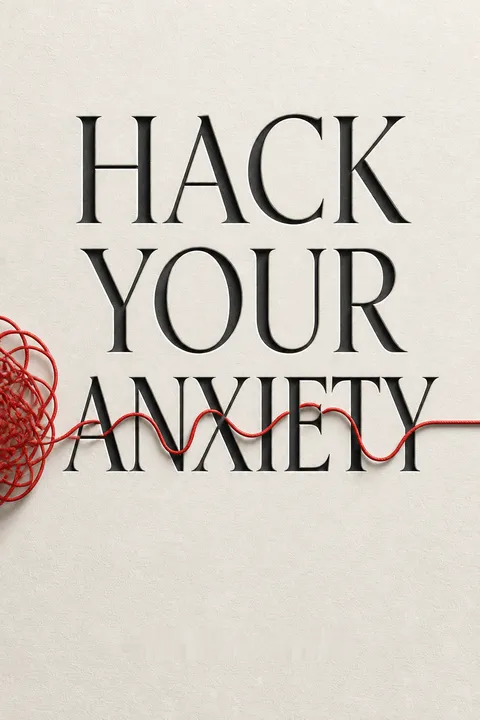
Hack Your Anxiety receives mixed reviews, with an average rating of 3.62 out of 5. Many readers find it insightful and practical, praising its approach to using anxiety as a positive tool. They appreciate the comprehensive overview of anxiety science and clear strategies for coping. However, some critics find it overly long, lacking in practical tips, and too focused on positive thinking. Several reviewers note that while the book offers valuable information, it may not be suitable for those seeking quick solutions or dealing with severe anxiety.
Glossary
Yell anxiety
Overwhelming, attention-grabbing anxietyClark’s label for intense anxiety that dominates attention and interferes with ordinary thinking or functioning. It can arise during major change, crisis, or loss. Because the feeling is so loud, its underlying concern may be hard to identify until the person first reduces the intensity enough to reflect.
Chatter anxiety
Persistent background remindersClark’s term for recognizable, ongoing anxiety that can function like a running commentary about tasks, deadlines, and potential problems. It may help someone stay prepared, but a rising load of responsibilities can make the chatter distracting or overwhelming. The aim is to identify what it is reminding the person to address.
Whisper anxiety
Anxiety hidden in behaviorClark’s term for anxiety that is difficult to recognize directly and may appear instead as procrastination, withdrawal, irritability, impulsive behavior, or attempts to numb feelings. It can point to an issue the person is avoiding or has not yet named. The label is a prompt for inquiry, not a diagnosis.
Secondary anxiety
Fear of feeling anxiousAn additional layer of distress that arises when a person becomes afraid of anxiety itself or assumes its sensations cannot be tolerated. Worry about having another panic attack is one example. Clark argues that this added fear can intensify the original distress and obscure the concern that first drew attention.
Avoidance fallacy
Avoidance can intensify fearClark’s term for the pattern in which repeatedly evading a manageable fear brings short-term relief but can make the feared situation seem more threatening over time. Avoidance is not always harmful: staying away from real danger is protective. The concept concerns overusing avoidance when measured engagement would be safer and more useful.
Yerkes-Dodson curve
Arousal and performance relationshipA performance model discussed in the book in which performance often improves as arousal rises from a low level, reaches an effective range, and declines when arousal becomes excessive. Clark uses it to explain why some anxiety can energize focus while overwhelming anxiety can disrupt it. The curve is a broad model, not a precise personal threshold.
Challenge Response
Stress framed as manageable challengeA stress response associated in the book with appraising demands as manageable in light of available resources. This contrasts with a threat response, in which demands seem to exceed those resources. The concept helps explain how perception, preparation, and confidence can affect how someone responds under pressure.
RAIN
Mindful emotional check-inA mindfulness sequence presented in the book: recognize an emotional reaction, allow the experience to be present, investigate it with kindness, and return to natural presence. It is intended to support awareness without immediate judgment or avoidance, so a person can notice feelings without being wholly swept up by them.
Ulysses Effect
Precommitment against temptationA strategy of arranging conditions in advance to make a chosen action more likely when future motivation may weaken. The name refers to Ulysses asking his crew to secure him before the sirens could tempt him. Examples include scheduling a commitment or setting up a consequence before facing a predictable distraction.
Tend-and-befriend response
Stress-driven care and connectionA social response to stress in which a person seeks connection, supports others, or protects loved ones, rather than responding only through fight or flight. The book links this pattern to social bonding and the stress-related hormone oxytocin. It offers a way to understand why distress can prompt people to reach out or help.
Mindful action
Insight directed into behaviorClark’s description of action guided by both an understanding of anxiety’s possible message and the energy it provides. The person first clarifies the concern, then identifies a proportionate step that is within their control. The concept distinguishes purposeful problem-solving from impulsive activity or worry that circles without producing a plan.
Download PDF
Download EPUB
.epub digital book format is ideal for reading ebooks on phones, tablets, and e-readers.








