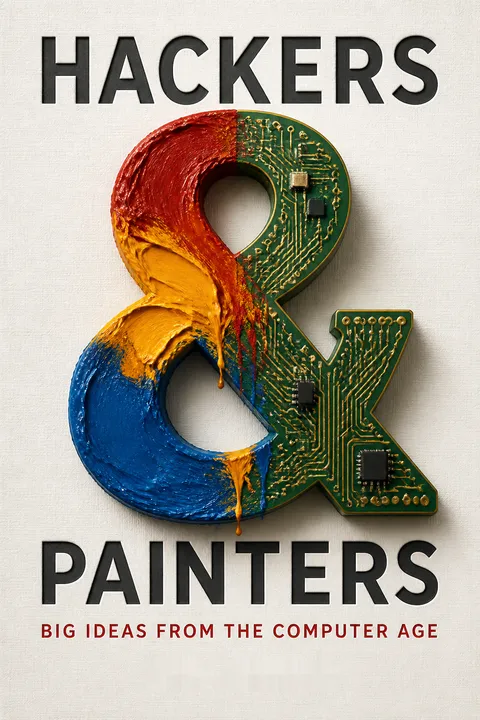


Key Takeaways
Treat programming as making, not merely implementing someone else's specification
Hackers are makers. Graham compares programming with painting because both involve creating something good, not simply executing a plan. Painters sketch, revise, and sometimes move a figure after the first attempt. Programmers can work the same way: write a rough version, discover what is wrong, and refine it. Treating code as a draft makes flexible tools valuable and premature decisions costly.
Design for real people. Good software must make sense to users, and good code must make sense to the people who maintain it. That means empathy belongs alongside technical skill. Clear modules with identifiable owners also help teams collaborate without turning shared code into neglected common ground.
The maker analogy gives software design a useful corrective to the idea that programming is mainly formal specification followed by implementation. Contemporary design practice echoes this: prototypes expose assumptions that planning alone cannot reveal. The analogy also highlights a tension. Iteration is powerful when mistakes are reversible, but rapid revision can become churn if teams lack shared goals or tests. The strongest version of Graham's point is not that planning is useless, but that plans should remain answerable to what working artifacts teach.
Don't mistake school’s popularity hierarchy for a verdict on your ability
School is an artificial world. Graham remembers being an unpopular student who cared more about understanding computers and making things than about winning social approval. He argues that secondary school often rewards conformity because students have little meaningful work or external purpose to organize around. Status then becomes a contest among students, and unpopular kids can become convenient targets for group bonding.
The setting matters. In adult life, people can seek communities where their skills are useful, and work can have visible consequences. The book does not claim every school or teenager fits this pattern. Its practical reassurance is narrower: a hostile school culture is not proof that an unusual or intellectually focused student is destined to fail.
This account usefully shifts attention from individual weakness to institutional incentives. Social psychology likewise finds that group identity can be strengthened by drawing boundaries against outsiders, though that does not make every instance of bullying a calculated status strategy. The essay's structural lens can help students and adults ask what meaningful roles, responsibilities, and communities are missing. Its broad criticism of schools should still be treated as a hypothesis about certain settings, not a universal diagnosis of adolescence.
Inspect the ideas your era punishes before accepting its moral consensus
Taboo is a clue. Graham argues that beliefs people are punished for expressing deserve scrutiny, not automatic acceptance. He proposes looking for ideas attacked with labels rather than rebutted as false, comparing present assumptions with past and other societies, and noticing which opinions feel difficult to voice. The point is not that forbidden beliefs are necessarily correct. It is that social penalties can prevent testing them.
Notice what you already know. In a study he cites, radiologists sometimes looked directly at cancerous lesions they later failed to report. Graham uses this to suggest that people may register uncomfortable possibilities without consciously acknowledging them. Private reflection and candid discussion with trusted friends can help bring such possibilities into view.
The essay offers a practical form of intellectual humility: treat social confidence as evidence about a belief's status, not proof of its truth. This resembles scientific efforts to identify confirmation bias, the tendency to notice evidence that supports existing views while discounting contradictions. But taboo alone is a noisy signal. Some views are stigmatized because they are harmful or demonstrably false, while others are suppressed by power. The useful discipline is to ask for evidence and examine the costs of speaking, rather than romanticizing transgression.
Protect the unruly curiosity that lets outsiders invent what institutions miss
Rule-breaking can reveal options. In programmer culture, a hacker is a skilled maker who enjoys making systems do what they were not expected to do. That disposition can produce ugly shortcuts, but it can also uncover a better design. Graham points to Apple’s early personal computers and Unix, which emerged outside official plans for the next generation of computing, as examples of outsiders taking a different route.
Freedom feeds experimentation. He worries that broad restrictions on copying, examining, or modifying technology can obstruct learning and invention. His argument extends to civil liberties: when people cannot question powerful institutions, influential interests may crowd out better ideas. The claim is not that every restriction is harmful, but that rules should be judged by what experimentation they prevent.
The defense of curiosity is strongest when it distinguishes exploration from entitlement. Reverse engineering and open inquiry can reveal flaws that closed systems conceal, while privacy, safety, and creators' interests can justify limits in specific cases. The central question is institutional: who can inspect a system, and who benefits when inspection is blocked? Graham's hacker is valuable not because disobedience is inherently virtuous, but because dissent gives societies a way to test assumptions before they harden into infrastructure.
Move software to the server when convenience can beat desktop control
Viaweb changed the delivery model. In 1995, Graham and Robert Morris began building software for online stores. They shifted from a desktop application to a web application that ran on their server, making it easier for customers to access and for the company to update. This was an early example of an Application Service Provider, or ASP: a company that hosts software for customers to use over a network.
Short cycles sharpen feedback. Viaweb often released several changes in a day rather than waiting for a large software version. The team could reproduce bugs using customer data, fix them quickly, and watch how people used the product. Studying the online trial revealed a confusing step. A small clarification raised completion from 60% to 90%, and the company reported 50% revenue growth from the resulting improvement.
The essay sees software delivery as a design choice, not just a technical one. Central updates reduce installation burdens and make learning from actual use faster, a pattern that now underlies many online services. Yet convenience shifts power toward the provider: customers depend on its uptime, security, pricing, and continued existence. The model works best when the operator earns trust through reliability and responsible data practices. The product's ease of use is only one side of the bargain.
Build wealth by solving hard problems where small teams can capture results
Wealth is created, not merely counted. Graham distinguishes money, a medium for exchanging value, from wealth, the useful goods and services people want. A startup can concentrate effort in a small group, making each person's contribution more visible. He calls the ingredients for exceptional returns measurement and leverage: a way to assess results, plus decisions or technology that can affect many users.
Difficulty can protect an advantage. Software or a repeatable business system can serve many customers without being recreated for each one. Graham advises startups to tackle technically difficult problems that larger rivals may struggle to copy. The risks are substantial: a startup may fail despite good work, and intense effort does not guarantee a large reward. User adoption is a practical test of whether the work creates value.
This model explains why scalable technology can reward a small team disproportionately: one useful tool can serve many people, while a small group makes performance easier to observe. It also corrects the assumption that a business creates value merely by generating revenue. However, market payment is an imperfect measure of social benefit. Monopoly power, bargaining inequality, external costs, and luck can separate private rewards from public value. The framework is most persuasive when paired with questions about who benefits and who bears the costs.
Train taste by removing what is ugly, not decorating what is weak
Taste improves through judgment. Graham rejects the idea that design quality is only personal preference. Designers become better by noticing what fails and learning to make stronger choices. Across painting, mathematics, architecture, and software, he identifies recurring virtues: simplicity, solving the actual problem, suggestiveness, and the willingness to revise. Leonardo’s carefully observed details illustrate that unseen effort can strengthen the whole work.
Redesign is part of the work. A first attempt is often a sketch, not a verdict. The essay points to Leonardo's repeated line studies and the Porsche 911's evolution through redesign. It also argues that strong work can be unusual, but that strangeness cannot be manufactured as a style. Skill, careful attention, and communities of talented makers help make daring work possible.
The essay makes aesthetic judgment practical by tying beauty to function, economy, and repeated correction. This resembles the idea of a minimum description: a strong solution often explains much with few arbitrary parts. Still, simplicity is not an absolute rule. Some tasks require complexity, and standards of beauty shift with culture and purpose. The useful question is not whether a design is simple in isolation, but whether each element earns its place for the people who will use or encounter it.
Choose languages for expressive power, not for their place in the corporate herd
Languages shape thought. Graham argues that programming languages differ in how directly they let developers express ideas. The Blub Paradox names the difficulty of recognizing languages more powerful than the one a programmer already uses: familiar tools can make their own limits hard to see. Lisp appealed to Graham partly because macros let programmers generate and shape code, making new abstractions possible.
Choose for the problem. At Viaweb, Lisp helped a small team build features quickly, while competitors used more conventional tools. Graham's broader design ideal is a language with a small, flexible core, useful libraries, and an interactive environment that supports experimentation. This is not a claim that one language wins every task. Existing libraries, integration needs, performance, and team expertise can outweigh expressive power for a particular project.
The Blub Paradox captures a genuine cognitive trap: tools influence which solutions feel natural, so practitioners may mistake habit for objective adequacy. Yet language comparisons are hard to separate from team skill, libraries, and system architecture. A powerful abstraction can accelerate development, but it can also make code opaque to newcomers or difficult to hire for. The productive test is empirical: does the language let this team explore, maintain, and deliver a particular product better than realistic alternatives?
Let evidence, not clever rules, teach your systems what to recognize
Learn from each message. Graham's Bayesian filtering approach estimates whether email is spam by learning which words and other features occur in unwanted versus legitimate messages. Bayesian filtering is statistical classification that updates a probability using accumulated evidence. Rather than maintaining a growing list of suspicious phrases, the filter combines clues from the message and adapts as new examples arrive.
Protect legitimate mail. In Graham's test, a corpus of roughly 4,000 spam and 4,000 non-spam messages supported a filter that missed fewer than 5 in 1,000 spam messages, with no false positives. He stresses that false positives are especially costly because users may lose important mail. Training a filter on each person's own messages also lets it learn what that individual considers normal.
The example shows how statistical learning can outperform a rigid checklist when adversaries change their tactics. It also makes the cost of classification errors explicit: a missed nuisance and a lost personal message are not equivalent. Modern applications of this logic need safeguards around training data, privacy, and uneven error rates across users. A probability is more interpretable than an arbitrary score, but it is only as trustworthy as the data and assumptions behind it.
Analysis
The essays range across adolescence, software design, wealth, free expression, and programming languages, but their shared question is how systems shape what people can make. Graham repeatedly favors environments where practitioners can test ideas directly: a painter revises a canvas, a programmer releases a change, a startup learns from users, and a dissenter examines a taboo rather than accepting its label. The book's deepest through-line is not simply that hackers are clever. It is that creative work needs room to experiment, feedback that reflects reality, and enough ownership for people to care about quality.
That emphasis gives the book lasting force. Its accounts of Viaweb show how technical choices, customer contact, and organizational structure can reinforce one another. Its comparisons between painting and programming make iteration and taste legible to readers outside computer science. Its language essays also make a subtle point: tools do not merely execute thought, they influence which thoughts are easy to form.
The same confidence can narrow the analysis. Market success is treated as strong evidence of value, but revenue and user adoption do not capture every social cost or benefit. Likewise, the defense of intellectual freedom is compelling as a warning against unexamined restrictions, yet freedom alone does not resolve conflicts among privacy, safety, and access. The essays often prefer small teams and individual judgment, while large systems sometimes require coordination, accountability, and maintenance beyond what a compact group can supply.
The book is also a product of its moment. Its specific forecast that software would move from desktops to servers captures a durable direction, while its larger value lies in the reasoning behind it: reduce friction, shorten feedback loops, and let capable makers shape the product. Read as a set of arguments rather than universal laws, the essays offer a sharp method for examining how institutions, tools, and incentives either amplify or suppress creative work.
Review Summary
Hackers & Painters receives mixed reviews, with ratings ranging from 1 to 5 stars. Positive reviews praise Graham's insightful essays on technology, entrepreneurship, and programming languages, particularly his advocacy for Lisp. Critics argue that Graham's views are often biased, arrogant, and lacking evidence. Many readers appreciate the chapter on why nerds are unpopular in school. The book's content is considered thought-provoking but sometimes controversial, especially regarding wealth creation and societal issues. Some find the essays disjointed and outdated, while others consider them valuable for understanding Silicon Valley culture.
People Also Read




Glossary
Blub Paradox
Blindness to stronger languagesThe difficulty programmers have recognizing the expressive power of languages beyond the one they know best. A programmer can easily see what a less powerful language lacks, but may interpret a more powerful language's unfamiliar features as unnecessary complexity. The term illustrates how a tool can shape the limits of its user's imagination.
measurement and leverage
Visible results, amplified impactGraham's paired conditions for earning exceptional returns through work. Measurement makes a person's or small team's contribution visible enough to reward. Leverage allows a decision, invention, or technique to affect many outcomes rather than one task at a time. Startups are presented as a setting that can combine both, though their rewards are uncertain.
bottom-up programming
Build abstractions toward the taskA programming style that develops a solution by first creating reusable operations suited to the problem, then expressing the application in terms of them. These operations form a specialized language for the task. Graham argues that this can make programs shorter and easier to change, rather than merely dividing a fixed plan into smaller pieces.
premature design
Committing to a specification too earlyDeciding too soon what a program should do, before implementation and user feedback have revealed whether the assumptions are sound. Graham compares software development to sketching and painting, where initial plans can change as the work takes shape. Flexible code and tools make it easier to revise the design instead of defending an early guess.
Bayesian filtering
Classify using accumulated evidenceA statistical method for identifying spam by estimating how strongly message features, such as words or headers, indicate unwanted mail. It combines evidence from examples of both spam and legitimate messages, then updates its estimates as new examples are classified. Graham favors training separate filters on each user's mail to reduce false positives and adapt to individual patterns.
ASP
Provider-hosted software serviceApplication Service Provider, a company that runs software on its own servers and lets customers use it over a network instead of installing it locally. In Graham's account, this model can simplify access and updates for users while giving the provider direct control over software, infrastructure, and customer feedback.
FAQ
What's Hackers & Painters about?
- Exploration of Technology and Art: Hackers & Painters by Paul Graham explores the intersection of technology and art, arguing that programming is a creative process similar to painting.
- Impact of Computers: The book examines how computers shape society and influence our lives, focusing on the mindset of hackers and their role in technological advancement.
- Independent Essays: It consists of independent essays that can be read in any order, allowing readers to explore topics of interest without following a linear narrative.
Why should I read Hackers & Painters?
- Insight into Technology: The book provides valuable insights into the world of technology and programming, making complex concepts accessible to non-programmers.
- Understanding Hackers: It demystifies hackers, portraying them as creative individuals who contribute positively to society and challenges negative stereotypes.
- Practical Advice for Entrepreneurs: Graham offers practical advice on wealth creation through startups and technology, making it a valuable read for aspiring entrepreneurs.
What are the key takeaways of Hackers & Painters?
- Creativity in Hacking: Hacking is presented as a form of art, requiring creativity, problem-solving, and a deep understanding of the medium.
- Wealth Creation: The book emphasizes that wealth is created through innovation and hard work, not merely through luck or inheritance.
- Programming Languages' Impact: Graham discusses how programming languages shape programmers' thinking and the software they create, impacting project success.
What are the best quotes from Hackers & Painters and what do they mean?
- "Hackers are makers.": This quote highlights hackers as creators who build and innovate, emphasizing hands-on work and creativity in tech.
- "Wealth is what people want.": It underscores that wealth is about fulfilling needs and desires, emphasizing entrepreneurs' role in creating societal value.
- "Good design is timeless.": This reflects the idea that effective design transcends trends and remains relevant over time, encouraging enduring designs.
How does Paul Graham define hackers in Hackers & Painters?
- Positive Connotation: Hackers are defined as skilled programmers passionate about creating software and solving problems, contrasting with negative stereotypes.
- Creative Thinkers: They are portrayed as creative thinkers who approach problems with an innovative mindset, akin to artists.
- Community and Collaboration: The book highlights the collaborative nature of the hacker community, where knowledge sharing fosters creativity and progress.
What does Hackers & Painters say about the relationship between programming and creativity?
- Programming as Art: Programming is argued to be a creative endeavor similar to painting, requiring vision and the ability to translate it into tangible form.
- Iterative Process: Programming is described as an iterative process where ideas evolve, akin to artists refining their work.
- Importance of Design: Good software design is crucial for creating beautiful and functional programs, with aesthetics playing a significant role.
What advice does Paul Graham offer for aspiring entrepreneurs in Hackers & Painters?
- Start Small: Graham advises starting small and focusing on solving specific problems, as small startups can be more agile and innovative.
- Listen to Users: Understanding user needs and feedback is emphasized, with successful products addressing users' desires and pain points.
- Embrace Hard Problems: Entrepreneurs are encouraged to tackle hard problems, as these often lead to significant innovations and differentiation.
How does Hackers & Painters address the concept of wealth?
- Wealth Creation: Wealth is discussed as something to be created by providing value and solving problems, rather than merely distributed.
- Misconceptions about Wealth: The book challenges the notion of wealth as a fixed pie, suggesting it can grow through innovation and entrepreneurship.
- Role of Technology: Technology, particularly through startups, is highlighted as a key driver of wealth creation and new opportunities.
What does Paul Graham mean by "the hacker mentality" in Hackers & Painters?
- Curiosity and Exploration: The hacker mentality is characterized by deep curiosity and a desire to explore and understand systems.
- Problem-Solving Approach: Hackers enjoy solving complex problems, a mindset essential for success in programming and entrepreneurship.
- Rejection of Authority: Questioning authority and conventional wisdom is part of the hacker mentality, fostering creativity and innovation.
What is the significance of Lisp in Hackers & Painters?
- Powerful Language: Lisp is highlighted as a powerful language allowing greater abstraction and flexibility, offering profound enlightenment.
- Macros and Abstraction: Lisp's macros enable writing programs that generate other programs, enhancing its power and expressiveness.
- Historical Context: Lisp's influence on modern programming languages is discussed, with many contemporary languages adopting its features.
How does Hackers & Painters relate to the startup culture?
- Startup Advantages: Startups are noted for their flexibility and ability to innovate without bureaucratic constraints, with high stakes involved.
- Technical Edge: Having a technical edge, particularly through powerful programming languages, is emphasized as crucial in a competitive market.
- Cultural Dynamics: The informal, passionate environment of startups is contrasted with larger organizations, fostering creativity and innovation.
How does Graham define "good taste" in Hackers & Painters?
- Subjective Yet Objective: While taste is often seen as subjective, Graham argues for objective standards in design, essential for improvement.
- Cultivating Taste: Readers are encouraged to cultivate taste through exposure to good design and critical reflection, improving their work.
- Overlap Across Disciplines: Taste is suggested to overlap across fields, with understanding beauty in one area enhancing skill in another.
Download PDF
Download EPUB
.epub digital book format is ideal for reading ebooks on phones, tablets, and e-readers.








