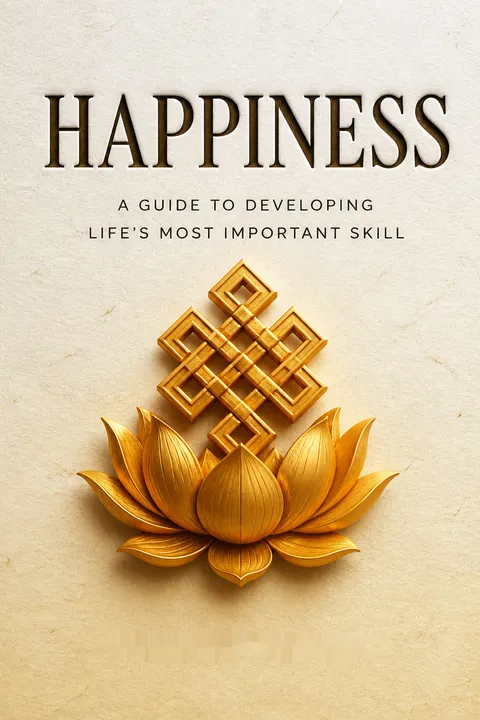


Key Takeaways
Treat happiness as a trainable way of being, not a lucky mood.
A different destination. Matthieu Ricard began as a promising cell biologist at the Pasteur Institute, but encounters with Tibetan teachers convinced him that intellectual brilliance alone did not make a life deeply fulfilled. He chose a life of Buddhist practice, not because the world lacked beauty, but because he wanted to understand what made a person wise, compassionate, and steady.
Well-being with roots. Ricard calls enduring well-being sukha: a state of inner flourishing grounded in clarity, freedom from destructive emotions, and care for others. It is not constant cheerfulness, nor a prize delivered by favorable circumstances. Fleeting happiness, such as relief after finishing a difficult task, offers a glimpse of calm, but the deeper skill is learning to return to that calm through life's changing conditions.
What's compelling is the shift from happiness as an emotional weather report to happiness as a practiced capacity. That resembles the distinction in clinical psychology between feeling good in a moment and building durable resources for coping, connection, and purpose. Ricard's account also resists the idea that inner practice means denying external reality. Still, the language of personal cultivation can sound too individualistic if applied to poverty, illness, or abuse. Mental training may change how hardship is met, but it cannot replace safety, treatment, or justice.
Enjoy pleasure without asking it to carry your whole life.
Pleasure has a short fuse. A delicious meal, a Bach prelude, or a warm fire can be genuinely enjoyable, but repeated exposure dulls the pleasure, and excess can turn it into discomfort. Ricard distinguishes such experiences from durable well-being: pleasure depends on a particular object or moment, while happiness can remain even when circumstances change. Pleasure is not the enemy; grasping at it is the trap.
Watch the craving loop. Ricard describes young Hong Kong traders who slept at the office to track markets, telling themselves that wealth would eventually buy freedom. One had saved far beyond his original target and still felt he had wasted years. Renunciation, in this account, means releasing what makes the mind dependent, not refusing every enjoyable thing. Ask whether a desire serves a considered aspiration or merely demands another round of satisfaction.
This distinction helps explain why a pleasant feeling and a good life are not interchangeable. Behavioral economics calls attention to adaptation: people get used to many gains, then reset their expectations. The book's strongest practical point is not that pleasure should be avoided, but that pleasure becomes costly when it dictates attention and choices. There is a useful caution here: long-term aims can also become rigid obsessions. A desire is not wise simply because it is ambitious; its effects on the person and those around them matter.
Separate unavoidable pain from the extra suffering the mind adds.
Pain is not the whole story. Ricard distinguishes physical or situational affliction from unhappiness, the mental distress that can grow around it. A person can feel grief or bodily pain without losing every sense of meaning and connection. He recounts a Tibetan prisoner who endured years of torture and hunger, yet preserved an inner stability that helped him survive. This is not a claim that pain is unreal or easy to bear; it is a claim that responses can differ.
Find the causes. The Four Noble Truths are a Buddhist framework: recognize suffering, identify its causes, understand that it can end, and follow a path of practice. Ricard also describes suffering as immediate pain, pleasure that changes into pain, and the less visible vulnerability created by confusion and self-centered habits. The framework turns despair into inquiry: what can be relieved, what needs care, and what response might reduce further harm?
The distinction between pain and the layers of distress around it has clear practical value. It supports agency without pretending that people control every event, and it resonates with approaches that help patients change their relationship to difficult thoughts and sensations. Yet the distinction must be handled gently. Trauma, depression, and chronic pain can constrain attention and choice in ways that are not solved by a better attitude. The framework is most humane when it encourages care and effective treatment, not when it becomes a reason to blame sufferers for suffering.
Train attention to meet emotions before they become actions.
Notice the first spark. Ricard presents meditation as gom, a Tibetan term meaning familiarization: repeatedly practicing a clearer way of relating to thoughts until it becomes more available in ordinary life. When anger appears, attention can turn from its target to the anger itself. Another option is to cultivate a counterquality, such as patience or goodwill. A more advanced approach examines the emotion closely, allowing it to pass without feeding it. These methods aim to interrupt escalation, not to numb feeling.
Practice has evidence, with limits. Ricard describes an early laboratory study comparing 12 experienced meditators with 12 controls. During compassion meditation, the experienced group showed unusually strong, coordinated gamma brain activity, with the largest responses among those reporting the most practice. Another study described in the book found improved vaccine response after three months of meditation training. These findings suggest trainability, though small studies cannot establish that every person will achieve the same effects.
The emphasis on noticing an emotion as it forms is a useful bridge between contemplative practice and cognitive behavioral approaches, which also examine thoughts rather than treating them as commands. The three responses offer flexibility: cultivate an alternative, observe the feeling, or redirect its energy. The laboratory results are intriguing because they make mental training empirically discussable. Their small samples and specialized participants also matter. Brain activity is not itself proof of happiness, and the reported findings should be treated as promising evidence, not a guarantee or a universal prescription.
Loosen the self-story that turns small injuries into lasting wounds.
The label intensifies the hurt. Ricard argues that the self is not an independent, permanent core, but a changing process shaped by body, mind, and relationships. A person still exists in the ordinary sense; the point is that identity is less solid and separate than it feels. He illustrates this with a vase: a broken vase in a shop window brings regret, but the same vase becomes a personal disaster once it is labeled mine. The attachment adds a second layer of pain.
Test the story. In another example, a bump from an empty boat provokes no lasting anger, while a bump believed to be deliberate can trigger outrage. The physical event is similar; the story about being targeted changes the response. Examining self-importance does not require abandoning boundaries or a stable sense of identity. It can instead create room to respond firmly without treating every slight as a verdict on one's worth.
This account makes a subtle point about how ownership and identity amplify emotional reactions. It fits with psychological findings that interpretation influences emotional experience, while offering a more radical philosophical question about whether the self is a fixed thing or a useful model. The distinction between a model and a reality is productive: identity can be functional without being absolute. But suspicion of ego should not become suspicion of legitimate self-protection. Healthy boundaries are compatible with humility; self-erasure is not the same as freedom.
Make other people's flourishing part of your own happiness.
Kindness can outlast a thrill. In an exercise described by Ricard, students compared an enjoyable outing with a philanthropic act. The act of kindness brought a more enduring sense of satisfaction and affected how students treated people for the rest of the day. Ricard uses this to distinguish gratification from the deeper fulfillment of acting in line with concern for others. Happiness and altruism, in this view, reinforce one another: a less self-absorbed mind is more available to help, and helping can strengthen well-being.
Widen the circle. A university experiment found that only 15 percent of passersby stopped to help an apparently ill person until he wore a rival soccer team's jersey; among supporters of that team, 85 percent stopped. The example shows how readily concern is limited to people who feel familiar. Ricard's practice is to extend the sense of belonging outward, remembering that all people seek relief from suffering and the conditions for well-being.
The link between helping and well-being is more interesting than a simple claim that kindness feels good. It suggests that attention can shift from private distress toward useful action, while social connection gives altruism a setting in which to grow. The soccer-shirt result also exposes how strongly group identity shapes care. Still, service can become self-sacrifice or a route to approval. A sound test is whether the action addresses another person's needs while respecting their agency, rather than merely soothing the helper's discomfort.
Improve life's conditions, but don't mistake wealth for inner well-being.
Circumstances matter, but not alone. Ricard reviews research suggesting that broad external factors accounted for only 10 to 15 percent of differences in reported life satisfaction, while genetic predisposition also played a role. These are population-level estimates, not a personal formula. Social connection, security, freedom, meaningful activity, and health all matter, especially when basic needs are unmet. Yet rising income does not reliably produce lasting satisfaction once people have enough to live on.
Beware comparison. Ricard cites the example of East Germans whose material circumstances improved after reunification, while reported happiness fell as their comparisons shifted toward wealthier western neighbors. He also describes Bhutan's Gross National Happiness policy, which weighs cultural and environmental protection alongside economic development. The point is not that poverty is romantic or that public policy can manufacture serenity. A good society supplies real conditions for a decent life, while inner habits affect how that life is experienced.
The book's two-level model is valuable: public conditions and private mental processes both matter, but neither can stand in for the other. The comparison example captures how relative status can erase the felt benefit of material gains. The numerical estimates deserve caution, since they depend on the populations and measures used and do not mean that circumstances barely matter to an individual facing hardship. The policy implication is not to choose mindfulness over social provision. It is to pursue material security without treating consumption as a substitute for belonging, agency, and meaning.
Choose optimistic explanations that preserve effort without denying reality.
Interpretation shapes action. Ricard contrasts optimism with denial. An optimist is more likely to see a setback as limited, changeable, and specific; a pessimist may treat it as permanent proof that nothing can improve. The book cites a follow-up of hospital patients in which the more optimistic group lived longer on average than the pessimistic group. That association does not prove optimism alone caused the difference, but it illustrates why explanatory habits matter.
Keep working with facts. Ricard's example is practical: while some colleagues predicted that local authorities would block humanitarian projects in Tibet, his group proceeded and built schools, health centers, and bridges. Optimism helped sustain effort through uncertainty. It is useful when it focuses attention on workable next steps, not when it ignores risk. Hope, in this account, means believing that routes toward a goal can be found and having the motivation to pursue them.
Optimism is strongest here as a style of problem-solving, not a promise that events will turn out well. That distinction aligns with research on learned helplessness: repeated expectations of futility can reduce attempts to act, while perceived options can sustain effort. The humanitarian story also shows optimism operating collectively, through planning and persistence, rather than as private positive thinking. A necessary limit is that some obstacles are structural or irreversible. Realistic hope names constraints clearly, then asks where action still has leverage.
Spend time on what matters before death chooses your priorities.
Attention gives time its value. Ricard draws on psychologist Mihaly Csikszentmihalyi's concept of flow: full absorption in an activity that is challenging enough to hold attention without overwhelming the person. A painter, climber, or interpreter may become so engaged that time and self-consciousness recede. Flow can make ordinary work absorbing, but it is not automatically good; gambling or crime can also engross someone. The purpose behind the activity matters.
Let mortality clarify. Ricard separates meaningful rest from the distracted busyness that leaves a person feeling life has passed unused. Remembering that death is certain but its timing is unknown can sharpen priorities without requiring constant fear. A daily pause for reflection, or focused presence during routine activity, helps keep attention from being consumed by trivial distractions. The question is not how to fill every minute, but whether time is being spent in ways that support a life worth having.
Flow explains why satisfaction often comes from engaged effort rather than from waiting for a reward at the finish line. Pairing it with mortality adds a useful test: does absorption serve something worth serving? That prevents productivity from becoming its own unquestioned virtue. The distinction also matters for modern attention economies, where endless stimulation can feel active while leaving little sense of agency. Reflection should not turn into another performance metric, however. Rest, caregiving, and unstructured time can be valuable even when they produce no visible achievement.
Judge actions by compassionate purpose and their real effects.
Ethics begins in motivation. Ricard presents Buddhist ethics as a practical inquiry into whether actions reduce suffering and support genuine well-being. Neither a rule nor a pleasant result is enough by itself. A mother who pushes a child out of a car's path acts roughly but protectively; a smiling deceiver may appear kind while causing harm. Ethical judgment requires attention to intention, consequences, context, and the welfare of those affected.
Use rules wisely. General rules against violence, theft, and deception protect people, but rigid application can miss the point of the rule. Ricard discusses lying to protect someone from a pursuer as an example of a possible exception. Compassion is not permission to do whatever feels justified: self-interest can disguise itself as benevolence. The discipline is to examine motivation repeatedly, consider the other person's perspective, and choose the response most likely to prevent harm.
This approach treats ethical character as a practiced capacity to perceive a situation, rather than as mere rule compliance. That is a powerful corrective to moral systems that ignore context and to outcome calculations that can sacrifice individuals too easily. It also creates a serious demand: compassionate exceptions need safeguards, because people are skilled at dressing convenience as virtue. A useful discipline is to make reasoning accountable to those affected, to evidence about likely consequences, and to principles that protect vulnerable people.
Analysis
Ricard's central contribution is a change in the object of the happiness project. Instead of treating happiness as a favorable feeling delivered by circumstances, he treats it as a trainable quality of mind, expressed through clarity, emotional balance, and concern for others. That shift organizes an unusually broad book: Buddhist analysis of suffering and selfhood, anecdotes from a monastic life, social psychology, and early neuroscience all become evidence about what human beings can cultivate.
The strongest argument is not that circumstances are irrelevant, but that they are insufficient. Ricard's examples repeatedly separate an event from the interpretation and habits that shape its emotional afterlife. This lets the book hold two ideas at once: pain and injustice are real, and the mind is not merely a passive receiver of them. The distinction is ethically important. Without it, inner training becomes victim-blaming; with it, training can increase a person's ability to respond without compounding harm.
The most productive tension lies between universal compassion and individual practice. Ricard argues that self-centeredness obstructs well-being, yet the path begins with a person's own attention and effort. That is not necessarily a contradiction: a less reactive person may become more useful to others. But private transformation cannot substitute for institutions that provide safety, health care, education, and justice. The book is most persuasive when inner discipline and social responsibility are treated as partners.
Its scientific material should be read in proportion to its evidence. The meditation studies described are small and preliminary, and reported associations between optimism, happiness, and longevity do not prove simple causal pathways. Their value is suggestive: mental habits may be trainable and measurable, not merely matters of belief. The durable insight does not depend on a brain scan. It is the invitation to test, through repeated practice and observable consequences, whether attention, compassion, and less possessive desire make life more stable and generous.
Review Summary
Happiness by Matthieu Ricard is widely praised for its comprehensive approach to the subject, blending Buddhist philosophy with scientific research. Readers appreciate its insights on cultivating happiness as a skill through meditation and mindfulness. Many found it life-changing, offering practical advice on managing emotions and developing compassion. Some critics felt it was occasionally dry or preachy, but most valued its unique perspective from a scientist-turned-monk. The book's exploration of neuroplasticity and positive psychology was particularly compelling for many readers.
People Also Read






Glossary
sukha
lasting inner well-beingA Buddhist term Ricard uses for durable well-being grounded in clear understanding, freedom from afflictive emotions, and loving concern for others. Sukha is not a passing pleasant sensation or an uninterrupted cheerful mood. It describes a stable way of being that can coexist with changing circumstances, including difficulty.
dukkha
suffering and vulnerabilityThe Sanskrit term Ricard presents as the counterpart of sukha. It refers not only to obvious pain, but also to the vulnerability and dissatisfaction that accompany change, loss, illness, and confusion. The term includes both suffering that is directly felt and the deeper conditions that make further suffering likely.
nyön-mong (klesha)
afflictive mental disturbanceA Buddhist term for mental states that disturb clarity, undermine well-being, and often lead to harmful speech or action. Ricard uses it for states such as hatred, obsessive desire, jealousy, and delusion. These states are treated as changeable patterns of mind, not permanent features of a person's essential nature.
gom
familiarization through practiceA Tibetan word commonly translated as meditation. Ricard emphasizes its sense of becoming familiar with a way of seeing or being through repeated practice. Meditation, in this account, is not simply relaxation or abstract thought; it trains attention and helps cultivate qualities such as patience, compassion, and clarity.
Four Noble Truths
a map for ending sufferingA foundational Buddhist teaching: suffering should be recognized, its causes investigated, its cessation understood as possible, and a path practiced to bring that possibility into reality. Ricard presents the framework as a practical sequence of diagnosis and response, rather than as a claim that every painful circumstance can immediately be removed.
hedonic treadmill
adaptation to new rewardsA concept Ricard attributes to psychologists P. Brickman and D. Campbell. It describes how people can adapt to improved possessions or circumstances, returning toward a familiar level of satisfaction and then wanting further gains. Comparison with others can intensify this cycle, making continued acquisition feel necessary just to maintain contentment.
flow
absorbed, focused engagementPsychologist Mihaly Csikszentmihalyi's term for deep absorption in an activity, with attention fully engaged and challenge balanced against ability. Flow can make an experience intrinsically satisfying and reduce self-consciousness and awareness of time. It is not inherently ethical or beneficial; its value depends partly on the activity and the motivation behind it.
neuroplasticity
experience-shaped brain changeThe brain's capacity to change in response to experience, including through altered connections and activity patterns. Ricard discusses this idea to explain why sustained practice might affect attention and emotional habits. The book's meditation experiments are presented as early evidence relevant to this possibility, not proof that every practice produces the same changes.
Gross National Happiness (GNH)
well-being as national progressA policy idea Ricard describes through Bhutan's effort to assess development using quality of life, cultural and environmental protection, and economic considerations. It challenges the assumption that economic growth alone measures collective success. In the book, GNH serves as an example of broadening public priorities, not as proof that a single national index can capture happiness completely.
FAQ
What's Happiness: A Guide to Developing Life's Most Important Skill about?
- Exploration of Happiness: The book explores happiness as a profound state of being, not just a fleeting emotion, and suggests it can be cultivated through mental training.
- Mind Over Circumstances: Matthieu Ricard emphasizes that happiness is found in controlling the mind rather than relying on external circumstances, highlighting the power of perception.
- Integration of Wisdom: Ricard combines Tibetan Buddhist insights with Western scientific perspectives, providing a comprehensive view of happiness and practical tools for personal development.
Why should I read Happiness: A Guide to Developing Life's Most Important Skill by Matthieu Ricard?
- Transformative Insights: The book offers a unique blend of philosophical and scientific insights, leading to a deeper understanding of oneself and happiness.
- Practical Tools: It includes practical exercises and methods to cultivate happiness, making it applicable to everyday life.
- Personal Growth: Ricard’s journey from scientist to monk serves as inspiration, demonstrating the potential for inner transformation through dedicated practice.
What are the key takeaways of Happiness: A Guide to Developing Life's Most Important Skill?
- Happiness is a Skill: Ricard emphasizes that happiness requires effort and time to develop, similar to training for a sport.
- Mindfulness and Awareness: Mindfulness is crucial for observing and understanding thoughts and emotions, leading to better emotional regulation.
- Altruism and Connection: True happiness is deeply connected to the well-being of others, highlighting the importance of altruism and compassion.
What are the best quotes from Happiness: A Guide to Developing Life's Most Important Skill and what do they mean?
- “Happiness does not come automatically.”: This quote underscores that happiness requires conscious effort and is not merely a result of good fortune.
- “One does not become happy overnight.”: Ricard highlights the importance of patience and consistent practice in cultivating happiness.
- “To change the individual is also, ultimately, to change the world.”: This suggests that personal transformation can lead to broader positive societal changes.
How does Matthieu Ricard define happiness in Happiness: A Guide to Developing Life's Most Important Skill?
- Deep Sense of Flourishing: Happiness is defined as a profound state of flourishing from a healthy mind, not just a pleasurable feeling.
- Optimal State of Being: It is an optimal state influenced by how we interpret the world, emphasizing perspective.
- Interconnectedness with Others: Happiness is relational, intertwined with the well-being of others.
What methods does Matthieu Ricard suggest for cultivating happiness in Happiness: A Guide to Developing Life's Most Important Skill?
- Mindfulness Practice: Ricard advocates mindfulness meditation to develop awareness of thoughts and emotions, allowing for thoughtful responses.
- Cultivating Altruism: Practicing loving-kindness and compassion towards others can enhance personal happiness and fulfillment.
- Emotional Regulation Techniques: Techniques for transforming negative emotions into positive states are outlined, such as patience for anger.
What role does suffering play in achieving happiness according to Happiness: A Guide to Developing Life's Most Important Skill?
- Alchemy of Suffering: Suffering can be transformed into a source of growth and understanding, leading to deeper life insights.
- Understanding Impermanence: Recognizing suffering's transient nature helps cultivate resilience and peace.
- Motivation for Change: Suffering can motivate personal transformation, prompting individuals to seek happiness and develop inner qualities.
How does Matthieu Ricard suggest we deal with negative emotions in Happiness: A Guide to Developing Life's Most Important Skill?
- Recognizing Emotions: Acknowledge negative emotions as they arise to understand their nature and impact.
- Using Antidotes: Apply specific antidotes, like patience for anger, to neutralize negative emotions.
- Liberation Technique: Practice observing emotions without attachment, allowing them to dissipate naturally for greater emotional freedom.
What is the significance of altruism in Happiness: A Guide to Developing Life's Most Important Skill?
- Foundation of True Happiness: Altruism is essential for genuine happiness, fostering connections and enhancing well-being.
- Cultivating Compassion: Developing compassion leads to a more fulfilling life, shifting focus from self-centered desires to collective well-being.
- Interdependence: Happiness is linked to others' happiness, reinforcing the importance of altruistic actions.
How does Happiness: A Guide to Developing Life's Most Important Skill address the relationship between happiness and altruism?
- Interconnectedness of Happiness and Altruism: True happiness is intertwined with altruistic behavior, enhancing fulfillment and joy.
- Empirical Evidence: Studies show altruistic individuals report higher happiness levels, fostering connection and purpose.
- Cultivating Altruism: Practical advice is given on cultivating altruism, suggesting small acts of kindness can improve personal happiness.
What is the mechanism of desire according to Happiness: A Guide to Developing Life's Most Important Skill?
- Desire as a Mental Representation: Desire often begins with a mental image, shaping our perception of desirability.
- Conflict of Satisfaction: Satisfying desires leads to temporary relief, often followed by new desires, creating a cycle of craving.
- Overcoming Afflictive Desire: Understanding desire allows for inner dialogue to overcome it, essential for lasting happiness.
How can I apply the teachings of Happiness: A Guide to Developing Life's Most Important Skill in my daily life?
- Daily Mindfulness Practice: Incorporate mindfulness meditation to enhance awareness and balance.
- Acts of Kindness: Engage in small acts of kindness to cultivate connection and joy.
- Reflect on Happiness: Regularly reflect on what brings true happiness, aligning actions with these insights for a meaningful life.
About the Author
Other books by Matthieu Ricard

Download PDF
Download EPUB
.epub digital book format is ideal for reading ebooks on phones, tablets, and e-readers.








