

Key Takeaways
Treat material frugality as a Christian calling in every vocation.
The call is shared. Dubay argues that the New Testament’s teaching on material goods is meant for laypeople as well as clergy and religious. He calls this evangelical poverty: a materially sparing way of life joined to sharing, not destitution. Some Gospel passages invite particular people to surrender all their property, but the broader call to use possessions with restraint and generosity applies across vocations.
Different lives, same aim. A married couple, a priest, and a religious community will not practice poverty identically. Their responsibilities differ, but Dubay insists they share the same spiritual destination: freedom from being ruled by possessions and readiness to serve God and neighbor. The book’s central challenge is to stop treating poverty as an ideal reserved for monasteries.
The argument makes a useful distinction between a shared moral direction and identical rules for everyone. That distinction matters in any ethical tradition: common values need context-sensitive practice, especially where children, health, or public responsibilities are involved. Dubay’s insistence that lay holiness includes material choices also challenges a familiar division in which spiritual ideals belong to clergy while consumption is treated as private preference. The harder question is how communities translate a broad call into fair, usable norms without turning discernment into either an excuse for comfort or an inflexible demand.
Define poverty by what you own and share, not intentions alone.
Good intentions are insufficient. Dubay distinguishes Gospel poverty from dirt, disorder, laziness, destitution, miserliness, and mere thrift. It is not simply inner detachment, availability to others, or respectful use of nature. Those may matter, but he argues they cannot replace the material question: how much a person uses, keeps, and shares.
Measure the lived reality. Someone may speak sincerely about the poor while retaining an extravagant wardrobe and costly recreations. Conversely, a frugal person may be miserly if saving money matters more than meeting another person’s need. The positive ideal is not austerity for its own sake. It is a sparing use of possessions that makes generosity possible and puts things in service of people and God.
This definition resists a common ethical loophole: substituting a virtuous-sounding attitude for observable conduct. In moral psychology, stated values and repeated behavior can diverge, so material choices provide a concrete test of sincerity. Still, visible frugality is not a complete measure of compassion. A person can live simply and remain ungenerous in time, attention, or public action. The strongest reading treats material sharing as indispensable evidence of love, not as the only evidence that love exists.
Make love concrete by sharing goods with people in greater need.
Need makes love tangible. Dubay draws on several New Testament traditions: John the Baptist tells people to share food and clothing; Acts describes early Christians distributing resources according to need; Paul praises poor Macedonians who contributed to another community; James and John condemn faith or love that stays verbal when someone lacks necessities. For Dubay, material sharing is not an optional charitable extra but a consequence of belonging to one human family in Christ.
Give beyond leftovers. He argues that Christians may be called to share not only from surplus but, at times, from what they themselves need. His standard is rough equality: a neighbor’s urgent lack should matter as much as one’s own lesser comforts. Saints in his examples gave money, welcomed poor guests, and personally served them.
The ethical force comes from connecting emotion to allocation. Care becomes credible when it changes who can eat, live safely, or access basic goods. This principle also points beyond private generosity toward public arrangements that distribute resources fairly. Individual giving cannot by itself resolve large-scale deprivation, and a focus on charity can sometimes leave unjust systems intact. Dubay’s strongest contribution is to make personal consumption morally visible while leaving room to ask what institutions must change alongside it.
Own less to become more ready for God's kingdom.
Poverty prepares perception. Dubay calls the resulting openness “radical readiness for the kingdom”: a deepened ability to recognize and respond to the values Jesus teaches. He links this readiness to detachment from possessions and humility about status. The point is not that having little automatically makes someone holy, but that possessions can occupy attention and make surrender harder.
A revealing encounter. Dubay recounts how Catherine of Siena challenged a Franciscan scholar whose elegant way of life sat uneasily with his religious ideals. The scholar responded by giving away his accumulated goods. For Dubay, the episode shows how material habits can either dull or sharpen a person’s receptivity to spiritual claims. A voluntary limit makes the choice to let go less abstract.
The psychological mechanism is plausible: people often value what they possess more highly simply because it is theirs, which can make giving it up feel like a loss. Fewer possessions can also reduce the attention spent maintaining, comparing, and protecting them. But material simplicity is not a guaranteed route to spiritual insight. People facing scarcity may be consumed by survival concerns, while wealthy people can be generous and contemplative. The claim is best understood as a discipline that can support readiness, not as a formula that produces it.
Let a modest life make your religious message believable.
Conduct carries the message. Dubay argues that people are less persuaded by religious speech when the speaker’s lifestyle contradicts it. He points to John Vianney, a parish priest remembered for a severely simple life: he kept only a small number of worn garments and sold personal belongings to help the poor. His reputation for holiness grew through the fit between what he taught and how he lived.
Poverty serves the apostolate. The Gospel accounts of missionaries traveling with few provisions present material dependence as a sign of trust and a way to avoid appearing self-interested. The practical details vary with circumstances, but Dubay’s principle is that a preacher should not use the faith to defend comforts that the message itself calls into question.
Consistency functions as a form of credibility: audiences naturally ask whether a speaker accepts the cost of the principles being urged on others. This is especially important for leaders who speak about sacrifice or inequality. Yet poverty alone does not prove sound judgment, compassion, or truth. Austerity can become performance, and visible simplicity can conceal other forms of privilege. The strongest witness combines restrained consumption with honest service, accountability, and a willingness to explain how practical needs are being met.
Live as a pilgrim, not a permanent resident of consumer culture.
A lifestyle makes a claim. Dubay describes Christians as pilgrims whose ultimate home is not secured by salary, property, or possessions. A frugal life makes this belief visible and challenges the assumption that the good life means continually expanding comfort and consumption. He distinguishes economic arrangements from the values beneath them: rules and institutions are difficult to change when a society still treats consumption as its highest priority.
Watch the word “afford.” In his example, a couple considers a modest donation affordable so long as it does not require changing their usual spending. They could give more by cutting back on dining out or a vacation, but that possibility never enters the calculation. Their habits reveal an unspoken rule: generosity may not disturb the preferred lifestyle.
The example exposes how economic choices are guided by norms, not just available cash. A person’s definition of “affordable” often protects existing priorities from scrutiny. Visible counterexamples can widen what a community considers normal, especially when a simple life is shown to be joyful rather than grim. Still, personal witness cannot replace policy or collective action. The most persuasive approach joins changed habits to efforts that address the institutions shaping unequal access to housing, food, health care, and security.
Test every claimed necessity against its purpose and another's need.
Purpose defines need. Dubay separates intrinsic necessities, such as knowing and loving, from material means that help achieve an end. He proposes four practical categories: survival needs, health needs, spiritual needs, and functional needs related to one’s work. A possession is superfluous when it serves neither a genuine purpose nor a necessary means to one.
Need is not always equal. A tool required for work may be functional for one person and unnecessary for another. More importantly, when someone else faces a severe lack, a lesser comfort may need to yield. Dubay asks readers to examine clothing, food, travel, entertainment, and household goods by asking what they actually do, whether they are needed, and whether the resources could better serve someone in greater need.
This framework improves on a simple “buy less” rule because it asks what goods are for. It also recognizes that necessity depends on health, work, and spiritual practice rather than on a universal inventory. The difficult part is that people can sincerely mistake habit or status for need. Shared reflection and transparent budgets can help expose those assumptions. Any such test should also protect legitimate needs: accessibility, caregiving, safety, and rest are not luxuries merely because they cost money.
Match austerity to your vocation without shrinking the shared ideal.
One call, different degrees. Dubay arranges practice into three levels. The first includes the common obligations: use goods for good purposes, earn one’s living when able, share with those in need, avoid excess, and choose simplicity. The second includes giving up some necessities or serving the poor directly. The third is chosen destitution, which he presents as a special calling, not a requirement for everyone.
Family responsibility remains real. Married saints in the book care for their households while living simply and sharing generously. Thomas More, for example, supported his children’s education, lived personally with restraint, and welcomed poor neighbors. His example illustrates Dubay’s point: family obligations shape the practice of poverty, but they do not erase the call to generosity.
The levels help distinguish a universal direction from exceptional forms of renunciation. That distinction is ethically important: voluntary poverty should not become a reason to neglect dependents or to treat preventable hardship as spiritually desirable. The book’s married examples make the ideal more credible by showing that care for family and care for strangers can coexist. A sound application asks what obligations are genuinely present, then considers how much comfort can be surrendered without shifting the cost onto vulnerable people.
Replace vague communal agreement with clear, shared standards for possessions.
A vow has practical consequences. Dubay argues that religious poverty involves dependence on a community’s shared resources, not merely private good intentions. Income and gifts belong to the common fund, while personal needs are met through communal decisions. Asking permission is meant to express shared ownership, not just satisfy a rule. Leaders act as stewards of community resources rather than private owners.
Comfort can hide inside consensus. When members disagree about what poverty requires, communities may settle for the least demanding option to avoid conflict. Dubay identifies this inertia, along with attachment to comfort, as a major obstacle to change. His answer is not to force every member into an identical extreme, but to prevent a few people’s resistance from blocking standards that the community has chosen together.
Shared standards address a collective-action problem: an individual may be willing to consume less but find it difficult when everyone else’s expectations remain unchanged. Clear rules can make restraint fairer, reduce private exceptions, and protect communal resources from being treated as personal property. They also need room for differences in health, work, and responsibility. Without transparent reasoning and accountability, community rules can become either bureaucratic formalities or tools of control rather than expressions of shared purpose.
Pursue durable joy, but never confuse chosen simplicity with imposed deprivation.
Pleasure and joy differ. Dubay describes sense pleasure as tied to a particular bodily stimulus, such as food or drink, and often limited by satiety. Joy, in his account, is a deeper well-being rooted in goodness, truth, love, and God; it can coexist with physical suffering and is not exhausted by repetition. This distinction explains how voluntary simplicity might bring happiness rather than merely remove comforts.
A story of cheerful restraint. Thomas More, imprisoned before his execution, wrote to his daughter with calmness and hope despite losing his position and facing death. Dubay presents his composure as an example of joy rooted in faith rather than possessions. The beatitude about the poor, he insists, does not praise hunger or unsafe shelter: it calls for sharing that relieves such deprivation.
The distinction helps explain why more stimulation does not necessarily produce a more satisfying life. Pleasure is valuable, but it can become a poor substitute for belonging, purpose, or love when treated as the whole of happiness. The book’s spiritual account of joy is compelling within its theological commitments, though it cannot establish that deprivation itself makes people happier. The decisive distinction is agency and care: chosen simplicity can express freedom, while involuntary poverty is a harm that calls for remedy.
Analysis
Dubay’s book builds a sustained argument rather than offering a budget plan. It begins with confusion about what Christian poverty means, argues that material restraint is part of the Gospel’s broad call, then explains why that restraint matters: it can loosen attachment, make sharing concrete, lend credibility to religious speech, and embody a pilgrim identity. The final appeal is not to deprivation as an achievement but to joy understood as deeper than consumption.
The argument’s strength is its refusal to let spiritual language float free of material consequences. A reader cannot claim that possessions are irrelevant while ignoring how much they shape daily life and how resources might meet another person’s urgent needs. Its distinction between a common call and exceptional destitution also prevents the most dramatic saintly examples from becoming a universal prescription.
The book’s method, however, depends on specifically Catholic authorities: Scripture as interpreted by the Church, and saints as exemplary interpreters of Christian life. Those sources give the work coherence for readers who share its premises, but they do not function as neutral evidence for every audience. Its account of simplicity as a condition for spiritual receptivity is best treated as a serious religious claim, not a demonstrated psychological law.
A second tension concerns the scale of responsibility. Dubay presses readers to change personal consumption and insists that witness can challenge a society’s values. That is a valuable corrective to distant criticism of inequality. Yet personal austerity and charity cannot by themselves resolve the institutional causes of deprivation. The book is most useful when its personal examen is paired with attention to public policy, labor, and the distribution of essential goods.
Its durable question is practical: what does a person’s use of material goods reveal about what they love, whom they consider family, and which needs they regard as negotiable?
Review Summary
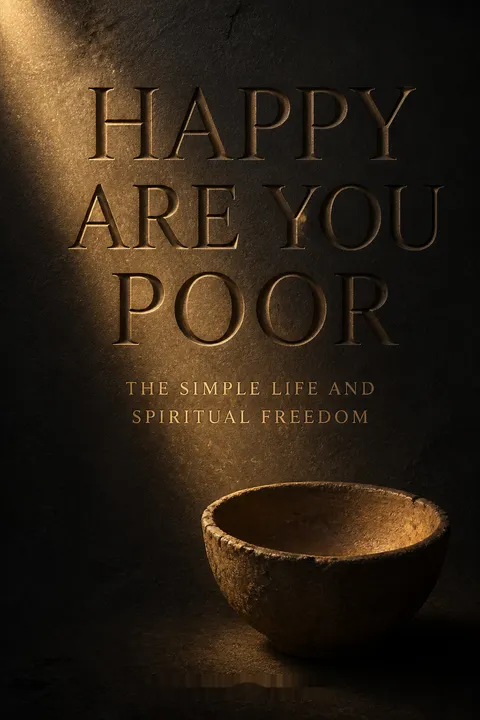
Happy Are You Poor receives high praise from most reviewers for its challenging and thought-provoking examination of Gospel poverty. Many find it life-changing, praising its radical approach and scriptural basis. Readers appreciate its call to reflection on materialism and attachment. Some criticize its writing style or find its conclusions too extreme. Several note it's not an easy read but consider it essential for Christians seeking spiritual growth. A few dissenters argue it oversimplifies complex economic issues or misinterprets scripture. Overall, most reviewers recommend it as a powerful, transformative work on Christian poverty.
People Also Read





Glossary
Evangelical poverty
Faithful restraint and sharingA Christian way of using material goods with restraint and generosity. In Dubay’s account, it is neither destitution nor an inner attitude alone. It includes avoiding unnecessary excess and sharing resources with people in need. The practice applies across Christian vocations, although its concrete form differs for families, clergy, and religious communities.
Radical readiness for the kingdom
Openness to God's valuesDubay’s term for a deepened ability to recognize and respond to the values of God’s kingdom. He connects this readiness to humility and detachment from possessions, which can otherwise draw attention toward status, comfort, or security. It describes a spiritual disposition that voluntary material simplicity may support, not an automatic result of having little.
Sparing-sharing lifestyle
Restraint joined to generosityA pattern of living that limits personal consumption while making material goods available to others, especially people in need. Dubay uses the idea to distinguish Christian poverty from mere thrift, abstract concern, or responsible use without sacrifice. The aim is not to accumulate savings for their own sake, but to use resources for human and spiritual goods.
Pilgrim witness
Visible life beyond consumerismA public sign, expressed through a restrained way of life, that earthly possessions and status are not the ultimate source of security or purpose. Dubay argues that such a witness challenges consumerist assumptions and makes religious belief visible in ordinary choices. It is meant to accompany, not replace, direct care for people in need and social reform.
Superfluity
What serves no real needA possession, activity, or indulgence that is needed neither as a worthwhile end nor as a means to a worthwhile end. Dubay’s test depends on purpose: food can be necessary for health, while excess food may be superfluous; a work tool may be functional for one person but unnecessary for another. The term requires discernment about genuine needs.
Levels of Radicality
Degrees of material renunciationDubay’s three-part account of Christian poverty. The first level describes common duties such as using goods for good purposes, sharing, and avoiding excess. The second includes giving up some necessities or serving the poor directly. The third is chosen destitution, which Dubay describes as a special calling rather than a requirement for all Christians.
Download PDF
Download EPUB
.epub digital book format is ideal for reading ebooks on phones, tablets, and e-readers.








