

Key Takeaways
Plan the hatch and brooder as one continuous job
Prepare before arrival. Damerow began with chicks in a cardboard box, then discovered how quickly the birds outgrew it. A brooder is temporary housing that replaces a mother hen’s warmth and protection until young birds grow enough feathers to regulate their temperature. It must keep them warm, dry, safe from predators, and able to reach food and water, while allowing fresh air to circulate.
Expect rapid growth. A small box may work for a few days, but growing birds need more floor space, larger feeders, and less heat. Before ordering chicks or setting eggs, decide where the birds will move next. A garage, shed, or future coop can work if it is draft-free and secure. Keep spare heat bulbs or another backup ready, since a failed heater can chill a whole brood.
The book’s opening anecdote makes a useful point about infrastructure: the first container is rarely the whole plan. The same principle appears in emergency management and product design, where a system must be built for changing demand, not just its initial state. Planning the next housing stage also reduces rushed moves, a common source of stress for young animals. The practical challenge is that growth rates vary by breed, species, and temperature, so fixed calendars can mislead. Observing space, cleanliness, and bird behavior is more reliable than treating any single brooder size as universal.
Choose poultry for the job, not the catalog photograph
Match breed to purpose. A layer breed may produce roughly 250 to 280 eggs a year and begin laying at 17 to 21 weeks. Dual-purpose hens typically start later, at 24 to 26 weeks, and are less efficient at laying than specialized layers or growing meat than broilers. They offer a compromise: useful eggs, edible cockerels, and offspring that tend to resemble their parents.
Know what reproduces. A hybrid is a cross between breeds or specialized strains, often selected for fast growth or high egg output. Hybrid vigor can make these birds productive, but their offspring do not reliably reproduce the parents’ traits. For a self-replacing flock, choose straightbred birds. For rare or show breeds, seek knowledgeable local breeders; local stock may also be better suited to the area. Ask about health practices and National Poultry Improvement Plan participation.
This is a decision about tradeoffs, not a ranking of breeds. Specialized production often improves one output by sacrificing another, while a utility flock values versatility and predictable descendants. That resembles the distinction between optimizing a component and optimizing a whole system. The choice also has an ethical and ecological dimension: maintaining a breeding population can support local adaptation and breed conservation, but it demands more skill than repeatedly buying commercial hybrids. Breed descriptions and production figures are useful filters, not guarantees; individual strains, care, and climate can change the result.
Read chick behavior before reaching for the thermostat
Let birds report comfort. A starting brooder temperature of about 90 to 95°F is a rule of thumb, with heat reduced roughly 5°F each week. But the chicks’ distribution is the more immediate guide. Birds crowded beneath the heater are cold; birds pressed away from it, panting, or holding their wings out are too hot. A group huddled on one side may be avoiding a draft. Comfortable chicks spread out, move around, and make quiet, relaxed sounds.
Adjust the whole setup. Raising the heater, improving ventilation, or giving chicks more room can matter as much as changing a bulb. Fast-growing broilers overheat more easily, while poults chill readily. Too much heat can suppress eating and growth; too little can cause piling and suffocation. Use a secure fixture, and do not rely on a single bulb without a spare or alternative heat source.
The chicks’ clustering works like a living sensor: it integrates temperature, airflow, and the animals’ own ability to move. This is a form of feedback control, where the operator adjusts conditions in response to observed outcomes rather than trusting a static setting. It is especially valuable in small brooders, where a thermometer may measure a hot spot instead of the birds’ actual comfort. Still, behavior is evidence, not a diagnosis. Distress can also come from illness, crowding, or inaccessible water, so good husbandry combines observation with inspection of the entire environment.
Keep food, water, and bedding species-specific, visible, and dry
Start with simple access. Give hatchlings clean water as soon as practical, ideally warmed to brooder temperature, and make sure they find the drinker. Feed a commercial starter ration after they have begun drinking. Do not substitute layer feed: its higher calcium content can harm young birds’ kidneys. Ducklings and goslings need more niacin than chick starter supplies, so the book recommends adding brewer’s yeast when land-fowl starter is their only ration.
Manage moisture from day one. Land-fowl chicks can first walk on paper towels or another nonslip surface with a little feed scattered on it. Once they eat and walk confidently, switch to loose, absorbent bedding. Waterfowl splash and wet bedding quickly, so they need separate housing from chicks and more frequent moisture management. Keep feeders and drinkers clean, apart from each other, and within easy reach. Damp litter can become moldy and unhealthy.
The practical logic is deceptively strong: access, nutrition, and sanitation are linked rather than separate chores. A chick that cannot find water will not benefit from an ideal feed formula, and a sound ration cannot compensate for wet, contaminated bedding. This systems view also explains why waterfowl need different arrangements, even when their basic nutritional needs overlap with land fowl. The book’s emphasis on commercial starter feed is sensible for beginners because formulation is complex. Feed labels and veterinary guidance remain important, especially when medicated products or unusual species are involved.
Prevent picking by fixing crowding, heat, light, and boredom
Separate pecking from picking. Pecking helps birds explore and establish a social hierarchy. Cannibalistic picking is different: birds pull feathers or injure flesh, sometimes after one wound attracts more attention. Crowding, overheating, bright continuous light, too few feeders, poor ventilation, and low-protein feed can contribute. Birds also need room to get away from one another and enough feeder space to eat without competition.
Give normal behavior somewhere to go. Expand the brooder as birds grow, reduce heat gradually, provide dimmer light and a daily dark period, and use loose bedding that allows scratching and dustbathing. Perches, greens, or other safe objects can occupy curious birds. Speak softly before approaching, since sudden movement can frighten them. Avoid handling hatchlings on their first day; excessive handling can stress them, and close human imprinting is especially unwise with goslings that may become aggressive adults.
The key insight is that damaging behavior often signals a poor fit between animals and their surroundings. This parallels behavioral ecology: when an environment blocks ordinary activities, abnormal or costly behavior becomes more likely. Enrichment is not decoration; it can redirect attention and lower competition. At the same time, the book does not present enrichment as a cure-all. A toy cannot solve overcrowding, and a persistent aggressive bird may need removal. Treating picking as both a welfare issue and a management signal helps prevent the mistaken response of blaming the birds alone.
Let a dependable hen hatch, but give her privacy and backup
Natural incubation can simplify the work. A broody hen supplies warmth, turns the eggs, and protects hatchlings, avoiding many mechanical failures. But broodiness is not guaranteed, and even breeds known for setting contain unreliable individuals. A hen that stays on the nest overnight and defends it is more likely to be serious. A clutch must fit beneath her: around a dozen chicken eggs is a useful guide, fewer if the eggs are much larger than hers.
Make the nest safe. Separate a brooding chicken from other hens to prevent nest switching, added eggs, or attacks on chicks. Provide dry nesting material, food, and clean water, and check occasionally without disturbing her. Guinea, turkey, duck, and goose nests can be difficult to move, so site them carefully. After hatching, keep the mother and brood in a predator-proof enclosure. If the hen abandons the nest or cannot protect the hatchlings, be ready to finish the job in an incubator or brooder.
The hen is a highly capable biological control system, but not a perfectly predictable one. Her success depends on individual temperament, nest placement, and flock dynamics, which makes contingency planning part of trusting nature rather than a rejection of it. The distinction between species matters too: a chicken hen may accept other birds’ eggs, yet a waterfowl brood can create challenges she cannot manage. The book’s approach is best understood as a partnership between animal behavior and human oversight. Intervention should be limited, but readiness to intervene can prevent avoidable losses.
Fresh, clean, normal-shaped eggs give incubation its best odds
Choose for viability. Select eggs that are typical in size and shape for the breed, with clean, sound shells. Avoid cracked, misshapen, unusually small, or very large eggs. Collect eggs from the nest several times daily to reduce contamination and temperature extremes. Dirty eggs can carry bacteria into the warm, humid incubator, where an infected egg may spoil or even explode. Candling, shining a light through the shell, helps reveal cracks, double yolks, and the size of the air cell.
Store briefly and carefully. The book gives an ideal storage temperature near 55°F and humidity around 75 percent, with eggs placed large-end up. Hatchability declines as storage time increases; after six days, each additional day may reduce it by about 0.5 to 1 percent. Shipped eggs are riskier because handling, temperature changes, and delays can damage them. Let transported eggs rest and warm gradually before incubation, rather than placing cold eggs directly into a warm machine.
Egg handling is a form of risk reduction before the incubator ever switches on. The shell is protective, but porous, so cleanliness, storage, and temperature stability all affect what happens inside. This resembles food-safety practice: prevention at the source is usually easier than correcting contamination after it spreads. The stated storage figures are practical targets, not guarantees, because shell porosity and ambient conditions vary. A useful correction to wishful thinking is the book’s insistence that buying fertile eggs transfers risk to the buyer; even excellent eggs cannot guarantee a hatch.
Treat incubation as a measured process, not a set-and-forget box
Control several variables. Temperature, humidity, ventilation, egg position, and turning all affect embryo development. Typical settings are about 99.5°F for a forced-air incubator and 102°F for a still-air model, but the manufacturer’s instructions take priority because thermometer placement and airflow differ. Humidity governs how quickly moisture leaves the egg. Candling the air cell, or weighing sample eggs, helps reveal whether moisture loss is on track. Ventilation supplies oxygen and removes carbon dioxide, and its importance rises as embryos grow.
Turn, then stop. Turning keeps the embryo from sticking to the shell membrane and supports development. Manual turning three or five times daily is a practical substitute for an automatic turner. Keep the blunt end higher than the pointed end. Stop turning chicken eggs around day 19 and most other poultry eggs around day 25, allowing embryos to position for hatching. Raise humidity for the hatch, and avoid opening the incubator repeatedly while chicks are emerging.
Incubation is a coupled system: changing ventilation affects humidity, and temperature errors can alter hatch timing and deformity risk. That is why the book favors records and stable conditions over constant tinkering. Its guidance also shows the value of separating incubation from hatching when equipment and workload justify it, since the two stages need different conditions. Numerical settings are starting points rather than universal truths, particularly across species and incubator designs. The soundest operating habit is to learn one machine’s behavior through careful observation, then make small, documented adjustments.
Diagnose hatch failures with records, candling, and egg breakouts
Count outcomes, not impressions. A typical artificial hatch may produce about 85 percent of fertile land-fowl eggs and 70 to 75 percent of waterfowl eggs, but results depend on egg quality, breeder health, and incubation. Record the source and number of eggs, setting date, candling results, temperature problems, and hatch dates. Candle about a week into incubation and again near the hatch. A clear egg may be infertile; a blood ring indicates an embryo died early; a late dark mass may still be alive, so movement against the air cell matters.
Inspect failures for patterns. Breakout analysis means opening unhatched eggs to examine embryo development, position, and deformities. A cluster of early deaths can point toward egg handling or storage; late deaths may suggest incubation conditions, breeder nutrition, or contamination. One failed egg proves little. Repeated failures at the same stage are more informative. Clean and disinfect the incubator after each hatch, since debris and microbes can lower the next hatch’s success.
The book turns disappointment into diagnosis. That shift resembles quality improvement in engineering: a failure becomes useful when it is classified, compared, and linked to a process variable. It also guards against overreacting to a single bad outcome, since some embryos will fail even under careful management. The strongest method combines quantitative records with physical inspection, but breakout findings are not always definitive. A dead embryo can reflect multiple interacting causes. When disease is suspected, expert veterinary or Extension advice is more reliable than treating a visual clue as a complete diagnosis.
Use pedigree tools when each chick's ancestry matters
Keep identity attached to the bird. Breeders may need to know which hen laid an egg and which male fertilized it, especially when conserving a rare breed, selecting show birds, or identifying weak breeders. Pedigree baskets separate groups of eggs in the hatcher; temporary color marks can distinguish hatchlings before more durable identification is applied. Records should link each bird to its breed, parents, hatch date, sex, and identifying mark.
Choose a method you can maintain. Leg bands and zip ties need repeated size checks as birds grow, or they can constrict a leg. Wing bands are more permanent but require careful placement. Toe punching creates coded marks in the web between toes, though the holes can be hard to see or may grow closed. For a small flock without breeding goals, elaborate identification may add work without value. For conservation breeding, accurate records help preserve genetic diversity and avoid perpetuating known defects.
Identification is not merely clerical. It determines whether selection decisions are based on evidence about parentage, fertility, hatchability, and inherited traits. This is a small-scale version of traceability in agriculture, where knowing a product’s origin supports both quality control and long-term stewardship. Yet precision has a cost: bands can injure growing birds if neglected, and records become unreliable if the system is too complicated to sustain. The right method is therefore the least burdensome one that preserves the information the keeper genuinely needs.
Analysis
This is a practical reference organized around a useful learning sequence: first choose and raise young birds, then decide whether to let a hen hatch eggs or operate an incubator. That order reflects the realities of novice poultry keeping. A reader can begin with store-bought chicks, learn the daily work of brooding, and approach incubation with a better understanding of what hatchlings require. The author’s own movement from an expanding cardboard box to specialized brooders gives the technical material a modest but memorable narrative thread.
The book’s central strength is its treatment of hatching as a chain of dependent decisions. Breed choice shapes growth and brooding needs. Egg collection and storage affect embryo viability. Incubator temperature, humidity, airflow, and turning interact. After hatching, sanitation and space influence disease and behavior. This is more than a list of equipment instructions: it is a model of husbandry as continuous observation and adjustment. The practical cues, such as where chicks cluster beneath a heater, make the model accessible even when instruments are imperfect.
Its breadth is also its summarizing challenge. Chickens, turkeys, guineas, ducks, and geese share some biological needs but differ in noise, growth, moisture, incubation time, and parental behavior. The book handles those differences through repeated comparisons, which a short adaptation must compress without pretending every species is interchangeable. Its numbers are best read as starting ranges, since breed, room conditions, equipment, and management alter outcomes.
A further strength is the distinction between normal development and preventable trouble. The book explains why pecking, imprinting, huddling, and bathing can be natural, while showing when those behaviors signal stress or danger. Its insistence on record keeping makes experience cumulative rather than anecdotal. Because the book was published in 2013, readers should verify current product labels, disease recommendations, and local regulations with a veterinarian or agricultural Extension service. The enduring lesson is procedural: observe carefully, keep conditions stable, and change one factor at a time when diagnosing a problem.
Review Summary
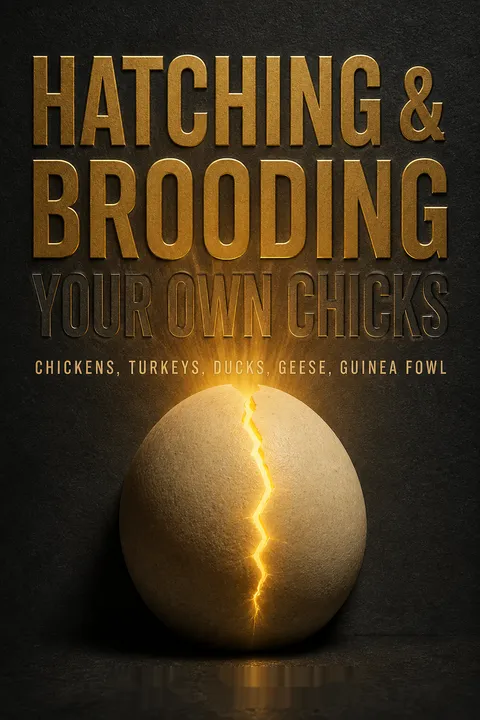
Hatching & Brooding Your Own Chicks receives mostly positive reviews, with readers praising its comprehensive coverage of hatching and raising various fowl. Many find it informative and useful for beginners and experienced farmers alike. The book's thorough explanations, practical advice, and helpful illustrations are frequently mentioned. Some readers appreciate its DIY suggestions and honest approach. However, a few reviewers note that it may lack depth on specific topics or contain some inaccuracies, particularly regarding ducks and geese. Overall, most readers consider it a valuable resource for poultry enthusiasts.
Glossary
Brooder
Temporary hatchling housingA protected facility that replaces a mother hen while young poultry grow enough feathers to keep warm. A brooder must provide appropriate heat, dry bedding, secure containment, ventilation, and access to food and water. It may be a simple box, a purpose-built unit, or a larger area arranged around a heat source.
Hybrid vigor
Crossbred performance advantageThe tendency for offspring produced by crossing breeds or specialized strains to be stronger, healthier, faster-growing, or more productive than either parental population. Commercial poultry may be selected for this advantage, but their offspring do not necessarily reproduce the same traits consistently. Continued production of the same hybrid generally requires repeating the original cross.
Brood patch
Bare egg-warming skinA featherless area that develops on a setting hen’s breast. The patch brings the hen’s body warmth closer to the eggs and helps transfer moisture from her body, reducing excessive egg drying. It is part of the hen’s natural incubation equipment, along with her periodic turning and rearrangement of the eggs.
Coccidiosis
Parasitic intestinal diseaseAn intestinal disease caused by coccidia, microscopic parasitic protozoa. It most often affects chicks and poults several weeks old, especially when contaminated droppings are consumed in feed, water, or litter. Signs can include slow growth, hunched posture, and loose or bloody droppings. Prevention relies on appropriate sanitation, management, and, where indicated, vaccination or medication.
Candling
Light-based egg inspectionExamining an intact egg by shining a bright light through its shell. Before incubation, candling can reveal cracks, shell irregularities, and some internal defects. During incubation, it can show blood vessels and embryo growth, identify clear or nondeveloping eggs, and help assess the air cell as moisture evaporates.
Breakout analysis
Inspection of failed eggsThe examination of an incubated egg that was culled or failed to hatch. The shell and membranes are opened so the keeper can assess embryo development, position, and visible abnormalities. When findings are recorded across multiple eggs and hatches, they can help distinguish possible egg-handling, breeder-flock, sanitation, or incubator problems.
Single-stage incubation
One synchronized hatchAn incubation method in which all eggs are set together and expected to hatch at approximately the same time. The approach suits small batches and allows conditions to be adjusted for the hatching stage after incubation. It also makes it easier to clean and sanitize the incubator between hatches.
Pedigree basket
Egg-parentage separatorA small enclosure fitted inside an incubator or hatcher to keep eggs or newly hatched birds from different matings separate. The keeper can then connect each hatchling to known parents. Baskets are commonly made to fit a particular hatching tray and must allow adequate airflow while preventing chicks from escaping or mixing.
National Poultry Improvement Plan
Poultry health certification programA federal program administered through state programs that certifies participating poultry producers as having flocks tested or managed for specified serious diseases. Purchasing from a participant provides an added health assurance, though nonparticipation alone does not prove that a breeder’s birds are unhealthy. Buyers should still assess the flock and source carefully.
Download PDF
Download EPUB
.epub digital book format is ideal for reading ebooks on phones, tablets, and e-readers.








