

Key Takeaways
Let each pose's name become a question about your life
Practice beyond performance. Swami Radha treats an asana, or yoga posture, as more than a shape to achieve. Its name offers a starting point for reflection: Mountain might suggest strength, isolation, or an obstacle. As the body settles into the pose, the practitioner notices which associations arise and what they reveal about present concerns. The physical practice becomes a meeting place for body, mind, and spiritual attention.
Repeat, listen, record. The method is simple: choose one pose, practise it repeatedly, observe sensations and thoughts, and write down what surfaces. The aim is not to decode a fixed meaning but to use the posture as a prompt for self-inquiry. Radha calls this approach Hidden Language Hatha Yoga.
The book's distinctive move is to turn exercise into interpretation without abandoning the body. A still stance can expose how quickly attention escapes into plans, memories, or self-judgment. This resembles reflective practices that use a concrete object to make diffuse experience easier to examine. The value lies less in discovering a secret meaning hidden inside a pose than in noticing what a symbol evokes today. That distinction matters: a posture can invite inquiry, but it cannot certify that an interpretation is true.
Treat bodily resistance as information, not a verdict
Notice the whole response. Radha asks practitioners to observe more than whether a posture looks correct. Track tension, ease, fear, breath, and the urge to move away. A forward bend might reveal physical limitation, impatience, or discomfort with surrender. The instruction is to stay curious, not to label the body as weak or the person as psychologically blocked. The book emphasizes that posture and attention influence one another, while also warning that yoga is not a substitute for professional help when serious emotional difficulties arise.
Listen without forcing. In a suggested body-and-mind dialogue, the mind takes the role of a compassionate listener and asks gentle questions while the body moves at its own pace. Notes can help distinguish recurring sensations from momentary reactions. Physical instruction should come from a qualified teacher; this book focuses on reflection, not on teaching safe alignment.
The practice resembles attention to interoception, the perception of internal bodily signals. That attention can help a person notice stress before it becomes an unexamined reaction. The important safeguard is to avoid treating a tight muscle as a psychological diagnosis. Pain can reflect injury, anatomy, fatigue, or technique, and symbolism should never overrule those possibilities. Radha's emphasis on curiosity and professional support makes the method more responsible than a simplistic claim that every physical restriction has an emotional cause.
Use symbols as mirrors, not as universal diagnoses
Meaning depends on the observer. Radha draws on myths and religious traditions to show how animals, plants, and structures carry layers of meaning. A lotus can represent spiritual possibility because it rises from muddy water; a tortoise can suggest patient withdrawal or defensive retreat. Yet she also asks readers to begin with their own associations. What a symbol means to one person may differ from its meaning in another culture or at another time.
Let associations open inquiry. The point is not to memorize a symbolic dictionary. It is to notice which image has emotional force, then ask why. A question about the tortoise's shell might reveal a wish for safety, or a habit of keeping others out. The symbol gives an abstract concern a form that can be examined without immediate confrontation.
Symbols make difficult subjects discussable because they create a little distance between a person and a painful thought. That distance can support reflection without requiring denial. At the same time, the book's cross-cultural examples are best approached as invitations, not proof that all traditions assign identical meanings. A symbol imposed from outside can obscure rather than clarify. The reader's own response, checked against context and lived experience, is therefore a better guide than any claim to one final interpretation.
Train balance by meeting opposites without worshipping either
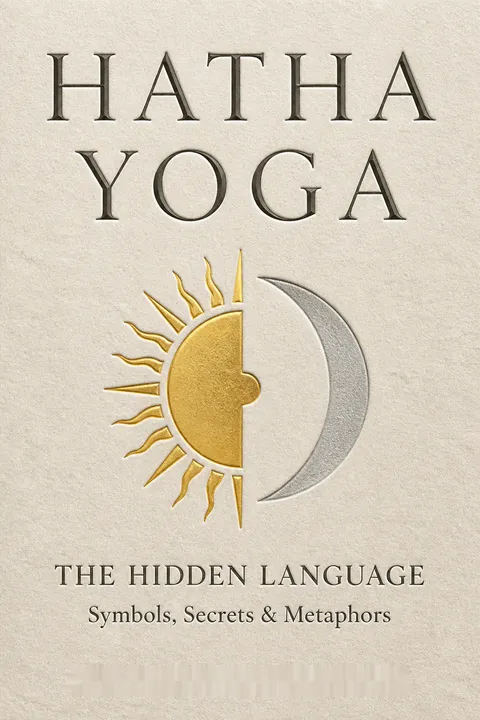
Hatha begins with polarity. Radha presents ha as the active, solar principle and tha as the receptive, lunar principle. The terms describe contrasting forces, not a contest in which one must defeat the other. Yoga, meaning union, aims to bring such polarities into balance and move beyond habitual swings between extremes. In practice, effort needs receptivity, strength needs flexibility, and concentration needs rest.
The Bow makes the lesson visible. Dhanurasana, the Bow pose, combines tension with release. The image prompts questions about purpose: What is the target, and how much strain is useful? Radha connects the posture to the need for a clear aim and sensitivity to limits. The image is not an instruction to push harder. It asks whether effort is serving a considered direction or merely feeding self-will.
This is a useful alternative to the idea that self-mastery means suppressing unwanted impulses. In many practical domains, from learning a skill to maintaining a relationship, flexibility and structure are mutually supporting rather than interchangeable virtues. The book's solar and lunar language can make that complementarity memorable. Its spiritual account of these forces is a matter of yogic philosophy, not a scientific description of the nervous system. Readers can use the metaphor without confusing it with physiology.
Match the pose to the question you need to face
Each posture offers a lens. The Mountain asks where a person stands and what obstacles seem immovable. The Shoulderstand turns the body upside down and raises questions about responsibility, perspective, and assumptions. The Spinal Twist invites examination of rigid thinking and the ways people can distort facts to protect themselves. The Lotus presents the possibility of growing through difficulty without being defined by it.
Choose for relevance, not spectacle. The most useful pose is not necessarily the hardest one. Radha repeatedly shifts attention away from perfect execution and toward the questions that become visible in practice. A posture's physical form supplies the image, while reflection makes the image personal. Beginners can use a gentler variation or visualize a pose rather than forcing their body into a demanding position.
The variety matters because no single metaphor explains a whole person. A twist is a strong image for reconsidering a story, while an inversion can make familiar surroundings feel strange enough to question. This is close to perspective-taking: changing the frame can reveal options that were hidden by routine. The image remains a prompt, not a treatment plan. Choosing a pose for reflective relevance, while respecting physical limits, preserves both its imaginative power and its practical safety.
Write down insight, then prove it through daily action
Reflection needs a next step. Radha recommends moving between a pose and a notebook. Practitioners record sensations, words, images, memories, and questions, then consider what action follows. She also suggests a brief mind-watching exercise: spend ten minutes observing what appears in the mind, then ten minutes writing observations. The written record helps reveal recurring patterns that are easy to miss in the moment.
Make practice part of a larger path. Radha calls sadhana a spiritual practice directed toward realization of the Divine. Psychological self-examination can prepare for it, but does not replace it. Mantra, or repeated sacred sound, and the Divine Light Invocation, a visualization and affirmation practice, are among the tools she describes. The central discipline is sustained effort: insight matters when it changes how a person lives.
Writing converts fleeting impressions into material that can be reviewed, challenged, and compared over time. It also creates a useful gap between an emotional reaction and a decision. Yet journals can reinforce selective attention if every sensation is made to confirm a favored story. A practical check is to ask what observable behavior would follow from an insight, and whether that behavior helps in real relationships. The book's distinction between self-analysis and spiritual practice also guards against mistaking endless introspection for transformation.
Withdraw to regain clarity, then return to other people
Retreat can be restorative. Kurmasana, the Tortoise pose, evokes drawing inward for protection, patience, and reflection. Radha connects that image with withdrawing the senses when distraction or emotion overwhelms judgment. Shavasana, the Corpse pose, offers another kind of pause: the body rests while attention remains awake. These forms of stillness are meant to restore perspective, not to avoid every difficult encounter.
Life remains interdependent. The book uses animal imagery to emphasize that human beings belong to a wider world of living things. A school of fish suggests the support people can find in shared purpose; the tree offers an image of shelter and nourishment. The lesson is to know when solitude is useful and when it has hardened into defensiveness. Reflection should support clearer engagement with others, not justify isolation or self-importance.
The distinction between restorative solitude and social withdrawal is crucial. A temporary reduction in stimulation can make it easier to notice what matters, much as a pause in conversation can prevent a reactive reply. But retreat becomes limiting when it removes the relationships that could challenge a distorted self-image. The book's images of shelter and community help keep inward practice connected to responsibility. Stillness is most useful when it improves the quality of a person's return to ordinary life.
Let final relaxation rehearse surrender, not unconscious escape
Rest can be an active practice. In Shavasana, the body lies still while the mind remains alert. Radha presents relaxation as a first step in letting go of resistance, ambition, and self-importance. The pose also brings mortality into view. Asking how to use the time that remains can make daily choices feel less automatic and bring neglected purposes into focus.
Surrender is not passivity. The book links the symbolic death of old habits with the possibility of renewed attention and action. It invites practitioners to notice where mental resistance consumes energy and what might change if that resistance eased. The pose can end in quiet, but its point is not to disappear from life. Rest supports repair, reflection, and a more deliberate return to responsibilities.
The image of rehearsing death can concentrate attention on the finite nature of ordinary time without requiring a particular belief about an afterlife. That can make rest more than a physical pause: it becomes a question about what deserves attention. The metaphor should remain invitational. For some people, death-focused reflection may be distressing rather than clarifying, and relaxation itself can feel unsafe. A sound practice allows the individual to adapt or stop, rather than treating surrender as an obligation.
Choose celibacy only as a considered discipline, never a badge
Brahmacharya requires honest choice. Radha discusses celibacy as one possible way to direct attention toward spiritual aims, not as a universal requirement or a mark of superiority. She asks readers to examine what sex, love, marriage, desire, and power mean in their lives. The decision depends on temperament, responsibilities, and purpose. A person in a relationship must also consider the effects of personal choices on a partner and any children.
Ethics outrank appearance. Radha challenges spiritual traditions that praise celibacy while neglecting the burdens placed on women or abandoning dependents. She argues that self-mastery begins in daily conduct, whether a person is single or partnered. Sexual restraint, in her framework, is useful only when chosen deliberately and joined to responsibility, compassion, and a larger spiritual commitment.
The chapter is valuable because it treats sexual ethics as a question of agency and consequences, not merely purity. Its attention to gender and dependency makes the spiritual ideal answerable to ordinary responsibilities. Claims that sexual energy must be conserved for spiritual development belong to the book's yogic worldview, rather than being a universal medical conclusion. The stronger transferable principle is to examine motives, power, and commitments honestly, and not use an ascetic ideal to evade care for other people.
Analysis
The book's central innovation is a method of embodied interpretation. A posture gives attention a concrete anchor, its name supplies an image, and reflection connects sensation with memory, emotion, language, and choice. This makes the text less a catalogue of yoga poses than a guided practice in asking better questions of oneself. The Mountain, the Twist, and the Tortoise function as portable metaphors: each gives a different shape to questions about obstacles, self-deception, safety, and withdrawal.
That method is strongest when symbols remain invitations. Radha recognizes that personal associations vary, and her practice of observing, writing, and returning to a posture makes meaning something to investigate rather than receive as doctrine. Her account also treats speech and inner self-talk as part of practice, and places physical yoga within a broader spiritual discipline rather than reducing it to fitness.
The approach has limits that deserve attention. It can encourage a reader to interpret bodily tension as a sign of personality or emotional conflict, when ordinary physical causes may explain it. Metaphorical insight is not diagnosis, and an evocative experience does not establish a medical or psychological fact. The text itself supports caution by distinguishing reflective practice from physical instruction and recommending professional care for serious emotional difficulties.
There is also a productive tension between the book's universal spiritual language and its recognition that symbols change across cultures. Read as a fixed map, its mythology could impose meanings that do not fit a practitioner's life. Read as a set of culturally situated prompts, it becomes more adaptable. The lasting value is the discipline of attention: feel carefully, interpret provisionally, write honestly, and translate what seems useful into responsible action. The practice asks the body to participate in self-knowledge, while leaving the final authority with the practitioner's discernment.
Review Summary
Hatha Yoga receives mixed reviews, with an overall rating of 4.32/5. Readers appreciate the insightful explanations of asanas, their symbolic meanings, and connections to psychology and physiology. Some find the content revealing and valuable for understanding yoga's Eastern traditions. However, critics note repetitiveness, outdated psychology references, and technical writing. One reviewer criticizes the book's stance on celibacy and sexuality. Despite these critiques, many readers find the book's exploration of yoga poses, their origins, and symbolism to be enlightening and thought-provoking.
People Also Read






Glossary
Hidden Language Hatha Yoga
Symbolic posture inquirySwami Radha's reflective approach to Hatha Yoga. Practitioners connect an asana's physical experience with its name and symbolic associations, observing sensations, thoughts, emotions, and memories. The posture becomes a prompt for personal inquiry rather than only an exercise in flexibility or alignment. Repetition and written reflection help the practitioner explore what the image means in daily life.
yoga psychology
Self-inquiry through yogaRadha's term for investigating how body, mind, emotion, senses, and speech interact in practice. It uses observation, reflection, and symbolic association to identify habits and obstacles. In her account, this psychological work can prepare a person for spiritual practice, but it is not itself the ultimate spiritual goal and does not replace professional therapy when that is needed.
sadhana
Spiritual practiceA sustained spiritual discipline directed toward realization of the Divine or a higher consciousness. In this book, sadhana can include asana practice, meditation, mantra, reflection, and other devotional exercises. Radha distinguishes it from psychological self-analysis: self-understanding can clarify what needs attention, while sadhana is the spiritual practice through which the aspirant pursues transformation.
brahmacharya
Celibacy or sexual restraintA yogic discipline associated in the book with celibacy, continence, and directing sexual attention toward spiritual aims. Radha does not present it as a simple rule for everyone. She asks practitioners to consider temperament, relationships, responsibilities, and motivation, and argues that restraint should not be used to avoid duties or claim spiritual superiority.
chakra
Center of consciousnessA Sanskrit term meaning wheel, used in the Kundalini system for a center or level of consciousness associated with the spinal column. Radha describes seven chakras as stages in the development of awareness, represented through symbolic imagery such as lotuses. The book refers to chakras as part of a spiritual picture language, not as a substitute for ordinary anatomical description.
mudra
Sealing postureA gesture or posture understood as a seal. Radha says an asana, as it becomes established through practice, can take on this spiritual quality. The body is treated as a seal containing something to be discovered through attention and reflection. In this account, the physical posture is not merely a position but a means of opening inquiry into deeper experience.
Mantra Yoga
Practice with sacred soundA spiritual practice using the repetition or chanting of a sacred word or phrase. Radha describes mantra as a way to focus attention, settle mental chatter, and work with breath and emotion. A mantra may be spoken or repeated silently during an asana. The book presents its effects within a spiritual framework and notes that meaning is not limited to intellectual translation.
prana
Life forceA yogic term for the subtle life force present in living beings, often associated with breath but understood by Radha as more than respiration. In the book, awareness of prana is linked to the felt energy of posture, breath, and spiritual practice. It belongs to the text's traditional yogic vocabulary and should not be confused with a measured physiological substance.
Download PDF
Download EPUB
.epub digital book format is ideal for reading ebooks on phones, tablets, and e-readers.








