

Key Takeaways
Rebuild the case from records before trusting its famous theories.
A conclusion changed with evidence. Richard T. Cahill Jr. opens by admitting that a brief early investigation led him to call Bruno Richard Hauptmann an innocent man framed by police. Decades of archival work changed his view. He examined police files, trial transcripts, federal records, and original evidence, finding that books on both sides repeated unsupported claims as facts. One example: an allegation that a reporter planted a note in Hauptmann's closet conflicts with Hauptmann's own admission that he wrote it.
Separate fact from theory. Cahill's method is to identify what records establish, what witnesses recalled, and what remains conjecture. His central conclusion is that Hauptmann kidnapped the child, while several details of the crime and trial remain uncertain.
The book's most useful discipline is not simply consulting primary sources, but making the route from source to conclusion visible. That distinction matters in famous cases, where repetition can make a rumor feel documented. Cahill's own reversal gives this method a human dimension: conviction is not the same as certainty, and changing one's mind can be evidence of better inquiry. The method also has limits. Archives preserve some voices better than others, and an extensive record can still leave crucial gaps. Documentation strengthens an argument, but does not remove the need to interpret it carefully.
Protect the scene, or later investigators may mistake noise for evidence.
The first hours mattered. After the kidnapping, Hopewell officers and state troopers examined the area but left the ladder, chisel, and ground around them unsecured. Reporters and others soon crowded the property. The police later found a second set of footprints leading away from the ladder, but those prints differed from the covered-foot impressions by the window and appeared beside dog tracks. Cahill argues that they were likely made by a reporter or trooper, not the kidnapper.
One clue corrected another. Investigators initially treated those tracks as the escape route. A crushed thumb guard found farther along the driveway pointed in another direction. The author infers that the kidnapper carried the child down the driveway. Because the scene was not preserved, that route cannot be established conclusively.
This episode illustrates a basic problem of inference: a clue can be real without being relevant to the crime. Once officers treated the later prints as the kidnapper's trail, an unverified assumption shaped the search. Modern investigations formalize scene control for precisely this reason, but the deeper lesson is conceptual: record who touched what, when, and under what conditions. The thumb guard offers a competing account, not a complete reconstruction. Cahill is persuasive when he exposes the difference between an observation and its interpretation, though his own proposed route remains an inference rather than a witnessed fact.
Rail sixteen ties Hauptmann's attic to the kidnapping ladder.
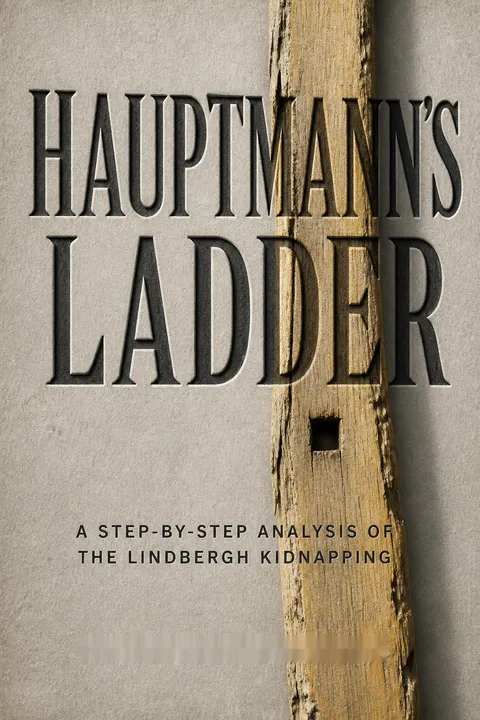
A piece of wood became a link. Arthur Koehler, a wood specialist, examined the ladder and numbered its parts. Rail Sixteen contained four extra nail holes. In Hauptmann's attic, investigators found a floorboard cut short, with corresponding holes in the exposed joists. Koehler reported that the rail and remaining attic board shared matching grain and wood, and that the nails fit the joist holes. He also connected marks on the ladder to a hand plane found in Hauptmann's garage.
The physical comparison endured. Later reviews cited by Cahill upheld the soundness of Koehler's analysis. Critics proposed that police fabricated or replaced the rail, but photographs taken soon after the kidnapping show the same grain pattern. Cahill treats this as the strongest evidence connecting Hauptmann directly to the crime.
The force of this evidence comes from convergence, not from any single dramatic test. Nail placement, grain, tool marks, and early photographs all bear on the same physical history. That makes the rail more probative than a witness's distant memory, though it is still circumstantial evidence: it connects Hauptmann's material to the ladder, while other evidence is needed to establish who used it and when. The episode also shows why forensic claims should be auditable. A persuasive expert explanation gains strength when later examiners can inspect the underlying objects rather than merely trust the expert's authority.
Follow the ransom's gold certificates, not just the witnesses.
Currency created a trail. Much of the ransom was paid in gold certificates. After President Roosevelt ordered gold currency exchanged, those bills became easier to notice. Banks and police tracked serial numbers. In September 1934, a gas station attendant recalled a customer paying with a gold certificate and recorded his car's license plate. The plate belonged to Hauptmann. Police later found a ransom $20 bill on him and about $13,760 in ransom money concealed in his garage.
Separate finds reinforced one another. Earlier, a theater employee had identified Hauptmann as the man who spent a folded ransom bill. Other descriptions of people passing the money also resembled the suspected kidnapper. Each lead had weaknesses, but the bills, plate number, hidden cash, and spending pattern formed a material chain the prosecution could present.
The money trail is powerful because it converts an abstract demand into traceable objects and transactions. Its evidentiary value comes from independent points of contact: a remembered purchase, a recorded plate, a bill on Hauptmann, and concealed currency. This is a useful model for evaluating circumstantial cases: ask whether different evidence sources genuinely converge or merely repeat the same original assumption. The chain is not flawless. Some tellers could not describe customers, and the identity of the person behind the Faulkner deposit remained unresolved. Strong convergence can support guilt without explaining every transaction.
Treat eyewitness certainty as a claim, not a verdict.
The key witness hesitated. John Condon was the only person who spoke at length with the man he called John. Yet when police placed Hauptmann in a lineup, Condon said he could not positively identify him. At trial, he identified Hauptmann as the kidnapper. Condon was known to exaggerate his own role, and versions of his cemetery conversation changed over time. The cab driver Joseph Perrone, who delivered a note to Condon, independently identified Hauptmann as the man who gave it to him.
Corroboration matters. Condon's later identification supports the prosecution, but his initial uncertainty complicates it. Lindbergh also identified Hauptmann's voice after hearing only a few words years earlier, a claim Cahill treats as possible but not necessarily reliable.
Memory is not a recording. Confidence can reflect sincere recognition, later reinforcement, or the pressure of a consequential setting, so a careful reader should examine how an identification developed, not merely whether it occurred. Condon's hesitation is especially important because he had the strongest opportunity to observe the kidnapper, yet his later certainty cannot erase the earlier qualification. Perrone's identification supplies another line of evidence, although it answers a narrower question: who delivered the note. The book rightly resists both extremes, treating witnesses as either infallible or useless.
A suspect's guilt does not establish intent to murder.
The charge shaped the outcome. New Jersey treated kidnapping as a misdemeanor, so the prosecution relied on the felony murder rule. This doctrine treats a death during certain felonies as murder even without proof that the accused intended to kill. Prosecutors characterized the entry as burglary, with the intended theft described as taking the baby's bedclothes. That legal theory made a capital conviction possible.
The evidence left intent uncertain. The autopsy found a fatal skull fracture, but could not establish whether it was deliberate or accidental. Cahill thinks the ladder broke under the combined weight of the adult and child, causing a fatal fall. He concludes Hauptmann was guilty of kidnapping and other crimes, but should not have been convicted and executed for murder. The distinction is between proving participation and proving a capital offense.
This distinction is essential to legal reasoning. A person can be responsible for a death without having intended it, and a legal rule can assign a category of guilt broader than the evidence can establish about mental state. Cahill's criticism is strongest when he separates the kidnapping evidence from the prosecution's particular route to a death sentence. His accident reconstruction is plausible, especially given the broken ladder, but cannot be confirmed from the surviving medical record. The case therefore supports a firm conclusion about participation more readily than a confident conclusion about how the child died.
Public pressure can turn an inquiry into a second victimization.
Suspicion narrowed around Violet Sharp. A maid at the Morrow estate, Sharp gave an evasive first account of her evening, then explained that she had gone to a roadhouse with a date. Police questioned her repeatedly about the date, her savings, and her private life. She was physically ill, distressed by the baby's death, and under pressure as the investigation turned toward her. After learning she would be questioned again, she drank poison and died.
Suspicion was not proof. The man she had dated, Ernest Miller, later confirmed the roadhouse story. Investigators had mistakenly pursued Ernest Brinkert. Cahill cannot know exactly why Sharp died, but concludes that the available evidence does not establish her involvement and suggests that intense questioning and personal pressures contributed to her despair.
The Sharp episode is a warning about investigative tunnel vision. A lie about a socially embarrassing evening became a reason to suspect a young employee of a kidnapping, while an unverified name sent police after the wrong man. The tragedy does not prove that every question was improper, but it shows how a suspect's vulnerability can be mistaken for guilt. Careful interviewing should distinguish inconsistencies that bear on the crime from details that merely offend social expectations. Cahill's explanation of Sharp's suicide remains an interpretation, and the uncertainty should be preserved rather than converted into a neat causal story.
Don't let courtroom performance replace proof or fair procedure.
The trial was a spectacle. The 1935 proceedings drew an enormous crowd and intense press coverage. Prosecutor David Wilentz presented a forceful case, but also made arguments that would be considered improper today, including using Hauptmann's resistance to extradition against him and asserting that he killed the baby in the nursery without proof of that claim. Defense lawyer Edward Reilly advanced a sprawling conspiracy theory involving servants, Condon, and others. Several defense witnesses were discredited, and the defense failed to object to some damaging arguments.
The judge shaped the record. Judge Trenchard summarized evidence and expressed views to the jury, a practice allowed under New Jersey law then. Cahill considers the trial broadly fair by its period's standards, while noting that modern safeguards and standards would judge parts of it harshly.
A trial is both a fact-finding process and a performance, and the Lindbergh case makes the tension unusually visible. Wilentz's confidence could make weak inferences sound settled; Reilly's theatrical conspiracy could distract from the strongest physical evidence. The defense's failures matter because legal rights are meaningful only when counsel invokes them. At the same time, judging a 1935 proceeding solely by present rules risks flattening legal history. The better question is which practices distorted the jury's task, and which were then accepted procedure. The book identifies that tension without treating the verdict as automatically invalid.
Hauptmann's guilt does not settle every claim made about him.
Keep conclusions in separate boxes. Cahill concludes that Hauptmann kidnapped the child, but says the evidence does not settle whether he had an accomplice or intended the child to die. He considers a later-discovered note in a table, called the table board confession, a hoax rather than a genuine confession. Its holes resemble those on the ransom notes, but there is no proof the table existed at the time of the crime, and its text does not establish who wrote the ransom letters.
The central conclusion is narrower than the legend. The unresolved Faulkner deposit and uncertain death circumstances remain open questions. Cahill's account argues that a strong case for kidnapping can coexist with doubts about motive, additional participants, and the justice of the execution.
The most credible historical conclusions are often layered rather than total. Here, evidence can strongly implicate Hauptmann in the kidnapping while leaving his intent, accomplices, and some money movements uncertain. That is not indecision; it is calibrated judgment. The table board is an especially useful example of how a striking physical match can attract a dramatic story that the object itself cannot prove. A disciplined account keeps the observation, the proposed explanation, and the historical claim distinct. The remaining uncertainty is not a license to declare Hauptmann innocent, nor a reason to accept every allegation against him.
Analysis
Hauptmann's Ladder is at once a reconstruction of a notorious crime and an argument about how historical certainty is made. Cahill's central claim is not that every part of the prosecution was sound. It is that the best physical evidence, especially the match between ladder rail sixteen and a board from Hauptmann's attic, outweighs weaknesses in eyewitness identification and the investigation's early mistakes. His method is strongest when it distinguishes primary records from repeated assertions, and when it labels inference rather than disguising it as fact.
The narrative gains force from contradiction. The investigation began with a careless scene, a grieving father who prioritized recovery over arrest, a self-promoting intermediary, false leads, and a public hungry for resolution. Later, a precise evidentiary chain emerged through the ransom currency and wood analysis. That arc makes the case more than a whodunit: it shows how evidence can be damaged, recovered, and interpreted under pressure. The account also refuses to equate conviction with justice. Hauptmann may have committed the kidnapping, yet the felony murder theory and execution raise a separate question about proportional punishment and what the evidence actually established about intent.
The book's main limitation is the temptation to complete the story where evidence stops. The proposed accidental fall, the likely route down the driveway, and possible assistance with laundering money are plausible readings, not demonstrated facts. Cahill usually marks that distinction, but the vivid narrative can make a theory feel more certain than its evidence warrants. His own initial conversion from believer in innocence to advocate of guilt adds credibility, while also making the case for continuously testing conclusions rather than merely replacing one fixed theory with another.
The most durable lesson is methodological: separate the identity question, the manner of death, the legal charge, and the fairness of punishment. They are connected, but not interchangeable. That discipline produces a conclusion that is firm where the record is strong and restrained where it is not.
Review Summary
Hauptmann's Ladder is highly rated for its meticulous research and objective analysis of the Lindbergh kidnapping case. Readers appreciate the author's thorough examination of evidence and debunking of myths. While some find the trial coverage extensive, many consider it the definitive account of the case. The book is praised for its factual approach, avoiding sensationalism. Some readers note the level of detail can be overwhelming, but most find it compelling and well-researched, offering new insights into this infamous crime.
Glossary
Rail Sixteen
Ladder rail linked to atticThe label Arthur Koehler assigned to one side rail of the kidnapping ladder. He concluded that it had been cut from a floorboard removed from Bruno Richard Hauptmann's attic. The conclusion rested on matching wood grain and nail-hole placement, as well as tool marks connecting the ladder to a plane found in Hauptmann's garage.
Felony murder rule
Death during a felony counts as murderA legal doctrine under which a person may be guilty of murder if someone dies during the commission of a qualifying felony, even when the accused did not intend the death. In Hauptmann's case, prosecutors relied on burglary rather than kidnapping, because New Jersey treated kidnapping as a misdemeanor at the time.
Cemetery John
Condon's name for the ransom messengerThe nickname John F. Condon used for the disguised man he met at Woodlawn Cemetery and later at St. Raymond's Cemetery. The man negotiated the ransom and exchanged a note for money. Condon identified Hauptmann as this person at trial, though he had hesitated to identify him in an earlier police lineup.
Jafsie
Condon's newspaper-ad aliasThe code name John F. Condon used in newspaper advertisements communicating with the kidnapper. It came from pronouncing Condon's initials, J. F. C., quickly. The alias let him post messages without immediately revealing his identity to the press or to people who might interfere with negotiations.
Table board confession
A disputed note found in furnitureA German-language message discovered on a table-repair block in 1948. It claimed its writer had been one of the Lindbergh kidnappers and that ransom money remained buried in New Jersey. Cahill regards the confession as a hoax: its date and authorship are unverified, its language is suspect, and its Nazi reference does not establish a connection to the crime.
Download PDF
Download EPUB
.epub digital book format is ideal for reading ebooks on phones, tablets, and e-readers.








