

Key Takeaways
Build a strategy rivals cannot reproduce by simply copying best practices
Efficiency is the entry fee. Operational effectiveness means doing similar work better than competitors, through lower costs, fewer defects, or faster service. It matters, but successful methods spread. When firms imitate the same techniques, the industry’s productivity improves while any one company’s relative advantage fades. Porter describes this as movement toward a shifting productivity frontier: the best performance available at a given cost.
Difference creates staying power. Strategy means choosing a distinct way to compete, through different activities or a different configuration of familiar ones. Japanese manufacturers showed how superior quality and cost could unsettle rivals, but operational gains alone did not guarantee lasting profits. The strategic question is not only how to improve, but what distinctive value the company will deliver.
What's useful here is the separation between doing work well and choosing which work to do. That distinction prevents managers from mistaking a long list of improvement projects for a competitive position. It also explains why operational excellence remains necessary: a distinctive strategy built on clumsy execution will not survive contact with customers. The tension is that best practices are not always easy to copy perfectly. Execution skills can persist. But unless those skills support a recognizable choice, competitors can still meet the same customer need in similar ways.
Diagnose industry profit through five forces, not rival-watching alone
Competition has hidden participants. The five forces are rivalry among existing competitors, the threat of new entrants, substitutes, buyer power, and supplier power. Together, they explain how much of an industry’s value companies can keep rather than surrender to customers, suppliers, new rivals, or alternatives. The strongest force often matters more than the most visible one.
Trace the economics. Commercial aviation is punishing because rivalry is intense, customers can compare fares, suppliers have leverage, new airlines keep appearing, and travelers can choose other forms of transport. Heavy-truck maker Paccar found a more favorable position by serving owner-operators, who had less buying power and valued their trucks beyond price. Industry analysis is most useful when it reveals where profits leak and what could change that pattern.
The framework shifts attention from the familiar rival across the street to the structure that makes rivalry profitable or destructive. That is a powerful correction to competitor obsession. It also encourages useful questions about who captures value and why. Still, the map depends on defining the industry sensibly. A service that looks like a substitute today may become a core rival tomorrow, while a new channel can alter buyer power. The five forces work best as a repeated diagnosis, not a one-time label stamped on an industry.
Choose what to exclude, then make every activity reinforce the choice
Trade-offs protect a position. A company that tries to combine incompatible promises can confuse customers, waste resources, and weaken its reputation. Southwest built a low-cost, convenient airline around short routes, quick turnarounds, a standardized fleet, and few services that slowed planes down. Those choices reinforced one another rather than operating as isolated efficiencies.
Fit makes imitation harder. Strategic fit is the way a company’s activities support and strengthen one another. Continental Lite tried to borrow some of Southwest’s low-cost practices while keeping its full-service operation. The mixed model created delays, customer complaints, and financial losses because the rest of the airline’s system had not changed to match. A competitor can copy a visible feature; reproducing a tightly connected activity system is much harder.
This is a systems view of advantage: a choice becomes durable when it shapes many linked decisions, from staffing to service design. It also gives leaders a practical test for proposed growth. Does the addition strengthen the existing system, or does it require contradictory behaviors? The caution is that trade-offs can become excuses for ignoring changing customer needs. A firm should defend its coherence, not worship its original design. The useful discipline is to change the position only when a new, equally coherent system is possible.
Keep the company’s reason for being steady while its plans evolve
Separate identity from ambition. Collins and Porras divide a durable vision into core ideology and an envisioned future. Core ideology combines a few enduring values with the organization’s fundamental purpose. The envisioned future describes an ambitious destination and a vivid picture of what reaching it would mean. One guides continuity; the other demands change.
Sony aimed beyond its products. Its early ambition was to change the world’s poor impression of Japanese goods and become known for quality and innovation. That goal was not a product line or a permanent operating plan. The authors’ research reported that the visionary companies they studied outperformed the general market by a factor of 12 over the period examined. Their argument is to discover authentic values and purpose, then set challenging goals that can energize people without pretending the future is predictable.
The distinction helps resolve a common leadership confusion: stability need not mean keeping the same products, and change need not mean abandoning identity. A clear purpose can act as a filter for strategic reinvention. The framework also warns against turning aspirations into claimed values. Employees quickly recognize the difference between a principle that guides hard choices and polished language that does not. Its strongest use is not to make every worker feel the same way, but to clarify what the organization protects and what it is willing to remake.
Reinvent the business model around a job customers cannot get done
Start with the customer’s task. A business model explains how a company creates value for customers and earns value for itself. The article identifies four connected parts: the customer value proposition, the profit formula, key resources, and key processes. A useful starting question is what important job a customer needs done that existing options handle poorly.
Products alone do not explain success. Apple’s iPod was not the first portable digital music player. The company paired the device with convenient music downloads, making hardware, software, and service work as one model. Hilti, a power-tool maker, saw that contractors needed reliable access to tools more than ownership, and shifted toward a rental and fleet-management service. Such changes can require new costs, capabilities, and routines, not merely a redesigned product.
The job-focused lens helps teams escape the assumption that customers want more features in the category they already know. It directs innovation toward the whole experience and the economics required to deliver it. The four-part model is especially useful because it exposes mismatches: a compelling customer offer may still fail if its cost structure cannot support it. A new model also carries organizational risk. Established processes often protect the old business, so leaders must decide whether the new approach can coexist with existing rules or needs room to operate differently.
Create demand by raising customer value while stripping out cost
Make rivals less relevant. Blue ocean strategy means creating a market space where direct competition matters less because the offer attracts new demand. The central move is to increase value for customers while removing costly features that matter little to them. This challenges the assumption that better value must always require higher cost.
Cirque du Soleil changed the show. It retained circus elements such as clowns and acrobatics, removed expensive animal acts and traditional three-ring confusion, and added theatrical themes, music, and staging. It appealed to adults and organizations who had largely stopped attending circuses. In a study of 108 business launches, 14% targeted new markets and generated 38% of revenues and 61% of profits. New market creation was uncommon in the sample, yet disproportionately valuable.
The idea is strongest when treated as disciplined redesign rather than a promise to escape competition forever. Cirque did not invent demand from nothing; it recombined familiar forms around an audience the old format underserved. That makes the approach more practical than its ocean imagery suggests. The hard part is judging which industry conventions customers no longer value and which still carry the experience. The launch figures are striking, but they describe the studied companies, not a guaranteed payoff for every business that declares itself uncontested.
Most strategies deliver only 63% of their promised financial value
Plans often lose force in translation. Mankins and Steele report that companies in their survey realized, on average, 63% of the financial performance their strategies promised. Causes included missing resources, poor communication, vague actions, weak accountability, and inadequate monitoring. A shortfall may reflect a flawed strategy, an unrealistic plan, or poor execution, and those problems require different fixes.
Make planning usable. The authors recommend keeping strategy concrete, challenging assumptions instead of bargaining over forecasts, using a shared method to assess markets, and discussing resource needs early. Managers should name a few priorities, track results as work proceeds, and develop people who can deliver. Tyco used cross-functional teams to examine market economics and its competitive position, producing more grounded plans during a major turnaround.
The headline number makes the cost of implementation failure tangible, but it should not be treated as a universal constant. The survey captures executives’ assessments, and a promised result is only as credible as the assumptions beneath it. The deeper lesson is diagnostic: compare expectations with outcomes early enough to identify the mechanism of failure. If the market changed, revise the strategy. If resources arrived late, repair planning. If responsibilities were unclear, fix execution. Treating every gap as a call to work harder conceals the cause.
Fix decision ownership and information flow before reorganizing
Org charts rarely cure confusion. Research by Neilson, Martin, and Powers identified decision rights and information flow as more powerful drivers of execution than structural changes or incentives. Their database included more than 26,000 responses from 31 companies. The traits most associated with effectiveness included employees knowing which decisions they owned and important market information reaching headquarters quickly.
Caterpillar changed where decisions lived. Its functional leaders at headquarters controlled key choices while useful market knowledge sat with field managers. The company reorganized into business units and shifted operating authority closer to the markets. That brought decision-making power nearer to the information needed to use it, while senior leaders could focus more on broader strategic questions. Structure mattered, but as a support for better decisions rather than as the first remedy.
This account connects organizational design to information economics: authority is most useful when it sits near relevant knowledge, while coordination still matters when choices affect the whole company. It also explains why another reorganization can produce only temporary relief if nobody clarifies accountability. The study offers a practical diagnostic, though association does not prove that one lever causes all the improvement. Different organizations may need different balances between local discretion and central consistency. The useful starting point is to locate the bottleneck before prescribing a new chart.
Give one person authority to close each consequential decision
Name the handoffs. The RAPID decision model assigns distinct responsibilities: someone develops a recommendation, relevant people provide input, designated parties can raise required objections, one person makes the final call, and others carry it out. Its central safeguard is a single accountable decision maker. Too many veto holders can paralyze a proposal; too many nominal advisers can obscure whose contribution matters.
John Lewis fixed a shelf-space mistake. Buyers at the department-store chain reduced the range of salt and pepper mills to simplify the offer, but sales fell. Store staff had halved the shelf space along with the product range, rather than displaying more of each remaining model. Buyers were made responsible for space allocation, while sales staff could challenge impractical decisions and implement the layouts. Once the roles were clear, sales exceeded the original level.
A named decision owner reduces diffusion of responsibility without requiring that the owner work alone. The distinction between input and authority is crucial: people can be heard without turning every choice into a referendum. The model also makes execution part of the decision rather than an afterthought. Its limitation is human, not procedural. A poor decision maker can still misuse authority, and a badly designed process can exclude vital expertise. Clear roles improve the odds of action; they do not replace sound judgment or candid disagreement.
Track strategy through customer, process, learning, and financial measures
Measure what creates future results. The balanced scorecard supplements financial indicators with measures of customer outcomes, internal processes, and organizational learning and growth. It helps leaders connect daily work to longer-term objectives instead of relying only on financial results that report what has already happened.
Use measures to learn, not just to judge. The scorecard links strategy to objectives, communicates those objectives across the organization, connects planning and budgets, and supports review of results and assumptions. At Metro Bank, building the scorecard exposed disagreement over which customers the strategy targeted and what superior service meant. Reaching agreement on measures forced executives to make the strategy more specific. If the expected improvements in employee capabilities do not lead to better customer outcomes, managers can reconsider the assumptions behind the strategy.
The scorecard is more than a dashboard when its measures express a causal theory: capability improves a process, the process improves customer value, and customer value supports financial performance. That structure makes strategic assumptions discussable. It also creates a danger. Measures tied mechanically to rewards can become targets people optimize at the expense of the purpose they were meant to represent. The scorecard is most valuable as a shared learning system, where unexpected results prompt inquiry into the strategy rather than automatic blame for missing a number.
Compress strategy into a phrase that guides frontline trade-offs
A slogan should make choices easier. A strategic principle is a brief, memorable statement of how a company intends to allocate scarce resources and compete. Unlike a broad mission statement, it should guide action by clarifying what the company will do, what it will decline, and where employees have room to adapt.
Southwest used a clear boundary. Its principle tied short-haul travel to fares competitive with driving. When expansion into Denver brought weather and airport delays that threatened that promise, the airline withdrew rather than make the route fit at any cost. A useful principle lets frontline employees act without waiting for headquarters, while keeping local decisions aligned with the broader strategy. It must be repeated and tested against real choices, not merely printed on a wall.
A compact principle can function like a decision rule under time pressure: it reduces the number of choices employees need to escalate and makes trade-offs more visible. Its power comes from the strategy behind the words, not from clever phrasing. A vague statement about excellence or customer focus offers little guidance when priorities conflict. Nor can a short phrase replace judgment in unfamiliar situations. The principle works when leaders use it consistently, explain its boundaries, and accept the consequences of choices it rules out.
Analysis
This collection treats strategy as a chain linking market economics, a distinctive position, organizational choices, and measurable execution. Porter supplies the economic foundation: profitability depends on industry structure, while durable advantage depends on distinct activities, trade-offs, and their fit. Collins and Porras add an identity question, distinguishing enduring purpose from changeable goals. The business-model and blue-ocean essays then show how firms can reshape the offer and, sometimes, the market itself. The execution articles address the organizational machinery needed to turn these choices into action.
The strongest synthesis is that coherence matters at several levels. A company needs a coherent answer to whom it serves, a coherent set of activities for serving them, and coherent decision systems that allow people to carry out that choice. The tools are not interchangeable. Five-forces analysis diagnoses an industry; it does not choose a position. A scorecard translates a strategy into indicators; it cannot make a weak strategy strong. A decision-rights model clarifies authority; it cannot supply missing market knowledge.
There are productive tensions. Porter emphasizes continuity and warns against compromising a position, while business-model innovation and blue-ocean strategy invite substantial redesign. These ideas fit together if continuity applies to a company’s chosen logic, not necessarily its current products or methods. Likewise, a stable purpose can guide reinvention, but it must not be used to protect obsolete assumptions. The collection’s execution statistics are persuasive prompts for scrutiny, though survey estimates and company examples cannot establish a single causal recipe for every organization.
The practical discipline is therefore sequential but iterative: understand the profit structure, define a distinct customer promise, align activities and resources, assign decision authority, and monitor whether the underlying assumptions hold. When results diverge, diagnose before prescribing. A strategy is not a document that survives unchanged; it is a set of choices whose internal coherence must be maintained even as evidence tests its validity.
Review Summary
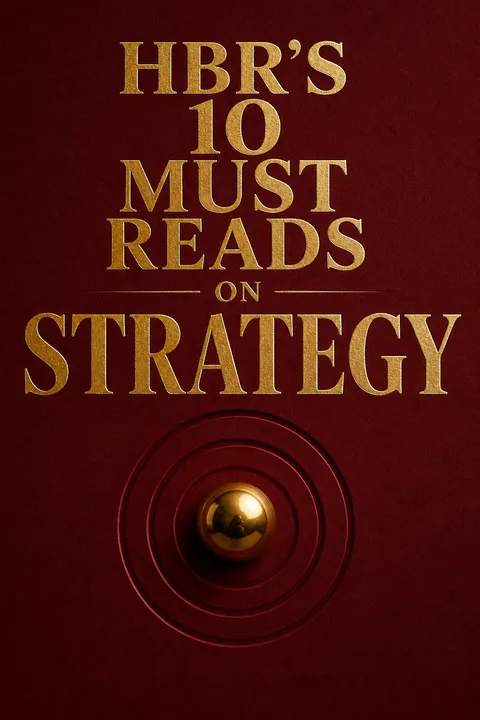
HBR's 10 Must Reads on Strategy is a highly regarded collection of articles on business strategy. Readers praise its comprehensive coverage of topics from competitive forces to vision-setting and strategy execution. The book offers valuable insights for both students and professionals, with Michael Porter's articles being particularly well-received. While some content may be dated, the core principles remain relevant. Readers appreciate the book's concise format and practical frameworks, though a few found certain articles less engaging or repetitive.
People Also Read






Glossary
Operational effectiveness
Better execution of similar workThe ability to perform activities more efficiently or effectively than competitors, such as reducing defects, improving speed, or using resources better. It is essential to strong performance, but common practices can spread across an industry. It therefore differs from strategic positioning, which depends on choosing a distinctive set of activities or performing them in a distinctive way.
Strategic positioning
A distinctive way to competeA company’s choice to serve particular products, customer needs, or customer groups through activities that differ from competitors’ activities. Positioning can be broad or focused. Its value comes not simply from describing a target market, but from configuring the work required to serve that market in a distinctive and economically viable way.
Five competitive forces
An industry-profitability frameworkA framework for analyzing rivalry, the threat of new entrants, substitutes, buyer power, and supplier power. Together, these forces shape how industry value is divided and how much profit companies can retain. The framework helps managers identify the strongest constraints on profitability and consider how positioning or industry changes might alter them.
Fit
Reinforcement among activitiesThe way a company’s activities interact so that they support and strengthen one another. Fit may involve consistency between activities and strategy, activities that reinforce each other, or coordination that eliminates wasted effort. A well-fitted system can improve value or reduce cost and is harder to copy than a single practice.
Core ideology
Enduring values and purposeThe lasting identity of an organization, made up of its core values and core purpose. Values are principles the organization genuinely holds; purpose is its fundamental reason for existing. Core ideology is distinguished from strategies, products, and goals, which can change as the organization responds to new conditions.
Big, Hairy, Audacious Goal (BHAG)
A bold long-term goalA clear, ambitious objective intended to focus and energize an organization over a long period, commonly 10 to 30 years. It should stretch the organization beyond its present capabilities while remaining graspable and meaningful. Unlike a core purpose, a BHAG is designed to be achieved, after which a new challenge may take its place.
Customer value proposition
The value offered to customersThe part of a business model that explains how an offering helps a defined customer perform an important job or solve a problem. A strong proposition addresses a need that existing alternatives handle poorly, and makes the task easier, more accessible, or more valuable for the customer.
Profit formula
How the business earns valueThe economic logic that allows a company to create value for itself while delivering value to customers. It includes the revenue model, cost structure, expected margins, and the speed and degree of resource use needed to achieve the desired results. It must work alongside the customer proposition, resources, and processes.
Blue ocean strategy
Creating uncontested market spaceAn approach to growth that seeks new demand and market space rather than fighting solely over established customers. It aims to raise customer value while reducing or removing costs that matter less to buyers. New market space may come from recombining familiar features, not necessarily from inventing new technology.
RAPID
A decision-role frameworkA method for clarifying who recommends a decision, provides input, must agree or raise a formal objection, makes the final call, and performs the resulting actions. Its purpose is to reduce ambiguity and delay by assigning responsibility across the decision process, especially by identifying one accountable decision maker.
Balanced scorecard
A strategy-linked measurement systemA management system that supplements financial measures with indicators of customer outcomes, internal processes, and learning and growth. It connects strategic objectives to targets, communication, resource planning, and review. Used well, it helps leaders test whether current actions and capabilities are producing the outcomes the strategy predicts.
Strategic principle
A concise guide to choicesA memorable statement that distills a company’s strategy into practical guidance for allocating resources and making decisions. It should clarify what the company will pursue and what it will not, while leaving employees room to act within those boundaries. It differs from an inspirational mission because it is intended to guide concrete choices.
FAQ
What's HBR's 10 Must Reads on Strategy about?
- Collection of Articles: This book is a compilation of essential articles on strategy from the Harvard Business Review, featuring insights from renowned authors like Michael E. Porter and Clayton Christensen.
- Strategic Concepts Focus: It covers fundamental concepts such as competitive advantage, strategic positioning, and aligning activities within a company for long-term success.
- Practical Frameworks: The articles provide practical methodologies that managers can apply to develop and execute effective strategies in their organizations.
Why should I read HBR's 10 Must Reads on Strategy?
- Expert Contributions: The book features insights from leading thinkers in the field of strategy, offering valuable perspectives to enhance strategic management understanding.
- Timeless Principles: The concepts discussed are applicable across various industries, making it a relevant resource for both new and experienced managers.
- Actionable Tools: Readers gain access to frameworks and tools that can be implemented to improve strategic decision-making within their organizations.
What are the key takeaways of HBR's 10 Must Reads on Strategy?
- Strategic Positioning: Emphasizes creating a unique and valuable market position that competitors cannot easily replicate.
- Operational Effectiveness vs. Strategy: Highlights that operational effectiveness is necessary but not sufficient for competitive advantage; true strategy requires trade-offs and focus on unique activities.
- Activity Fit: Stresses that a company’s activities must fit together to reinforce one another, creating a sustainable competitive advantage.
What are the best quotes from HBR's 10 Must Reads on Strategy and what do they mean?
- "Strategy is the creation of a unique and valuable position.": Differentiating a company from its competitors by focusing on unique value propositions.
- "Operational effectiveness is not strategy.": Distinguishes between performing better than competitors and having a strategic plan for long-term success.
- "Fit drives both competitive advantage and sustainability.": Emphasizes the importance of aligning and interacting company activities for maintaining a competitive edge.
What is the concept of strategic positioning in HBR's 10 Must Reads on Strategy?
- Unique Value Creation: Involves creating a unique value proposition that addresses specific customer needs, setting a company apart from competitors.
- Trade-offs in Strategy: Requires making deliberate trade-offs about which activities to pursue and which to avoid, focusing on core strengths.
- Sustainable Advantage: Aims to achieve a sustainable competitive advantage that is difficult for competitors to replicate.
How does HBR's 10 Must Reads on Strategy define operational effectiveness?
- Performance Improvement: Refers to performing similar activities better than rivals, focusing on efficiency, quality, and speed.
- Not a Substitute for Strategy: While important, operational effectiveness alone does not constitute a strategy, as it can be easily imitated.
- Relative vs. Absolute Improvement: Leads to absolute improvements but often results in relative improvements that do not provide a competitive edge.
What is the significance of the "Five Competitive Forces" framework in HBR's 10 Must Reads on Strategy?
- Industry Analysis Tool: Developed by Michael E. Porter, it analyzes competitive dynamics within an industry.
- Understanding Profitability: Helps companies understand factors influencing industry profitability, like bargaining power and threat of substitutes.
- Strategic Decision-Making: Informs strategic decisions to enhance competitive position and profitability.
What is the Blue Ocean Strategy mentioned in HBR's 10 Must Reads on Strategy?
- Uncontested Market Space: Focuses on developing new markets where competition is minimal or nonexistent, allowing for innovation.
- Value Innovation: Involves offering customers a leap in value while reducing costs, leading to new products or services.
- Success Examples: Includes companies like Cirque du Soleil, illustrating how innovative thinking can lead to market advantages.
How does HBR's 10 Must Reads on Strategy address execution challenges?
- Aligning Strategy with Execution: Stresses the need to align resources and capabilities with strategic objectives for successful implementation.
- Monitoring Performance: Advocates for continuous monitoring of performance against strategic goals, with regular reviews and adjustments.
- Clear Decision Roles: Highlights defining clear decision-making roles to enhance accountability and streamline execution.
What is the RAPID Decision Model discussed in HBR's 10 Must Reads on Strategy?
- Roles in Decision Making: Outlines five key roles: Recommend, Agree, Perform, Input, and Decide, each with specific responsibilities.
- Clarity and Accountability: Assigns clear roles to avoid confusion and delays, ensuring everyone knows their responsibilities.
- Improving Decision Quality: Encourages collaboration and input from stakeholders, enhancing decision quality.
How can I apply the concepts from HBR's 10 Must Reads on Strategy in my organization?
- Assess Current Strategy: Evaluate your organization’s strategy against the book's principles, identifying areas for improvement.
- Implement Blue Ocean Thinking: Encourage creative thinking about new market opportunities using the blue ocean strategy framework.
- Establish Clear Decision Roles: Adopt the RAPID model to clarify decision-making roles, streamlining processes and enhancing accountability.
What are some common pitfalls in strategy execution mentioned in HBR's 10 Must Reads on Strategy?
- Lack of Clarity: Ambiguity in decision-making roles can lead to confusion and delays in execution.
- Poor Communication: Ineffective communication of strategy can result in misalignment and lack of buy-in from employees.
- Failure to Monitor Performance: Neglecting to track performance against strategic goals makes it difficult to identify shortfalls and take corrective action.
About the Author

Download PDF
Download EPUB
.epub digital book format is ideal for reading ebooks on phones, tablets, and e-readers.








