

Key Takeaways
Put the discovery before the domestic trivia in every scientific biography.
A familiar distortion. When rocket scientist Yvonne Brill died, her obituary initially led with her cooking and family life, not the propulsion system that made her a scientific figure. Dorothy Hodgkin, who won the Nobel Prize in Chemistry for determining the structures of important molecules, was similarly reduced in a newspaper headline to a wife who had won a prize. The point is not that family life is irrelevant. It is that women’s achievements are often treated as surprising details, while men’s expertise is assumed to be the story.
Swaby assembles 52 biographies to make that missing record harder to ignore. The women are included for discoveries that changed science and public life, not simply because they worked in fields where women were rare.
What's striking is that framing is not a cosmetic choice. It directs attention, and attention influences who is remembered as a source of expertise. Sociologist Robert Merton called one form of this imbalance the Matthew effect: established figures tend to receive disproportionate recognition, while less visible contributors can be overlooked. Correcting the record therefore takes more than adding names to a list. It means describing the work first, giving its makers intellectual agency, and making their contributions ordinary enough that the next generation can imagine belonging.
Challenge prejudice with measurements, not merely with personal testimony.
Evidence against exclusion. In the 1870s, Harvard professor Edward Clarke argued that higher education could damage women’s health and fertility. Physician Mary Putnam Jacobi answered with a 232-page study: she collected information on menstrual cycles, exercise, pain, and physical measures, then compared muscle strength before, during, and after menstruation. Her findings contradicted the claim that women needed to stop studying during their periods. The evidence helped weaken a medical rationale used to keep women out of universities.
Jacobi’s approach mattered because she refused to let her own experience stand in for a broader answer. She made the claim testable, gathered relevant data, and presented the results in a form that institutions had to confront.
Jacobi’s strategy resembles a core principle of public-interest science: turn sweeping claims into questions that can be measured. That does not make evidence neutral by magic. Researchers still choose what to count, whose bodies to study, and which outcomes matter. The strength of Jacobi’s work is that it directly examined the supposed harm, rather than accepting a biased premise as fact. Her example also shows why access to research itself matters: excluded groups need not only a voice, but the means to produce credible evidence.
Turn scattered observations into standards that change whole fields.
Make evidence usable. Before Virginia Apgar devised a standard newborn assessment, doctors lacked a consistent way to identify babies in immediate distress. Her score rated five signs, including heart rate, breathing, and muscle tone, from zero to two. Applied across thousands of births, the results helped clinicians connect low scores with serious problems and identify when resuscitation was needed.
Florence Nightingale used statistics and a clear visual chart to show that disease killed far more soldiers in British hospitals than wounds did. Ruth Patrick developed another kind of indicator: the range of tiny organisms living in a river could reveal the water’s condition. In each case, the breakthrough was not simply noticing a problem. It was creating a repeatable way to see it.
Standards make knowledge portable. A vivid observation may persuade one audience; a shared measurement system lets many people compare cases, detect patterns, and change practice. This is why Apgar’s quick assessment had power beyond any single delivery room. Yet standards can also narrow attention to what is easy to count. Good measurement therefore needs judgment alongside consistency. The strongest systems in these stories made hidden conditions visible while remaining connected to the human or ecological realities they were designed to improve.
Treat credit as part of scientific accuracy, not ceremonial bookkeeping.
Name the contributors. Rosalind Franklin produced a precise X-ray photograph of DNA and research findings that James Watson and Francis Crick used in developing their model of its structure. The information reached them without Franklin’s knowledge, and the pair’s early account did not make her contribution clear. The book does not claim that Franklin certainly would have shared their Nobel Prize, but it shows how the story of discovery was shaped by who had access to data and who received public credit.
Other profiles reveal collaboration with less dramatic conflict. Gerty Cori and her husband, Carl, built a major body of biochemical research together, though their university titles did not initially reflect equal standing. Helen Taussig’s heart surgery breakthrough also depended on technician Vivien Thomas’s work developing the procedure.
Credit is part of science’s memory system. It affects whose ideas are pursued, whose authority is trusted, and whose careers become possible. Research is collaborative, so assigning credit is rarely as simple as naming a single discoverer. Still, that complexity should sharpen attribution, not excuse its absence. Franklin’s case particularly invites attention to the movement of information: a result can be scientifically shared while its originator remains institutionally invisible. Fairer credit practices help make the history of evidence more faithful to how evidence was produced.
Look across disciplines; breakthroughs often live in the overlap.
Connect unlike ideas. Lynn Margulis argued that some complex cells evolved through a lasting partnership between formerly independent bacteria. Her proposal challenged a strong emphasis on competition in evolutionary thinking, and fifteen publications rejected her paper before it appeared in 1967. Later evidence supported the central idea that cellular structures such as mitochondria have bacterial origins.
Ada Lovelace saw that Charles Babbage’s proposed Analytical Engine could do more than calculate numbers. In annotations to a paper about the machine, she described instructions for generating Bernoulli numbers and considered how machines might operate on other symbols. Mary Cartwright brought mathematical tools from the study of celestial motion to a problem in radar amplification, helping explain why a nonlinear system could behave unpredictably.
These stories illustrate a productive form of interdisciplinarity: importing a method or question can reveal structure that a field’s routine habits obscure. The combination must still be disciplined by evidence. Novel connections are not automatically correct, as Margulis’s long wait for supporting research makes clear. The value lies in making a risky synthesis precise enough to test. Institutions can encourage this by allowing researchers to cross boundaries without treating every unfamiliar approach as unserious or every established specialty as a sealed territory.
Aim science at lived problems, from sick infants to polluted rivers.
Research with consequences. Alice Ball found a way to prepare chaulmoogra oil so it could be injected and absorbed more effectively by people with leprosy. The treatment helped patients leave Hawaii’s isolated settlement at Kalaupapa, where people with the disease had been forcibly confined. Virginia Apgar’s newborn assessment helped doctors recognize babies needing urgent care. Gertrude Elion’s systematic drug research produced treatments for cancer and viral disease.
Rachel Carson brought scientific evidence about pesticide harms to a general audience, connecting laboratory findings and field observations to the broader consequences of widespread chemical use. Alice Hamilton investigated dangerous workplaces and helped establish evidence for protections and compensation for workers exposed to toxic substances.
The profiles widen the definition of scientific impact. It includes a new theory or instrument, but also a treatment reaching patients, a hazard becoming legible, or a public argument grounded in research. This resembles the idea of translational science, where findings move from investigation into practical use. That movement is not automatic: it requires communication, institutions, and people willing to act on uncomfortable results. At the same time, practical benefit should not be the only measure of scientific worth. Foundational discoveries may matter before their applications are visible.
Do not confuse exclusion with lack of talent or ambition.
Barriers distort the record. Emmy Noether helped develop mathematical ideas central to modern physics, yet worked for years without a title or salary. Maria Goeppert Mayer conducted research in university settings where anti-nepotism rules prevented her from being paid because her husband held a faculty position. Mary Anning’s fossil discoveries shaped paleontology, while her class and gender kept her out of the academic circles that published and discussed the findings.
The book shows that exclusion took many forms: denied admissions, blocked promotions, restricted access to laboratories, and recognition granted only after a breakthrough became impossible to ignore. These conditions affected not just individual careers, but which questions could be studied and whose expertise entered the scientific record.
A biography centered only on exceptional perseverance can make structural barriers look like personal tests that the unusually determined can overcome. These lives suggest a more accurate reading: talent may persist despite exclusion, but persistence does not make exclusion harmless. The loss is institutional as well as individual. When people are denied pay, tools, or a place in the conversation, a field loses potential discoveries and narrows its own talent pool. Celebrating endurance is meaningful, but changing the conditions that demanded it is more consequential.
Keep testing anomalies when an elegant consensus cannot explain them.
Follow the awkward result. Barbara McClintock found that elements in corn’s genetic material could move, challenging the belief that genes stayed fixed in place. Her colleagues largely failed to accept the work at first; molecular biologists recognized its importance much later. Lise Meitner helped explain that experiments bombarding uranium had split its nucleus, rather than producing heavier elements as researchers initially expected. She was forced to flee Nazi Germany before the discovery was completed, and Otto Hahn received the Nobel Prize alone.
Marie Tharp’s maps of the ocean floor revealed a pattern that supported continental drift, an idea her colleague initially dismissed. In each case, observations that did not fit accepted expectations became clues to a better explanation.
Anomaly-driven science is powerful because it treats mismatch as information rather than noise. But skepticism cuts both ways: not every surprising result overturns a theory, and isolated observations can mislead. The discipline lies in checking the anomaly, testing alternatives, and explaining why the existing model fails. These accounts also reveal a social dimension. Evidence may be strong and still take years to persuade a community, especially when it comes from a person the community does not readily regard as authoritative.
Make opportunity visible, then build institutions that let it grow.
Recognition needs infrastructure. Sally Ride’s flight into space gave girls a visible example of a woman doing advanced science, but she also pressed NASA to consider how space research could help understand Earth. Maria Mitchell used her position as an astronomer and teacher to give women students access to observation and professional experience. Ellen Swallow Richards helped open a science laboratory for women at MIT before women were admitted to its regular science classes.
Other scientists built structures that outlasted a single career. Apgar helped establish training in pediatric cardiology, while Anne McLaren contributed expertise to guidelines for human in vitro fertilization. Their work suggests that representation matters most when it is paired with access to education, research, and decision-making.
Role models can expand a young person’s sense of what is possible, but visibility alone cannot remove tuition barriers, hiring bias, or unequal access to laboratories. The profiles are strongest when they connect inspiration to institutional change: teaching, training, professional pathways, and rules that make participation sustainable. This distinction matters beyond science. Representation can alter aspiration, while infrastructure determines whether aspiration has somewhere to go. A fuller measure of progress asks not only who is celebrated, but who can enter, advance, and shape the work.
Analysis
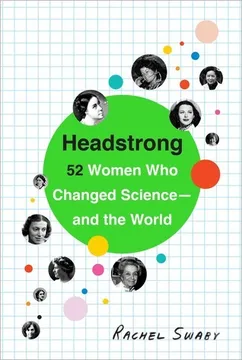
Headstrong is a biographical anthology with a clear corrective purpose: restore the scientific work of women whose names were obscured, minimized, or detached from their discoveries. Its profiles range across medicine, biology, physics, mathematics, astronomy, and invention, but a recurring narrative structure binds them. A stubborn question leads to close observation, a difficult experiment, or a useful instrument. The result then meets a second challenge: convincing institutions and audiences that the work counts, and ensuring the person responsible is recognized.
The book’s deepest argument is therefore about knowledge and memory. Science accumulates through shared evidence, yet its public history often simplifies collaboration into a few famous names. The profiles make that simplification visible without reducing every achievement to a morality tale. Franklin’s data, Thomas’s surgical work, and the Coris’ partnership show that discovery is often collective, while the uneven distribution of credit is social. Jacobi, Hamilton, and Carson further demonstrate that evidence can contest assumptions and redirect policy.
The anthology also has limits that its introduction acknowledges. It focuses on deceased scientists so their completed influence can be assessed, and it notes that white women gained access to STEM fields earlier than women of color. Its 52 subjects cannot represent the full range of scientific lives. The structure also risks celebrating extraordinary individual endurance so vividly that institutional failure becomes background scenery. Yet many stories resist that trap by showing what exclusion cost, including missed appointments, unpaid labor, stolen recognition, and delayed acceptance.
The strongest lesson is not that exceptional people can overcome any barrier. It is that scientific capacity is widely distributed, while opportunity and recognition are not. Making forgotten names familiar improves historical accuracy, but the more ambitious task is to build research cultures where evidence matters more than gender, collaboration is credited carefully, and access does not depend on being an exception.
Review Summary
Headstrong receives an overall 4/5 rating, with readers praising its inspiring profiles of 52 overlooked women scientists across medicine, physics, math, and more. Many appreciate how the book corrects historical oversights, highlighting women whose contributions were stolen or ignored. Common criticisms include profiles being too brief, inconsistent formatting, and occasionally slangy writing. Despite wanting more depth, most readers found it a compelling introduction that sparked curiosity for further research, recommending it especially for students and those interested in STEM history.
Glossary
Apgar score
Newborn health assessmentA standardized assessment of a newborn’s condition shortly after birth. It rates five areas: appearance, pulse, reflex response, muscle activity, and respiration. Each area receives a score from zero to two. The combined score helps clinicians identify babies who may need immediate attention, and made it possible to compare newborn health consistently across many births.
Cori cycle
Lactate and glucose pathwayA biochemical cycle associated with Gerty and Carl Cori’s work on how the body processes carbohydrates. It describes the relationship between glucose and glycogen metabolism and the production and reuse of lactic acid during muscular activity. Their research helped establish core knowledge about how food fuels the body and how enzymes control chemical reactions.
radioimmunoassay
Hormone measurement techniqueA laboratory method developed by Rosalyn Yalow and Solomon Berson that uses radioactive labels and the interaction between a substance and its antibodies to measure extremely small quantities. Their initial work on insulin revealed that antibodies could be used to detect hormones. The technique made it possible to measure substances in blood without injecting radioactive material into a patient.
organizer
Embryonic tissue organizerA region of cells in an early embryo that can direct the development of surrounding tissue. Hilde Mangold’s transplantation experiments showed that organizer cells placed into another amphibian embryo could prompt the formation of an additional body structure, including a second head. The finding established the importance of cell interactions in shaping early development.
spread-spectrum
Frequency-hopping communication methodA communication approach that distributes a signal across changing radio frequencies according to a coordinated pattern. Hedy Lamarr and George Antheil proposed synchronizing the sender and receiver so that a signal would be harder for an adversary to jam or intercept. Their patented frequency-hopping concept was not adopted for wartime torpedoes, but the underlying approach later informed communication technologies.
mobile genetic elements
Movable DNA sequencesGenetic elements that can change position within an organism’s genetic material. Barbara McClintock’s research in corn showed that genetic material was not always fixed in place, and that such movement could affect inherited traits. Her findings challenged the prevailing picture of genes as stable, stationary units and became important to later genetics.
Download PDF
Download EPUB
.epub digital book format is ideal for reading ebooks on phones, tablets, and e-readers.








